MARKET INSIGHTS
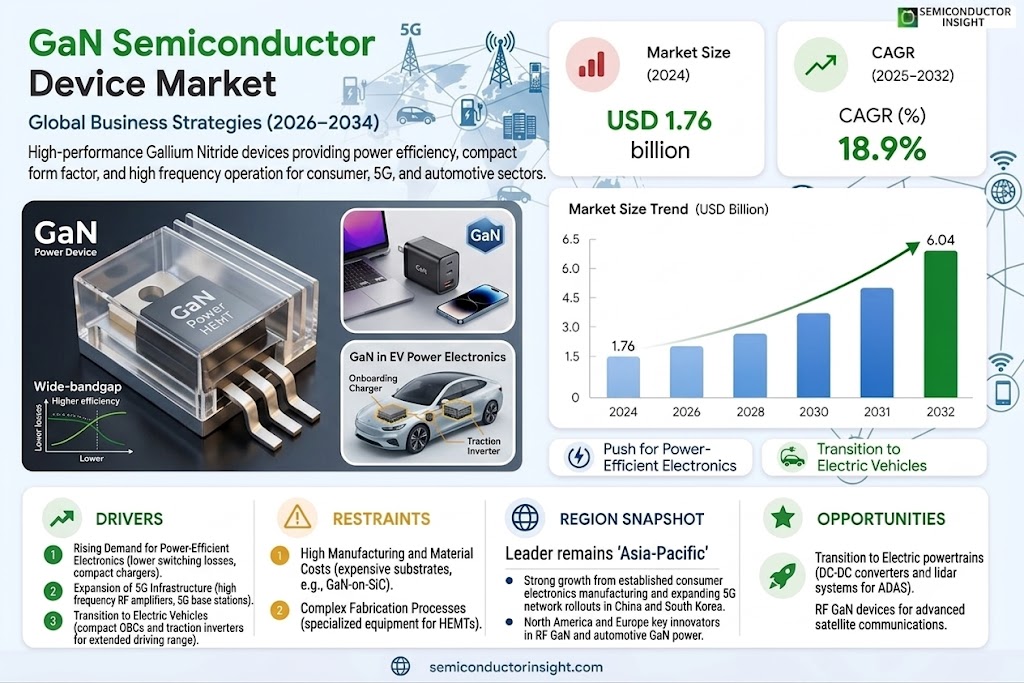
Global GaN Semiconductor Device Market was valued at USD 1.76 billion in 2024 and is projected to reach USD 6.04 billion by 2032, exhibiting a CAGR of 18.9% during the forecast period.
GaN semiconductor devices are advanced semiconductor components that offer superior performance compared to traditional silicon-based devices. They are categorized into two main types: GaN RF devices, which are used for high-frequency applications in communication and defense, and GaN power devices, which are used for power conversion and management in various industries. The market is currently dominated by GaN RF devices, holding about 85% of the market share, while GaN power devices account for the remaining 15%. However, GaN power devices have been growing rapidly in recent years, with many new companies entering the industry. It is expected that the market share of GaN power devices will further increase in the next few years.
The market growth is driven by several factors, including the increasing demand for high-frequency communication systems, such as 5G infrastructure and satellite communication, which require high-performance GaN RF devices. In the power electronics sector, the push for higher efficiency and miniaturization in consumer electronics, industrial equipment, and electric vehicles is driving the adoption of GaN power devices. Additionally, the growing emphasis on renewable energy and energy-efficient systems is creating new opportunities for GaN power devices in solar inverters, wind turbines, and electric vehicle chargers. The automotive industry, in particular, is expected to be a major driver for GaN power devices, with the on-board charger (OBC) for electric vehicles being a key application area.
The market is also supported by significant investments and strategic initiatives from key players. For example, Infineon’s acquisition of GaN Systems and onsemi’s expansion in the GaN market have strengthened the supply chain. Furthermore, governments and private sectors are increasing their investments in semiconductor manufacturing and research, particularly in the United States, Europe, and Asia-Pacific, to strengthen their positions in the global semiconductor industry. Collaborations and partnerships, such as those between STMicroelectronics and TSMC, are also accelerating the development and commercialization of GaN technologies.
MARKET DRIVERS
Rising Demand for Power-Efficient Electronics
The global push for energy efficiency across consumer electronics, data centers, and industrial applications is a primary driver for GaN semiconductor devices. GaN technology offers significantly lower switching losses and higher efficiency compared to traditional silicon, enabling smaller, cooler, and more powerful chargers, adapters, and power supplies. The adoption of fast-charging technologies in smartphones and laptops has created a substantial market for GaN power ICs.
Expansion of 5G Infrastructure
The deployment of 5G networks worldwide requires radio frequency (RF) components that can operate efficiently at high frequencies. GaN-on-SiC devices are increasingly favored in 5G base station power amplifiers due to their high power density and thermal performance. This infrastructure build-out is a major catalyst for the RF GaN device market, which is projected to grow at a compound annual growth rate of over 20%.
➤ The electric vehicle revolution is accelerating the need for high-performance power electronics, where GaN devices are enabling more efficient onboard chargers and traction inverters.
Furthermore, the automotive sector’s transition to electric powertrains presents a significant growth avenue. GaN semiconductors are critical for developing compact and high-efficiency DC-DC converters and lidar systems for advanced driver-assistance systems (ADAS), contributing to extended driving range and improved vehicle performance.
MARKET CHALLENGES
High Initial Manufacturing and Material Costs
Despite their performance advantages, GaN semiconductors face challenges related to cost. The substrates, particularly GaN-on-GaN and GaN-on-SiC, are more expensive than silicon wafers. Furthermore, the fabrication processes for high-electron-mobility transistors (HEMTs) are complex and require specialized equipment, leading to higher initial production costs compared to mature silicon-based technologies. This cost barrier can slow adoption in highly price-sensitive consumer markets.
Other Challenges
Technical Hurdles in Reliability and Thermal Management
Ensuring long-term reliability under high-power and high-temperature operation remains a technical challenge. Managing heat dissipation effectively is critical, as excessive temperatures can degrade device performance and lifespan. This requires advanced packaging solutions, adding to the overall system cost and complexity.
Competition from Established Silicon and Emerging SiC
GaN devices compete not only with entrenched silicon power MOSFETs and IGBTs but also with silicon carbide (SiC) semiconductors, which also offer high-performance characteristics. In some high-voltage applications, SiC is currently considered more mature and reliable, creating a competitive landscape that GaN must navigate.
MARKET RESTRAINTS
Supply Chain Constraints and Geopolitical Factors
The GaN semiconductor supply chain is susceptible to disruptions, as the production of high-quality substrates and epitaxial wafers is concentrated among a few key players globally. Geopolitical tensions and trade policies can impact the availability of raw materials and manufacturing equipment, potentially restraining market growth. Ensuring a stable and diversified supply chain is a critical concern for industry participants.
Design Complexity and Standardization Issues
The integration of GaN devices into existing electronic systems often requires significant redesign of circuit layouts and control systems. The lack of standardized packages and characterization models compared to silicon components can increase design cycles and engineering costs, acting as a restraint for faster widespread adoption, especially among smaller OEMs.
MARKET OPPORTUNITIES
Growth in Renewable Energy and Industrial Motor Drives
The renewable energy sector offers substantial opportunities for GaN power devices. They are ideal for solar inverters and wind turbine converters due to their high-frequency operation, which allows for smaller passive components and increased power density. Similarly, in industrial applications, GaN-based motor drives can significantly improve the efficiency of automation systems and HVAC equipment.
Advancements in Consumer Electronics and Aerospace/Defense
Beyond fast charging, the miniaturization trend in consumer electronics creates opportunities for GaN in applications like gaming consoles, ultra-thin laptops, and AR/VR headsets. In the aerospace and defense sector, the need for robust, high-power RF components for radar and electronic warfare systems presents a high-value, albeit specialized, growth market for GaN technology.
GaN Semiconductor Device Market Trends
Rapid Market Expansion and Growth Trajectory
The global GaN Semiconductor Device market is on a trajectory of significant expansion, with its valuation set to rise from $1,758 million in 2024 to a projected $6,046 million by 2032, representing a compound annual growth rate (CAGR) of 18.9%. This robust growth is fueled by the material’s superior properties, including high efficiency, faster switching speeds, and the ability to operate at higher temperatures and voltages compared to traditional silicon. The market comprises two primary segments: GaN RF (Radio Frequency) devices and GaN power devices, which are driving innovation across multiple high-growth industries.
Other Trends
Dominance and Shift in Device Segments
Currently, the market is dominated by GaN RF devices, which hold approximately 85% of the market share. These devices are critical for telecom infrastructure, defense, and aerospace applications. However, GaN power devices, which account for the remaining 15%, are experiencing rapid growth as a large number of companies enter the industry. This segment is expected to capture a larger market share in the coming years, propelled by demand for more efficient power conversion in consumer electronics, data centers, and notably, the automotive sector.
Automotive Sector as a Key Growth Driver
The automotive industry is emerging as a primary driver for GaN power devices, with the initial entry point being the on-board charger (OBC) for electric vehicles (EVs). The push for faster charging and greater energy efficiency in EVs is creating substantial demand. The competitive landscape is diverse: the GaN RF device segment is led by companies like Sumitomo Electric Device Innovations (SEDI), Wolfspeed, Qorvo, and NXP, while the power device segment is populated by key players such as Innoscience—the world’s largest GaN power device manufacturer—Power Integrations, Navitas Semiconductor, and GaN Systems.
COMPETITIVE LANDSCAPE
Key Industry Players
A Market Evolving from RF Supremacy to Power Device Proliferation
The global GaN Semiconductor Device market is currently characterized by two distinct segments with different competitive dynamics. GaN RF devices, which account for approximately 85% of the market, are dominated by a mature, concentrated group of established players. Key leaders in this high-frequency segment include Sumitomo Electric Device Innovations (SEDI), Wolfspeed, Qorvo, and NXP Semiconductors. These companies possess significant technological expertise and hold strong positions in demanding applications such as telecom infrastructure, military, defense, and aerospace. The competitive landscape for RF devices features high barriers to entry, leading to a stable market share distribution among the incumbents.
In stark contrast, the GaN power device segment, though currently holding a smaller 15% market share, is experiencing rapid growth and intense competition. This segment is fragmented, with a large number of specialized companies and established semiconductor giants vying for position. Innoscience has emerged as the world’s largest manufacturer of GaN power devices, leading a field that includes Power Integrations, Inc., Navitas Semiconductor, GaN Systems, Efficient Power Conversion Corporation (EPC), and Transphorm Inc. Traditional power semiconductor leaders like Infineon are also aggressively expanding their GaN portfolios. The competition is further fueled by the projected surge in demand from the automotive sector, particularly for onboard chargers (OBCs), attracting numerous new entrants and driving innovation.
List of Key GaN Semiconductor Device Companies Profiled
- Infineon (GaN Systems)
- STMicroelectronics
- Texas Instruments
- onsemi
- Microchip Technology
- Rohm
- NXP Semiconductors
- Toshiba
- Innoscience
- Wolfspeed, Inc
- Renesas Electronics (Transphorm)
- Sumitomo Electric Device Innovations (SEDI)
- Alpha and Omega Semiconductor Limited (AOS)
- Nexperia
- Qorvo
- Navitas Semiconductor
- Power Integrations, Inc.
- Efficient Power Conversion Corporation (EPC)
Segment Analysis:
| Segment Category | Sub-Segments | Key Insights |
| By Type |
|
GaN RF Devices represent the established and dominant segment, characterized by high-performance characteristics essential for telecommunications and defense applications. The market for these devices is mature, with a concentrated competitive landscape dominated by a few key players who have significant technical expertise. In contrast, the GaN Power Devices segment is an emerging and rapidly growing area, attracting a diverse range of new market entrants. This growth is primarily fueled by the demand for greater energy efficiency in power electronics across multiple industries, indicating a strong future trajectory as technology adoption increases. |
| By Application |
|
Telecom & Datacom is a foundational application segment, leveraging GaN technology to enable the expansion of 5G infrastructure and high-speed data networks due to its superior frequency performance. However, the most significant future growth is anticipated in the Automotive & Mobility segment, where GaN power devices are becoming crucial for the electrification of vehicles, particularly in on-board chargers and power conversion systems. This trend is driven by the global push towards electric vehicles and the need for compact, efficient power management solutions. |
| By End User |
|
Commercial & Industrial Corporations are the leading end-user segment, driving demand through widespread adoption in sectors like telecommunications, data centers, and industrial automation. These users prioritize the efficiency and performance gains offered by GaN semiconductors. Government and defense agencies represent a key segment with stringent requirements for reliability and high performance in critical systems. Consumer goods manufacturers are increasingly integrating GaN technology into products like fast chargers and adapters, reflecting a growing consumer demand for smaller, more efficient electronic devices. |
| By Technology Maturity |
|
Mature (Established Applications) encompasses RF devices for telecom and defense, where the supply chain and manufacturing processes are well-developed. The Growth (Emerging Applications) segment is the most dynamic, driven by the rapid adoption of GaN power devices in automotive and consumer electronics, creating significant market expansion opportunities. The Nascent (R&D Focus) segment includes next-generation applications in areas like ultra-high-power conversion and photonics, which represent the future frontier for GaN technology but are still in the research and development phase. |
| By Competitive Landscape |
|
Established Leaders (RF Focus) dominate the high-performance RF segment with deep expertise and strong intellectual property portfolios, creating a high barrier to entry. The Power Device Specialists segment is highly fragmented and intensely competitive, featuring numerous innovative companies focused on capturing market share in the rapidly growing power electronics space. Integrated Device Manufacturers (IDMs) represent a formidable force, leveraging their broad semiconductor portfolios and extensive customer relationships to offer integrated solutions that combine GaN technology with other components, providing a significant competitive advantage. |
Regional Analysis: GaN Semiconductor Device Market
Asia-Pacific
The region’s dominance is rooted in its unparalleled semiconductor manufacturing ecosystem. It is home to major GaN device fabricators and packaging specialists, supported by a dense network of material suppliers. This integrated supply chain enables rapid production scaling and cost-efficiency, making it the primary global source for GaN components, from discrete transistors to complex monolithic microwave integrated circuits (MMICs) for high-frequency applications.
Massive production and consumption of consumer electronics, especially smartphones, laptops, and gaming consoles, create immense demand for GaN-based fast chargers. The push for smaller, more efficient power adapters has made GaN technology a standard for flagship devices. This consumer-driven market is a primary growth engine, with regional brands leading the adoption and setting global trends in power density and charging speed.
Aggressive deployment of 5G base stations across the region is a major catalyst. GaN semiconductors are critical for the RF power amplifiers in these stations due to their high-frequency efficiency and thermal performance. National strategies aiming for comprehensive 5G coverage are driving sustained investment, making telecom infrastructure a cornerstone of the regional GaN market’s expansion beyond consumer applications.
Growing investment in industrial automation, robotics, and data center power supplies is increasing the uptake of efficient GaN power conversion systems. Simultaneously, the world’s largest electric vehicle market is beginning to adopt GaN for onboard chargers and DC-DC converters, promising significant long-term growth. These industrial and automotive sectors represent the next wave of demand diversification.
North America
North America is a key innovation and early-adoption center for GaN technology, characterized by strong R&D capabilities and high-value applications. The presence of leading GaN semiconductor design houses and technology innovators, particularly in the United States, drives advancements in device performance and new application development. The market is heavily influenced by demand from the aerospace and defense sectors, where GaN’s performance in radar and electronic warfare systems is critical. Furthermore, the region’s robust data center industry is a significant consumer of GaN-based power supplies seeking higher efficiency. Telecommunications operators are also integrating GaN for 5G infrastructure, albeit at a pace influenced by regulatory and deployment strategies different from Asia. The market is matured by high-performance computing applications and a growing focus on renewable energy systems.
Europe
The European market for GaN semiconductors is steadily growing, propelled by stringent energy efficiency regulations and a strong automotive industrial base. The region’s focus on sustainability drives adoption in applications like renewable energy inverters for solar and wind power, and industrial motor drives. The automotive sector, with its rapid transition to electric vehicles, presents a major opportunity for GaN in traction inverters and charging infrastructure. European research institutions and companies are active in developing advanced GaN-on-Si and GaN-on-SiC technologies, particularly for automotive and industrial uses. Demand is also supported by investments in telecom infrastructure upgrades and a growing industrial automation sector, though the market volume is tempered by a more cautious adoption curve compared to Asia-Pacific.
South America
The GaN semiconductor market in South America is in a nascent but developing stage, with growth primarily linked to the gradual modernization of infrastructure. The main drivers include the expansion of telecommunications networks, particularly in urban areas, creating demand for GaN components in 4G/LTE and emerging 5G equipment. The consumer electronics market also contributes to demand, mostly through the import of devices featuring GaN fast-charging technology. Industrial applications are limited but show potential in areas like power supply units for a growing data presence. Market growth is constrained compared to other regions by economic volatility and slower-paced industrial technological adoption, but it represents a future growth area as infrastructure investments increase.
Middle East & Africa
The Middle East & Africa region represents an emerging market with potential driven by specific strategic investments. In the Middle East, investments in smart city initiatives, modern telecommunications infrastructure, and diversification away from oil-based economies are creating niches for GaN technology, particularly in telecom base stations and efficient power systems for new construction. Africa’s growth is more fragmented, centered on mobile telecommunications expansion and off-grid renewable energy solutions, where the efficiency of GaN can be highly beneficial. Overall, the market is characterized by high growth potential from a small base, with adoption closely tied to large-scale infrastructure projects rather than broad-based industrial or consumer demand.
Report Scope
This market research report provides a comprehensive analysis of the GaN Semiconductor Device Market , covering the forecast period 2025–2032. It offers detailed insights into market dynamics, technological advancements, competitive landscape, and key trends shaping the industry.
Key focus areas of the report include:
- Market Overview: The report begins with an overview outlining its current market scenario, key growth indicators, and industry transformation drivers. It discusses macroeconomic factors, demand–supply balance, regulatory landscape, and the strategic role of semiconductors in powering advancements across industries such as automotive, telecommunications, consumer electronics, and industrial automation.
- Market Size & Forecast: Historical data and future projections for revenue, unit shipments, and market value across major regions and segments.
- Segmentation Analysis: Detailed breakdown by product type, technology, application, and end-user industry to identify high-growth segments and investment opportunities.
- Regional Insights: Insights into market performance across North America, Europe, Asia-Pacific, Latin America, and the Middle East & Africa, including country-level analysis where relevant.
- Competitive Landscape: Profiles of leading market participants, including their product offerings, R&D focus, manufacturing capacity, pricing strategies, and recent developments such as mergers, acquisitions, and partnerships.
- Technology Trends & Innovation: Assessment of emerging technologies, integration of AI/IoT, semiconductor design trends, fabrication techniques, and evolving industry standards.
- Market Drivers & Restraints: Evaluation of factors driving market growth along with challenges, supply chain constraints, regulatory issues, and market-entry barriers.
- Stakeholder Insights: Insights for component suppliers, OEMs, system integrators, investors, and policymakers regarding the evolving ecosystem and strategic opportunities.
Primary and secondary research methods are employed, including interviews with industry experts, data from verified sources, and real-time market intelligence to ensure the accuracy and reliability of the insights presented.
FREQUENTLY ASKED QUESTIONS:
What is the current market size of GaN Semiconductor Device Market?
-> GaN Semiconductor Device Market was valued at USD 1.76 billion in 2024 and is projected to reach USD 6.04 billion by 2032, exhibiting a CAGR of 18.9% during the forecast period.
Which key companies operate in GaN Semiconductor Device Market?
-> Key players include Infineon (GaN Systems), STMicroelectronics, Texas Instruments, Wolfspeed, Qorvo, NXP Semiconductors, Sumitomo Electric Device Innovations (SEDI), Power Integrations, Inc., Navitas Semiconductor, Innoscience, and Efficient Power Conversion Corporation (EPC), among others.
What are the key growth drivers?
-> Key growth drivers include the rapid expansion of the automotive sector, particularly demand for on-board chargers (OBC), growing adoption in telecom & datacom infrastructure, and the performance advantages of GaN power devices.
Which region dominates the market?
-> Asia is a key market, with significant presence and manufacturing, while the market sees global participation from North America and Europe.
What are the emerging trends?
-> Emerging trends include the rapid growth of GaN power devices, increasing market entry by new companies, and the strategic focus on the automotive industry as a primary future demand driver.
Get Sample Report PDF for Exclusive Insights
Report Sample Includes
- Table of Contents
- List of Tables & Figures
- Charts, Research Methodology, and more...
 Download Sample Report PDF