Key Statistics
Key Takeaways
- Market size: The market is valued at USD 251.19 million in 2025 and is projected to reach USD 1.25 billion by 2034, representing a 19.5% CAGR during 2026–2034.
- GaN-on-SiC remains the premium RF platform because SiC provides strong thermal conductivity and high-frequency performance for base stations, radar and defense.
- GaN-on-Si is the strongest scale-up route for power electronics, using larger silicon-compatible wafers to lower cost and leverage established manufacturing infrastructure.
- Asia Pacific leads the market through semiconductor manufacturing, 5G infrastructure and growing GaN power-device ecosystems in China, Japan, South Korea and Taiwan.
- Wafer-diameter migration is a major cost lever, with 6-inch production established and 8-inch development becoming strategically important for power GaN.
GaN HEMT Epitaxial Wafer Market Overview
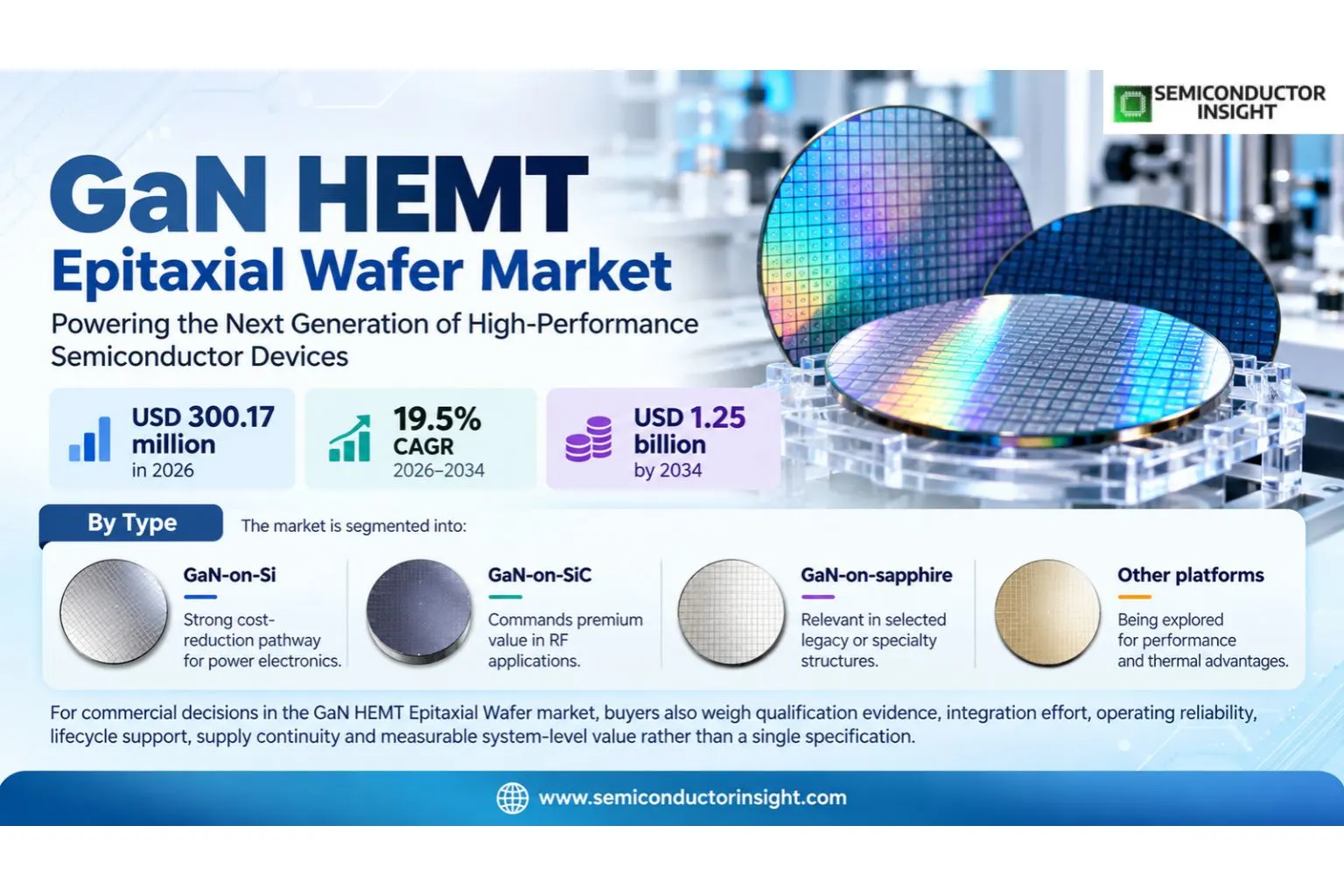
GaN HEMT epitaxial wafer market is valued at USD 251.19 million in 2025 and is projected to reach USD 1.25 billion by 2034, expanding at a 19.5% CAGR during 2026–2034. The 2026 market level is USD 300.17 million. Asia Pacific leads through a large compound-semiconductor manufacturing base and fast adoption of GaN in power and RF applications. Market growth is supported by 5G, data-center power, EV charging, aerospace and the broader shift toward higher-efficiency wide-bandgap semiconductors.
GaN HEMT epitaxial wafers are engineered multilayer semiconductor structures grown by MOVPE or related methods on silicon, silicon carbide, sapphire or other substrates. A typical stack includes nucleation, buffer, GaN channel and AlGaN or related barrier layers that create a high-mobility two-dimensional electron gas. Epitaxial quality determines device breakdown, electron mobility, RF power, current collapse and long-term reliability.
Material platforms are diverging by application. GaN-on-SiC is favored for high-power RF because the substrate removes heat efficiently, while GaN-on-Si is attractive for power switching because larger silicon wafers offer lower cost and compatibility with existing fabs. Sumitomo Chemical’s SCIOCS business supplies MOVPE GaN epiwafers for HEMT and power switching devices, illustrating the established merchant epiwafer supply chain.
Epiwafer suppliers compete on defect density, thickness uniformity, bow, electrical performance and reproducibility across wafer lots. Customers often co-develop layer structures around specific HEMT designs, which creates long qualification cycles and high switching costs. Larger wafer diameter improves die economics only if epitaxial uniformity and downstream device yield remain high.
Segment Analysis: By Type
By type, the market is segmented into GaN-on-Si, GaN-on-SiC, GaN-on-sapphire and other platforms. GaN-on-SiC commands premium value in RF, while GaN-on-Si provides the strongest cost-reduction pathway for power electronics. Sapphire remains relevant in selected legacy or specialty structures, and other substrates are being explored for performance and thermal advantages. For commercial decisions in the GaN HEMT Epitaxial Wafer market, buyers also weigh qualification evidence, integration effort, operating reliability, lifecycle support, supply continuity and measurable system-level value rather than a single specification.
| Type | Commercial role |
|---|---|
| GaN-on-Si | Cost-focused power GaN platform leveraging large-diameter silicon infrastructure. |
| GaN-on-SiC | Premium RF and high-power platform with superior thermal performance. |
| GaN-on-Sapphire | Specialty and legacy GaN structures with established crystal supply. |
| Others | Emerging GaN-on-GaN and alternative substrate approaches. |
Additional Segmentation: By Wafer Diameter
Wafer diameter is a key manufacturing-economic variable. Smaller wafers remain in R&D and specialty production, 6-inch is widely established in RF and power GaN, and 8-inch is increasingly important for GaN-on-Si because it aligns with larger silicon fabs and can reduce cost per die. The transition requires tight control of bow, stress and epitaxial uniformity across the larger area.
| Wafer Diameter | Demand characteristics |
|---|---|
| ≤4 Inch | Research, specialty RF and lower-volume compound-semiconductor production. |
| 6 Inch | Established commercial format for GaN-on-SiC and GaN-on-Si devices. |
| 8 Inch & Above | Scaling path for lower-cost power GaN and higher manufacturing throughput. |
Segment Analysis: By Application
By application, 5G and RF remain high-value markets, while power electronics provides the broadest long-term volume opportunity. Automotive and charging applications are increasing as GaN moves into efficient converters, while aerospace and defense continue to use GaN RF devices for radar, electronic warfare and satellite communications. For commercial decisions in the GaN HEMT Epitaxial Wafer market, buyers also weigh qualification evidence, integration effort, operating reliability, lifecycle support, supply continuity and measurable system-level value rather than a single specification.
| Application | Demand characteristics |
|---|---|
| 5G / RF | Base stations, microwave links, radar and high-power RF amplification. |
| Power Electronics | Adapters, data centers, industrial power and high-frequency conversion. |
| Automotive | Onboard charging, DC/DC conversion and emerging high-frequency power systems. |
| Aerospace & Defense | Radar, electronic warfare, satellite and extreme-performance RF. |
| Others | Consumer, scientific and specialized high-frequency devices. |
Additional Segmentation: By End Device
End-device segmentation separates RF HEMTs from power HEMTs and other GaN devices. RF HEMTs prioritize gain, frequency and thermal behavior at high power, while power HEMTs prioritize breakdown voltage, switching loss and reliability. Epi structures therefore differ substantially by end device even when they share the same GaN material system.
| End Device | Commercial relevance |
|---|---|
| RF HEMT | High-frequency power amplifiers for telecom, radar and defense. |
| Power HEMT | High-efficiency switching devices for power supplies, data centers and automotive. |
| Other GaN Devices | Specialized diodes, sensors and emerging heterostructure devices. |
Regional Analysis
Asia Pacific leads because Japan, China, Taiwan and South Korea combine epiwafer supply, power semiconductor manufacturing and 5G deployment. North America remains important in RF, defense and data-center power, while Europe contributes automotive and industrial power electronics. Other regions are primarily downstream end markets. For commercial decisions in the GaN HEMT Epitaxial Wafer market, buyers also weigh qualification evidence, integration effort, operating reliability, lifecycle support, supply continuity and measurable system-level value rather than a single specification.
Why does regional demand differ across the GaN HEMT Epitaxial Wafer market?
Regional advantage depends on compound-semiconductor epitaxy, wafer fabrication and end-market qualification. Asia has the strongest manufacturing ecosystem, North America has advanced RF and defense demand, and Europe has high-value automotive and industrial applications. Government semiconductor programs also support local GaN capacity and supply-chain resilience. For commercial decisions in the GaN HEMT Epitaxial Wafer market, buyers also weigh qualification evidence, integration effort, operating reliability, lifecycle support, supply continuity and measurable system-level value rather than a single specification.
| Region | Position | Demand profile | Supplier-selection factor |
|---|---|---|---|
| Asia Pacific | Largest / fastest | 5G, power GaN, manufacturing | Epitaxy and fab ecosystem |
| North America | High-value | Defense, RF, data centers | Advanced device design |
| Europe | Strategic | Automotive, industrial power | Qualification and electrification |
| South America | Emerging | Telecom, renewable power | Imported devices |
| Middle East & Africa | Emerging | Telecom, defense, infrastructure | Project-led demand |
Competitive Landscape
Sumitomo Chemical/SCIOCS, IQE, NTT-AT-related ecosystems, Soitec-linked substrate programs and Asian epitaxy specialists compete through substrate platform, wafer diameter, epitaxial uniformity and customer-specific HEMT structures. Merchant suppliers must support both RF and power customers with different defect and stress requirements. For commercial decisions in the GaN HEMT Epitaxial Wafer market, buyers also weigh qualification evidence, integration effort, operating reliability, lifecycle support, supply continuity and measurable system-level value rather than a single specification.
GaN-on-SiC suppliers defend premium pricing through thermal and RF performance, while GaN-on-Si suppliers compete on larger wafer formats and cost. Epitaxy vendors that can scale 8-inch GaN-on-Si without excessive bow or cracking are strategically positioned for higher-volume power-device markets. For commercial decisions in the GaN HEMT Epitaxial Wafer market, buyers also weigh qualification evidence, integration effort, operating reliability, lifecycle support, supply continuity and measurable system-level value rather than a single specification.
Customer qualification is sticky because epitaxial layer thickness, composition and stress directly affect transistor behavior. Device manufacturers often co-optimize their process with a specific wafer supplier, creating durable relationships once yield and reliability targets are met. For commercial decisions in the GaN HEMT Epitaxial Wafer market, buyers also weigh qualification evidence, integration effort, operating reliability, lifecycle support, supply continuity and measurable system-level value rather than a single specification.
| Competitive tier | Representative companies | Primary differentiation |
|---|---|---|
| Merchant epiwafer leaders | SCIOCS, IQE and compound-semiconductor specialists | Custom MOVPE structures, RF/power experience and customer qualification. |
| Integrated device manufacturers | GaN RF and power IDMs with internal epitaxy | Vertical integration and device-specific optimization. |
| Emerging regional suppliers | Asian GaN material and foundry companies | Cost, larger wafers and local supply-chain access. |
Key companies profiled
Sumitomo Chemical/SCIOCS, IQE and a wider group of GaN epitaxy, substrate and integrated device suppliers form the competitive landscape. Commercial positions differ significantly between GaN-on-SiC RF, GaN-on-Si power and emerging larger-wafer platforms, so market share is best evaluated by substrate and end-device segment. For commercial decisions in the GaN HEMT Epitaxial Wafer market, buyers also weigh qualification evidence, integration effort, operating reliability, lifecycle support, supply continuity and measurable system-level value rather than a single specification.
Production Capacity Analysis
Epiwafer capacity depends on MOVPE reactor count, wafer diameter, substrate supply, run time and qualified yield. GaN HEMT structures require many carefully controlled layers, and reactor matching is important when customers qualify material across multiple chambers. SiC substrate availability can also limit RF GaN capacity. For commercial decisions in the GaN HEMT Epitaxial Wafer market, buyers also weigh qualification evidence, integration effort, operating reliability, lifecycle support, supply continuity and measurable system-level value rather than a single specification.
Scaling from 6-inch to 8-inch creates new capacity but introduces wafer bow, thermal stress and uniformity challenges. Manufacturers need metrology and process control that can maintain electrical properties across larger wafers. Effective capacity is therefore determined by qualified saleable wafers rather than nominal reactor starts. For commercial decisions in the GaN HEMT Epitaxial Wafer market, buyers also weigh qualification evidence, integration effort, operating reliability, lifecycle support, supply continuity and measurable system-level value rather than a single specification.
Market Dynamics
The market grows with 5G/RF, defense, data-center power, automotive and industrial efficiency. Growth is restrained by epitaxy cost, substrate constraints and technical yield challenges. GaN-on-Si scale-up, larger wafers and high-performance GaN-on-SiC remain the strongest strategic opportunities. For commercial decisions in the GaN HEMT Epitaxial Wafer market, buyers also weigh qualification evidence, integration effort, operating reliability, lifecycle support, supply continuity and measurable system-level value rather than a single specification.
Market Drivers
| Driver | Impact | Commercial mechanism |
|---|---|---|
| 5G and RF infrastructure | High | GaN HEMTs deliver high power and efficiency at microwave frequencies. |
| Power electronics | High | Fast switching reduces conversion losses and passive-component size. |
| Automotive electrification | Medium-High | EV power systems need efficient high-frequency conversion. |
| Defense and aerospace | Medium | Radar and electronic warfare value RF power density. |
5G and RF infrastructure
Base stations, radar and communications equipment use GaN because it can operate at high voltage and frequency. GaN-on-SiC remains particularly valuable for premium RF power amplifiers. For commercial decisions in the GaN HEMT Epitaxial Wafer market, buyers also weigh qualification evidence, integration effort, operating reliability, lifecycle support, supply continuity and measurable system-level value rather than a single specification.
Power electronics
GaN HEMTs can switch faster than conventional silicon devices, supporting compact chargers, data-center supplies and industrial converters. This creates a large volume pathway for GaN-on-Si. For commercial decisions in the GaN HEMT Epitaxial Wafer market, buyers also weigh qualification evidence, integration effort, operating reliability, lifecycle support, supply continuity and measurable system-level value rather than a single specification.
Automotive electrification
GaN is expanding in onboard chargers, DC/DC converters and auxiliary power. Automotive qualification is demanding but creates long product lifecycles once a device is approved. For commercial decisions in the GaN HEMT Epitaxial Wafer market, buyers also weigh qualification evidence, integration effort, operating reliability, lifecycle support, supply continuity and measurable system-level value rather than a single specification.
Defense and aerospace
Military applications can justify premium GaN-on-SiC material because performance and thermal handling matter more than semiconductor cost. For commercial decisions in the GaN HEMT Epitaxial Wafer market, buyers also weigh qualification evidence, integration effort, operating reliability, lifecycle support, supply continuity and measurable system-level value rather than a single specification. For commercial decisions in the GaN HEMT Epitaxial Wafer market, buyers also weigh qualification evidence, integration effort, operating reliability, lifecycle support, supply continuity and measurable system-level value rather than a single specification.
Market Restraints
| Restraint | Impact | Commercial consequence |
|---|---|---|
| High epitaxy cost | High | MOVPE growth and premium substrates raise wafer price. |
| Substrate constraints | Medium-High | SiC availability and quality influence RF GaN economics. |
| Yield and wafer bow | Medium-High | Stress increases as wafer diameter and layer thickness rise. |
| Competition from SiC and silicon | Medium | Alternative power technologies remain strong in overlapping voltage ranges. |
High epitaxy cost
GaN layers require long reactor runs, expensive precursors and tight process control. The cost is especially high on SiC substrates, limiting use to applications that value performance. For commercial decisions in the GaN HEMT Epitaxial Wafer market, buyers also weigh qualification evidence, integration effort, operating reliability, lifecycle support, supply continuity and measurable system-level value rather than a single specification.
Substrate constraints
GaN-on-SiC depends on high-quality semi-insulating SiC. Supply expansion helps, but substrate cost remains a meaningful part of epiwafer economics. For commercial decisions in the GaN HEMT Epitaxial Wafer market, buyers also weigh qualification evidence, integration effort, operating reliability, lifecycle support, supply continuity and measurable system-level value rather than a single specification.
Yield and wafer bow
GaN and silicon have different lattice and thermal properties. Larger GaN-on-Si wafers require sophisticated buffer structures to avoid cracking and excessive bow. For commercial decisions in the GaN HEMT Epitaxial Wafer market, buyers also weigh qualification evidence, integration effort, operating reliability, lifecycle support, supply continuity and measurable system-level value rather than a single specification.
Competition from SiC and silicon
SiC dominates many higher-voltage applications, while advanced silicon remains cost-effective at lower power. GaN must win on frequency, efficiency and system size. For commercial decisions in the GaN HEMT Epitaxial Wafer market, buyers also weigh qualification evidence, integration effort, operating reliability, lifecycle support, supply continuity and measurable system-level value rather than a single specification.
Market Opportunities
8-inch GaN-on-Si
Larger silicon-compatible wafers can lower die cost and expand power GaN into data-center, consumer and automotive applications. For commercial decisions in the GaN HEMT Epitaxial Wafer market, buyers also weigh qualification evidence, integration effort, operating reliability, lifecycle support, supply continuity and measurable system-level value rather than a single specification. For commercial decisions in the GaN HEMT Epitaxial Wafer market, buyers also weigh qualification evidence, integration effort, operating reliability, lifecycle support, supply continuity and measurable system-level value rather than a single specification.
AI data-center power
High rack power density creates demand for compact high-frequency converters where GaN switching speed provides system-level value. For commercial decisions in the GaN HEMT Epitaxial Wafer market, buyers also weigh qualification evidence, integration effort, operating reliability, lifecycle support, supply continuity and measurable system-level value rather than a single specification. For commercial decisions in the GaN HEMT Epitaxial Wafer market, buyers also weigh qualification evidence, integration effort, operating reliability, lifecycle support, supply continuity and measurable system-level value rather than a single specification.
Defense RF
GaN-on-SiC can capture premium growth in radar, satellite and electronic-warfare systems. For commercial decisions in the GaN HEMT Epitaxial Wafer market, buyers also weigh qualification evidence, integration effort, operating reliability, lifecycle support, supply continuity and measurable system-level value rather than a single specification. For commercial decisions in the GaN HEMT Epitaxial Wafer market, buyers also weigh qualification evidence, integration effort, operating reliability, lifecycle support, supply continuity and measurable system-level value rather than a single specification.
Automotive charging
Higher-frequency GaN converters can reduce size and improve efficiency in onboard charging and auxiliary power systems. For commercial decisions in the GaN HEMT Epitaxial Wafer market, buyers also weigh qualification evidence, integration effort, operating reliability, lifecycle support, supply continuity and measurable system-level value rather than a single specification. For commercial decisions in the GaN HEMT Epitaxial Wafer market, buyers also weigh qualification evidence, integration effort, operating reliability, lifecycle support, supply continuity and measurable system-level value rather than a single specification.
Supply Chain Analysis
Materials. Gallium precursors, ammonia and substrates such as silicon or SiC form the upstream base. Substrate quality and thermal properties strongly influence the final device. For commercial decisions in the GaN HEMT Epitaxial Wafer market, buyers also weigh qualification evidence, integration effort, operating reliability, lifecycle support, supply continuity and measurable system-level value rather than a single specification.
Epitaxy. MOVPE reactors grow buffer, channel, barrier and cap layers with precise composition and thickness. Uniformity, stress and defect control determine downstream device yield. For commercial decisions in the GaN HEMT Epitaxial Wafer market, buyers also weigh qualification evidence, integration effort, operating reliability, lifecycle support, supply continuity and measurable system-level value rather than a single specification.
Device fabrication. Epiwafers are processed into HEMTs using lithography, etch, contacts and passivation. RF and power designs use different gate structures, field plates and packaging. For commercial decisions in the GaN HEMT Epitaxial Wafer market, buyers also weigh qualification evidence, integration effort, operating reliability, lifecycle support, supply continuity and measurable system-level value rather than a single specification.
Deployment. Finished GaN devices are integrated into RF amplifiers, chargers, data-center supplies, radar and automotive systems. Qualification feeds back into epiwafer specifications and supplier selection. For commercial decisions in the GaN HEMT Epitaxial Wafer market, buyers also weigh qualification evidence, integration effort, operating reliability, lifecycle support, supply continuity and measurable system-level value rather than a single specification.
Recent Developments in the GaN HEMT Epitaxial Wafer Market
Developments tracked through September 2026 and limited to events that materially affect technology, capacity, adoption or competition.
- 2026 Commercial Portfolio
Sumitomo Chemical’s SCIOCS business continues to offer MOVPE GaN epitaxial wafers for HEMT and power-switching devices, illustrating established merchant supply for compound-semiconductor customers. Source - 2025–2026 Industry Trend
GaN-on-Si development continues moving toward larger wafer diameters for power electronics, while GaN-on-SiC remains the premium RF platform for telecom and defense applications. Source - 2025–2026 Market Expansion
Public GaN roadmaps across power and RF suppliers increasingly target data-center power, automotive conversion and high-frequency infrastructure, expanding epiwafer demand beyond traditional telecom RF. Source
Report Scope & Segmentation
| Attribute | Scope |
|---|---|
| Base year | 2025 |
| Estimated year | 2026 |
| Forecast period | 2026–2034 |
| 2025 market size | USD 251.19 million |
| 2026 estimated size | USD 300.17 million |
| 2034 projected size | USD 1.25 billion |
| CAGR (2026–2034) | 19.5% |
| Largest market in 2025 | Asia Pacific |
| By Type | GaN-on-Si; GaN-on-SiC; GaN-on-Sapphire; Others |
| By Application | 5G/RF; Power Electronics; Automotive; Aerospace & Defense; Others |
| By Wafer Diameter | ≤4 Inch; 6 Inch; 8 Inch & Above |
| By End Device | RF HEMT; Power HEMT; Other GaN Devices |
| Companies profiled | SCIOCS/Sumitomo Chemical; IQE; integrated GaN device manufacturers; Asian epitaxy specialists |
Frequently Asked Questions
What is the GaN HEMT epitaxial wafer market size in 2025?
The global market is valued at USD 251.19 million in 2025 across GaN-on-SiC, GaN-on-Si and other epitaxial wafer platforms.
What is the market forecast for 2034?
The market is projected to reach USD 1.25 billion by 2034, representing a 19.5% CAGR during 2026–2034. The 2026 market level is USD 300.17 million.
Which region leads the market?
Asia Pacific leads because Japan, China, Taiwan and South Korea combine epiwafer supply, semiconductor manufacturing and strong GaN end markets.
Which substrate platform is most important for RF?
GaN-on-SiC is the premium RF platform because SiC provides strong thermal conductivity and supports high-frequency high-power operation.
Why is GaN-on-Si important?
GaN-on-Si offers a lower-cost route for power devices and can leverage larger silicon wafer infrastructure.
Which applications drive demand?
5G/RF, power electronics, automotive, aerospace and defense are the principal applications.
Why does wafer diameter matter?
Larger wafers can reduce cost per die and improve manufacturing throughput if bow, stress and uniformity are controlled.
Who are the major suppliers?
SCIOCS/Sumitomo Chemical, IQE and integrated or regional GaN epitaxy suppliers are important participants.
What limits market growth?
High epitaxy cost, substrate constraints, wafer bow, yield challenges and competition from SiC or silicon are the main restraints.
What will drive growth through 2034?
5G, defense RF, AI data-center power, 8-inch GaN-on-Si and automotive power conversion will support expansion.
Research Sources & Evidence Base
View research sources used in this market overview
- Sumitomo Chemical — GaN Epiwafer. MOVPE GaN epiwafer and HEMT/power-device application evidence.
- Synopsys — GaN Design and Power Electronics Context. General GaN power and RF application context.
Get Sample Report PDF for Exclusive Insights
Report Sample Includes
- Table of Contents
- List of Tables & Figures
- Charts, Research Methodology, and more...
 Download Sample Report PDF