MARKET INSIGHTS
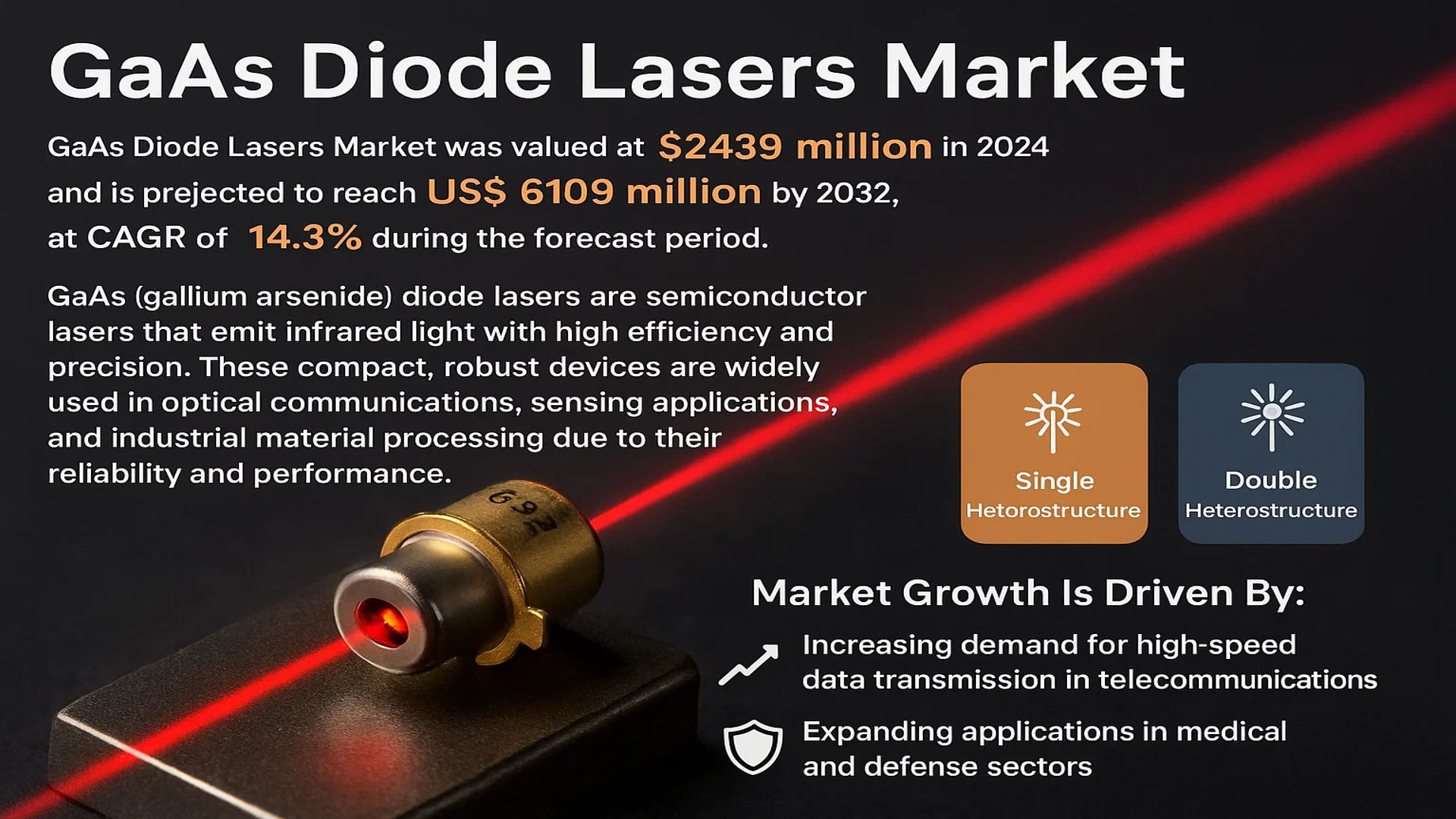
The global GaAs Diode Lasers Market was valued at 2439 million in 2024 and is projected to reach US$ 6109 million by 2032, at a CAGR of 14.3% during the forecast period.
GaAs (gallium arsenide) diode lasers are semiconductor lasers that emit infrared light with high efficiency and precision. These compact, robust devices are widely used in optical communications, sensing applications, and industrial material processing due to their reliability and performance. The market includes products like single heterostructure and double heterostructure lasers, catering to diverse industry needs.
The market growth is driven by increasing demand for high-speed data transmission in telecommunications and expanding applications in medical and defense sectors. However, cost sensitivity in emerging markets remains a challenge. Key players such as Lumentum, Coherent (II-VI), and Broadcom dominate the competitive landscape, collectively holding a significant revenue share in 2024.
MARKET DYNAMICS
MARKET DRIVERS
Expanding Fiber Optic Communication Networks Accelerating GaAs Diode Laser Adoption
The global fiber optics market continues its strong growth trajectory, with data traffic projected to increase nearly threefold between 2024 and 2030. This expansion directly drives demand for GaAs diode lasers, which serve as critical light sources in optical communication systems. Their ability to transmit high-speed data over long distances with minimal signal loss makes them indispensable for 5G infrastructure and hyperscale data centers. Recent deployments of 400G and 800G optical modules in telecommunication networks significantly contribute to the market expansion, as these systems increasingly rely on high-power GaAs-based laser diodes for efficient photonic integration.
Industrial Material Processing Applications Creating New Growth Vectors
Manufacturing sectors are rapidly adopting GaAs diode lasers for precision material processing applications such as laser cutting, welding, and additive manufacturing. The automotive industry’s shift toward lightweight materials has increased demand for high-power diode laser systems capable of processing advanced composites and aluminum alloys. In the electronics sector, miniaturization trends drive adoption of GaAs lasers for semiconductor wafer dicing and micro-processing applications where their superior beam quality and wavelength characteristics prove advantageous. The industrial segment now accounts for over 30% of the total GaAs diode laser market value, demonstrating the growing importance of manufacturing applications.
➤ The global industrial laser market is anticipated to maintain a 12.7% CAGR through 2030, with diode lasers capturing an expanding share of applications traditionally served by CO2 and fiber laser systems.
Furthermore, military and defense applications continue to provide stable demand, particularly for infrared countermeasures and directed energy systems where GaAs laser diodes offer rugged reliability in extreme environments.
MARKET RESTRAINTS
Supply Chain Constraints and Gallium Arsenide Material Limitations Impact Production Capacity
While GaAs diode lasers offer numerous advantages, the market faces material-related challenges that constrain expansion. Gallium arsenide substrates represent approximately 18-22% of total diode laser production costs, with price volatility in raw materials creating margin pressure for manufacturers. The photonics industry consumes a significant portion of global gallium supply, which remains concentrated in a few geographical regions. This creates potential supply risks, particularly as gallium is typically produced as a byproduct of aluminum smelting rather than through direct mining operations.
Technical Limitations in Power Scaling
Power output remains a critical limitation for GaAs-based diodes compared to alternative laser technologies. While recent advancements have pushed single-emitter continuous wave power beyond 20W, many industrial applications require significantly higher output levels that currently necessitate complex beam combining techniques. This power ceiling limits market penetration in heavy industrial processing sectors and some emerging defense applications.
Thermal Management Challenges
The relatively low thermal conductivity of GaAs substrates imposes performance constraints, particularly in high-power continuous wave operation. Effective thermal dissipation solutions add complexity and cost to system designs, especially in densely integrated photonic circuits where heat accumulation becomes problematic.
MARKET CHALLENGES
Intense Competition from Alternative Laser Technologies Creating Pricing Pressure
The GaAs diode laser market faces increasing competition from alternative technologies including InP-based lasers, GaN laser diodes, and fiber lasers. Fiber lasers in particular have captured significant market share in material processing applications that traditionally used direct diode systems, offering superior beam quality at higher power levels. This competitive landscape creates substantial pricing pressure, with average selling prices for high-volume communication lasers declining approximately 8-10% annually in recent years.
Standardization and Qualification Hurdles
Telecommunication applications require lasers to meet stringent reliability standards with qualification periods often exceeding 12-18 months. The aerospace and defense sectors impose even more rigorous testing protocols that can delay product commercialization cycles. These extended qualification timelines present challenges for manufacturers seeking to rapidly introduce new GaAs diode laser products to capitalize on emerging opportunities.
Geopolitical Factors Impacting Technology Access
Export controls on advanced photonics technologies, particularly those with dual-use potential, create market access challenges for GaAs diode laser manufacturers. Recent trade policy developments have resulted in restricted technology transfers and sales limitations to certain international markets.
MARKET OPPORTUNITIES
Emerging Photonic Integrated Circuit Applications Opening New Revenue Streams
The rapid advancement of silicon photonics creates significant opportunities for GaAs diode laser providers. As photonic integrated circuits gain traction in data center interconnects and optical computing applications, demand grows for compact, high-efficiency laser sources that can be heterogeneously integrated. GaAs lasers provide critical wavelength options between 780nm and 1550nm that complement silicon photonic platforms. Several industry leaders have announced development partnerships focused on co-packaged optics solutions that could revolutionize data center architectures within the next five years.
Growth in Medical and Scientific Applications Expanding Market Boundaries
Medical applications for GaAs diode lasers continue to diversify beyond traditional surgical uses. Emerging photodynamic therapy treatments and medical diagnostic systems increasingly incorporate GaAs-based lasers for their wavelength precision and reliability. The scientific instrumentation sector presents expanding opportunities as well, with spectroscopy and analytical chemistry applications driving demand for tunable diode laser systems. Ongoing research into quantum technologies also utilizes GaAs diode lasers for atom trapping and cooling experiments, representing a promising future growth segment.
The automotive LiDAR market represents another high-growth opportunity, with several Tier 1 suppliers selecting 905nm GaAs-based laser diodes for next-generation autonomous vehicle sensing systems. Industry projections suggest the automotive LiDAR market could require over 50 million diode laser units annually by 2028 as autonomous driving systems achieve broader commercial deployment.
GaAs DIODE LASERS MARKET TRENDS
Accelerated Growth in Optical Communications to Drive Market Expansion
The widespread adoption of GaAs diode lasers in optical communications is significantly boosting market growth. With the increasing demand for high-speed data transfer and the rollout of 5G networks, these lasers are becoming indispensable for fiber-optic communication systems. GaAs diode lasers offer superior efficiency and reliability in transmitting data over long distances, making them the preferred choice for telecom operators. In 2024, optical communications accounted for over 40% of the GaAs diode laser market share, and this segment is expected to grow at a CAGR of 12% through 2032. The expansion of cloud computing and data centers further amplifies this demand, as these applications require robust and energy-efficient laser technologies.
Other Trends
Advancements in Sensing and Remote Sensing Applications
GaAs diode lasers are increasingly being utilized in sensing and remote sensing applications due to their precision and compact design. Industries such as automotive, aerospace, and industrial manufacturing rely on these lasers for LiDAR systems, environmental monitoring, and industrial process control. The automotive sector, in particular, is witnessing rapid adoption for autonomous vehicle development, where GaAs-based LiDAR enhances object detection accuracy. The sensing and remote sensing segment is projected to grow at a CAGR of 15.5% during 2024-2032, driven by innovations in smart manufacturing and IoT-enabled devices.
Expansion in Material Processing and Industrial Applications
The material processing industry is another key growth area for GaAs diode lasers, particularly in precision cutting, welding, and additive manufacturing. Their high-power output and stability make them ideal for industrial applications, such as laser marking and engraving. The manufacturing sector is gradually shifting toward laser-based automation to improve efficiency and reduce operational costs. Recent advancements in high-power diode lasers have enabled their use in previously challenging materials like metals and composites. As industries adopt Industry 4.0 practices, the demand for GaAs diode lasers for automation is expected to rise by 18% annually by 2030.
Increasing R&D Investments in Quantum Technologies
Research and development in quantum computing and quantum communication systems are accelerating the adoption of GaAs diode lasers. Their ability to generate highly stable and coherent light makes them critical for quantum encryption and photonic computing applications. Governments and private enterprises are heavily investing in quantum research, with global R&D expenditure exceeding $3 billion in 2023. As quantum technologies transition from labs to practical applications, GaAs diode lasers will play a pivotal role in enabling secure communications and high-performance computing solutions.
COMPETITIVE LANDSCAPE
Key Industry Players
Strategic Expansion and Innovation Drive Competitive Edge in GaAs Diode Lasers Market
The global GaAs diode lasers market features a dynamic and competitive environment with established leaders and emerging players vying for market share. As of 2024, the market is valued at $2.44 billion, with projections indicating significant growth potential, reaching $6.11 billion by 2032 at a CAGR of 14.3%. This growth trajectory is fueled by rising demand in optical communications, sensing applications, and industrial material processing.
Lumentum emerges as a dominant player in the market, leveraging its strong foothold in photonics and laser technology to serve high-growth industries. The company’s strategic acquisitions and R&D investments in high-power diode lasers have solidified its position, particularly in North America and Asia-Pacific regions.
Coherent (II-VI) and Broadcom also hold substantial market shares, driven by their diversified product portfolios and focus on next-generation laser solutions. These players are capitalizing on the surging demand for GaAs lasers in fiber-optic networks and 5G infrastructure, which require high-speed, reliable components.
Meanwhile, Sumitomo Electric and Furukawa Electric are making significant strides through vertical integration and partnerships with downstream manufacturers. Their ability to offer customized GaAs laser solutions for specialized applications like LiDAR and medical diagnostics enhances their competitive positioning.
Newer entrants such as Applied Optoelectronics and Vertilas are gaining traction with niche, high-performance diode lasers optimized for precision applications. While these companies currently hold smaller market shares, their innovative approaches and agility in adapting to emerging technologies position them for accelerated growth.
List of Key GaAs Diode Laser Companies Profiled
- Lumentum Holdings Inc. (U.S.)
- Coherent, Inc. (II-VI) (U.S.)
- Broadcom Inc. (U.S.)
- Sumitomo Electric Industries, Ltd. (Japan)
- Applied Optoelectronics, Inc. (U.S.)
- Furukawa Electric Co., Ltd. (Japan)
- MACOM Technology Solutions (U.S.)
- Philips Photonics (Germany)
- Vertilas GmbH (Germany)
Looking ahead, competition is expected to intensify as companies expand their manufacturing capabilities and develop advanced GaAs laser technologies. While larger players focus on scalability and global distribution networks, smaller innovators are carving out niches in emerging application areas, creating a balanced yet fiercely competitive market ecosystem.
Segment Analysis:
By Type
Single Heterostructure Segment Dominates Due to High Efficiency in Optical Communications
The market is segmented based on type into:
- Single Heterostructure
- Subtypes: Edge-emitting, Vertical-cavity surface-emitting (VCSEL), and others
- Double Heterostructure
- Subtypes: Broad area lasers, Distributed feedback lasers (DFB), and others
By Application
Optical Communications Segment Leads Due to Rising Demand for High-Speed Data Transmission
The market is segmented based on application into:
- Optical Communications
- Subtypes: Fiber optic networks, Data centers, and others
- Sensing and Remote Sensing
- Subtypes: LiDAR, Medical sensors, and others
- Industrial Processing
- Subtypes: Cutting, Welding, and others
- Military and Defense
- Others
By Material
Pure GaAs Segment Holds Major Share Due to Superior Performance Characteristics
The market is segmented based on material into:
- Pure GaAs
- GaAs-based Alloys
- Subtypes: AlGaAs, InGaAs, and others
By Power Output
Low Power Segment Accounts for Significant Market Share
The market is segmented based on power output into:
- Low Power (below 1W)
- Medium Power (1W-10W)
- High Power (above 10W)
Regional Analysis: GaAs Diode Lasers Market
Asia-Pacific
The Asia-Pacific region dominates the global GaAs diode lasers market, driven by rapid industrialization and technological advancements in countries like China, Japan, and South Korea. China, in particular, has emerged as both a manufacturing hub and a major consumer, thanks to its expanding telecommunications infrastructure and electronics sector. With over 60% of global semiconductor production concentrated in this region, demand for GaAs lasers in optical communications and sensing applications remains robust. Meanwhile, Japan continues to lead in research and development, particularly in high-power laser applications for industrial use. However, cost competitiveness and intellectual property challenges pose barriers for smaller players entering this dynamic market.
North America
North America represents the second-largest market for GaAs diode lasers, with the U.S. accounting for approximately 85% of regional demand. The presence of industry leaders like Lumentum and Coherent drives innovation in applications ranging from military defense systems to medical devices. The region benefits from substantial R&D investments, particularly in quantum computing and LiDAR technologies where GaAs lasers play a crucial role. While regulatory standards here are stringent, they have fostered the development of high-reliability products that command premium pricing. Recent supply chain reshoring initiatives are creating new opportunities for domestic GaAs laser manufacturers.
Europe
Europe maintains a strong position in the GaAs diode lasers market through its focus on specialized industrial and automotive applications. Germany leads in manufacturing automation technologies that utilize laser-based sensors, while the UK and France show growing demand for fiber-optic communication components. The region’s emphasis on environmentally sustainable production has spurred development of energy-efficient laser diodes. European manufacturers differentiate through precision engineering, though they face increasing competition from Asian suppliers in cost-sensitive market segments. Collaborative projects between industry and academia continue to drive innovations in GaAs laser technology.
Middle East & Africa
This emerging market shows potential in the oil & gas and defense sectors where GaAs lasers are used for sensing and monitoring applications. Countries like Israel and Saudi Arabia are investing in local semiconductor capabilities, with particular interest in security and surveillance technologies. While infrastructure limitations currently restrain market growth, increasing foreign investments in technology parks and industrial zones are creating pathways for future development. The region’s harsh environmental conditions also create demand for robust GaAs laser solutions that can withstand extreme temperatures and demanding operational conditions.
South America
South America represents the smallest but gradually expanding market for GaAs diode lasers, primarily serving the telecommunications and academic research sectors. Brazil accounts for nearly half of regional demand, with growing adoption in fiber-optic networks. Economic volatility and import dependencies have historically constrained the market, though local manufacturing initiatives are gaining traction. The medical device industry presents promising growth opportunities as healthcare infrastructure modernization programs gain momentum across the continent. However, technological adoption remains slower compared to other regions due to limited local expertise and funding constraints.
Report Scope
This market research report provides a comprehensive analysis of the global GaAs Diode Lasers market, covering the forecast period 2025–2032. It offers detailed insights into market dynamics, technological advancements, competitive landscape, and key trends shaping the industry.
Key focus areas of the report include:
- Market Size & Forecast: Historical data and future projections for revenue, unit shipments, and market value across major regions and segments. The global GaAs Diode Lasers market was valued at USD 2,439 million in 2024 and is projected to reach USD 6,109 million by 2032, growing at a CAGR of 14.3%.
- Segmentation Analysis: Detailed breakdown by product type (Single Heterostructure, Double Heterostructure), application (Optical Communications, Sensing and Remote Sensing, Others), and end-user industry to identify high-growth segments.
- Regional Outlook: Insights into market performance across North America (U.S., Canada, Mexico), Europe (Germany, France, U.K., Italy), Asia-Pacific (China, Japan, South Korea), and other key regions.
- Competitive Landscape: Profiles of leading market participants including Lumentum, Coherent (II-VI), Broadcom, Sumitomo, Applied Optoelectronics, and others, with their market share, product portfolios, and strategic initiatives.
- Technology Trends & Innovation: Assessment of emerging semiconductor laser technologies, miniaturization trends, and integration with next-gen communication systems.
- Market Drivers & Restraints: Evaluation of factors such as growing demand for fiber-optic communications, industrial automation needs, along with challenges in material costs and supply chain constraints.
- Stakeholder Analysis: Strategic insights for laser manufacturers, component suppliers, system integrators, and investors regarding market opportunities and competitive positioning.
The report employs both primary and secondary research methodologies, including interviews with industry experts and analysis of verified market data, to ensure accuracy and reliability.
FREQUENTLY ASKED QUESTIONS:
What is the current market size of Global GaAs Diode Lasers Market?
-> GaAs Diode Lasers Market was valued at 2439 million in 2024 and is projected to reach US$ 6109 million by 2032, at a CAGR of 14.3% during the forecast period.
Which key companies operate in Global GaAs Diode Lasers Market?
-> Key players include Lumentum, Coherent (II-VI), Broadcom, Sumitomo, Applied Optoelectronics, Furukawa Electric, Macom, Philips Photonics, and Vertilas.
What are the key growth drivers?
-> Key drivers include increasing demand for high-speed optical communication systems, growth in industrial laser applications, and advancements in semiconductor manufacturing technologies.
Which region dominates the market?
-> Asia-Pacific is the fastest-growing region due to expanding telecom infrastructure and electronics manufacturing, while North America leads in technological innovation.
What are the emerging trends?
-> Emerging trends include development of high-power GaAs lasers, integration with IoT systems, and increasing adoption in medical and defense applications.

Get Sample Report PDF for Exclusive Insights
Report Sample Includes
- Table of Contents
- List of Tables & Figures
- Charts, Research Methodology, and more...
 Download Sample Report PDF