Full Frame Digital Camera Market Insights
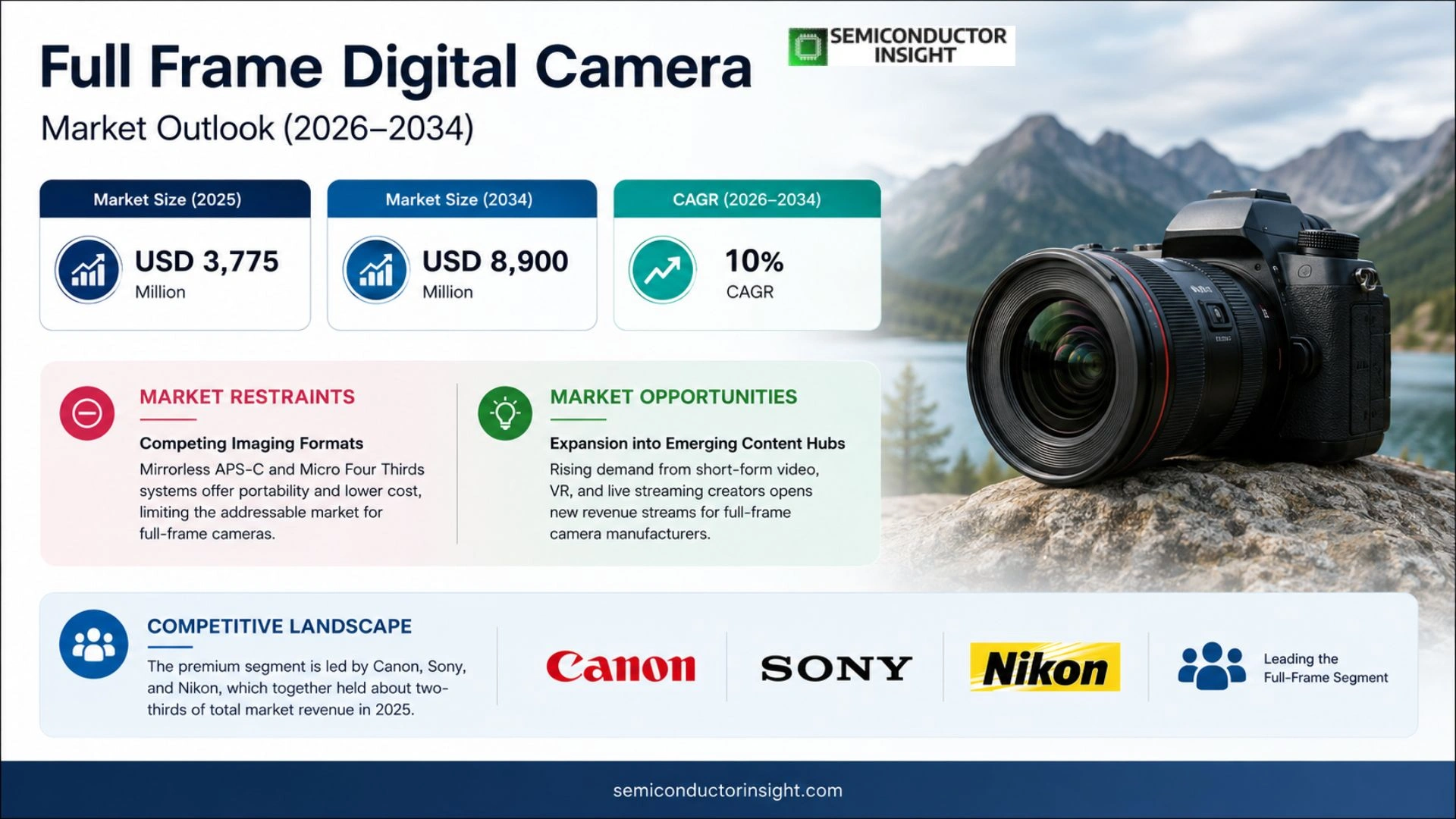
Global Full Frame Digital Camera market size was valued at USD 3,775 million in 2025 and is forecasted to reach approximately USD 8,900 million by 2034, indicating an implied compound annual growth rate of roughly 10 % over the period.
A full‑frame digital camera employs a ~36 × 24 mm “35 mm full‑frame” image sensor, typically found in interchangeable‑lens systems. Compared with smaller formats such as APS‑C, this sensor size delivers superior low‑light performance, broader dynamic range, and shallower depth‑of‑field characteristics, making it favored for portraiture, wedding photography, commercial assignments, documentary work, and hybrid photo/video production.
MARKET DRIVERS
Rising Enthusiast Adoption
The proliferation of high‑resolution content on social platforms has nudged serious hobbyists toward full‑frame systems, where sensor size translates into superior low‑light performance and depth‑of‑field control. Manufacturers report that the average annual growth in unit shipments among 30‑plus‑mm interchangeable‑lens cameras has steadied at approximately 5 %, reflecting a willingness to invest in premium optics.
Advancements in Sensor Technology
Recent breakthroughs in backside‑illuminated (BSI) designs and stacked sensor architectures have lifted read‑out speeds, enabling high‑frame‑rate video without compromising still‑image quality. This technical edge has broadened the appeal of full‑frame bodies to hybrid shooters who demand both cinematic video and professional stills from a single platform.
➤ Analysts note that the integration of AI‑driven autofocus in full‑frame models has shortened the decision cycle for buyers, turning what was once a niche purchase into a mainstream upgrade.
Combined, these forces are reshaping the competitive landscape, prompting legacy brands to accelerate product cycles while new entrants leverage niche differentiators to capture market share in Full Frame Digital Camera Market.
MARKET CHALLENGES
Price Sensitivity Among Emerging Professionals
Despite the allure of larger sensors, price points remain a decisive barrier. Entry‑level full‑frame bodies frequently exceed US$1,500, a level that deters photographers transitioning from crop‑sensor kits. Retail surveys indicate that cost concerns have slowed adoption rates among the 25‑34 demographic, a segment traditionally viewed as growth‑prone.
Other Challenges
Supply Chain Volatility
Component shortages, particularly for high‑precision sensor wafers, have triggered production delays that ripple through the distribution network. Manufacturers have reported lead‑time extensions of up to 12 weeks, pressuring inventory management and potentially inflating end‑user prices.
MARKET RESTRAINTS
Competing Imaging Formats
The surge of mirrorless micro‑four‑thirds and APS‑C systems, which deliver respectable image quality at lower cost and size, creates a restraint for full‑frame growth. Users prioritizing portability are increasingly gravitating toward these alternatives, limiting the addressable pool for Full Frame Digital Camera Market offerings.
MARKET OPPORTUNITIES
Expansion into Emerging Content Hubs
Growth in short‑form video platforms and virtual reality production is opening a niche where full‑frame sensors can provide the dynamic range demanded by creators. Companies that bundle dedicated video codecs, robust heat‑dissipation, and streamlined live‑streaming workflows stand to capture a new revenue stream within Full Frame Digital Camera Market.
Full Frame Digital Camera Market Trends
Shift Toward Integrated Photo‑Video Workflows
Full Frame Digital Camera Market is moving away from the classic “still‑only” positioning that defined early generations of premium bodies. Manufacturers now embed high‑performance autofocus, in‑body image stabilization and codec suites that support 10‑bit 4K video, enabling a single device to serve photographers, documentary crews and online creators alike. This convergence responds to a palpable rise in hybrid shooting, where professionals need to capture decisive moments in low‑light stills and then transition seamlessly to cinematic footage without swapping gear. By consolidating image‑processing pipelines and offering firmware that evolves post‑sale, brands reduce the total cost of ownership for studios and freelancers, reinforcing purchase justification for equipment that would otherwise be viewed as a discretionary luxury. The net effect is a thicker profit margin per unit, as customers are willing to pay a premium for the convenience of a one‑stop imaging solution.
Other Trends
Ecosystem Lock‑In via Lens Mount Strategies
Lens‑mount architecture has become the principal lever for retaining high‑spending users within Full Frame Digital Camera Market. Companies that maintain a broad native lens catalog and support third‑party manufacturers create a barrier to exit that is difficult for professionals to overcome. Firmware updates that unlock new focal lengths, improved stabilization algorithms and cloud‑based metadata workflows deepen the relationship between body and glass. As a result, purchasing decisions are increasingly evaluated on the long‑term value of an ecosystem rather than the immediate specifications of a single camera. This dynamic encourages manufacturers to invest in open‑source SDKs and collaborative lens programs, thereby expanding the accessory market while securing a recurring revenue stream from lens sales and service contracts.
Premiumization and Creator‑Centric Demand
While smartphones dominate entry‑level imaging, Full Frame Digital Camera Market concentrates on segments that require superior low‑light performance, shallow depth of field and robust build quality. Professional studios, wedding teams and streaming studios prioritize reliability, weather sealing and consistent color science, driving a modest yet steady uplift in high‑end sales. The premium pricing tier, anchored by gross margins of 15‑30 %, is justified by the added value of rapid sensor readout, heat‑dissipation engineering and dedicated support services. Brands that align product roadmaps with the workflow expectations of content creators, such as seamless cloud upload, real‑time LUT preview and ergonomic video controls, are better positioned to capture incremental market share as production budgets shift toward digital distribution channels.
COMPETITIVE LANDSCAPE
Key Industry Players
Full Frame Digital Camera Market: Competitive Overview
The premium tier remains anchored by Canon, Sony and Nikon, whose combined revenue accounted for roughly two‑thirds of total market sales in 2025. Their advantage stems from vertically integrated sensor supply chains, extensive native lens portfolios and firmware ecosystems that are refreshed on a 2‑year cadence. Sony’s leadership in backside‑illuminated CMOS sensors translates into superior low‑light performance, a decisive factor for wedding and documentary crews who prioritize high ISO capability. Canon leverages its long‑standing EF‑mount heritage while gradually transitioning users to the RF system, a move that sustains upgrade cycles and service revenue. Nikon’s Z‑mount strategy mirrors this approach, emphasizing weather‑sealing and in‑body stabilization to lock professional adopters into a single‑body workflow. Collectively, these three manufacturers operate factories capable of producing upwards of 200 k units annually, maintaining gross margins in the 15‑30 % range despite aggressive promotional pricing.
Beyond the dominant trio, a constellation of specialist firms fuels diversification. Fujifilm and Panasonic continue to chase hybrid shooters with video‑centric features, while OM Digital Solutions (the parent of OM System) targets high‑resolution stills users through modest sensor‑size increases. Ricoh’s GR series, although APS‑C, influences full‑frame aspirants by showcasing compact ergonomics. Hasselblad and Leica command ultra‑premium pricing by coupling legacy craftsmanship with bespoke optics, attracting commercial studios willing to pay a premium for color fidelity. Sigma’s focus on high‑resolution lenses and Mamiya’s renewed interest in medium‑format interfaces provide ancillary revenue streams. These niche players sustain a competitive pressure that forces the leading brands to innovate on autofocus algorithms, codec support and post‑production workflow integration.
List of Key Full Frame Digital Camera Companies Profiled
- Canon Inc.
- Sony Corporation
- Nikon Corporation
- Fujifilm Holdings Corporation
- Panasonic Corporation
- OM Digital Solutions Corp.
- Ricoh Company, Ltd.
- Hasselblad AB
- Sigma Corporation
- Leica Camera AG
- Mamiya Digital Imaging Co., Ltd.
- Pentax (Ricoh Imaging)
- Zeiss International
Segment Analysis:
| Segment Category | Sub-Segments | Key Insights |
| By Type |
|
Mirrorless Cameras dominate the narrative for several reasons:
|
| By Application |
|
Hybrid Content Creation emerges as the leading application:
|
| By End User |
|
Professional Photographers drive core demand:
|
| By Lens Ecosystem |
|
Native Lens Breadth shapes ecosystem loyalty:
|
| By Market Positioning |
|
High‑End anchors premium perception:
|
Regional Analysis: Full Frame Digital Camera Market
North America
Enthusiasts across the United States gravitate toward full‑frame bodies as a step up from crop‑sensor models, attracted by improved depth‑of‑field control and superior high‑ISO noise handling. Social media platforms amplify word‑of‑mouth, encouraging peer‑driven upgrades that keep the market fluid.
Commercial photographers in advertising, fashion, and wedding sectors rely on the robustness of full‑frame systems to deliver consistent output under demanding lighting conditions, reinforcing a premium pricing tolerance that sustains profitability.
U.S. R&D facilities experiment with sensor‑stacking and AI‑assisted exposure controls, fostering a pipeline of features that quickly filter to consumer models, thereby sharpening the competitive edge of domestic brands.
Proximity to component manufacturers in the Midwest and access to sophisticated logistics networks reduce lead times for new releases, enabling timely market roll‑outs that keep momentum strong.
Europe
European consumers exhibit a nuanced relationship with Full Frame Digital Camera Market, balancing a reverence for classic optics with a willingness to trial emerging sensor technologies. Major metropolitan hubs such as London, Paris, and Berlin host lens‑focused exhibitions that attract both seasoned photojournalists and aspiring creators. Regulatory frameworks around privacy and data handling influence the adoption of integrated Wi‑Fi and cloud‑sync features, prompting vendors to tailor firmware updates for compliance. Moreover, a robust network of independent repair workshops sustains the longevity of high‑end equipment, encouraging a secondary‑market ecosystem that complements primary sales. These dynamics collectively shape a market that values durability, heritage, and incremental technological refinement.
Asia‑Pacific
The Asia‑Pacific region presents a tapestry of divergent market forces, from the fast‑moving consumer base in Japan and South Korea to the burgeoning professional segments in India and Southeast Asia. Cultural emphasis on visual content for digital platforms fuels a demand for cameras capable of delivering cinematic quality without extensive post‑processing. Local manufacturers, leveraging cost‑effective supply chains, introduce hybrid models that marry full‑frame image quality with compact form factors, appealing to travelers and content creators alike. Simultaneously, rising disposable incomes in emerging economies expand the pool of hobbyists willing to invest in premium gear, creating a fertile ground for brand expansion and partnership with regional influencers.
South America
In South America, Full Frame Digital Camera Market is anchored by a passionate community of outdoor and adventure photographers who prize rugged construction and reliable performance in harsh environments. Countries such as Brazil and Argentina host annual photography festivals that double as product showcases, fostering direct interaction between manufacturers and end‑users. While price sensitivity remains a consideration, the allure of high‑resolution sensors for wildlife and landscape work justifies premium pricing for many professionals. Additionally, collaborative programs between camera brands and local universities nurture a new generation of technically proficient shooters, reinforcing long‑term market sustainability.
Middle East & Africa
The Middle East & Africa region demonstrates a growing appetite for full‑frame equipment, propelled by expanding media production hubs in Dubai, Johannesburg, and Lagos. Luxury tourism and architectural photography drive demand for cameras that can capture intricate details under extreme lighting conditions. Infrastructure investments in e‑commerce platforms have eased access to international product lines, while regional trade shows provide venues for hands‑on demonstrations that build confidence among prospective buyers. Despite logistical challenges in some areas, the convergence of aspirational branding and localized training initiatives is gradually solidifying the market’s foothold across the continent.
Report Scope
This market research report provides a comprehensive analysis of the Full Frame Digital Camera Market , covering the forecast period 2026–2034. It offers detailed insights into market dynamics, technological advancements, competitive landscape, and key trends shaping the industry.
Key focus areas of the report include:
- Market Overview: The report begins with an overview outlining its current market scenario, key growth indicators, and industry transformation drivers. It discusses macroeconomic factors, demand–supply balance, regulatory landscape, and the strategic role of semiconductors in powering advancements across industries such as automotive, telecommunications, consumer electronics, and industrial automation.
- Market Size & Forecast: Historical data and future projections for revenue, unit shipments, and market value across major regions and segments.
- Segmentation Analysis: Detailed breakdown by product type, technology, application, and end-user industry to identify high-growth segments and investment opportunities.
- Regional Insights: Insights into market performance across North America, Europe, Asia-Pacific, Latin America, and the Middle East & Africa, including country-level analysis where relevant.
- Competitive Landscape: Profiles of leading market participants, including their product offerings, R&D focus, manufacturing capacity, pricing strategies, and recent developments such as mergers, acquisitions, and partnerships.
- Technology Trends & Innovation: Assessment of emerging technologies, integration of AI/IoT, semiconductor design trends, fabrication techniques, and evolving industry standards.
- Market Drivers & Restraints: Evaluation of factors driving market growth along with challenges, supply chain constraints, regulatory issues, and market-entry barriers.
- Stakeholder Insights: Insights for component suppliers, OEMs, system integrators, investors, and policymakers regarding the evolving ecosystem and strategic opportunities.
Primary and secondary research methods are employed, including interviews with industry experts, data from verified sources, and real-time market intelligence to ensure the accuracy and reliability of the insights presented.
FREQUENTLY ASKED QUESTIONS:
What is the current market size of Full Frame Digital Camera Market?
-> Full Frame Digital Camera market is forecasted to reach approximately USD 8,900 million by 2034
Which key companies operate in Full Frame Digital Camera Market?
-> Key players include Canon, Sony, Nikon, Fujifilm, Panasonic, OM Digital Solutions, Ricoh, Hasselblad, SIGMA Corporation, Leica, Mamiya, Pentax.
What are the key growth drivers?
-> Key growth drivers include creator and commercial content demand, strong low‑light performance requirements, need for shallow depth‑of‑field control, and the efficiency of hybrid photo‑video shooting in a single body.
Which region dominates the market?
-> Based on the provided information, the market shows strong demand across North America, Europe, and Asia, with no single region explicitly identified as dominant.
What are the emerging trends?
-> Emerging trends include premiumization, creator‑centric hybrid photo‑video workflows, expanding lens‑mount ecosystems, and increased integration of advanced autofocus, in‑body stabilization and high‑resolution video codecs.

Get Sample Report PDF for Exclusive Insights
Report Sample Includes
- Table of Contents
- List of Tables & Figures
- Charts, Research Methodology, and more...
 Download Sample Report PDF