Front-illuminated (FI) CMOS Sensor Market Trends, Business Strategies 2026-2036

Front-illuminated (FI) CMOS Sensor market is projected to grow from USD 2,697 million in 2026 to USD 3,946 million by 2034, exhibiting a CAGR of 5.6% during the forecast period.

PDF Icon Download Sample Report PDF
  • Quick Dispatch

    All Orders

  • Secure Payment

    100% Secure Payment

Price range: $1,500.00 through $4,250.00

Clear

Front-illuminated (FI) CMOS Sensor Market Insights

Front-illuminated (FI) CMOS Sensor market is projected to grow from USD 2,697 million in 2026 to USD 3,946 million by 2034, exhibiting a CAGR of 5.6% during the forecast period.

Front-illuminated (FI) CMOS Sensor, also known as Front‑side Illuminated (FSI) CMOS Sensor, is a classic image sensor that converts light into electrical signals for digital imaging. It employs a “top‑down” architecture where light passes through microlenses and color filters before reaching the metal wiring and circuit layer on the front side and finally the photodiodes – the photosensitive core. This foundational technology offers simple manufacturing, high yields and low cost, although the front metal layer blocks roughly 30% of incoming light, limiting utilization to about 70% and resulting in lower low‑light performance compared with back‑illuminated designs.

The demand for FI sensors stems from steady expansion of cost‑sensitive segments such as entry‑level consumer electronics, IoT devices and basic security monitoring, as well as consistent need for global shutter architectures in industrial automation and machine vision. Medical imaging adds incremental volume for certified units meeting clinical standards. Opportunities arise from refining process steps to boost quantum efficiency while preserving cost advantages, targeting emerging low‑power IoT and entry‑level automotive imaging markets, and delivering customized solutions for machine‑vision applications that prioritize global shutter performance over extreme low‑light capability.
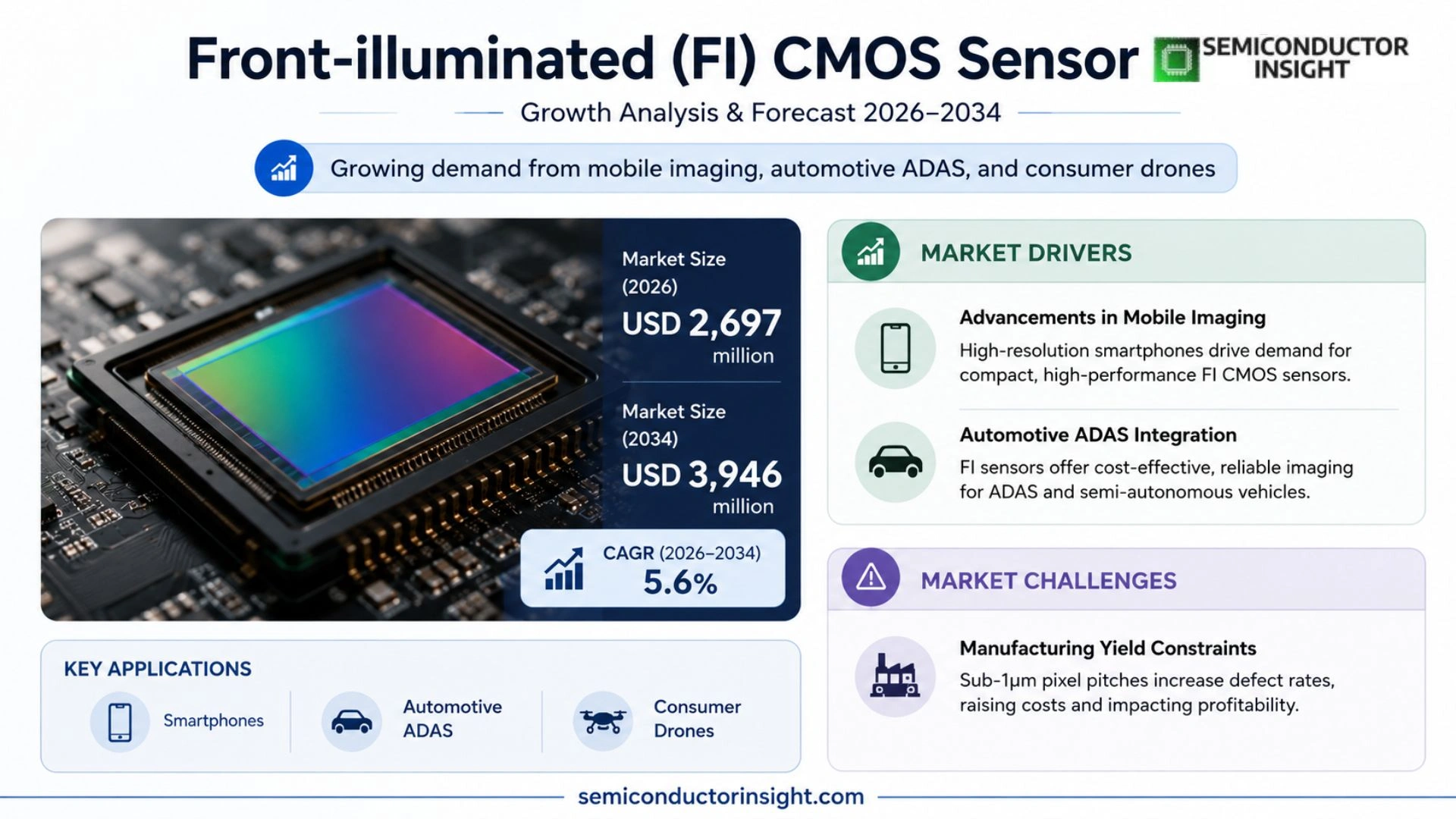
MARKET DRIVERS

Advancements in Mobile Imaging

The proliferation of high‑resolution photography in flagship smartphones has heightened the need for sensors that combine pixel density with strong low‑light response. Front-illuminated (FI) CMOS Sensor Market participants are capitalising on process refinements that shrink photodiode footprints while preserving quantum efficiency, enabling manufacturers to embed 50 MP modules without a proportional rise in device thickness.

Automotive ADAS Integration

Vehicle manufacturers are embedding camera‑based advanced driver‑assistance systems (ADAS) that rely on reliable, cost‑effective imaging components. FI sensors deliver the necessary field‑of‑view and durability for radar‑camera fusion, and their simpler stack architecture translates into lower bill‑of‑materials, a compelling advantage as OEMs scale production of semi‑autonomous platforms.

➤ Industry analysts note that the FI architecture’s reduced material stack shortens assembly cycle time, granting suppliers a competitive edge in price‑sensitive segments.

Beyond smartphones and cars, consumer‑grade drones are adopting FI sensors to meet budget constraints while still achieving acceptable video quality, signalling a broader market diffusion that bolsters overall growth prospects.

MARKET CHALLENGES

Manufacturing Yield Constraints

As pixel pitches shrink below 1 µm, defect density becomes a critical bottleneck. Foundries report that maintaining acceptable yield levels demands tighter process control, which inflates fab overhead and compresses margins for sensor makers targeting volume tiers.

Other Challenges

Supply Chain Volatility

Fluctuations in silicon wafer availability and the recent surge in semiconductor demand have introduced lead‑time uncertainty. Companies that cannot secure long‑term wafer contracts face schedule disruptions that reverberate throughout downstream device assemblers.

MARKET RESTRAINTS

Higher Power Consumption at Peak Performance

When FI sensors operate at their highest frame rates and resolutions, they tend to draw more current than their backside‑illuminated counterparts. This power draw necessitates larger battery packs or more aggressive thermal management, factors that deter integration in ultra‑thin devices.

Cost Competition from BSI Alternatives

Back‑side‑illuminated (BSI) sensors have narrowed the performance gap while offering superior light‑collection efficiency. Their gradual price decline erodes the traditional cost advantage of FI designs, compelling manufacturers to justify the selection on parameters other than price alone.

Regulatory Hurdles for Automotive Deployments

Automotive applications must satisfy stringent functional safety standards (ISO 26262). The certification process adds time and expense, and any deviation from established sensor architectures can trigger additional validation cycles, slowing market entry for new FI models.

MARKET OPPORTUNITIES

Emerging Wearable Applications

Wearable devices such as smart glasses and health‑monitoring bands are demanding compact imaging solutions that balance resolution with power efficiency. FI sensors, with their shallow stack and modest cost, align well with the ergonomic constraints of head‑mounted displays, opening a niche with limited competition.

IoT Edge Cameras

Edge‑computing cameras deployed in smart factories and retail analytics require on‑device processing and affordable optics. The FI sensor’s lower fabrication complexity enables manufacturers to embed AI accelerators alongside the sensor die, delivering intelligent vision at the edge without inflating unit cost.

Medical Imaging Miniaturisation

Portable diagnostic tools, including handheld endoscopes, benefit from the shallow form factor of FI sensors. Their ability to maintain adequate signal‑to‑noise ratios in constrained lighting environments positions them as viable components for next‑generation point‑of‑care imaging equipment.

Front-illuminated (FI) CMOS Sensor Market Trends

Cost‑Driven Adoption in Consumer and IoT Segments

Front-illuminated (FI) CMOS Sensor Market recorded revenues of roughly $2.7 billion in 2025 and is forecasted to reach about $3.9 billion by 2034. Production volumes topped 1.64 billion units that year, with an average transaction price near $1.80 per kilounit. These figures reflect the sensor’s enduring appeal where price sensitivity outweighs the need for extreme low‑light performance. Applications such as entry‑level smartphones, wearable gadgets, and connected home devices capitalize on the sensor’s straightforward manufacturing flow and high yield, keeping component costs low while delivering acceptable image quality for everyday use. The modest light‑utilization rate of roughly 70 %,a consequence of the front‑metal stack,remains acceptable in well‑lit environments, cementing the sensor’s position as the workhorse of cost‑conscious imaging solutions.

Other Trends

Industrial Automation and Global Shutter Preference

In manufacturing and machine‑vision contexts, the demand for global‑shutter enabled FI sensors has stayed resilient. Factories that rely on precise motion capture favor the read‑out architecture that eliminates rolling‑shutter distortion, even though the light‑sensitivity trade‑off is less critical than in consumer photography. The sensor’s ability to be produced at scale with minimal defect rates makes it a logical choice for robotics, quality‑control stations, and high‑throughput inspection lines. Moreover, the medical imaging niche,particularly devices requiring certified components,has introduced a modest yet steady stream of orders, reinforcing the sensor’s versatility across regulated environments.

Process Optimization as a Competitive Lever

Manufacturers are channeling R&D resources toward refining the front‑side architecture to squeeze additional photons from the same aperture. Techniques such as microlens redesign, thinner metal interconnects, and optimized color‑filter stacks are being trialed to lift effective quantum efficiency toward the mid‑70 % range without sacrificing the low‑cost advantage. Parallel efforts focus on noise‑reduction algorithms embedded in sensor firmware, enhancing signal‑to‑noise ratios for borderline lighting conditions. Companies that master these incremental gains can defend market share against back‑illuminated alternatives while opening doors to emerging low‑power IoT cameras and budget‑oriented automotive imaging modules, where price margins are razor‑thin but volume potential is massive.

COMPETITIVE LANDSCAPE

Key Industry Players

Competitive dynamics among leading FI CMOS sensor manufacturers

Sony dominates the front‑illuminated CMOS sensor arena, leveraging its deep photodiode expertise and scale‑driven cost efficiencies. The company’s ability to integrate global‑shutter architectures within a mature production line sustains its market share in both consumer‑grade and industrial segments. Sony’s extensive IP portfolio and its strategic focus on incremental light‑sensitivity improvements keep it ahead of cost‑sensitive rivals, allowing the firm to command premium pricing for higher‑resolution modules while still competing on volume. This concentration around a single powerhouse shapes pricing benchmarks and drives smaller players toward niche differentiation or regional specialization.

Beyond Sony, the competitive set fragments into a mix of diversified semiconductor giants and specialist firms. Samsung and OmniVision exploit advanced wafer‑fab capacity to supply mid‑tier FI sensors for entry‑level smartphones and IoT devices, emphasizing aggressive price points. STMicroelectronics and ON Semiconductor (Onsemi) concentrate on industrial automation, where global‑shutter performance outweighs low‑light sensitivity, delivering customized solutions for machine‑vision OEMs. SK Hynix and GalaxyCore have entered the market to capture emerging demand in cost‑constrained automotive imaging, while Panasonic and Canon apply their optical heritage to medical‑grade FI sensors that must meet stringent regulatory standards. Smaller innovators such as SmartSens Technology, Silicon Optronics, Sharp and Toshiba differentiate through ultra‑small pixel designs or multi‑spectral extensions, targeting emerging low‑power edge applications. The resulting ecosystem reflects a balance between scale advantages and targeted specialization, compelling incumbents to refine process yields while prompting newcomers to carve out narrowly defined value propositions.

List of Key Front-illuminated (FI) CMOS Sensor Companies Profiled

  • Sony, Samsung, OmniVision, STMicroelectronics
  • ON Semiconductor, SK Hynix, GalaxyCore, Panasonic
  • SmartSens Technology, Canon, Silicon Optronics, Sharp, Toshiba

Segment Analysis:

Segment Category Sub-Segments Key Insights
By Type
  • Standard Front‑illuminated (FI) sensor
  • Global‑shutter FI sensor
  • Rolling‑shutter FI sensor
Standard FI Sensor

  • Provides a cost‑effective solution for mass‑market devices where ultra‑high sensitivity is not critical.
  • Benefits from mature manufacturing processes, delivering high yields and low unit cost.
  • Favoured in entry‑level smartphones, basic IoT cameras, and affordable security lenses.
By Application
  • Consumer Electronics
  • IoT Devices
  • Security Monitoring
  • Industrial Automation & Machine Vision
  • Medical Imaging
Consumer Electronics

  • Drives volume sales due to price sensitivity and adequate performance for everyday photography.
  • Enables manufacturers to integrate imaging modules without inflating bill‑of‑materials.
  • Supports rapid product cycles where design simplicity outweighs low‑light excellence.
By End User
  • Cost‑conscious consumer device manufacturers
  • Industrial machine‑vision system integrators
  • Healthcare equipment providers
Cost‑Conscious Consumer Devices

  • Prioritize affordability, leveraging the simple structure of FI sensors to keep device cost low.
  • Accept modest low‑light performance in exchange for economies of scale.
  • Drive demand for incremental improvements in light efficiency without sacrificing price advantage.
By Pixel Size
  • Small Pixel (≤1.0 µm)
  • Medium Pixel (1.0–2.0 µm)
  • Large Pixel (>2.0 µm)
Medium Pixel FI Sensors

  • Balance between sensor cost and adequate light‑gathering ability for most mid‑range applications.
  • Offer a sweet spot for IoT cameras where footprint and power consumption are limited.
  • Facilitate design flexibility for both consumer and industrial products without requiring advanced optics.
By Spectral Response
  • Visible Light FI Sensors
  • Near‑Infrared (NIR) FI Sensors
  • Multi‑Spectral FI Sensors
Visible Light FI Sensors

  • Dominant in everyday imaging where color fidelity under normal illumination is essential.
  • Leverage existing filter and microlens stacks, keeping production complexity low.
  • Support a broad range of devices from smartphones to entry‑level automotive cameras.

Regional Analysis: Front-illuminated (FI) CMOS Sensor Market

Asia-Pacific

The Asia-Pacific basin has become the fulcrum of Front-illuminated (FI) CMOS Sensor Market activity. A confluence of high‑volume smartphone assemblers, burgeoning automotive electronics firms, and aggressive government incentives for semiconductor fabs has created a self‑reinforcing ecosystem. Talent pipelines from leading engineering universities feed a steady stream of design expertise, while prominent players have expanded wafer lines to accommodate multi‑patterned sensor architectures. Investment in advanced lithography and packaging is reshaping the cost structure, allowing regional manufacturers to offer competitive pricing without compromising yield. Moreover, the proximity of key downstream OEMs shortens design‑to‑production cycles, giving suppliers an edge in rapid product iteration. This concentration of capability not only sustains current demand but also positions the region to capture emerging opportunities in augmented‑reality wearables and edge‑AI vision systems.

Manufacturing Capacity
Recent expansions in 300‑mm fabs across Taiwan, South Korea and China have lifted output ceilings, enabling manufacturers to meet the surge in high‑resolution sensor orders. The shift toward wafer‑scale integration reduces per‑unit cost and improves consistency across product families, a critical factor for volume‑driven appliance makers.
Supply Chain Resilience
Companies are diversifying raw material sources and bolstening logistics networks to mitigate geopolitical friction. Strategic stockpiling of silicon wafers and localized packaging facilities have shortened lead times, ensuring smoother fulfillment for automotive tier‑1 suppliers.
Application Segments
Mobile imaging remains the dominant driver, but the region is witnessing rapid adoption of FI sensors in autonomous‑driving camera stacks and industrial machine‑vision rigs. The convergence of miniaturization and low‑light performance requirements is widening the addressable market.
Regulatory Landscape
Harmonized environmental standards across ASEAN and Greater China facilitate cross‑border component flow. Meanwhile, relaxed export controls on photonic equipment have accelerated technology transfer, allowing smaller firms to scale more quickly.

North America
In North America, the market narrative is shaped by an emphasis on advanced driver‑assistance systems and high‑end consumer electronics. A handful of fabless innovators leverage deep R&D budgets to push pixel‑type innovations, while contract manufacturers in the United States focus on low‑defect assembly for premium devices. The region’s regulatory emphasis on data privacy has spurred demand for on‑sensor processing, nudging OEMs toward FI architectures that can embed preprocessing capabilities. Though domestic wafer capacity is limited compared with Asia, strategic partnerships with overseas foundries offset the shortfall and keep supply chains agile.

Europe
European activity centers on automotive safety and industrial automation, where stringent functional‑safety certifications drive sensor selection criteria. Companies based in Germany and France are pioneering sensor‑fusion algorithms that rely on FI devices for their superior quantum efficiency under limited illumination. Collaborative research programs funded by the EU encourage co‑development of heterogeneous integration techniques, merging sensors with AI accelerators on a single die. While volume manufacturing remains export‑oriented, the region’s design expertise continues to shape product roadmaps for global brands.

South America
South American markets exhibit a cautious but growing appetite for FI sensors, primarily in consumer electronics imports and localized medical imaging equipment. Brazil’s recent tax incentives for semiconductor assembly have attracted modest investment, allowing regional firms to assemble and test sensors for domestic distribution. The ecosystem is still dependent on imported wafers, but improved logistics corridors are reducing lead times. As smartphone penetration deepens, end‑users are demanding better low‑light performance, prompting importers to favor FI solutions over legacy options.

Middle East & Africa
The Middle East & Africa region is driven by surveillance and smart‑city initiatives that require reliable imaging under diverse lighting conditions. Investments in data‑center infrastructure have encouraged OEMs to adopt sensors with higher dynamic range, a niche where FI technology excels. In the United Arab Emirates, government‑backed pilots for autonomous public transport are evaluating sensor stacks that integrate FI chips for robust perception. Although local fabrication is minimal, the region’s role as a testing ground for high‑performance applications is expanding, creating downstream demand for specialized sensor modules.

Report Scope

This market research report provides a comprehensive analysis of the Front-illuminated (FI) CMOS Sensor Market , covering the forecast period 2026–2034. It offers detailed insights into market dynamics, technological advancements, competitive landscape, and key trends shaping the industry.

Key focus areas of the report include:

  • Market Overview: The report begins with an overview outlining its current market scenario, key growth indicators, and industry transformation drivers. It discusses macroeconomic factors, demand–supply balance, regulatory landscape, and the strategic role of semiconductors in powering advancements across industries such as automotive, telecommunications, consumer electronics, and industrial automation.
  • Market Size & Forecast: Historical data and future projections for revenue, unit shipments, and market value across major regions and segments.
  • Segmentation Analysis: Detailed breakdown by product type, technology, application, and end-user industry to identify high-growth segments and investment opportunities.
  • Regional Insights: Insights into market performance across North America, Europe, Asia-Pacific, Latin America, and the Middle East & Africa, including country-level analysis where relevant.
  • Competitive Landscape: Profiles of leading market participants, including their product offerings, R&D focus, manufacturing capacity, pricing strategies, and recent developments such as mergers, acquisitions, and partnerships.
  • Technology Trends & Innovation: Assessment of emerging technologies, integration of AI/IoT, semiconductor design trends, fabrication techniques, and evolving industry standards.
  • Market Drivers & Restraints: Evaluation of factors driving market growth along with challenges, supply chain constraints, regulatory issues, and market-entry barriers.
  • Stakeholder Insights: Insights for component suppliers, OEMs, system integrators, investors, and policymakers regarding the evolving ecosystem and strategic opportunities.

Primary and secondary research methods are employed, including interviews with industry experts, data from verified sources, and real-time market intelligence to ensure the accuracy and reliability of the insights presented.

FREQUENTLY ASKED QUESTIONS:

What is the current market size of Front-illuminated (FI) CMOS Sensor Market?

-> Global Front-illuminated (FI) CMOS Sensor market is projected to grow from USD 2,697 million in 2026 to USD 3,946 million by 2034, exhibiting a CAGR of 5.6%

Which key companies operate in Front-illuminated (FI) CMOS Sensor Market?

-> Key players include SONY, Samsung, OmniVision, STMicroelectronics, Onsemi, SK Hynix, GalaxyCore, Panasonic, SmartSens Technology, Canon, and Silicon Optronics, among others.

What are the key growth drivers?

-> Key growth drivers include steady demand from cost‑sensitive consumer electronics, expanding IoT device deployments, increasing security‑monitoring installations, rising adoption of global‑shutter architectures in industrial automation and machine vision, and incremental demand from medical imaging applications requiring certified FI sensors.

Which region dominates the market?

-> Asia‑Pacific holds the largest market share, driven by high manufacturing capacity and robust demand in consumer electronics and automotive sectors, while North America and Europe remain important secondary markets.

What are the emerging trends?

-> Emerging trends include integration of FI sensors with AI‑enabled edge processing, development of ultra‑low‑power designs for battery‑operated IoT devices, customization for entry‑level automotive imaging, and advances in global‑shutter technologies to improve motion‑capture performance in industrial machine‑vision systems.

Front-illuminated (FI) CMOS Sensor Market Trends, Business Strategies 2026-2036

Get Sample Report PDF for Exclusive Insights

Report Sample Includes

  • Table of Contents
  • List of Tables & Figures
  • Charts, Research Methodology, and more...

PDF Icon Download Sample Report PDF
SKU: 8901cf13693e
Category:
License Type

Corporate License, Excel License, PDF and Excel Databook License

Download Sample Report

Table of Content

1 Introduction to Research & Analysis Reports
1.1 Front-illuminated (FI) CMOS Sensor Market Definition
1.2 Market Segments
1.2.1 Segment by Pixel Size
1.2.2 Segment by Shutter Type
1.2.3 Segment by Spectral Response Range
1.2.4 Segment by Application
1.3 Global Front-illuminated (FI) CMOS Sensor Market Overview
1.4 Features & Benefits of This Report
1.5 Methodology & Sources of Information
1.5.1 Research Methodology
1.5.2 Research Process
1.5.3 Base Year
1.5.4 Report Assumptions & Caveats
2 Global Front-illuminated (FI) CMOS Sensor Overall Market Size
2.1 Global Front-illuminated (FI) CMOS Sensor Market Size: 2025 VS 2034
2.2 Global Front-illuminated (FI) CMOS Sensor Market Size, Prospects & Forecasts: 2021-2034
2.3 Global Front-illuminated (FI) CMOS Sensor Sales: 2021-2034
3 Company Landscape
3.1 Top Front-illuminated (FI) CMOS Sensor Players in Global Market
3.2 Top Global Front-illuminated (FI) CMOS Sensor Companies Ranked by Revenue
3.3 Global Front-illuminated (FI) CMOS Sensor Revenue by Companies
3.4 Global Front-illuminated (FI) CMOS Sensor Sales by Companies
3.5 Global Front-illuminated (FI) CMOS Sensor Price by Manufacturer (2021-2026)
3.6 Top 3 and Top 5 Front-illuminated (FI) CMOS Sensor Companies in Global Market, by Revenue in 2025
3.7 Global Manufacturers Front-illuminated (FI) CMOS Sensor Product Type
3.8 Tier 1, Tier 2, and Tier 3 Front-illuminated (FI) CMOS Sensor Players in Global Market
3.8.1 List of Global Tier 1 Front-illuminated (FI) CMOS Sensor Companies
3.8.2 List of Global Tier 2 and Tier 3 Front-illuminated (FI) CMOS Sensor Companies
4 Sights by Pixel Size
4.1 Overview
4.1.1 Segment by Pixel Size – Global Front-illuminated (FI) CMOS Sensor Market Size Markets, 2025 & 2034
4.1.2 Small Pixel (?1.0?m) FI CMOS Sensor
4.1.3 Medium Pixel (1.0?m-2.0?m) FI CMOS Sensor
4.1.4 Large Pixel (>2.0?m) FI CMOS Sensor
4.2 Segment by Pixel Size – Global Front-illuminated (FI) CMOS Sensor Revenue & Forecasts
4.2.1 Segment by Pixel Size – Global Front-illuminated (FI) CMOS Sensor Revenue, 2021-2026
4.2.2 Segment by Pixel Size – Global Front-illuminated (FI) CMOS Sensor Revenue, 2027-2034
4.2.3 Segment by Pixel Size – Global Front-illuminated (FI) CMOS Sensor Revenue Market Share, 2021-2034
4.3 Segment by Pixel Size – Global Front-illuminated (FI) CMOS Sensor Sales & Forecasts
4.3.1 Segment by Pixel Size – Global Front-illuminated (FI) CMOS Sensor Sales, 2021-2026
4.3.2 Segment by Pixel Size – Global Front-illuminated (FI) CMOS Sensor Sales, 2027-2034
4.3.3 Segment by Pixel Size – Global Front-illuminated (FI) CMOS Sensor Sales Market Share, 2021-2034
4.4 Segment by Pixel Size – Global Front-illuminated (FI) CMOS Sensor Price (Manufacturers Selling Prices), 2021-2034
5 Sights by Shutter Type
5.1 Overview
5.1.1 Segment by Shutter Type – Global Front-illuminated (FI) CMOS Sensor Market Size Markets, 2025 & 2034
5.1.2 Rolling Shutter FI CMOS Sensor
5.1.3 Global Shutter FI CMOS Sensor
5.2 Segment by Shutter Type – Global Front-illuminated (FI) CMOS Sensor Revenue & Forecasts
5.2.1 Segment by Shutter Type – Global Front-illuminated (FI) CMOS Sensor Revenue, 2021-2026
5.2.2 Segment by Shutter Type – Global Front-illuminated (FI) CMOS Sensor Revenue, 2027-2034
5.2.3 Segment by Shutter Type – Global Front-illuminated (FI) CMOS Sensor Revenue Market Share, 2021-2034
5.3 Segment by Shutter Type – Global Front-illuminated (FI) CMOS Sensor Sales & Forecasts
5.3.1 Segment by Shutter Type – Global Front-illuminated (FI) CMOS Sensor Sales, 2021-2026
5.3.2 Segment by Shutter Type – Global Front-illuminated (FI) CMOS Sensor Sales, 2027-2034
5.3.3 Segment by Shutter Type – Global Front-illuminated (FI) CMOS Sensor Sales Market Share, 2021-2034
5.4 Segment by Shutter Type – Global Front-illuminated (FI) CMOS Sensor Price (Manufacturers Selling Prices), 2021-2034
6 Sights by Spectral Response Range
6.1 Overview
6.1.1 Segment by Spectral Response Range – Global Front-illuminated (FI) CMOS Sensor Market Size Markets, 2025 & 2034
6.1.2 Visible Light FI CMOS Sensor
6.1.3 Near-Infrared (NIR) FI CMOS Sensor
6.1.4 Multi-Spectral FI CMOS Sensor
6.2 Segment by Spectral Response Range – Global Front-illuminated (FI) CMOS Sensor Revenue & Forecasts
6.2.1 Segment by Spectral Response Range – Global Front-illuminated (FI) CMOS Sensor Revenue, 2021-2026
6.2.2 Segment by Spectral Response Range – Global Front-illuminated (FI) CMOS Sensor Revenue, 2027-2034
6.2.3 Segment by Spectral Response Range – Global Front-illuminated (FI) CMOS Sensor Revenue Market Share, 2021-2034
6.3 Segment by Spectral Response Range – Global Front-illuminated (FI) CMOS Sensor Sales & Forecasts
6.3.1 Segment by Spectral Response Range – Global Front-illuminated (FI) CMOS Sensor Sales, 2021-2026
6.3.2 Segment by Spectral Response Range – Global Front-illuminated (FI) CMOS Sensor Sales, 2027-2034
6.3.3 Segment by Spectral Response Range – Global Front-illuminated (FI) CMOS Sensor Sales Market Share, 2021-2034
6.4 Segment by Spectral Response Range – Global Front-illuminated (FI) CMOS Sensor Price (Manufacturers Selling Prices), 2021-2034
7 Sights by Application
7.1 Overview
7.1.1 Segment by Application – Global Front-illuminated (FI) CMOS Sensor Market Size, 2025 & 2034
7.1.2 Consumer Electronics
7.1.3 Industrial Automation
7.1.4 Security Monitoring
7.1.5 Medical Imaging
7.1.6 Others
7.2 Segment by Application – Global Front-illuminated (FI) CMOS Sensor Revenue & Forecasts
7.2.1 Segment by Application – Global Front-illuminated (FI) CMOS Sensor Revenue, 2021-2026
7.2.2 Segment by Application – Global Front-illuminated (FI) CMOS Sensor Revenue, 2027-2034
7.2.3 Segment by Application – Global Front-illuminated (FI) CMOS Sensor Revenue Market Share, 2021-2034
7.3 Segment by Application – Global Front-illuminated (FI) CMOS Sensor Sales & Forecasts
7.3.1 Segment by Application – Global Front-illuminated (FI) CMOS Sensor Sales, 2021-2026
7.3.2 Segment by Application – Global Front-illuminated (FI) CMOS Sensor Sales, 2027-2034
7.3.3 Segment by Application – Global Front-illuminated (FI) CMOS Sensor Sales Market Share, 2021-2034
7.4 Segment by Application – Global Front-illuminated (FI) CMOS Sensor Price (Manufacturers Selling Prices), 2021-2034
8 Sights Region
8.1 By Region – Global Front-illuminated (FI) CMOS Sensor Market Size, 2025 & 2034
8.2 By Region – Global Front-illuminated (FI) CMOS Sensor Revenue & Forecasts
8.2.1 By Region – Global Front-illuminated (FI) CMOS Sensor Revenue, 2021-2026
8.2.2 By Region – Global Front-illuminated (FI) CMOS Sensor Revenue, 2027-2034
8.2.3 By Region – Global Front-illuminated (FI) CMOS Sensor Revenue Market Share, 2021-2034
8.3 By Region – Global Front-illuminated (FI) CMOS Sensor Sales & Forecasts
8.3.1 By Region – Global Front-illuminated (FI) CMOS Sensor Sales, 2021-2026
8.3.2 By Region – Global Front-illuminated (FI) CMOS Sensor Sales, 2027-2034
8.3.3 By Region – Global Front-illuminated (FI) CMOS Sensor Sales Market Share, 2021-2034
8.4 North America
8.4.1 By Country – North America Front-illuminated (FI) CMOS Sensor Revenue, 2021-2034
8.4.2 By Country – North America Front-illuminated (FI) CMOS Sensor Sales, 2021-2034
8.4.3 United States Front-illuminated (FI) CMOS Sensor Market Size, 2021-2034
8.4.4 Canada Front-illuminated (FI) CMOS Sensor Market Size, 2021-2034
8.4.5 Mexico Front-illuminated (FI) CMOS Sensor Market Size, 2021-2034
8.5 Europe
8.5.1 By Country – Europe Front-illuminated (FI) CMOS Sensor Revenue, 2021-2034
8.5.2 By Country – Europe Front-illuminated (FI) CMOS Sensor Sales, 2021-2034
8.5.3 Germany Front-illuminated (FI) CMOS Sensor Market Size, 2021-2034
8.5.4 France Front-illuminated (FI) CMOS Sensor Market Size, 2021-2034
8.5.5 U.K. Front-illuminated (FI) CMOS Sensor Market Size, 2021-2034
8.5.6 Italy Front-illuminated (FI) CMOS Sensor Market Size, 2021-2034
8.5.7 Russia Front-illuminated (FI) CMOS Sensor Market Size, 2021-2034
8.5.8 Nordic Countries Front-illuminated (FI) CMOS Sensor Market Size, 2021-2034
8.5.9 Benelux Front-illuminated (FI) CMOS Sensor Market Size, 2021-2034
8.6 Asia
8.6.1 By Region – Asia Front-illuminated (FI) CMOS Sensor Revenue, 2021-2034
8.6.2 By Region – Asia Front-illuminated (FI) CMOS Sensor Sales, 2021-2034
8.6.3 China Front-illuminated (FI) CMOS Sensor Market Size, 2021-2034
8.6.4 Japan Front-illuminated (FI) CMOS Sensor Market Size, 2021-2034
8.6.5 South Korea Front-illuminated (FI) CMOS Sensor Market Size, 2021-2034
8.6.6 Southeast Asia Front-illuminated (FI) CMOS Sensor Market Size, 2021-2034
8.6.7 India Front-illuminated (FI) CMOS Sensor Market Size, 2021-2034
8.7 South America
8.7.1 By Country – South America Front-illuminated (FI) CMOS Sensor Revenue, 2021-2034
8.7.2 By Country – South America Front-illuminated (FI) CMOS Sensor Sales, 2021-2034
8.7.3 Brazil Front-illuminated (FI) CMOS Sensor Market Size, 2021-2034
8.7.4 Argentina Front-illuminated (FI) CMOS Sensor Market Size, 2021-2034
8.8 Middle East & Africa
8.8.1 By Country – Middle East & Africa Front-illuminated (FI) CMOS Sensor Revenue, 2021-2034
8.8.2 By Country – Middle East & Africa Front-illuminated (FI) CMOS Sensor Sales, 2021-2034
8.8.3 Turkey Front-illuminated (FI) CMOS Sensor Market Size, 2021-2034
8.8.4 Israel Front-illuminated (FI) CMOS Sensor Market Size, 2021-2034
8.8.5 Saudi Arabia Front-illuminated (FI) CMOS Sensor Market Size, 2021-2034
8.8.6 UAE Front-illuminated (FI) CMOS Sensor Market Size, 2021-2034
9 Manufacturers & Brands Profiles
9.1 SONY
9.1.1 SONY Company Summary
9.1.2 SONY Business Overview
9.1.3 SONY Front-illuminated (FI) CMOS Sensor Major Product Offerings
9.1.4 SONY Front-illuminated (FI) CMOS Sensor Sales and Revenue in Global (2021-2026)
9.1.5 SONY Key News & Latest Developments
9.2 Samsung
9.2.1 Samsung Company Summary
9.2.2 Samsung Business Overview
9.2.3 Samsung Front-illuminated (FI) CMOS Sensor Major Product Offerings
9.2.4 Samsung Front-illuminated (FI) CMOS Sensor Sales and Revenue in Global (2021-2026)
9.2.5 Samsung Key News & Latest Developments
9.3 OmniVision
9.3.1 OmniVision Company Summary
9.3.2 OmniVision Business Overview
9.3.3 OmniVision Front-illuminated (FI) CMOS Sensor Major Product Offerings
9.3.4 OmniVision Front-illuminated (FI) CMOS Sensor Sales and Revenue in Global (2021-2026)
9.3.5 OmniVision Key News & Latest Developments
9.4 STMicroelectronics
9.4.1 STMicroelectronics Company Summary
9.4.2 STMicroelectronics Business Overview
9.4.3 STMicroelectronics Front-illuminated (FI) CMOS Sensor Major Product Offerings
9.4.4 STMicroelectronics Front-illuminated (FI) CMOS Sensor Sales and Revenue in Global (2021-2026)
9.4.5 STMicroelectronics Key News & Latest Developments
9.5 Onsemi
9.5.1 Onsemi Company Summary
9.5.2 Onsemi Business Overview
9.5.3 Onsemi Front-illuminated (FI) CMOS Sensor Major Product Offerings
9.5.4 Onsemi Front-illuminated (FI) CMOS Sensor Sales and Revenue in Global (2021-2026)
9.5.5 Onsemi Key News & Latest Developments
9.6 SK Hynix
9.6.1 SK Hynix Company Summary
9.6.2 SK Hynix Business Overview
9.6.3 SK Hynix Front-illuminated (FI) CMOS Sensor Major Product Offerings
9.6.4 SK Hynix Front-illuminated (FI) CMOS Sensor Sales and Revenue in Global (2021-2026)
9.6.5 SK Hynix Key News & Latest Developments
9.7 GalaxyCore
9.7.1 GalaxyCore Company Summary
9.7.2 GalaxyCore Business Overview
9.7.3 GalaxyCore Front-illuminated (FI) CMOS Sensor Major Product Offerings
9.7.4 GalaxyCore Front-illuminated (FI) CMOS Sensor Sales and Revenue in Global (2021-2026)
9.7.5 GalaxyCore Key News & Latest Developments
9.8 Panasonic
9.8.1 Panasonic Company Summary
9.8.2 Panasonic Business Overview
9.8.3 Panasonic Front-illuminated (FI) CMOS Sensor Major Product Offerings
9.8.4 Panasonic Front-illuminated (FI) CMOS Sensor Sales and Revenue in Global (2021-2026)
9.8.5 Panasonic Key News & Latest Developments
9.9 SmartSens Technology
9.9.1 SmartSens Technology Company Summary
9.9.2 SmartSens Technology Business Overview
9.9.3 SmartSens Technology Front-illuminated (FI) CMOS Sensor Major Product Offerings
9.9.4 SmartSens Technology Front-illuminated (FI) CMOS Sensor Sales and Revenue in Global (2021-2026)
9.9.5 SmartSens Technology Key News & Latest Developments
9.10 Canon
9.10.1 Canon Company Summary
9.10.2 Canon Business Overview
9.10.3 Canon Front-illuminated (FI) CMOS Sensor Major Product Offerings
9.10.4 Canon Front-illuminated (FI) CMOS Sensor Sales and Revenue in Global (2021-2026)
9.10.5 Canon Key News & Latest Developments
9.11 Silicon Optronics
9.11.1 Silicon Optronics Company Summary
9.11.2 Silicon Optronics Business Overview
9.11.3 Silicon Optronics Front-illuminated (FI) CMOS Sensor Major Product Offerings
9.11.4 Silicon Optronics Front-illuminated (FI) CMOS Sensor Sales and Revenue in Global (2021-2026)
9.11.5 Silicon Optronics Key News & Latest Developments
10 Global Front-illuminated (FI) CMOS Sensor Production Capacity, Analysis
10.1 Global Front-illuminated (FI) CMOS Sensor Production Capacity, 2021-2034
10.2 Front-illuminated (FI) CMOS Sensor Production Capacity of Key Manufacturers in Global Market
10.3 Global Front-illuminated (FI) CMOS Sensor Production by Region
11 Key Market Trends, Opportunity, Drivers and Restraints
11.1 Market Opportunities & Trends
11.2 Market Drivers
11.3 Market Restraints
12 Front-illuminated (FI) CMOS Sensor Supply Chain Analysis
12.1 Front-illuminated (FI) CMOS Sensor Industry Value Chain
12.2 Front-illuminated (FI) CMOS Sensor Upstream Market
12.3 Front-illuminated (FI) CMOS Sensor Downstream and Clients
12.4 Marketing Channels Analysis
12.4.1 Marketing Channels
12.4.2 Front-illuminated (FI) CMOS Sensor Distributors and Sales Agents in Global
13 Conclusion
14 Appendix
14.1 Note
14.2 Examples of Clients
14.3 DisclaimerList of Tables
Table 1. Key Players of Front-illuminated (FI) CMOS Sensor in Global Market
Table 2. Top Front-illuminated (FI) CMOS Sensor Players in Global Market, Ranking by Revenue (2025)
Table 3. Global Front-illuminated (FI) CMOS Sensor Revenue by Companies, (US$, Mn), 2021-2026
Table 4. Global Front-illuminated (FI) CMOS Sensor Revenue Share by Companies, 2021-2026
Table 5. Global Front-illuminated (FI) CMOS Sensor Sales by Companies, (Million Units), 2021-2026
Table 6. Global Front-illuminated (FI) CMOS Sensor Sales Share by Companies, 2021-2026
Table 7. Key Manufacturers Front-illuminated (FI) CMOS Sensor Price (2021-2026) & (US$/K Units)
Table 8. Global Manufacturers Front-illuminated (FI) CMOS Sensor Product Type
Table 9. List of Global Tier 1 Front-illuminated (FI) CMOS Sensor Companies, Revenue (US$, Mn) in 2025 and Market Share
Table 10. List of Global Tier 2 and Tier 3 Front-illuminated (FI) CMOS Sensor Companies, Revenue (US$, Mn) in 2025 and Market Share
Table 11. Segment by Pixel Size – Global Front-illuminated (FI) CMOS Sensor Revenue, (US$, Mn), 2025 & 2034
Table 12. Segment by Pixel Size – Global Front-illuminated (FI) CMOS Sensor Revenue (US$, Mn), 2021-2026
Table 13. Segment by Pixel Size – Global Front-illuminated (FI) CMOS Sensor Revenue (US$, Mn), 2027-2034
Table 14. Segment by Pixel Size – Global Front-illuminated (FI) CMOS Sensor Sales (Million Units), 2021-2026
Table 15. Segment by Pixel Size – Global Front-illuminated (FI) CMOS Sensor Sales (Million Units), 2027-2034
Table 16. Segment by Shutter Type – Global Front-illuminated (FI) CMOS Sensor Revenue, (US$, Mn), 2025 & 2034
Table 17. Segment by Shutter Type – Global Front-illuminated (FI) CMOS Sensor Revenue (US$, Mn), 2021-2026
Table 18. Segment by Shutter Type – Global Front-illuminated (FI) CMOS Sensor Revenue (US$, Mn), 2027-2034
Table 19. Segment by Shutter Type – Global Front-illuminated (FI) CMOS Sensor Sales (Million Units), 2021-2026
Table 20. Segment by Shutter Type – Global Front-illuminated (FI) CMOS Sensor Sales (Million Units), 2027-2034
Table 21. Segment by Spectral Response Range – Global Front-illuminated (FI) CMOS Sensor Revenue, (US$, Mn), 2025 & 2034
Table 22. Segment by Spectral Response Range – Global Front-illuminated (FI) CMOS Sensor Revenue (US$, Mn), 2021-2026
Table 23. Segment by Spectral Response Range – Global Front-illuminated (FI) CMOS Sensor Revenue (US$, Mn), 2027-2034
Table 24. Segment by Spectral Response Range – Global Front-illuminated (FI) CMOS Sensor Sales (Million Units), 2021-2026
Table 25. Segment by Spectral Response Range – Global Front-illuminated (FI) CMOS Sensor Sales (Million Units), 2027-2034
Table 26. Segment by Application – Global Front-illuminated (FI) CMOS Sensor Revenue, (US$, Mn), 2025 & 2034
Table 27. Segment by Application – Global Front-illuminated (FI) CMOS Sensor Revenue, (US$, Mn), 2021-2026
Table 28. Segment by Application – Global Front-illuminated (FI) CMOS Sensor Revenue, (US$, Mn), 2027-2034
Table 29. Segment by Application – Global Front-illuminated (FI) CMOS Sensor Sales, (Million Units), 2021-2026
Table 30. Segment by Application – Global Front-illuminated (FI) CMOS Sensor Sales, (Million Units), 2027-2034
Table 31. By Region – Global Front-illuminated (FI) CMOS Sensor Revenue, (US$, Mn), 2025 & 2034
Table 32. By Region – Global Front-illuminated (FI) CMOS Sensor Revenue, (US$, Mn), 2021-2026
Table 33. By Region – Global Front-illuminated (FI) CMOS Sensor Revenue, (US$, Mn), 2027-2034
Table 34. By Region – Global Front-illuminated (FI) CMOS Sensor Sales, (Million Units), 2021-2026
Table 35. By Region – Global Front-illuminated (FI) CMOS Sensor Sales, (Million Units), 2027-2034
Table 36. By Country – North America Front-illuminated (FI) CMOS Sensor Revenue, (US$, Mn), 2021-2026
Table 37. By Country – North America Front-illuminated (FI) CMOS Sensor Revenue, (US$, Mn), 2027-2034
Table 38. By Country – North America Front-illuminated (FI) CMOS Sensor Sales, (Million Units), 2021-2026
Table 39. By Country – North America Front-illuminated (FI) CMOS Sensor Sales, (Million Units), 2027-2034
Table 40. By Country – Europe Front-illuminated (FI) CMOS Sensor Revenue, (US$, Mn), 2021-2026
Table 41. By Country – Europe Front-illuminated (FI) CMOS Sensor Revenue, (US$, Mn), 2027-2034
Table 42. By Country – Europe Front-illuminated (FI) CMOS Sensor Sales, (Million Units), 2021-2026
Table 43. By Country – Europe Front-illuminated (FI) CMOS Sensor Sales, (Million Units), 2027-2034
Table 44. By Region – Asia Front-illuminated (FI) CMOS Sensor Revenue, (US$, Mn), 2021-2026
Table 45. By Region – Asia Front-illuminated (FI) CMOS Sensor Revenue, (US$, Mn), 2027-2034
Table 46. By Region – Asia Front-illuminated (FI) CMOS Sensor Sales, (Million Units), 2021-2026
Table 47. By Region – Asia Front-illuminated (FI) CMOS Sensor Sales, (Million Units), 2027-2034
Table 48. By Country – South America Front-illuminated (FI) CMOS Sensor Revenue, (US$, Mn), 2021-2026
Table 49. By Country – South America Front-illuminated (FI) CMOS Sensor Revenue, (US$, Mn), 2027-2034
Table 50. By Country – South America Front-illuminated (FI) CMOS Sensor Sales, (Million Units), 2021-2026
Table 51. By Country – South America Front-illuminated (FI) CMOS Sensor Sales, (Million Units), 2027-2034
Table 52. By Country – Middle East & Africa Front-illuminated (FI) CMOS Sensor Revenue, (US$, Mn), 2021-2026
Table 53. By Country – Middle East & Africa Front-illuminated (FI) CMOS Sensor Revenue, (US$, Mn), 2027-2034
Table 54. By Country – Middle East & Africa Front-illuminated (FI) CMOS Sensor Sales, (Million Units), 2021-2026
Table 55. By Country – Middle East & Africa Front-illuminated (FI) CMOS Sensor Sales, (Million Units), 2027-2034
Table 56. SONY Company Summary
Table 57. SONY Front-illuminated (FI) CMOS Sensor Product Offerings
Table 58. SONY Front-illuminated (FI) CMOS Sensor Sales (Million Units), Revenue (US$, Mn) and Average Price (US$/K Units) & (2021-2026)
Table 59. SONY Key News & Latest Developments
Table 60. Samsung Company Summary
Table 61. Samsung Front-illuminated (FI) CMOS Sensor Product Offerings
Table 62. Samsung Front-illuminated (FI) CMOS Sensor Sales (Million Units), Revenue (US$, Mn) and Average Price (US$/K Units) & (2021-2026)
Table 63. Samsung Key News & Latest Developments
Table 64. OmniVision Company Summary
Table 65. OmniVision Front-illuminated (FI) CMOS Sensor Product Offerings
Table 66. OmniVision Front-illuminated (FI) CMOS Sensor Sales (Million Units), Revenue (US$, Mn) and Average Price (US$/K Units) & (2021-2026)
Table 67. OmniVision Key News & Latest Developments
Table 68. STMicroelectronics Company Summary
Table 69. STMicroelectronics Front-illuminated (FI) CMOS Sensor Product Offerings
Table 70. STMicroelectronics Front-illuminated (FI) CMOS Sensor Sales (Million Units), Revenue (US$, Mn) and Average Price (US$/K Units) & (2021-2026)
Table 71. STMicroelectronics Key News & Latest Developments
Table 72. Onsemi Company Summary
Table 73. Onsemi Front-illuminated (FI) CMOS Sensor Product Offerings
Table 74. Onsemi Front-illuminated (FI) CMOS Sensor Sales (Million Units), Revenue (US$, Mn) and Average Price (US$/K Units) & (2021-2026)
Table 75. Onsemi Key News & Latest Developments
Table 76. SK Hynix Company Summary
Table 77. SK Hynix Front-illuminated (FI) CMOS Sensor Product Offerings
Table 78. SK Hynix Front-illuminated (FI) CMOS Sensor Sales (Million Units), Revenue (US$, Mn) and Average Price (US$/K Units) & (2021-2026)
Table 79. SK Hynix Key News & Latest Developments
Table 80. GalaxyCore Company Summary
Table 81. GalaxyCore Front-illuminated (FI) CMOS Sensor Product Offerings
Table 82. GalaxyCore Front-illuminated (FI) CMOS Sensor Sales (Million Units), Revenue (US$, Mn) and Average Price (US$/K Units) & (2021-2026)
Table 83. GalaxyCore Key News & Latest Developments
Table 84. Panasonic Company Summary
Table 85. Panasonic Front-illuminated (FI) CMOS Sensor Product Offerings
Table 86. Panasonic Front-illuminated (FI) CMOS Sensor Sales (Million Units), Revenue (US$, Mn) and Average Price (US$/K Units) & (2021-2026)
Table 87. Panasonic Key News & Latest Developments
Table 88. SmartSens Technology Company Summary
Table 89. SmartSens Technology Front-illuminated (FI) CMOS Sensor Product Offerings
Table 90. SmartSens Technology Front-illuminated (FI) CMOS Sensor Sales (Million Units), Revenue (US$, Mn) and Average Price (US$/K Units) & (2021-2026)
Table 91. SmartSens Technology Key News & Latest Developments
Table 92. Canon Company Summary
Table 93. Canon Front-illuminated (FI) CMOS Sensor Product Offerings
Table 94. Canon Front-illuminated (FI) CMOS Sensor Sales (Million Units), Revenue (US$, Mn) and Average Price (US$/K Units) & (2021-2026)
Table 95. Canon Key News & Latest Developments
Table 96. Silicon Optronics Company Summary
Table 97. Silicon Optronics Front-illuminated (FI) CMOS Sensor Product Offerings
Table 98. Silicon Optronics Front-illuminated (FI) CMOS Sensor Sales (Million Units), Revenue (US$, Mn) and Average Price (US$/K Units) & (2021-2026)
Table 99. Silicon Optronics Key News & Latest Developments
Table 100. Front-illuminated (FI) CMOS Sensor Capacity of Key Manufacturers in Global Market, 2024-2026 (Million Units)
Table 101. Global Front-illuminated (FI) CMOS Sensor Capacity Market Share of Key Manufacturers, 2024-2026
Table 102. Global Front-illuminated (FI) CMOS Sensor Production by Region, 2021-2026 (Million Units)
Table 103. Global Front-illuminated (FI) CMOS Sensor Production by Region, 2027-2034 (Million Units)
Table 104. Front-illuminated (FI) CMOS Sensor Market Opportunities & Trends in Global Market
Table 105. Front-illuminated (FI) CMOS Sensor Market Drivers in Global Market
Table 106. Front-illuminated (FI) CMOS Sensor Market Restraints in Global Market
Table 107. Front-illuminated (FI) CMOS Sensor Raw Materials
Table 108. Front-illuminated (FI) CMOS Sensor Raw Materials Suppliers in Global Market
Table 109. Typical Front-illuminated (FI) CMOS Sensor Downstream
Table 110. Front-illuminated (FI) CMOS Sensor Downstream Clients in Global Market
Table 111. Front-illuminated (FI) CMOS Sensor Distributors and Sales Agents in Global Market

List of Figures
Figure 1. Front-illuminated (FI) CMOS Sensor Product Picture
Figure 2. Front-illuminated (FI) CMOS Sensor Segment by Pixel Size in 2025
Figure 3. Front-illuminated (FI) CMOS Sensor Segment by Shutter Type in 2025
Figure 4. Front-illuminated (FI) CMOS Sensor Segment by Spectral Response Range in 2025
Figure 5. Front-illuminated (FI) CMOS Sensor Segment by Application in 2025
Figure 6. Global Front-illuminated (FI) CMOS Sensor Market Overview: 2025
Figure 7. Key Caveats
Figure 8. Global Front-illuminated (FI) CMOS Sensor Market Size: 2025 VS 2034 (US$, Mn)
Figure 9. Global Front-illuminated (FI) CMOS Sensor Revenue: 2021-2034 (US$, Mn)
Figure 10. Front-illuminated (FI) CMOS Sensor Sales in Global Market: 2021-2034 (Million Units)
Figure 11. The Top 3 and 5 Players Market Share by Front-illuminated (FI) CMOS Sensor Revenue in 2025
Figure 12. Segment by Pixel Size – Global Front-illuminated (FI) CMOS Sensor Revenue, (US$, Mn), 2025 & 2034
Figure 13. Segment by Pixel Size – Global Front-illuminated (FI) CMOS Sensor Revenue Market Share, 2021-2034
Figure 14. Segment by Pixel Size – Global Front-illuminated (FI) CMOS Sensor Sales Market Share, 2021-2034
Figure 15. Segment by Pixel Size – Global Front-illuminated (FI) CMOS Sensor Price (US$/K Units), 2021-2034
Figure 16. Segment by Shutter Type – Global Front-illuminated (FI) CMOS Sensor Revenue, (US$, Mn), 2025 & 2034
Figure 17. Segment by Shutter Type – Global Front-illuminated (FI) CMOS Sensor Revenue Market Share, 2021-2034
Figure 18. Segment by Shutter Type – Global Front-illuminated (FI) CMOS Sensor Sales Market Share, 2021-2034
Figure 19. Segment by Shutter Type – Global Front-illuminated (FI) CMOS Sensor Price (US$/K Units), 2021-2034
Figure 20. Segment by Spectral Response Range – Global Front-illuminated (FI) CMOS Sensor Revenue, (US$, Mn), 2025 & 2034
Figure 21. Segment by Spectral Response Range – Global Front-illuminated (FI) CMOS Sensor Revenue Market Share, 2021-2034
Figure 22. Segment by Spectral Response Range – Global Front-illuminated (FI) CMOS Sensor Sales Market Share, 2021-2034
Figure 23. Segment by Spectral Response Range – Global Front-illuminated (FI) CMOS Sensor Price (US$/K Units), 2021-2034
Figure 24. Segment by Application – Global Front-illuminated (FI) CMOS Sensor Revenue, (US$, Mn), 2025 & 2034
Figure 25. Segment by Application – Global Front-illuminated (FI) CMOS Sensor Revenue Market Share, 2021-2034
Figure 26. Segment by Application – Global Front-illuminated (FI) CMOS Sensor Sales Market Share, 2021-2034
Figure 27. Segment by Application -Global Front-illuminated (FI) CMOS Sensor Price (US$/K Units), 2021-2034
Figure 28. By Region – Global Front-illuminated (FI) CMOS Sensor Revenue, (US$, Mn), 2025 & 2034
Figure 29. By Region – Global Front-illuminated (FI) CMOS Sensor Revenue Market Share, 2021 VS 2025 VS 2034
Figure 30. By Region – Global Front-illuminated (FI) CMOS Sensor Revenue Market Share, 2021-2034
Figure 31. By Region – Global Front-illuminated (FI) CMOS Sensor Sales Market Share, 2021-2034
Figure 32. By Country – North America Front-illuminated (FI) CMOS Sensor Revenue Market Share, 2021-2034
Figure 33. By Country – North America Front-illuminated (FI) CMOS Sensor Sales Market Share, 2021-2034
Figure 34. United States Front-illuminated (FI) CMOS Sensor Revenue, (US$, Mn), 2021-2034
Figure 35. Canada Front-illuminated (FI) CMOS Sensor Revenue, (US$, Mn), 2021-2034
Figure 36. Mexico Front-illuminated (FI) CMOS Sensor Revenue, (US$, Mn), 2021-2034
Figure 37. By Country – Europe Front-illuminated (FI) CMOS Sensor Revenue Market Share, 2021-2034
Figure 38. By Country – Europe Front-illuminated (FI) CMOS Sensor Sales Market Share, 2021-2034
Figure 39. Germany Front-illuminated (FI) CMOS Sensor Revenue, (US$, Mn), 2021-2034
Figure 40. France Front-illuminated (FI) CMOS Sensor Revenue, (US$, Mn), 2021-2034
Figure 41. U.K. Front-illuminated (FI) CMOS Sensor Revenue, (US$, Mn), 2021-2034
Figure 42. Italy Front-illuminated (FI) CMOS Sensor Revenue, (US$, Mn), 2021-2034
Figure 43. Russia Front-illuminated (FI) CMOS Sensor Revenue, (US$, Mn), 2021-2034
Figure 44. Nordic Countries Front-illuminated (FI) CMOS Sensor Revenue, (US$, Mn), 2021-2034
Figure 45. Benelux Front-illuminated (FI) CMOS Sensor Revenue, (US$, Mn), 2021-2034
Figure 46. By Region – Asia Front-illuminated (FI) CMOS Sensor Revenue Market Share, 2021-2034
Figure 47. By Region – Asia Front-illuminated (FI) CMOS Sensor Sales Market Share, 2021-2034
Figure 48. China Front-illuminated (FI) CMOS Sensor Revenue, (US$, Mn), 2021-2034
Figure 49. Japan Front-illuminated (FI) CMOS Sensor Revenue, (US$, Mn), 2021-2034
Figure 50. South Korea Front-illuminated (FI) CMOS Sensor Revenue, (US$, Mn), 2021-2034
Figure 51. Southeast Asia Front-illuminated (FI) CMOS Sensor Revenue, (US$, Mn), 2021-2034
Figure 52. India Front-illuminated (FI) CMOS Sensor Revenue, (US$, Mn), 2021-2034
Figure 53. By Country – South America Front-illuminated (FI) CMOS Sensor Revenue Market Share, 2021-2034
Figure 54. By Country – South America Front-illuminated (FI) CMOS Sensor Sales, Market Share, 2021-2034
Figure 55. Brazil Front-illuminated (FI) CMOS Sensor Revenue, (US$, Mn), 2021-2034
Figure 56. Argentina Front-illuminated (FI) CMOS Sensor Revenue, (US$, Mn), 2021-2034
Figure 57. By Country – Middle East & Africa Front-illuminated (FI) CMOS Sensor Revenue, Market Share, 2021-2034
Figure 58. By Country – Middle East & Africa Front-illuminated (FI) CMOS Sensor Sales, Market Share, 2021-2034
Figure 59. Turkey Front-illuminated (FI) CMOS Sensor Revenue, (US$, Mn), 2021-2034
Figure 60. Israel Front-illuminated (FI) CMOS Sensor Revenue, (US$, Mn), 2021-2034
Figure 61. Saudi Arabia Front-illuminated (FI) CMOS Sensor Revenue, (US$, Mn), 2021-2034
Figure 62. UAE Front-illuminated (FI) CMOS Sensor Revenue, (US$, Mn), 2021-2034
Figure 63. Global Front-illuminated (FI) CMOS Sensor Production Capacity (Million Units), 2021-2034
Figure 64. The Percentage of Production Front-illuminated (FI) CMOS Sensor by Region, 2025 VS 2034
Figure 65. Front-illuminated (FI) CMOS Sensor Industry Value Chain
Figure 66. Marketing Channels