MARKET INSIGHTS
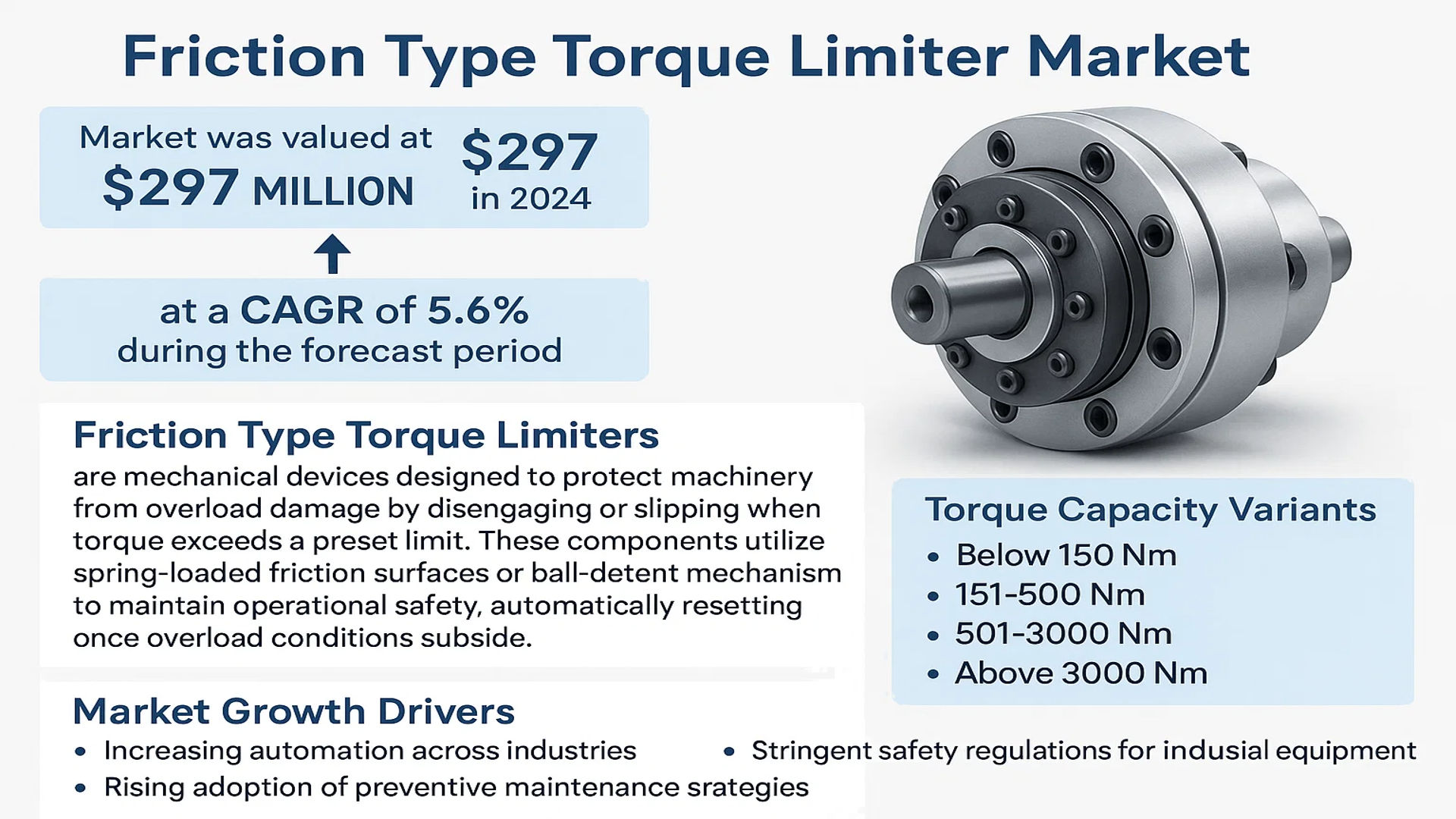
The global Friction Type Torque Limiter Market was valued at 297 million in 2024 and is projected to reach US$ 433 million by 2032, at a CAGR of 5.6% during the forecast period.
Friction Type Torque Limiters are mechanical devices designed to protect machinery from overload damage by disengaging or slipping when torque exceeds a preset limit. These components utilize spring-loaded friction surfaces or ball-detent mechanisms to maintain operational safety, automatically resetting once overload conditions subside. Key variants include models rated below 150 Nm, 151-500 Nm, 501-3000 Nm, and above 3000 Nm torque capacities.
The market growth is driven by increasing automation across industries, stringent safety regulations for industrial equipment, and the rising adoption of preventive maintenance strategies. Industrial machinery dominates application segments, accounting for over 35% market share, while the automotive sector exhibits the fastest growth potential with 6.2% projected CAGR. Regionally, Asia-Pacific leads demand due to expanding manufacturing bases in China and India, though North America maintains technological superiority in high-precision applications. Major players including Chr. Mayr GmbH and R+W Antriebselemente GmbH are investing in compact, IoT-enabled torque limiters to capitalize on Industry 4.0 trends.
MARKET DYNAMICS
MARKET DRIVERS
Rising Demand for Industrial Automation to Fuel Market Expansion
The global friction type torque limiter market is experiencing significant growth, driven by the accelerating adoption of industrial automation across key sectors. With manufacturing facilities increasingly implementing automated systems to enhance productivity and reduce operational costs, the need for reliable torque protection devices has surged. Friction type torque limiters play a critical role in preventing mechanical failures in automated equipment by disengaging or slipping when torque exceeds predetermined levels. The industrial automation market is projected to maintain a steady growth trajectory, subsequently boosting demand for these safety components, particularly in robotics and conveyor systems where precise torque control is essential.
Growth in Automotive Production Accelerating Adoption
Expanding automotive production worldwide is creating substantial opportunities for friction type torque limiter manufacturers. The automotive industry requires high-precision torque control systems for applications ranging from assembly line equipment to powertrain testing. As electric vehicle production ramps up globally, there is increasing demand for torque limiters in battery manufacturing processes and electric motor assembly lines. Major automotive markets in Asia and Europe are witnessing significant investments in production capacity expansion, which directly correlates with higher consumption of torque limiting solutions.
Furthermore, stringent safety regulations in manufacturing environments are compelling automotive OEMs to incorporate torque limiting devices as standard components in their production equipment. This regulatory push is creating a stable, long-term demand driver for the market.
MARKET CHALLENGES
Technical Limitations in High-Torque Applications Pose Operational Challenges
While friction type torque limiters offer excellent performance in many applications, they face inherent limitations in extremely high-torque environments. The physical constraints of friction materials and spring mechanisms create practical upper limits for torque capacity, typically capping effective performance in applications requiring transmission above 5000 Nm. This technical barrier forces end-users in heavy industries to consider alternative solutions such as hydraulic or magnetic torque limiters, creating competitive pressure on the friction type segment.
Other Challenges
Maintenance Requirements
Friction type torque limiters require regular maintenance to ensure optimal performance, including periodic recalibration and replacement of wear components. This ongoing maintenance burden can deter adoption in industries prioritizing minimal downtime and low-maintenance solutions.
Temperature Sensitivity
The performance characteristics of friction materials can vary significantly with temperature fluctuations, potentially affecting torque transmission accuracy in extreme operating environments. This limitation restricts application in certain industrial settings with wide temperature variations.
MARKET RESTRAINTS
Price Sensitivity in Emerging Markets Limiting Market Penetration
In developing economies, intense price competition and budget constraints among end-users are creating barriers to widespread adoption of friction type torque limiters. Many small and medium enterprises in these regions opt for lower-cost mechanical solutions or forego torque protection entirely to minimize upfront costs. This price sensitivity is particularly evident in price-driven markets where equipment manufacturers prioritize initial purchase price over long-term reliability and protection benefits.
Additionally, the availability of counterfeit or substandard torque limiting products in certain regions undermines market growth by creating negative perceptions about product reliability and performance. These economic factors combine to restrain the market’s expansion potential in key growth regions.
MARKET OPPORTUNITIES
Emerging Applications in Renewable Energy Sector Creating New Growth Avenues
The rapid development of renewable energy infrastructure worldwide is generating promising opportunities for friction type torque limiter applications. Wind turbine manufacturers are increasingly incorporating torque limiters in pitch control systems and yaw drives to protect critical components from overload conditions. As global wind power capacity continues its upward trajectory, this sector represents a high-potential market for advanced torque limiting solutions.
Furthermore, innovations in solar tracking systems are driving demand for precision torque control devices. The need to protect delicate solar panel positioning mechanisms while maintaining precise orientation creates ideal application scenarios for friction type torque limiters, particularly in utility-scale solar installations where reliability is paramount.
The transition toward smart manufacturing technologies also presents significant opportunities, with torque limiters playing an essential role in Industry 4.0 implementations where equipment protection and predictive maintenance capabilities are highly valued.
FRICTION TYPE TORQUE LIMITER MARKET TRENDS
Industrial Automation and Smart Manufacturing Drive Demand for Precision Torque Control
The global friction type torque limiter market is experiencing strong growth due to increasing adoption of industrial automation and smart manufacturing technologies. These advanced production systems require highly reliable overload protection mechanisms to prevent equipment damage and minimize downtime. The market is projected to grow from $297 million in 2024 to $433 million by 2032, reflecting a compound annual growth rate of 5.6%. This expansion is primarily fueled by manufacturing sectors upgrading their facilities with Industry 4.0 capabilities, where torque limiters play a crucial role in protecting sensitive automated equipment from unexpected load variations. Their quick response time during overload situations makes them particularly valuable in high-speed production environments.
Other Trends
Energy Efficiency Requirements
Growing emphasis on energy-efficient industrial operations has led to increased specifications for friction type torque limiters that minimize power loss during normal operation. Modern designs now incorporate advanced friction materials that maintain consistent torque transmission while reducing heat generation and wear. This adaptation to sustainability requirements has opened new opportunities in sectors like wind energy, where torque limiters are critical components in turbine gearbox protection systems. The <150 Nm segment, suitable for precision applications, is showing particularly strong growth as it addresses the needs of compact automation solutions.
Technological Advancements in Friction Materials
Recent innovations in friction materials and surface treatments are significantly enhancing the performance characteristics of torque limiters. New composite materials provide more consistent friction coefficients across wider temperature ranges, improving reliability in demanding industrial environments. These advancements are particularly relevant in applications with frequent start-stop cycles or variable loads. Leading manufacturers are focusing on developing maintenance-free designs with extended service intervals, addressing one of the key pain points in industrial applications. The integration of condition monitoring features, such as wear indicators and slip detection sensors, is creating smarter torque limiter solutions compatible with predictive maintenance strategies.
Regional Manufacturing Growth Patterns
While the United States maintains a strong position in high-end industrial applications, China’s rapidly expanding manufacturing sector is driving significant demand for cost-effective torque limiter solutions. The automotive industry, particularly electric vehicle production lines, represents a major growth segment for torque limiter adoption across all regions. Emerging economies in Southeast Asia are contributing to market expansion as they upgrade their industrial infrastructure, with the <500 Nm torque range seeing particularly strong adoption in these developing manufacturing hubs.
COMPETITIVE LANDSCAPE
Key Industry Players
Companies Expand Product Innovation and Global Reach to Maintain Market Dominance
The global friction type torque limiter market features a competitive landscape characterized by both established multinational corporations and specialized manufacturers. Chr. Mayr GmbH emerges as a market leader, commanding significant share due to its extensive product range and technological expertise in safety couplings. The company’s dominance is reinforced by its strong European manufacturing presence and growing foothold in North American industrial sectors.
German engineering firms R+W Antriebselemente GmbH and KTR Systems GmbH hold prominent positions, particularly in precision torque transmission applications. Their reputation for reliability in heavy machinery applications continues to drive adoption across automotive and industrial sectors. Meanwhile, Nexen Group, Inc. has carved out substantial market share through patented friction disc technology suited for high-torque applications up to 3000 Nm.
The competitive intensity continues to increase as manufacturers invest in product differentiation strategies. Altra Industrial Motion Corp. has recently expanded its torque limiter offerings through strategic acquisitions, while Japanese leader Tsubakimoto Chain strengthens its position in the Asian market with compact, high-efficiency designs for robotics and automation equipment.
Emerging trends show manufacturers focusing on customization capabilities to address diverse torque requirements across industries. Several key players are introducing smart torque limiters with integrated sensors, responding to growing Industry 4.0 adoption. Companies are also expanding service capabilities, offering on-site installation support and predictive maintenance solutions to extend product lifecycle and enhance customer retention.
List of Key Friction Type Torque Limiter Manufacturers
- Chr. Mayr GmbH (Germany)
- R+W Antriebselemente GmbH (Germany)
- KTR Systems GmbH (Germany)
- Nexen Group, Inc. (U.S.)
- Howdon Power Transmission Ltd. (UK)
- Altra Industrial Motion Corp. (U.S.)
- Tsubakimoto Chain (Japan)
- RINGSPANN GmbH (Germany)
- Industrial Clutch Parts (U.S.)
- Cross & Morse (UK)
Segment Analysis:
By Type
Friction-Type Dominates Due to Cost-Effective Overload Protection
The market is segmented based on working principle into:
- Friction-type torque limiters
- Ball-type (ball-roller) torque limiters
By Torque Range
151-500 Nm Segment Holds Significant Market Share
The market is segmented based on torque capacity into:
- Below 150 Nm
- 151-500 Nm
- 501-3000 Nm
- Above 3000 Nm
By Application
Industrial Machinery Leads Due to Widespread Automation Adoption
The market is segmented based on application into:
- Industrial machinery
- Automotive industry
- Agricultural machinery
- Aerospace
- Others
By End-User
Manufacturing Sector Accounts for Major Demand
The market is segmented based on end-user industries into:
- Automotive manufacturers
- Industrial equipment producers
- Agricultural machinery OEMs
- Aerospace component suppliers
- Other industrial applications
Regional Analysis: Friction Type Torque Limiter Market
Asia-Pacific
The Asia-Pacific (APAC) region dominates the global friction type torque limiter market, driven by rapid industrialization, expanding manufacturing sectors, and robust automotive production in countries like China, Japan, and India. China, the world’s largest manufacturing hub, accounts for over 35% of regional demand, with torque limiters widely used in automation, packaging, and heavy machinery. Japan’s advanced robotics industry further fuels the need for precision torque control devices. Meanwhile, India’s “Make in India” initiative and growing investments in infrastructure are accelerating adoption. However, price sensitivity in emerging economies prioritizes cost-effective friction-type solutions over advanced alternatives, creating a competitive landscape for regional and global suppliers.
Europe
Europe represents a mature yet innovation-centric market, with Germany, Italy, and France leading demand due to their strong industrial machinery and automotive sectors. Stricter EU safety and efficiency regulations (e.g., Machinery Directive 2006/42/EC) drive the replacement of outdated mechanical systems with high-performance torque limiters, particularly in <150 Nm and 151–500 Nm segments. German engineering firms like Chr. Mayr GmbH and R+W Antriebselemente GmbH are key innovators, introducing compact, maintenance-free designs. Sustainability trends also push adoption in renewable energy applications such as wind turbine pitch control systems, though high labor costs and economic instability in Eastern Europe pose growth challenges.
North America
North America’s market growth is anchored in the U.S., where industrial automation and aerospace sectors demand reliable overload protection. The region prioritizes high-torque (>3000 Nm) applications in oil & gas and mining equipment, with Altra Industrial Motion Corp. and Nexen Group as prominent suppliers. Reshoring initiatives and federal incentives for advanced manufacturing (e.g., CHIPS Act subsidies) are creating new opportunities. However, competition from non-friction alternatives like magnetic torque limiters and dependency on imports for low-cost models slightly restrain market expansion.
South America
South America exhibits gradual growth, primarily in Brazil and Argentina, where agricultural machinery and food processing industries utilize torque limiters for conveyor systems and grinders. Economic volatility and limited local manufacturing result in heavy reliance on imported components, though regional suppliers are emerging to cater to cost-conscious buyers. Infrastructure bottlenecks and inconsistent regulatory standards hinder large-scale adoption, but the region’s untapped potential in mining and pulp & paper industries offers long-term opportunities.
Middle East & Africa
The MEA region remains a nascent market, with growth concentrated in GCC countries (Saudi Arabia, UAE) due to oilfield equipment demand and diversification into industrial zones. Turkey’s manufacturing sector also contributes, particularly in automotive parts production. However, low awareness of torque limiter benefits, coupled with fragmented distribution networks, slows market penetration. Strategic partnerships with global suppliers and increasing FDI in industrial projects could unlock future demand.
Report Scope
This market research report provides a comprehensive analysis of the Global Friction Type Torque Limiter Market, covering the forecast period 2024–2032. It offers detailed insights into market dynamics, technological advancements, competitive landscape, and key trends shaping the industry.
Key focus areas of the report include:
- Market Size & Forecast: Historical data and future projections for revenue, unit shipments, and market value across major regions and segments. The Global Friction Type Torque Limiter Market was valued at USD 297 million in 2024 and is projected to reach USD 433 million by 2032, growing at a CAGR of 5.6%.
- Segmentation Analysis: Detailed breakdown by torque range (<150 Nm, 151-500 Nm, 501-3000 Nm, >3000 Nm) and application (Industrial Machinery, Automotive, Agricultural Machinery, Aerospace, Others) to identify high-growth segments.
- Regional Outlook: Insights into market performance across North America, Europe, Asia-Pacific, Latin America, and Middle East & Africa. The <150 Nm segment is expected to show significant growth, while Asia-Pacific leads in adoption.
- Competitive Landscape: Profiles of leading market participants including Chr. Mayr GmbH, R+W Antriebselemente GmbH, KTR Systems GmbH, Nexen Group, Inc., and Altra Industrial Motion Corp., covering their product portfolios and strategic developments.
- Technology Trends & Innovation: Assessment of spring-loaded friction mechanisms, precision torque setting technologies, and integration with Industry 4.0 systems.
- Market Drivers & Restraints: Evaluation of factors including industrial automation growth, machinery safety regulations, and challenges in high-torque applications.
- Stakeholder Analysis: Strategic insights for OEMs, system integrators, and component suppliers regarding product development and market expansion opportunities.
The research employs primary interviews with industry experts and analysis of verified market data to ensure accuracy and reliability of findings.
FREQUENTLY ASKED QUESTIONS:
What is the current market size of Global Friction Type Torque Limiter Market?
-> Friction Type Torque Limiter Market was valued at 297 million in 2024 and is projected to reach US$ 433 million by 2032, at a CAGR of 5.6% during the forecast period.
Which key companies operate in Global Friction Type Torque Limiter Market?
-> Key players include Chr. Mayr GmbH, R+W Antriebselemente GmbH, KTR Systems GmbH, Nexen Group, Inc., and Altra Industrial Motion Corp.
What are the key growth drivers?
-> Key growth drivers include rising industrial automation, stringent machinery safety regulations, and increasing adoption in automotive and aerospace applications.
Which region dominates the market?
-> Asia-Pacific shows the highest growth potential, while Europe maintains strong market share due to established manufacturing sectors.
What are the emerging trends?
-> Emerging trends include development of compact torque limiters, integration with IoT for predictive maintenance, and advanced friction materials.

Get Sample Report PDF for Exclusive Insights
Report Sample Includes
- Table of Contents
- List of Tables & Figures
- Charts, Research Methodology, and more...