France AI Satellite On-Board Image Processing Chip Market Insights
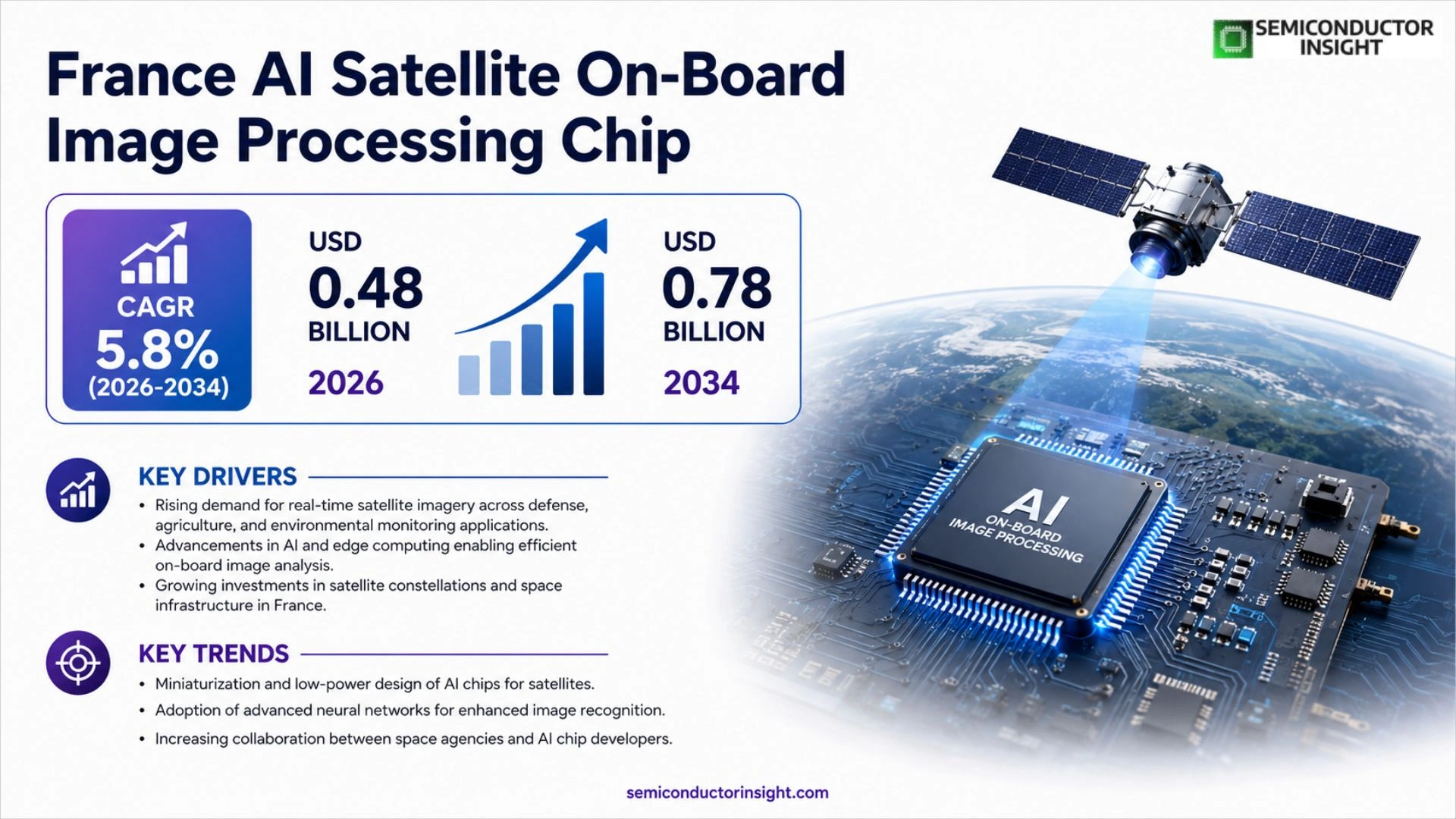
France AI Satellite On-Board Image Processing Chip market size was valued at USD 0.45 billion in 2025. The market is projected to grow from USD 0.48 billion in 2026 to USD 0.78 billion by 2034, exhibiting a CAGR of 5.8% during the forecast period.
AI satellite on‑board image processing chips are specialized semiconductor devices that execute neural‑network inference directly within the spacecraft payload. These chips combine high‑throughput image compression, feature extraction, and autonomous decision‑making capabilities while meeting strict power‑budget and radiation‑hardening requirements.
The market is accelerating because European space agencies are increasing budgets for Earth‑observation constellations, while commercial operators demand real‑time analytics to reduce downlink latency. Furthermore, advances in low‑power AI accelerators and supportive French R&D incentives are encouraging new entrants, thereby expanding the addressable market.
MARKET DRIVERS
Increasing Demand for Real‑Time Earth Observation
France AI Satellite On-Board Image Processing Chip Market is propelled by growing governmental and commercial interest in instantaneous geospatial intelligence. Agencies require rapid anomaly detection for disaster response, while private operators seek to monetize near‑real‑time data streams for agriculture and logistics. This shift reduces reliance on ground‑based processing facilities and shortens the decision‑making cycle.
Advancements in AI Chip Miniaturization
Recent breakthroughs in semiconductor packaging allow high‑performance neural‑network accelerators to fit within the stringent mass and volume envelopes of modern satellites. Smaller, power‑efficient chips enable multi‑payload platforms, expanding the addressable market for French manufacturers and fostering ecosystem collaboration.
➤ Higher processing power enables on‑board analytics, reducing downlink latency and improving mission agility.
Overall, the convergence of policy support, technological progress, and emerging service models creates a robust growth engine for French market, positioning it as a regional hub for next‑generation satellite AI solutions.
MARKET CHALLENGES
Stringent Certification Procedures
Space‑qualified components must undergo rigorous reliability testing and comply with national aerospace standards. These certification cycles lengthen time‑to‑market, elevating development costs for firms entering France AI Satellite On-Board Image Processing Chip Market.
Other Challenges
Supply‑Chain Vulnerabilities
Limited availability of rare‑earth materials and specialized fab facilities can cause bottlenecks, especially when demand spikes during defense‑driven procurement phases.
MARKET RESTRAINTS
High Capital Expenditure
Developing AI‑enabled on‑board processors requires substantial upfront investment in R&D, qualification labs, and low‑volume production lines. Smaller startups often face financing gaps, constraining the overall pace of market expansion within France.
MARKET OPPORTUNITIES
Integration with 5G‑Enabled Ground Segments
Emerging 5G ground stations in metropolitan France will facilitate high‑bandwidth downlink of processed imagery, creating a value chain where on‑board AI chips can deliver actionable insights directly to end‑users. This synergy opens revenue streams for chip designers through licensing and joint‑venture models.
France AI Satellite On-Board Image Processing Chip Market Trends
Real‑Time Image Analytics Driving Market Evolution
The acceleration of Earth‑observation constellations across Europe has shifted design priorities toward on‑board decision making. Operators increasingly require AI‑enabled processors that can compress, classify and act on imagery before it is downlinked, thereby reducing latency and bandwidth consumption. In France, several aerospace firms are integrating neural‑network inference engines directly into payloads, enabling autonomous cloud‑free monitoring of agriculture, disaster zones and maritime traffic. These chips meet stringent power budgets and radiation‑hardening standards, positioning France AI Satellite On-Board Image Processing Chip Market as a key enabler of next‑generation satellite services. Security considerations are also prompting designers to embed encryption modules within the same die, ensuring that processed imagery remains protected throughout the transmission chain. Moreover, a handful of French semiconductor start‑ups have secured early contracts with commercial satellite operators, signalling a shift from reliance on imported components to a more domestically sourced supply chain.
Other Trends
Advances in Low‑Power AI Accelerators
Recent silicon‑photonic and finFET breakthroughs have lowered the energy per inference operation, allowing chips to run complex convolutional networks on the order of a few watts. Design houses are adopting heterogeneous integration, combining memory‑proximate compute clusters with hardened I/O interfaces to sustain high‑throughput image streams. The result is a noticeable improvement in on‑chip throughput‑to‑power ratios, which directly translates into longer mission lifetimes and greater payload flexibility for French satellite programs. These designs are validated using radiation testing facilities in Grenoble, where total ionizing dose tolerance exceeds 100 krad, meeting the most demanding orbital profiles. The modular nature of the new accelerators also simplifies firmware updates, allowing operators to deploy improved models without hardware replacement.
Government Incentives and Strategic Partnerships
National R&D tax credits, coupled with joint programmes between CNES and university research centres, are de‑risking early‑stage chip development. Funding streams favour projects that demonstrate end‑to‑end validation from silicon to flight‑qualified modules. In addition, collaborative agreements with leading European space agencies are creating shared test‑beds, accelerating technology transfer and standardisation. These policy levers are expected to broaden the supplier ecosystem, attract new entrants and sustain a steady pipeline of innovation for France AI Satellite On-Board Image Processing Chip Market over the next decade. The combined effect of fiscal support and collaborative testing is expected to double the number of qualified chip designs in the next five years. Talent pipelines are being reinforced through specialised graduate programmes in associated universities, ensuring a continuous flow of skilled engineers for the market.
COMPETITIVE LANDSCAPE
Key Industry Players
France AI Satellite On-Board Image Processing Chip Competitive Overview
French market is anchored by a handful of large aerospace and semiconductor groups that have leveraged national R&D incentives to develop radiation‑hard AI accelerators for on‑board image processing. Airbus Defence and Space leads the segment, integrating its AI‑enabled vision processors into ESA and CNES constellations, while Thales Alenia Space supplies modular chips that combine low‑power deep‑learning inference with hardened memory. These incumbents dominate the supply chain, controlling design, fabrication, and qualification, which creates a high barrier to entry for smaller firms. The market structure is therefore tiered: a core of vertically integrated OEMs, a secondary layer of specialized foundries such as Soitec, and emerging boutique vendors focused on niche algorithms or custom ASICs.
Beyond the dominant players, several niche companies are gaining relevance through differentiated technology or strategic partnerships. Safran’s electronics division is developing ultra‑low‑latency inference cores tailored for high‑resolution Earth‑observation payloads. ELISA Group provides radiation‑tolerant image compression IP that complements AI kernels. Myriota, although headquartered in the UK, operates a French R&D hub that delivers compact AI chips for CubeSat platforms. Additionally, STMicroelectronics’ Grenoble site contributes mixed‑signal AI ASICs that meet strict power‑budget constraints, while smaller innovators such as Burel Technologies and EdgeSpace focus on neural‑network optimized DSP blocks for autonomous navigation. Collectively, these firms broaden the ecosystem, fostering competition that can accelerate price reductions and technology diffusion across the French satellite sector.
List of Key France AI Satellite On-Board Image Processing Chip Companies Profiled
- Airbus Defence and Space
- Thales Alenia Space
- Soitec
- Safran Electronics
- ELISA Group
- Myriota
- STMicroelectronics (Grenoble)
- Burel Technologies
- EdgeSpace
- ArianeGroup
- CEA-LETI
- Fidelity Investments (French Satellite AI Unit)
- SpaceIT
- EuroSpace Labs
- Photonics France
Segment Analysis:
| Segment Category | Sub-Segments | Key Insights |
| By Type |
|
CNN Accelerators dominate this category because:
|
| By Application |
|
Earth‑Observation Imaging is the leading application segment because:
|
| By End User |
|
National Space Agencies lead this segment because:
|
| By Architecture |
|
Fixed‑Function ASICs dominate because:
|
| By Integration Model |
|
System‑in‑Package (SiP) is the preferred integration model because:
|
Regional Analysis: France AI Satellite On-Board Image Processing Chip Market
The European Space Agency and national regulators have harmonized certification pathways for AI‑driven chips, shortening time‑to‑market. Guidelines stress radiation hardness, data protection, and traceability, enabling manufacturers to align product roadmaps with compliance expectations early in development.
Leading semiconductor firms such as STMicroelectronics, Infineon, and small‑cap AI specialists maintain R&D facilities across France, Germany, and the UK, creating a dense ecosystem that accelerates co‑innovation and joint product launches.
Europe’s integrated supply chain, from silicon wafer fabrication to advanced packaging, ensures reliable component availability. Proximity between foundries and aerospace customers reduces lead times and supports iterative design cycles for on‑board processing solutions.
Growing demand for real‑time environmental monitoring, defense surveillance, and commercial earth imaging fuels the need for AI‑enabled chips that can execute complex algorithms directly on the satellite platform.
North America
The United States exhibits strong interest in on‑board image processing, driven by defense agencies and commercial constellations. While the market is not as concentrated on French‑origin chips, partnerships with European firms allow technology transfer and joint ventures, creating a secondary hub of activity. Investment in AI research labs and a vibrant venture capital scene stimulate innovative chip architectures that complement Europe’s offerings, resulting in cross‑Atlantic collaboration on standards and testing methodologies.
Asia‑Pacific
Rapid satellite constellation growth in countries such as Japan, South Korea, and India spurs demand for compact, energy‑efficient processing solutions. Although domestic manufacturers dominate, the region increasingly looks to European AI chip designs for their proven reliability and compliance pedigree. Collaborative programs between European research institutions and Asian universities foster knowledge exchange, positioning Asia‑Pacific as an emerging market for France AI Satellite On-Board Image Processing Chip Market.
South America
Emerging space programs in Brazil and Argentina are beginning to explore AI‑enabled payloads to enhance regional earth observation capabilities. Limited local chip production leads to reliance on imported solutions, with European suppliers gaining a foothold through strategic partnerships and technology licensing agreements that address local cost constraints and regulatory requirements.
Middle East & Africa
Space initiatives in the United Arab Emirates, Saudi Arabia, and South Africa emphasize high‑resolution imaging for climate monitoring and infrastructure planning. These programs often source AI on‑board processing chips from European manufacturers to meet stringent performance criteria. Joint research centers and training programs supported by EU funding accelerate skill development, paving the way for sustained adoption across the region.
Report Scope
This market research report provides a comprehensive analysis of the France AI Satellite On-Board Image Processing Chip Market , covering the forecast period 2026–2034. It offers detailed insights into market dynamics, technological advancements, competitive landscape, and key trends shaping the industry.
Key focus areas of the report include:
- Market Overview: The report begins with an overview outlining its current market scenario, key growth indicators, and industry transformation drivers. It discusses macroeconomic factors, demand–supply balance, regulatory landscape, and the strategic role of semiconductors in powering advancements across industries such as automotive, telecommunications, consumer electronics, and industrial automation.
- Market Size & Forecast: Historical data and future projections for revenue, unit shipments, and market value across major regions and segments.
- Segmentation Analysis: Detailed breakdown by product type, technology, application, and end-user industry to identify high-growth segments and investment opportunities.
- Regional Insights: Insights into market performance across North America, Europe, Asia-Pacific, Latin America, and the Middle East & Africa, including country-level analysis where relevant.
- Competitive Landscape: Profiles of leading market participants, including their product offerings, R&D focus, manufacturing capacity, pricing strategies, and recent developments such as mergers, acquisitions, and partnerships.
- Technology Trends & Innovation: Assessment of emerging technologies, integration of AI/IoT, semiconductor design trends, fabrication techniques, and evolving industry standards.
- Market Drivers & Restraints: Evaluation of factors driving market growth along with challenges, supply chain constraints, regulatory issues, and market-entry barriers.
- Stakeholder Insights: Insights for component suppliers, OEMs, system integrators, investors, and policymakers regarding the evolving ecosystem and strategic opportunities.
Primary and secondary research methods are employed, including interviews with industry experts, data from verified sources, and real-time market intelligence to ensure the accuracy and reliability of the insights presented.
FREQUENTLY ASKED QUESTIONS:
What is the current market size of France AI Satellite On-Board Image Processing Chip Market?
-> France AI Satellite On-Board Image Processing Chip market size is projected to grow from USD 0.48 billion in 2026 to USD 0.78 billion by 2034.
Which key companies operate in France AI Satellite On-Board Image Processing Chip Market?
-> Key players include Airbus Defence & Space, Thales Alenia Space, STMicroelectronics, L3Harris Technologies, Northrop Grumman, and Safran, among others.
What are the key growth drivers?
-> Key growth drivers include increased budgets from European space agencies, rising demand for real‑time Earth observation analytics, advances in low‑power AI accelerators, and supportive French R&D incentives.
Which region dominates the market?
-> Europe remains the dominant region, driven by strong government programs and a concentration of satellite manufacturers.
What are the emerging trends?
-> Emerging trends include radiation‑hardened low‑power AI chips, edge‑AI processing for autonomous decision‑making onboard, and integration of AI accelerators with next‑generation Earth‑observation constellations.
Get Sample Report PDF for Exclusive Insights
Report Sample Includes
- Table of Contents
- List of Tables & Figures
- Charts, Research Methodology, and more...
 Download Sample Report PDF