FPD Lithography Equipment Market Trends, Business Strategies 2026-2034

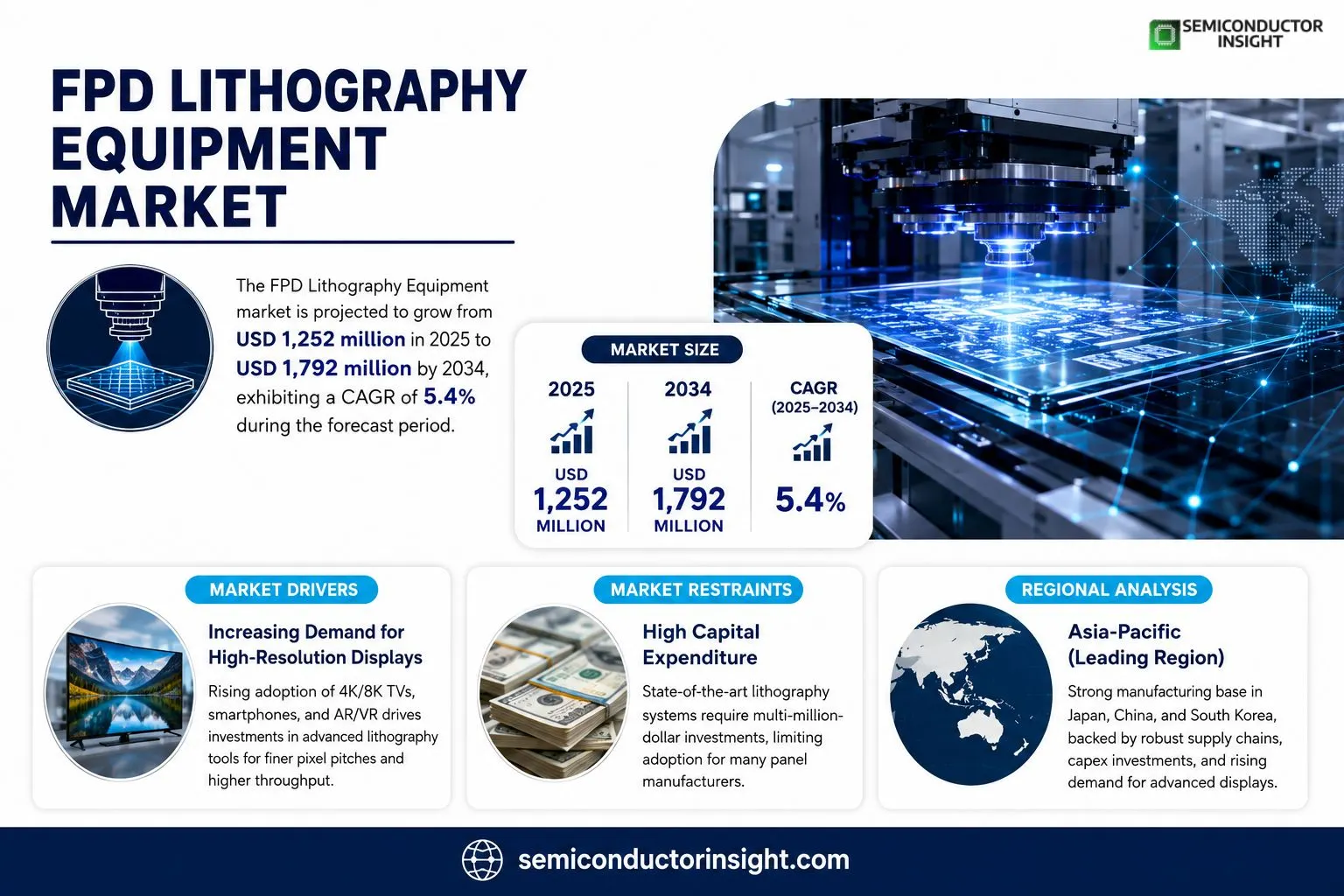
FPD Lithography Equipment Market was valued at USD 1252 million in 2025 and is expected to reach USD 1792 million by 2034, at a CAGR of 5.4% during the forecast period

PDF Icon Download Sample Report PDF
  • Quick Dispatch

    All Orders

  • Secure Payment

    100% Secure Payment

Price range: $1,500.00 through $4,250.00

Clear

FPD Lithography Equipment Market Insights

FPD Lithography Equipment market was valued at USD 1,252 million in 2025. The market is projected to grow from USD 1,252 million in 2025 to USD 1,792 million by 2034, exhibiting a CAGR of 5.4% during the forecast period.

FPD lithography equipment refers to exposure/patterning systems used in flat panel display manufacturing (LCD/OLED, etc.), whose core role is to transfer mask patterns onto photoresist‑coated large glass substrates to form thin‑film transistor circuitry and alignment references for downstream etch/deposition steps. Compared with wafer lithography, FPD lithography prioritizes wide‑area imaging uniformity, distortion/warpage compensation, stitching efficiency and high‑volume productivity while maintaining micron‑class overlay and linewidth control.The market is experiencing rapid growth due to several factors, including increased investment in display capex, rising demand for high‑resolution TV panels and smartphones with higher pixel density, and expanding automotive display applications. Additionally, advancements in multi‑lens projection architectures and DUV light‑source technologies are contributing to market expansion. Initiatives by key players are also expected to fuel market growth. For instance, Canon introduced its MPAsp‑E1003H series targeting Gen 6 substrates with ±0.30 µm overlay capability, while Nikon announced the FX‑103S tool featuring a 14‑lens array for Gen 10.5 glass panels delivering up to 85 plates per hour throughput.
MARKET DRIVERS

Increasing Demand for High‑Resolution Displays

The proliferation of 4K, 8K and immersive AR/VR experiences is compelling OEMs to upgrade panel production lines. When manufacturers target finer pixel pitches, the lithography step becomes a bottleneck, prompting investment in more advanced FPD Lithography Equipment. These equipment upgrades translate into higher wafer‑throughput and tighter line‑edge control, which are essential for maintaining competitive display quality.

Technological Advancements in Lithography Tools

Recent breakthroughs in numerical aperture (NA) optics and laser‑based exposure systems have expanded the feasible pattern size for flat‑panel manufacturing. Equipment that can deliver sub‑30 nm resolution without sacrificing cycle time enables producers to diversify into flexible OLED and micro‑LED formats, sectors that were previously constrained by older lithography generations. The industry’s push toward higher productivity directly fuels demand for next‑generation systems.

The shift toward flexible OLED panels is reshaping equipment specifications, driving a surge in capital projects for advanced lithography.

Beyond pure technical merit, the strategic alignment of these tools with sustainability goalssuch as reduced chemical waste and energy‑efficient exposure cyclesoffers manufacturers a dual incentive: meet market expectations while improving their carbon footprint. Consequently, the adoption curve for modern FPD Lithography Equipment continues to accelerate across major display hubs.

MARKET CHALLENGES

Supply Chain Volatility

Recent geopolitical tensions and semiconductor shortages have exposed the fragility of component suppliers for lithography machines. Lead times for high‑precision lenses, laser modules and specialty gases now extend beyond typical planning horizons, forcing fab operators to keep larger safety stocks and eroding margin flexibility.

Other Challenges

Regulatory Compliance

Stringent exposure‑related safety regulations in key regions require manufacturers to invest in additional shielding and monitoring systems. Compliance costs, while necessary, add a layer of financial pressure that can delay equipment rollout, particularly for midsized players.

MARKET RESTRAINTS

High Capital Expenditure

State‑of‑the‑art lithography platforms command multi‑million‑dollar price tags, a barrier that limits entry for many panel manufacturers. When the payback period stretches beyond typical investment cycles, firms may defer upgrades in favor of incremental process tweaks, slowing overall market momentum.Moreover, the steep learning curve associated with new exposure technologies means that additional training and talent acquisition expenses must be factored into the total cost of ownership. These financial considerations temper the speed at which the market can expand.Limited supplier concentration compounds the restraint; a few OEMs dominate the high‑end equipment space, leaving buyers with restricted negotiating power and heightened exposure to supply disruptions.

MARKET OPPORTUNITIES

Emerging Applications in Automotive Displays

Automotive interiors are embracing curved, high‑brightness panels for infotainment and instrument clusters. These applications demand lithography solutions that can handle larger substrate sizes and tighter curvature tolerances, opening a niche where specialized equipment can command premium pricing.

Micro‑LED Adoption

Micro‑LED technology, touted for its superior brightness and energy efficiency, relies on precise pixel‑by‑pixel patterning that current lithography tools are only beginning to address. Vendors that can certify equipment for sub‑10 µm pitch fabrication are poised to capture a rapidly forming segment of the display market.

Finally, the convergence of artificial‑intelligence‑driven defect detection with lithography process control offers a pathway to reduce scrap rates and improve yield. Companies that integrate AI analytics into their equipment platforms can differentiate themselves, creating a compelling value proposition for cost‑sensitive producers.

FPD Lithography Equipment Market Trends

Scaling to Gen 10.5 for Ultra‑Large Panels

The push for 8K television and premium OLED panels forces manufacturers to adopt the largest motherglass formats available. Equipment that can expose a 3.37 m × 2.94 m substrate in a single pass reduces the number of scans required per panel, directly translating into higher plates‑per‑hour rates. Multi‑lens projection systems, as demonstrated by the latest Nikon FX‑103 series, achieve micron‑level overlay while compensating for glass warpage in real time. This combination of wider field coverage and precise distortion correction creates a decisive competitive edge for fabs that must meet aggressive throughput targets without sacrificing yield. The broader implication is a shift in capital allocation toward tools that promise both scale and accuracy, compelling suppliers to prioritize engineering resources on large‑area optics and thermal stabilization technologies.

Other Trends

Smartphone & Wearable Impacts on Resolution Demands

Higher pixel‑per‑inch requirements in flagship smartphones, AR headsets, and compact wearables are prompting fabs to tighten line‑width uniformity and overlay tolerances. Canon’s MPAsp‑E1003H, originally designed for large‑format TV, has been adapted for Gen 6 substrates to serve this segment, delivering sub‑micron overlay while maintaining the same i‑line light source to avoid re‑tooling costs. The strategic advantage lies in leveraging existing process flows to unlock finer feature pitches, thereby supporting emerging backplane architectures such as LTPO. As OEMs chase thinner bezels and higher refresh rates, the equipment’s ability to deliver consistent resolution across smaller glass sizes becomes a key factor in sustaining market share.

Automotive Displays and Cockpit Diversification

Vehicle interiors are evolving into infotainment hubs that require panels with robust durability and varied aspect ratios. This trend is encouraging fabs to invest in equipment that can handle both Gen 6 and mid‑size formats with minimal reconfiguration time. The emphasis on distortion correction and rapid takt cycles aligns with automotive production schedules, where line downtime carries steep penalties. By integrating multi‑lens exposure architectures, manufacturers can achieve the necessary overlay precision for curved and segmented displays while keeping throughput comparable to consumer‑grade lines. Consequently, the equipment sector is witnessing a convergence of automotive‑specific demands with traditional consumer display requirements, prompting vendors to diversify their roadmap to address both markets effectively.

COMPETITIVE LANDSCAPE

Key Industry Players

FPD Lithography Equipment Market – Competitive Overview

Canon Inc. dominates the high‑end segment by offering the MPAsp family, which simultaneously addresses array, color‑filter and touch‑panel processes across Gen 6 and Gen 8 glass formats. The company’s strategy of integrating DUV light sources and multi‑lens projection enables a single exposure shot that covers a larger field, thereby trimming takt time and reducing plate‑per‑hour cost. This capability has made Canon the de‑facto supplier for leading panel fabs that produce 4K/8K TV panels and premium OLED displays. Nikon Corp. follows closely with its FX series, leveraging a proprietary 14‑lens array that corrects glass warpage in real time. Nikon’s emphasis on maintaining backward‑compatible i‑line sources while extending resolution to 1.1 µm L/S allows manufacturers to upgrade equipment without overhauling the entire process flow, a factor that resonates with factories seeking incremental productivity gains rather than disruptive capital projects.Beyond the two Japanese giants, a handful of regional and technology‑focused firms shape niche segments. Shanghai Microelectronics Equipment Co., Ltd. (SMEE) supplies mid‑range systems that cater to domestic Chinese fabs aiming for cost‑effective Gen 6 throughput. ASML Holding NV, while primarily known for wafer lithography, has begun exploring large‑area exposure architectures that could pressure the incumbents on innovation speed. Light‑source specialists such as Gigaphoton Inc., Hamamatsu Photonics and Coherent Inc. provide the high‑power DUV lasers that power multi‑lens arrays, giving them leverage in negotiations over equipment specifications. Optics manufacturers Hoya Corp. and ULVAC, Inc. contribute precision components that underpin distortion‑correction algorithms, and their vertical integration with equipment assemblers creates an ecosystem where component reliability directly translates into higher panel yields. The emerging presence of companies like Tokyo Electron Ltd. and Heraeus Noblelight GmbH, which focus on vacuum and illumination technologies respectively, indicates a gradual diffusion of ancillary expertise into the core lithography market, widening the competitive field and offering panel producers alternative supply‑chain options.

List of Key FPD Lithography Equipment Companies Profiled

Segment Analysis:

Segment Category Sub-Segments Key Insights
By Type
  • Array
  • Color Filter
  • Touch Panel
Array

  • Dominates large‑area exposure due to its ability to handle the widest substrates and deliver uniform imaging across the entire glass surface.
  • Enables high throughput by reducing the number of scan passes, which aligns with manufacturers’ push for faster takt times.
  • Requires precise distortion and warpage compensation, driving innovation in multi‑lens architectures and real‑time correction algorithms.
By Application
  • LCD Displays
  • OLED Displays
  • Automotive Displays
  • Others
OLED Displays

  • Pushes higher pixel‑per‑inch requirements, demanding tighter line‑width control and superior overlay accuracy.
  • Encourages adoption of DUV light sources and multi‑lens projection to meet fine resolution needs while preserving productivity.
  • Stimulates modular upgrades that retain existing process flows, reducing risk for fab conversion to newer panel formats.
By End User
  • Display Manufacturers
  • Advanced Packaging Firms
  • Research Institutes
Display Manufacturers

  • Prioritize equipment that balances ultra‑high resolution with the ability to sustain high-volume production for large‑format TVs and smartphones.
  • Seek tools that integrate distortion correction and real‑time alignment to reduce yield loss on ever‑larger motherglass.
  • Favor platforms that allow incremental upgrades, preserving capital investment while introducing new process capabilities.
By Substrate Generation
  • Gen 6 (≈1500×1850 mm)
  • Gen 8 (≈2200×2500 mm)
  • Gen 10.5 (≈3370×2940 mm)
Gen 10.5

  • Represents the frontier of large‑area exposure, driving the need for sophisticated multi‑lens arrays and advanced thermal deformation compensation.
  • Enables fewer scan passes for ultra‑large TV panels, directly translating into higher plates‑per‑hour productivity.
  • Challenges vendors to maintain micron‑class overlay despite increased glass warpage, fostering innovation in sensor‑feedback control loops.
By Light Source
  • Mercury Lamp
  • UV‑LED
  • DUV Laser
UV‑LED

  • Offers rapid on‑the‑fly wavelength tuning, supporting both i‑line and DUV processes without major hardware changes.
  • Improves energy efficiency and reduces thermal load, beneficial for distortion management on larger substrates.
  • Aligns with industry sustainability goals while delivering the resolution required for next‑generation OLED and LTPO backplanes.

Regional Analysis: FPD Lithography Equipment Market

Asia‑Pacific

The Asia‑Pacific corridor dominates FPD Lithography Equipment Market, propelled by an entrenched ecosystem of panel manufacturers and a relentless push for higher resolution displays. Countries such as South Korea, Taiwan and Japan have cultivated advanced supply chains that couple semiconductor‑grade photomask capabilities with localized component sourcing, thereby compressing lead times. This integration translates into a competitive advantage for OEMs that can iterate designs faster than peers in other continents. In parallel, rising consumer demand for large‑format and foldable screens fuels a cascade of investment in next‑generation light sources, prompting equipment vendors to fine‑tune wavelength precision and throughput. Policy frameworks across the region, especially in China, encourage capital expenditure on high‑tech equipment through subsidies and tax incentives, creating a fertile ground for both incumbents and emerging vendors. The convergence of these factors results in a dynamic environment where product roadmaps are continuously recalibrated to meet the aggressive cadence of display refresh cycles. Consequently, manufacturers are compelled to adopt modular equipment architectures that support rapid reconfiguration, a trend that reshapes procurement strategies and service contracts throughout the supply chain.

Manufacturing Capacity Expansion
Foundries in the region are scaling wafer volumes to match intensified display panel output, prompting equipment makers to offer higher‑throughput lithography platforms that balance resolution with cycle efficiency.
Talent and R&D Concentration
Universities and research institutes collaborate closely with industry, accelerating innovation cycles for next‑generation exposure tools and fostering a pipeline of skilled engineers.
Supply‑Chain Resilience
Proximity of optical component suppliers reduces logistical bottlenecks, allowing rapid substitution of critical parts and minimizing downtime for lithography lines.
Regulatory Incentives
Local governments leverage fiscal incentives to attract equipment investments, shaping vendor decisions on where to locate assembly and service hubs.

North America
North America remains a pivotal market for the FPD Lithography Equipment sector, driven largely by its mature semiconductor base and strategic focus on high‑value display applications such as automotive HUDs and augmented‑reality headsets. Companies headquartered in the United States leverage deep pockets to fund joint‑development programs, seeking to push the envelope of extreme‑ultraviolet (EUV) integration in flat‑panel processes. While the region does not match the volume production of Asia‑Pacific, it excels in setting technical standards and pioneering niche equipment configurations that later diffuse globally. The competitive pressure encourages local vendors to emphasize service reliability and upgrade pathways, fostering a business model that balances premium pricing with long‑term support contracts.

Europe
European players contribute a distinct blend of precision engineering and sustainability considerations to FPD Lithography Equipment Market. Nations such as Germany and the Netherlands host manufacturers that prioritize energy‑efficient exposure systems, aligning with the EU’s broader environmental directives. This emphasis on green manufacturing reshapes procurement criteria, prompting buyers to evaluate total‑ownership cost rather than just equipment capability. Moreover, the region’s strong intellectual‑property framework supports collaborative innovation clusters, where display makers and equipment suppliers co‑develop tools tailored for niche markets like medical imaging displays. The result is a market segment that values durability and compliance as much as throughput.

South America
South America presents a nascent yet evolving landscape for lithography equipment, with Brazil leading modest adoption driven by its growing consumer electronics sector. Local manufacturers are beginning to outsource advanced exposure tools, stimulating a modest influx of foreign capital. Although volume remains limited, the region’s emphasis on cost‑effective solutions encourages equipment providers to introduce modular platforms that can be scaled as demand matures. Strategic partnerships with regional distributors are becoming essential to navigate import regulations and after‑sales service requirements, laying groundwork for incremental market expansion.

Middle East & Africa
The Middle East & Africa region reflects a mixed profile, where select Gulf states invest heavily in smart‑city initiatives that include large‑format digital signage, thereby creating pockets of demand for high‑resolution panel production. Meanwhile, African nations focus on building foundational display capabilities, often relying on refurbished equipment to lower entry barriers. This divergence forces equipment vendors to adopt flexible business models, ranging from turnkey solutions for flagship projects to leasing schemes that support emerging manufacturers. As infrastructure projects proliferate, the region is poised to transition from opportunistic imports to a more structured procurement ecosystem.

Report Scope

This market research report provides a comprehensive analysis of the FPD Lithography Equipment Market , covering the forecast period 2026–2034. It offers detailed insights into market dynamics, technological advancements, competitive landscape, and key trends shaping the industry.

Key focus areas of the report include:

  • Market Overview: The report begins with an overview outlining its current market scenario, key growth indicators, and industry transformation drivers. It discusses macroeconomic factors, demand–supply balance, regulatory landscape, and the strategic role of semiconductors in powering advancements across industries such as automotive, telecommunications, consumer electronics, and industrial automation.
  • Market Size & Forecast: Historical data and future projections for revenue, unit shipments, and market value across major regions and segments.
  • Segmentation Analysis: Detailed breakdown by product type, technology, application, and end-user industry to identify high-growth segments and investment opportunities.
  • Regional Insights: Insights into market performance across North America, Europe, Asia-Pacific, Latin America, and the Middle East & Africa, including country-level analysis where relevant.
  • Competitive Landscape: Profiles of leading market participants, including their product offerings, R&D focus, manufacturing capacity, pricing strategies, and recent developments such as mergers, acquisitions, and partnerships.
  • Technology Trends & Innovation: Assessment of emerging technologies, integration of AI/IoT, semiconductor design trends, fabrication techniques, and evolving industry standards.
  • Market Drivers & Restraints: Evaluation of factors driving market growth along with challenges, supply chain constraints, regulatory issues, and market-entry barriers.
  • Stakeholder Insights: Insights for component suppliers, OEMs, system integrators, investors, and policymakers regarding the evolving ecosystem and strategic opportunities.

Primary and secondary research methods are employed, including interviews with industry experts, data from verified sources, and real-time market intelligence to ensure the accuracy and reliability of the insights presented.

FREQUENTLY ASKED QUESTIONS:

What is the current market size of FPD Lithography Equipment Market?

-> FPD Lithography Equipment Market was valued at USD 1252 million in 2025 and is expected to reach USD 1792 million by 2034, at a CAGR of 5.4% during the forecast period.

Which key companies operate in FPD Lithography Equipment Market?

-> Key players include Canon, Nikon, and SMEE, among others.

What are the key growth drivers?

-> Key growth drivers include adoption of 4K/8K large‑size TVs, increasing demand for high‑resolution OLED/LCD panels in smartphones and wearables, and expanding automotive display applications requiring higher pixel density and reliability.

Which region dominates the market?

-> Asia‑Pacific is the dominant region, driven by strong manufacturing bases in Japan, China, and South Korea, while also showing the fastest growth.

What are the emerging trends?

-> Emerging trends include multi‑lens large‑area exposure systems, advanced distortion/warpage compensation technologies, and the integration of FPD lithography know‑how into panel‑level advanced packaging processes.
FPD Lithography Equipment Market Trends, Business Strategies 2026-2034

Get Sample Report PDF for Exclusive Insights

Report Sample Includes

  • Table of Contents
  • List of Tables & Figures
  • Charts, Research Methodology, and more...

PDF Icon Download Sample Report PDF
SKU: b2150ecddcf8
Category:
License Type

Corporate License, Excel License, PDF and Excel Databook License

Download Sample Report

Table of Content

1 Introduction to Research & Analysis Reports
1.1 FPD Lithography Equipment Market Definition
1.2 Market Segments
1.2.1 Segment by Substrate Generation
1.2.2 Segment by Light Source
1.2.3 Segment by Application
1.3 Global FPD Lithography Equipment Market Overview
1.4 Features & Benefits of This Report
1.5 Methodology & Sources of Information
1.5.1 Research Methodology
1.5.2 Research Process
1.5.3 Base Year
1.5.4 Report Assumptions & Caveats
2 Global FPD Lithography Equipment Overall Market Size
2.1 Global FPD Lithography Equipment Market Size: 2025 VS 2034
2.2 Global FPD Lithography Equipment Market Size, Prospects & Forecasts: 2021-2034
2.3 Global FPD Lithography Equipment Sales: 2021-2034
3 Company Landscape
3.1 Top FPD Lithography Equipment Players in Global Market
3.2 Top Global FPD Lithography Equipment Companies Ranked by Revenue
3.3 Global FPD Lithography Equipment Revenue by Companies
3.4 Global FPD Lithography Equipment Sales by Companies
3.5 Global FPD Lithography Equipment Price by Manufacturer (2021-2026)
3.6 Top 3 and Top 5 FPD Lithography Equipment Companies in Global Market, by Revenue in 2025
3.7 Global Manufacturers FPD Lithography Equipment Product Type
3.8 Tier 1, Tier 2, and Tier 3 FPD Lithography Equipment Players in Global Market
3.8.1 List of Global Tier 1 FPD Lithography Equipment Companies
3.8.2 List of Global Tier 2 and Tier 3 FPD Lithography Equipment Companies
4 Sights by Substrate Generation
4.1 Overview
4.1.1 Segment by Substrate Generation – Global FPD Lithography Equipment Market Size Markets, 2025 & 2034
4.1.2 G10.5 FPD???
4.1.3 G7/8 FPD???
4.1.4 G5/6 FPD???
4.2 Segment by Substrate Generation – Global FPD Lithography Equipment Revenue & Forecasts
4.2.1 Segment by Substrate Generation – Global FPD Lithography Equipment Revenue, 2021-2026
4.2.2 Segment by Substrate Generation – Global FPD Lithography Equipment Revenue, 2027-2034
4.2.3 Segment by Substrate Generation – Global FPD Lithography Equipment Revenue Market Share, 2021-2034
4.3 Segment by Substrate Generation – Global FPD Lithography Equipment Sales & Forecasts
4.3.1 Segment by Substrate Generation – Global FPD Lithography Equipment Sales, 2021-2026
4.3.2 Segment by Substrate Generation – Global FPD Lithography Equipment Sales, 2027-2034
4.3.3 Segment by Substrate Generation – Global FPD Lithography Equipment Sales Market Share, 2021-2034
4.4 Segment by Substrate Generation – Global FPD Lithography Equipment Price (Manufacturers Selling Prices), 2021-2034
5 Sights by Light Source
5.1 Overview
5.1.1 Segment by Light Source – Global FPD Lithography Equipment Market Size Markets, 2025 & 2034
5.1.2 Mercury Lamp FPD Lithography Equipment
5.1.3 UV-LED FPD Lithography Equipment
5.2 Segment by Light Source – Global FPD Lithography Equipment Revenue & Forecasts
5.2.1 Segment by Light Source – Global FPD Lithography Equipment Revenue, 2021-2026
5.2.2 Segment by Light Source – Global FPD Lithography Equipment Revenue, 2027-2034
5.2.3 Segment by Light Source – Global FPD Lithography Equipment Revenue Market Share, 2021-2034
5.3 Segment by Light Source – Global FPD Lithography Equipment Sales & Forecasts
5.3.1 Segment by Light Source – Global FPD Lithography Equipment Sales, 2021-2026
5.3.2 Segment by Light Source – Global FPD Lithography Equipment Sales, 2027-2034
5.3.3 Segment by Light Source – Global FPD Lithography Equipment Sales Market Share, 2021-2034
5.4 Segment by Light Source – Global FPD Lithography Equipment Price (Manufacturers Selling Prices), 2021-2034
6 Sights by Application
6.1 Overview
6.1.1 Segment by Application – Global FPD Lithography Equipment Market Size, 2025 & 2034
6.1.2 LCD Displays
6.1.3 OLED Displays
6.2 Segment by Application – Global FPD Lithography Equipment Revenue & Forecasts
6.2.1 Segment by Application – Global FPD Lithography Equipment Revenue, 2021-2026
6.2.2 Segment by Application – Global FPD Lithography Equipment Revenue, 2027-2034
6.2.3 Segment by Application – Global FPD Lithography Equipment Revenue Market Share, 2021-2034
6.3 Segment by Application – Global FPD Lithography Equipment Sales & Forecasts
6.3.1 Segment by Application – Global FPD Lithography Equipment Sales, 2021-2026
6.3.2 Segment by Application – Global FPD Lithography Equipment Sales, 2027-2034
6.3.3 Segment by Application – Global FPD Lithography Equipment Sales Market Share, 2021-2034
6.4 Segment by Application – Global FPD Lithography Equipment Price (Manufacturers Selling Prices), 2021-2034
7 Sights Region
7.1 By Region – Global FPD Lithography Equipment Market Size, 2025 & 2034
7.2 By Region – Global FPD Lithography Equipment Revenue & Forecasts
7.2.1 By Region – Global FPD Lithography Equipment Revenue, 2021-2026
7.2.2 By Region – Global FPD Lithography Equipment Revenue, 2027-2034
7.2.3 By Region – Global FPD Lithography Equipment Revenue Market Share, 2021-2034
7.3 By Region – Global FPD Lithography Equipment Sales & Forecasts
7.3.1 By Region – Global FPD Lithography Equipment Sales, 2021-2026
7.3.2 By Region – Global FPD Lithography Equipment Sales, 2027-2034
7.3.3 By Region – Global FPD Lithography Equipment Sales Market Share, 2021-2034
7.4 North America
7.4.1 By Country – North America FPD Lithography Equipment Revenue, 2021-2034
7.4.2 By Country – North America FPD Lithography Equipment Sales, 2021-2034
7.4.3 United States FPD Lithography Equipment Market Size, 2021-2034
7.4.4 Canada FPD Lithography Equipment Market Size, 2021-2034
7.4.5 Mexico FPD Lithography Equipment Market Size, 2021-2034
7.5 Europe
7.5.1 By Country – Europe FPD Lithography Equipment Revenue, 2021-2034
7.5.2 By Country – Europe FPD Lithography Equipment Sales, 2021-2034
7.5.3 Germany FPD Lithography Equipment Market Size, 2021-2034
7.5.4 France FPD Lithography Equipment Market Size, 2021-2034
7.5.5 U.K. FPD Lithography Equipment Market Size, 2021-2034
7.5.6 Italy FPD Lithography Equipment Market Size, 2021-2034
7.5.7 Russia FPD Lithography Equipment Market Size, 2021-2034
7.5.8 Nordic Countries FPD Lithography Equipment Market Size, 2021-2034
7.5.9 Benelux FPD Lithography Equipment Market Size, 2021-2034
7.6 Asia
7.6.1 By Region – Asia FPD Lithography Equipment Revenue, 2021-2034
7.6.2 By Region – Asia FPD Lithography Equipment Sales, 2021-2034
7.6.3 China FPD Lithography Equipment Market Size, 2021-2034
7.6.4 Japan FPD Lithography Equipment Market Size, 2021-2034
7.6.5 South Korea FPD Lithography Equipment Market Size, 2021-2034
7.6.6 Southeast Asia FPD Lithography Equipment Market Size, 2021-2034
7.6.7 India FPD Lithography Equipment Market Size, 2021-2034
7.7 South America
7.7.1 By Country – South America FPD Lithography Equipment Revenue, 2021-2034
7.7.2 By Country – South America FPD Lithography Equipment Sales, 2021-2034
7.7.3 Brazil FPD Lithography Equipment Market Size, 2021-2034
7.7.4 Argentina FPD Lithography Equipment Market Size, 2021-2034
7.8 Middle East & Africa
7.8.1 By Country – Middle East & Africa FPD Lithography Equipment Revenue, 2021-2034
7.8.2 By Country – Middle East & Africa FPD Lithography Equipment Sales, 2021-2034
7.8.3 Turkey FPD Lithography Equipment Market Size, 2021-2034
7.8.4 Israel FPD Lithography Equipment Market Size, 2021-2034
7.8.5 Saudi Arabia FPD Lithography Equipment Market Size, 2021-2034
7.8.6 UAE FPD Lithography Equipment Market Size, 2021-2034
8 Manufacturers & Brands Profiles
8.1 Canon
8.1.1 Canon Company Summary
8.1.2 Canon Business Overview
8.1.3 Canon FPD Lithography Equipment Major Product Offerings
8.1.4 Canon FPD Lithography Equipment Sales and Revenue in Global (2021-2026)
8.1.5 Canon Key News & Latest Developments
8.2 Nikon
8.2.1 Nikon Company Summary
8.2.2 Nikon Business Overview
8.2.3 Nikon FPD Lithography Equipment Major Product Offerings
8.2.4 Nikon FPD Lithography Equipment Sales and Revenue in Global (2021-2026)
8.2.5 Nikon Key News & Latest Developments
8.3 SMEE
8.3.1 SMEE Company Summary
8.3.2 SMEE Business Overview
8.3.3 SMEE FPD Lithography Equipment Major Product Offerings
8.3.4 SMEE FPD Lithography Equipment Sales and Revenue in Global (2021-2026)
8.3.5 SMEE Key News & Latest Developments
9 Global FPD Lithography Equipment Production Capacity, Analysis
9.1 Global FPD Lithography Equipment Production Capacity, 2021-2034
9.2 FPD Lithography Equipment Production Capacity of Key Manufacturers in Global Market
9.3 Global FPD Lithography Equipment Production by Region
10 Key Market Trends, Opportunity, Drivers and Restraints
10.1 Market Opportunities & Trends
10.2 Market Drivers
10.3 Market Restraints
11 FPD Lithography Equipment Supply Chain Analysis
11.1 FPD Lithography Equipment Industry Value Chain
11.2 FPD Lithography Equipment Upstream Market
11.3 FPD Lithography Equipment Downstream and Clients
11.4 Marketing Channels Analysis
11.4.1 Marketing Channels
11.4.2 FPD Lithography Equipment Distributors and Sales Agents in Global
12 Conclusion
13 Appendix
13.1 Note
13.2 Examples of Clients
13.3 DisclaimerList of Tables
Table 1. Key Players of FPD Lithography Equipment in Global Market
Table 2. Top FPD Lithography Equipment Players in Global Market, Ranking by Revenue (2025)
Table 3. Global FPD Lithography Equipment Revenue by Companies, (US$, Mn), 2021-2026
Table 4. Global FPD Lithography Equipment Revenue Share by Companies, 2021-2026
Table 5. Global FPD Lithography Equipment Sales by Companies, (Units), 2021-2026
Table 6. Global FPD Lithography Equipment Sales Share by Companies, 2021-2026
Table 7. Key Manufacturers FPD Lithography Equipment Price (2021-2026) & (US$/Unit)
Table 8. Global Manufacturers FPD Lithography Equipment Product Type
Table 9. List of Global Tier 1 FPD Lithography Equipment Companies, Revenue (US$, Mn) in 2025 and Market Share
Table 10. List of Global Tier 2 and Tier 3 FPD Lithography Equipment Companies, Revenue (US$, Mn) in 2025 and Market Share
Table 11. Segment by Substrate Generation – Global FPD Lithography Equipment Revenue, (US$, Mn), 2025 & 2034
Table 12. Segment by Substrate Generation – Global FPD Lithography Equipment Revenue (US$, Mn), 2021-2026
Table 13. Segment by Substrate Generation – Global FPD Lithography Equipment Revenue (US$, Mn), 2027-2034
Table 14. Segment by Substrate Generation – Global FPD Lithography Equipment Sales (Units), 2021-2026
Table 15. Segment by Substrate Generation – Global FPD Lithography Equipment Sales (Units), 2027-2034
Table 16. Segment by Light Source – Global FPD Lithography Equipment Revenue, (US$, Mn), 2025 & 2034
Table 17. Segment by Light Source – Global FPD Lithography Equipment Revenue (US$, Mn), 2021-2026
Table 18. Segment by Light Source – Global FPD Lithography Equipment Revenue (US$, Mn), 2027-2034
Table 19. Segment by Light Source – Global FPD Lithography Equipment Sales (Units), 2021-2026
Table 20. Segment by Light Source – Global FPD Lithography Equipment Sales (Units), 2027-2034
Table 21. Segment by Application – Global FPD Lithography Equipment Revenue, (US$, Mn), 2025 & 2034
Table 22. Segment by Application – Global FPD Lithography Equipment Revenue, (US$, Mn), 2021-2026
Table 23. Segment by Application – Global FPD Lithography Equipment Revenue, (US$, Mn), 2027-2034
Table 24. Segment by Application – Global FPD Lithography Equipment Sales, (Units), 2021-2026
Table 25. Segment by Application – Global FPD Lithography Equipment Sales, (Units), 2027-2034
Table 26. By Region – Global FPD Lithography Equipment Revenue, (US$, Mn), 2025 & 2034
Table 27. By Region – Global FPD Lithography Equipment Revenue, (US$, Mn), 2021-2026
Table 28. By Region – Global FPD Lithography Equipment Revenue, (US$, Mn), 2027-2034
Table 29. By Region – Global FPD Lithography Equipment Sales, (Units), 2021-2026
Table 30. By Region – Global FPD Lithography Equipment Sales, (Units), 2027-2034
Table 31. By Country – North America FPD Lithography Equipment Revenue, (US$, Mn), 2021-2026
Table 32. By Country – North America FPD Lithography Equipment Revenue, (US$, Mn), 2027-2034
Table 33. By Country – North America FPD Lithography Equipment Sales, (Units), 2021-2026
Table 34. By Country – North America FPD Lithography Equipment Sales, (Units), 2027-2034
Table 35. By Country – Europe FPD Lithography Equipment Revenue, (US$, Mn), 2021-2026
Table 36. By Country – Europe FPD Lithography Equipment Revenue, (US$, Mn), 2027-2034
Table 37. By Country – Europe FPD Lithography Equipment Sales, (Units), 2021-2026
Table 38. By Country – Europe FPD Lithography Equipment Sales, (Units), 2027-2034
Table 39. By Region – Asia FPD Lithography Equipment Revenue, (US$, Mn), 2021-2026
Table 40. By Region – Asia FPD Lithography Equipment Revenue, (US$, Mn), 2027-2034
Table 41. By Region – Asia FPD Lithography Equipment Sales, (Units), 2021-2026
Table 42. By Region – Asia FPD Lithography Equipment Sales, (Units), 2027-2034
Table 43. By Country – South America FPD Lithography Equipment Revenue, (US$, Mn), 2021-2026
Table 44. By Country – South America FPD Lithography Equipment Revenue, (US$, Mn), 2027-2034
Table 45. By Country – South America FPD Lithography Equipment Sales, (Units), 2021-2026
Table 46. By Country – South America FPD Lithography Equipment Sales, (Units), 2027-2034
Table 47. By Country – Middle East & Africa FPD Lithography Equipment Revenue, (US$, Mn), 2021-2026
Table 48. By Country – Middle East & Africa FPD Lithography Equipment Revenue, (US$, Mn), 2027-2034
Table 49. By Country – Middle East & Africa FPD Lithography Equipment Sales, (Units), 2021-2026
Table 50. By Country – Middle East & Africa FPD Lithography Equipment Sales, (Units), 2027-2034
Table 51. Canon Company Summary
Table 52. Canon FPD Lithography Equipment Product Offerings
Table 53. Canon FPD Lithography Equipment Sales (Units), Revenue (US$, Mn) and Average Price (US$/Unit) & (2021-2026)
Table 54. Canon Key News & Latest Developments
Table 55. Nikon Company Summary
Table 56. Nikon FPD Lithography Equipment Product Offerings
Table 57. Nikon FPD Lithography Equipment Sales (Units), Revenue (US$, Mn) and Average Price (US$/Unit) & (2021-2026)
Table 58. Nikon Key News & Latest Developments
Table 59. SMEE Company Summary
Table 60. SMEE FPD Lithography Equipment Product Offerings
Table 61. SMEE FPD Lithography Equipment Sales (Units), Revenue (US$, Mn) and Average Price (US$/Unit) & (2021-2026)
Table 62. SMEE Key News & Latest Developments
Table 63. FPD Lithography Equipment Capacity of Key Manufacturers in Global Market, 2024-2026 (Units)
Table 64. Global FPD Lithography Equipment Capacity Market Share of Key Manufacturers, 2024-2026
Table 65. Global FPD Lithography Equipment Production by Region, 2021-2026 (Units)
Table 66. Global FPD Lithography Equipment Production by Region, 2027-2034 (Units)
Table 67. FPD Lithography Equipment Market Opportunities & Trends in Global Market
Table 68. FPD Lithography Equipment Market Drivers in Global Market
Table 69. FPD Lithography Equipment Market Restraints in Global Market
Table 70. FPD Lithography Equipment Raw Materials
Table 71. FPD Lithography Equipment Raw Materials Suppliers in Global Market
Table 72. Typical FPD Lithography Equipment Downstream
Table 73. FPD Lithography Equipment Downstream Clients in Global Market
Table 74. FPD Lithography Equipment Distributors and Sales Agents in Global Market

List of Figures
Figure 1. FPD Lithography Equipment Product Picture
Figure 2. FPD Lithography Equipment Segment by Substrate Generation in 2025
Figure 3. FPD Lithography Equipment Segment by Light Source in 2025
Figure 4. FPD Lithography Equipment Segment by Application in 2025
Figure 5. Global FPD Lithography Equipment Market Overview: 2025
Figure 6. Key Caveats
Figure 7. Global FPD Lithography Equipment Market Size: 2025 VS 2034 (US$, Mn)
Figure 8. Global FPD Lithography Equipment Revenue: 2021-2034 (US$, Mn)
Figure 9. FPD Lithography Equipment Sales in Global Market: 2021-2034 (Units)
Figure 10. The Top 3 and 5 Players Market Share by FPD Lithography Equipment Revenue in 2025
Figure 11. Segment by Substrate Generation – Global FPD Lithography Equipment Revenue, (US$, Mn), 2025 & 2034
Figure 12. Segment by Substrate Generation – Global FPD Lithography Equipment Revenue Market Share, 2021-2034
Figure 13. Segment by Substrate Generation – Global FPD Lithography Equipment Sales Market Share, 2021-2034
Figure 14. Segment by Substrate Generation – Global FPD Lithography Equipment Price (US$/Unit), 2021-2034
Figure 15. Segment by Light Source – Global FPD Lithography Equipment Revenue, (US$, Mn), 2025 & 2034
Figure 16. Segment by Light Source – Global FPD Lithography Equipment Revenue Market Share, 2021-2034
Figure 17. Segment by Light Source – Global FPD Lithography Equipment Sales Market Share, 2021-2034
Figure 18. Segment by Light Source – Global FPD Lithography Equipment Price (US$/Unit), 2021-2034
Figure 19. Segment by Application – Global FPD Lithography Equipment Revenue, (US$, Mn), 2025 & 2034
Figure 20. Segment by Application – Global FPD Lithography Equipment Revenue Market Share, 2021-2034
Figure 21. Segment by Application – Global FPD Lithography Equipment Sales Market Share, 2021-2034
Figure 22. Segment by Application -Global FPD Lithography Equipment Price (US$/Unit), 2021-2034
Figure 23. By Region – Global FPD Lithography Equipment Revenue, (US$, Mn), 2025 & 2034
Figure 24. By Region – Global FPD Lithography Equipment Revenue Market Share, 2021 VS 2025 VS 2034
Figure 25. By Region – Global FPD Lithography Equipment Revenue Market Share, 2021-2034
Figure 26. By Region – Global FPD Lithography Equipment Sales Market Share, 2021-2034
Figure 27. By Country – North America FPD Lithography Equipment Revenue Market Share, 2021-2034
Figure 28. By Country – North America FPD Lithography Equipment Sales Market Share, 2021-2034
Figure 29. United States FPD Lithography Equipment Revenue, (US$, Mn), 2021-2034
Figure 30. Canada FPD Lithography Equipment Revenue, (US$, Mn), 2021-2034
Figure 31. Mexico FPD Lithography Equipment Revenue, (US$, Mn), 2021-2034
Figure 32. By Country – Europe FPD Lithography Equipment Revenue Market Share, 2021-2034
Figure 33. By Country – Europe FPD Lithography Equipment Sales Market Share, 2021-2034
Figure 34. Germany FPD Lithography Equipment Revenue, (US$, Mn), 2021-2034
Figure 35. France FPD Lithography Equipment Revenue, (US$, Mn), 2021-2034
Figure 36. U.K. FPD Lithography Equipment Revenue, (US$, Mn), 2021-2034
Figure 37. Italy FPD Lithography Equipment Revenue, (US$, Mn), 2021-2034
Figure 38. Russia FPD Lithography Equipment Revenue, (US$, Mn), 2021-2034
Figure 39. Nordic Countries FPD Lithography Equipment Revenue, (US$, Mn), 2021-2034
Figure 40. Benelux FPD Lithography Equipment Revenue, (US$, Mn), 2021-2034
Figure 41. By Region – Asia FPD Lithography Equipment Revenue Market Share, 2021-2034
Figure 42. By Region – Asia FPD Lithography Equipment Sales Market Share, 2021-2034
Figure 43. China FPD Lithography Equipment Revenue, (US$, Mn), 2021-2034
Figure 44. Japan FPD Lithography Equipment Revenue, (US$, Mn), 2021-2034
Figure 45. South Korea FPD Lithography Equipment Revenue, (US$, Mn), 2021-2034
Figure 46. Southeast Asia FPD Lithography Equipment Revenue, (US$, Mn), 2021-2034
Figure 47. India FPD Lithography Equipment Revenue, (US$, Mn), 2021-2034
Figure 48. By Country – South America FPD Lithography Equipment Revenue Market Share, 2021-2034
Figure 49. By Country – South America FPD Lithography Equipment Sales, Market Share, 2021-2034
Figure 50. Brazil FPD Lithography Equipment Revenue, (US$, Mn), 2021-2034
Figure 51. Argentina FPD Lithography Equipment Revenue, (US$, Mn), 2021-2034
Figure 52. By Country – Middle East & Africa FPD Lithography Equipment Revenue, Market Share, 2021-2034
Figure 53. By Country – Middle East & Africa FPD Lithography Equipment Sales, Market Share, 2021-2034
Figure 54. Turkey FPD Lithography Equipment Revenue, (US$, Mn), 2021-2034
Figure 55. Israel FPD Lithography Equipment Revenue, (US$, Mn), 2021-2034
Figure 56. Saudi Arabia FPD Lithography Equipment Revenue, (US$, Mn), 2021-2034
Figure 57. UAE FPD Lithography Equipment Revenue, (US$, Mn), 2021-2034
Figure 58. Global FPD Lithography Equipment Production Capacity (Units), 2021-2034
Figure 59. The Percentage of Production FPD Lithography Equipment by Region, 2025 VS 2034
Figure 60. FPD Lithography Equipment Industry Value Chain
Figure 61. Marketing Channels