MARKET INSIGHTS
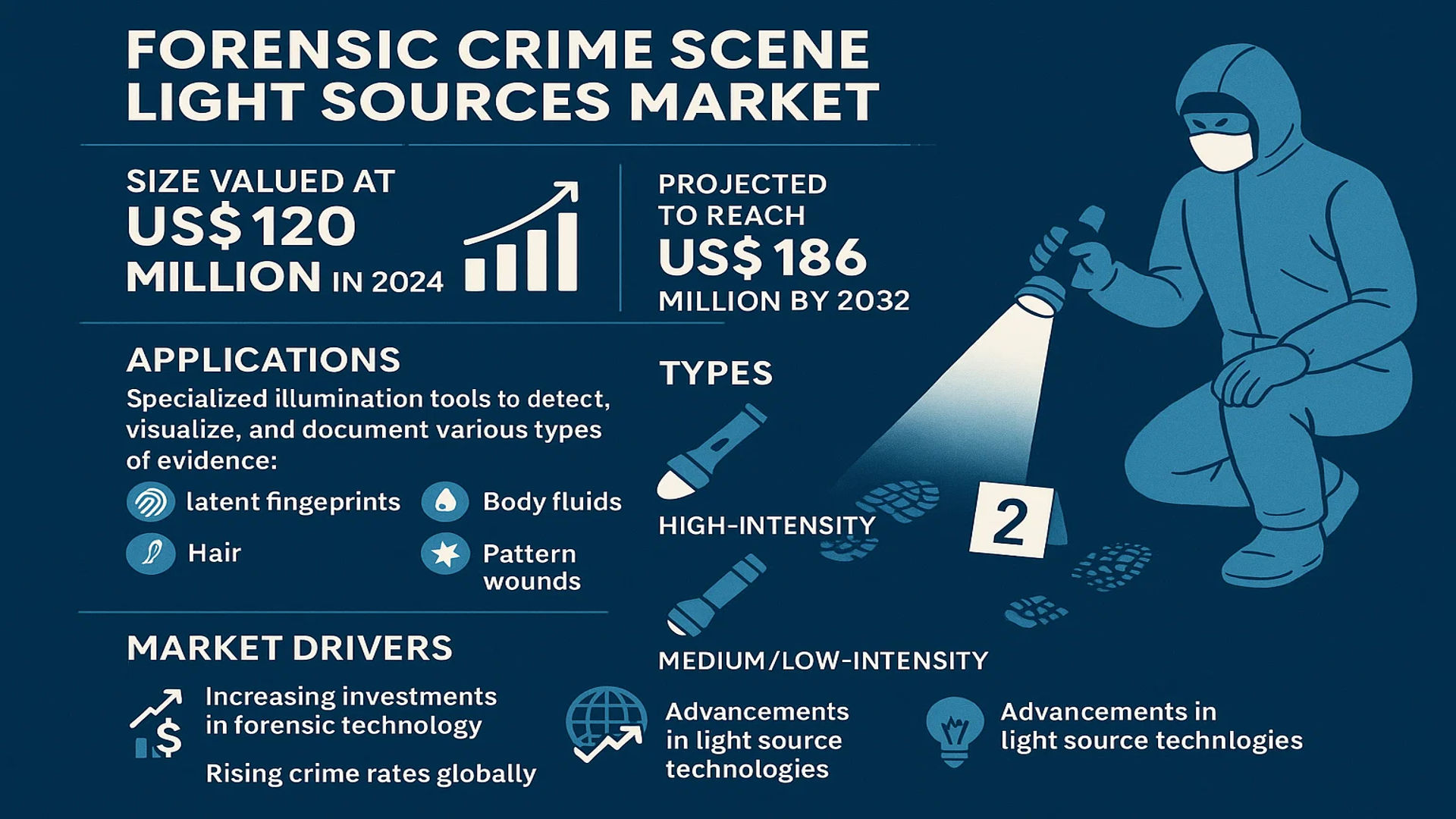
The global Forensic Crime Scene Light Sources Market size was valued at US$ 120 million in 2024 and is projected to reach US$ 186 million by 2032, at a CAGR of 5.6% during the forecast period 2025-2032.
Forensic crime scene light sources are specialized illumination tools used to detect, visualize, and document various types of evidence, including latent fingerprints, body fluids, hair, fibers, and pattern wounds. These devices employ specific wavelengths of light to enhance contrast and improve the visibility of trace evidence that may not be visible under normal lighting conditions. The market includes high-intensity and medium/low-intensity forensic footprint light sources, which are critical for investigations across law enforcement, forensic labs, and crime scene units.
The market growth is driven by increasing investments in forensic technology, rising crime rates globally, and advancements in light source technologies. Furthermore, government initiatives to modernize law enforcement infrastructure and growing demand for portable forensic equipment contribute to market expansion. Key players like Horiba, SPEX Forensics, and Sirchie are leading innovation in this space, with recent product developments focusing on enhanced portability and multi-wavelength capabilities to improve evidence detection efficiency.
MARKET DYNAMICS
MARKET DRIVERS
Rising Crime Rates and Technological Advancements to Fuel Market Growth
The global forensic crime scene light sources market is experiencing significant growth due to increasing crime rates worldwide, necessitating advanced forensic investigation tools. Law enforcement agencies are adopting cutting-edge forensic technologies to improve evidence detection and analysis efficiency. Recent technological advancements in forensic light sources, such as portable LED-based systems and multi-wavelength devices, enhance the ability to detect trace evidence like fingerprints, bodily fluids, and fibers with higher accuracy. The growing adoption of these sophisticated tools in criminal investigations is expected to drive market expansion throughout the forecast period.
Government Investments in Forensic Infrastructure to Accelerate Market Demand
Governments across both developed and developing nations are increasing budgets for forensic science departments, creating substantial opportunities in the crime scene light sources market. These investments aim to modernize forensic capabilities and reduce case backlogs in judicial systems. The allocation of substantial funds specifically for forensic equipment purchases has been observed in several national budgets, indicating strong governmental commitment to improving investigative capabilities. For example, several European countries have recently announced plans to upgrade their forensic laboratories with advanced light source technology as part of wider law enforcement modernization initiatives.
Additionally, the integration of forensic light sources with digital documentation systems is becoming increasingly common, allowing for more efficient evidence collection and preservation. This technological convergence is expected to further stimulate market growth as it enhances investigative workflows and evidentiary standards.
MARKET CHALLENGES
High Equipment Costs and Budget Constraints to Limit Market Penetration
Despite growing demand, the forensic light sources market faces significant challenges due to the high costs associated with advanced forensic equipment. Many law enforcement agencies, particularly in developing regions, operate with limited budgets that cannot accommodate expensive forensic tools. The price of high-performance forensic light sources can be prohibitive for smaller police departments, creating a substantial barrier to market growth. This financial constraint is particularly evident in regions where forensic science funding competes with other pressing law enforcement needs.
Additional Challenges
Limited Forensic Training
The effectiveness of forensic light sources depends heavily on operator expertise, yet many departments lack sufficient training programs. This skills gap can reduce the perceived value of advanced equipment, potentially slowing adoption rates. Without proper training, the full capabilities of these devices may remain underutilized, diminishing their return on investment.
Equipment Maintenance Requirements
Sophisticated forensic light sources often require specialized maintenance and calibration, creating ongoing costs that some agencies cannot sustain. The need for regular servicing and potential downtime can discourage organizations from upgrading their forensic equipment, particularly in resource-constrained environments.
MARKET RESTRAINTS
Regulatory Hurdles and Standardization Issues to Impede Market Expansion
The forensic light sources market faces constraints due to varying regulatory standards across different jurisdictions. The absence of universal guidelines for forensic equipment certification creates compliance challenges for manufacturers operating in multiple markets. Some regions maintain particularly stringent certification processes that can delay product launches and increase development costs. These regulatory variations may discourage manufacturers from expanding into certain geographic markets, limiting overall industry growth.
Furthermore, the lack of standardized protocols for forensic light source usage in evidence collection presents another significant restraint. Without consistent methodologies, the admissibility of evidence obtained using these tools may be challenged in court, potentially reducing their perceived reliability among law enforcement agencies.
MARKET OPPORTUNITIES
Emerging Economies and Collaborative Research to Create New Market Potential
The forensic light sources market presents significant growth opportunities in emerging economies where governments are increasingly investing in modern forensic capabilities. Many developing nations are establishing new forensic science facilities and upgrading existing ones, creating substantial demand for advanced investigative tools. These regions offer particularly strong growth potential as they work to align their forensic capabilities with international standards.
Strategic partnerships between manufacturers and academic institutions represent another promising opportunity. Collaborative research initiatives are driving innovation in forensic light source technology, particularly in areas like portable devices and enhanced evidence detection capabilities. These partnerships are expected to yield new product developments that could address current market challenges while opening up additional application areas.
Additionally, the increasing focus on cold case investigations in many jurisdictions is creating new demand for advanced forensic tools. Law enforcement agencies are revisiting unsolved cases with modern techniques, significantly boosting the need for high-performance forensic light sources capable of revealing previously undetected evidence.
FORENSIC CRIME SCENE LIGHT SOURCES MARKET TRENDS
Technological Advancements in Forensic Lighting Solutions Drive Market Growth
The global forensic crime scene light sources market is experiencing significant growth due to rapid advancements in forensic lighting technologies. Recent innovations include high-intensity LED forensic lights with multi-wavelength capabilities, allowing investigators to detect a broader range of trace evidence. The integration of portable, battery-operated systems has revolutionized crime scene investigations by enabling rapid deployment in diverse environments. The market is projected to grow at a 5.8% CAGR from 2024 to 2032, fueled by law enforcement agencies adopting advanced tools for improved evidence collection. Furthermore, forensic light sources with UV-VIS-NIR spectral ranges are gaining traction as they enhance the detection of biological evidence invisible to the naked eye.
Other Trends
Increased Demand for Portable and Multi-Functional Light Sources
The rising need for field-deployable forensic equipment has led to growing demand for compact, lightweight light sources that can be configured for multiple evidence types. Portable forensic lights now account for 42% of total market revenue, particularly in developing regions where mobile crime scene units are being modernized. These devices significantly reduce processing time by eliminating the need to transport evidence to laboratories for initial screening. Simultaneously, manufacturers are developing hybrid systems that combine alternate light sources (ALS) with digital documentation capabilities, creating an integrated forensic examination workflow.
Expansion of Forensic Capabilities in Developing Markets
Emerging economies are witnessing substantial growth in forensic infrastructure development, driving market expansion. Governments across Asia-Pacific and Latin America are allocating increased budgets for forensic equipment procurement as part of criminal justice system modernization programs. This has created opportunities for mid-range forensic light source manufacturers to penetrate these cost-sensitive markets. However, price competition remains intense as local manufacturers enter the space with economical alternatives to premium international brands. The demand for forensic light sources in developing nations currently grows at 7.2% annually, outpacing the global average.
Standardization and Training Initiatives Shape Product Development
Industry leaders are increasingly focusing on standardization and training support as key product differentiators. The establishment of international forensic lighting protocols has influenced manufacturers to develop systems with preset wavelength combinations for specific evidence types. This standardization reduces variability in evidence detection while improving cross-jurisdictional consistency in forensic practices. Many manufacturers now bundle their equipment with comprehensive training programs and certification courses, recognizing that operator skill significantly impacts the effectiveness of forensic light sources. These value-added services now represent 18-25% of total product cost structures for premium forensic lighting solutions.
COMPETITIVE LANDSCAPE
Key Industry Players
Technological Innovation and Strategic Expansion Drive Market Competition
The global forensic crime scene light sources market features a dynamic competitive environment, characterized by both established corporations and emerging players striving to enhance their technological capabilities. Horiba Scientific has emerged as a market leader, leveraging its expertise in optical spectroscopy to develop high-precision forensic light sources with advanced wavelength accuracy. The company’s global footprint, particularly in North America and Europe, gives it a competitive advantage in serving law enforcement agencies and forensic laboratories worldwide.
SPEX Forensics and Sirchie have secured significant market shares by focusing on portable and multi-functional light systems. These companies have invested heavily in R&D to introduce light sources that can detect multiple evidence types – from latent fingerprints to biological fluids – with higher sensitivity. Recent product launches featuring enhanced battery life and adjustable intensity settings have been particularly well-received in the market.
Meanwhile, mid-size players like Tri-Tech Forensics and Arrowhead Forensics are carving niches through specialized solutions. Their targeted approach – offering light sources optimized for specific applications like bite mark analysis or fiber detection – allows them to compete effectively against larger corporations. Both companies have expanded their distribution networks across Asia-Pacific to capitalize on growing forensic budgets in the region.
The competitive landscape is further enriched by innovative newcomers such as Foxfury, whose ruggedized light sources designed for outdoor crime scenes have gained traction among military and border security agencies. The company’s focus on durability and field usability demonstrates how market segments beyond traditional forensics are becoming increasingly important.
List of Key Forensic Light Source Manufacturers
- Horiba Scientific (Japan)
- SPEX Forensics (U.S.)
- Sirchie (U.S.)
- Obelux Oy (Finland)
- Foxfury Lighting Solutions (U.S.)
- Thomas Scientific (U.S.)
- LUMATEC GmbH (Germany)
- Advanced NDT Ltd. (UK)
- Tri-Tech Forensics (U.S.)
- Arrowhead Forensics (U.S.)
- ID Technology Partners (UK)
- Lynn Peavey Company (U.S.)
Market competition continues to intensify as companies adopt diverse strategies – from mergers and acquisitions to patent-protected innovations. The shift toward LED-based systems with customizable wavelength combinations represents the current technological frontier, with multiple players racing to develop the next generation of forensic illumination tools. Meanwhile, partnerships with academic institutions for advanced research in fluorescence techniques are becoming a key differentiator in this specialized market segment.
Segment Analysis:
By Type
High Intensity Forensic Footprint Light Source Segment Leads Due to Superior Evidence Detection Capabilities
The market is segmented based on type into:
- High Intensity Forensic Footprint Light Source
- Subtypes: LED, Laser, and Xenon
- Medium and Low Intensity Forensic Footprint Light Source
By Application
Latent Fingerprint Detection Dominates Due to Increasing Crime Investigation Requirements
The market is segmented based on application into:
- Latent Fingerprint Detection
- Body Fluids
- Hair & Fibers
- Bruises / Bite Marks / Pattern Wounds
By Technology
LED-Based Light Sources Hold Significant Share Due to Energy Efficiency
The market is segmented based on technology into:
- LED
- Laser
- Xenon
- Metal Halide
By End User
Law Enforcement Agencies Remain Primary Consumers of Forensic Light Sources
The market is segmented based on end user into:
- Law Enforcement Agencies
- Forensic Laboratories
- Military & Defense
- Others (Private Investigators, Research Institutes)
Regional Analysis: Forensic Crime Scene Light Sources Market
North America
North America dominates the forensic light source market, driven by advanced law enforcement infrastructure and significant investments in forensic technology. The U.S. accounts for over 60% of regional demand, with federal agencies like the FBI and local police departments adopting high-intensity forensic light sources for evidence collection. Stringent regulations such as the FBI’s Quality Assurance Standards for Forensic Testing laboratories reinforce the need for reliable equipment. Market leaders like SPEX Forensics and Sirchie benefit from steady demand. Growth is further supported by rising crime investigation budgets – the U.S. Department of Justice allocated $3.1 billion for forensic science programs in FY2024.
Europe
Europe represents the second-largest forensic light source market, characterized by standardized forensic protocols across EU member states. Countries like the UK, Germany, and France are adopting portable UV/IR forensic lights to modernize crime scene investigations. The European Network of Forensic Science Institutes actively promotes best practices in forensic equipment usage. Though price sensitivity exists among smaller agencies, major players like HORIBA and Obelux continue expanding their presence with advanced multispectral light sources. Brexit created temporary procurement challenges in the UK, but demand remains stable as forensic services are classified as essential.
Asia-Pacific
Asia-Pacific shows the fastest growth potential, fueled by expanding judicial systems and rising crime awareness. China and India account for 45% of regional sales, as their governments invest in forensic lab infrastructure. However, local manufacturers in China often compete on price rather than technology. Japan and South Korea favor premium forensic light systems for their advanced police forces. Key challenges include inconsistent regulatory frameworks and limited training on new forensic technologies in developing markets. Nevertheless, companies like LUMATEC are establishing regional partnerships to capitalize on this high-growth market.
South America
The South American market remains underdeveloped but shows gradual expansion. Brazil leads the region, accounting for 40% of forensic equipment purchases, followed by Argentina. Economic instability hinders technology adoption, with many agencies continuing to use outdated forensic equipment. However, rising drug-related crimes and international pressure to improve forensic capabilities are driving investments. Governments are collaborating with organizations like the International Criminal Police Organization (INTERPOL) to enhance forensic training programs, creating opportunities for mid-range forensic light suppliers.
Middle East & Africa
The MEA region presents a highly varied forensic equipment landscape. Wealthier Gulf nations including Saudi Arabia and the UAE actively invest in state-of-the-art forensic tools for counter-terrorism and cybercrime units. In contrast, African nations face budgetary constraints, with forensic programs often relying on donor funding. South Africa stands as the region’s most advanced market, utilizing forensic light sources in wildlife crime investigations. As urbanization accelerates, demand for basic forensic capabilities increases, though adoption remains slow outside major cities.
Report Scope
This market research report provides a comprehensive analysis of the global Forensic Crime Scene Light Sources market, covering the forecast period 2024–2032. It offers detailed insights into market dynamics, technological advancements, competitive landscape, and key trends shaping the industry.
Key focus areas of the report include:
- Market Size & Forecast: Historical data and future projections for revenue, unit shipments, and market value across major regions and segments.
- Segmentation Analysis: Detailed breakdown by product type, technology, application, and end-user industry to identify high-growth segments and investment opportunities.
- Regional Outlook: Insights into market performance across North America, Europe, Asia-Pacific, Latin America, and the Middle East & Africa, including country-level analysis where relevant.
- Competitive Landscape: Profiles of leading market participants, including their product offerings, R&D focus, manufacturing capacity, pricing strategies, and recent developments such as mergers, acquisitions, and partnerships.
- Technology Trends & Innovation: Assessment of emerging technologies, integration of AI/IoT, and evolving industry standards in forensic light sources.
- Market Drivers & Restraints: Evaluation of factors driving market growth along with challenges, supply chain constraints, regulatory issues, and market-entry barriers.
- Stakeholder Analysis: Insights for manufacturers, distributors, forensic agencies, and investors regarding the evolving ecosystem and strategic opportunities.
Primary and secondary research methods are employed, including interviews with industry experts, data from verified sources, and real-time market intelligence to ensure the accuracy and reliability of the insights presented.
FREQUENTLY ASKED QUESTIONS:
What is the current market size of Global Forensic Crime Scene Light Sources Market?
-> Forensic Crime Scene Light Sources Market size was valued at US$ 120 million in 2024 and is projected to reach US$ 186 million by 2032, at a CAGR of 5.6% during the forecast period 2025-2032.
Which key companies operate in Global Forensic Crime Scene Light Sources Market?
-> Key players include Horiba, SPEX Forensics, Obelux, Foxfury, Thomas Scientific, LUMATEC, Advanced NDT, Sirchie, Tri-Tech Forensics, Arrowhead Forensics, ID Technology, and Lynn Peavey Company.
What are the key growth drivers?
-> Key growth drivers include rising crime rates globally, increasing demand for advanced forensic tools, technological advancements in light source equipment, and growing investments in law enforcement infrastructure.
Which region dominates the market?
-> North America holds the largest market share (38.5% in 2024), while Asia-Pacific is expected to witness the highest growth rate (6.2% CAGR) during the forecast period.
What are the emerging trends?
-> Emerging trends include development of portable and battery-operated forensic light sources, integration of multi-wavelength LED technology, and increasing adoption of automated forensic analysis systems.

Get Sample Report PDF for Exclusive Insights
Report Sample Includes
- Table of Contents
- List of Tables & Figures
- Charts, Research Methodology, and more...