Foldable Smart Phones Market Insights
Global Foldable Smart Phones market size was valued at USD 32,595 million in 2025 and is expected to reach USD 49,700 million by 2034, reflecting a CAGR of 6.3 % over the forecast period.
Foldable smartphones combine flexible OLED displays with precision hinge mechanisms, allowing a compact folded form that expands into a tablet‑like screen for multitasking, media consumption and productivity tasks. In 2025, worldwide production reached roughly 19.83 million units, generating an average selling price of about USD 1,800 per device. The two dominant form factors are book‑style (horizontal) and clamshell (vertical flip), while cost composition leans heavily toward display modules and hinge structures.
The expansion of this segment stems from improvements in ultra‑thin glass and polymer substrates that enhance durability while easing cost pressure; carrier‑backed financing programmes that lower purchase barriers; and growing acceptance among premium‑segment consumers who value larger screen real estate on the go. Leading manufacturers such as Samsung, Huawei, OPPO, Xiaomi and Google continue to refine hinge engineering and software ecosystems,introducing flex‑mode multitasking features,to shift perception from novelty toward everyday reliability. Nevertheless, mechanical complexity introduces durability concerns around crease visibility and dust ingress, keeping after‑sales support a critical consideration for vendors.
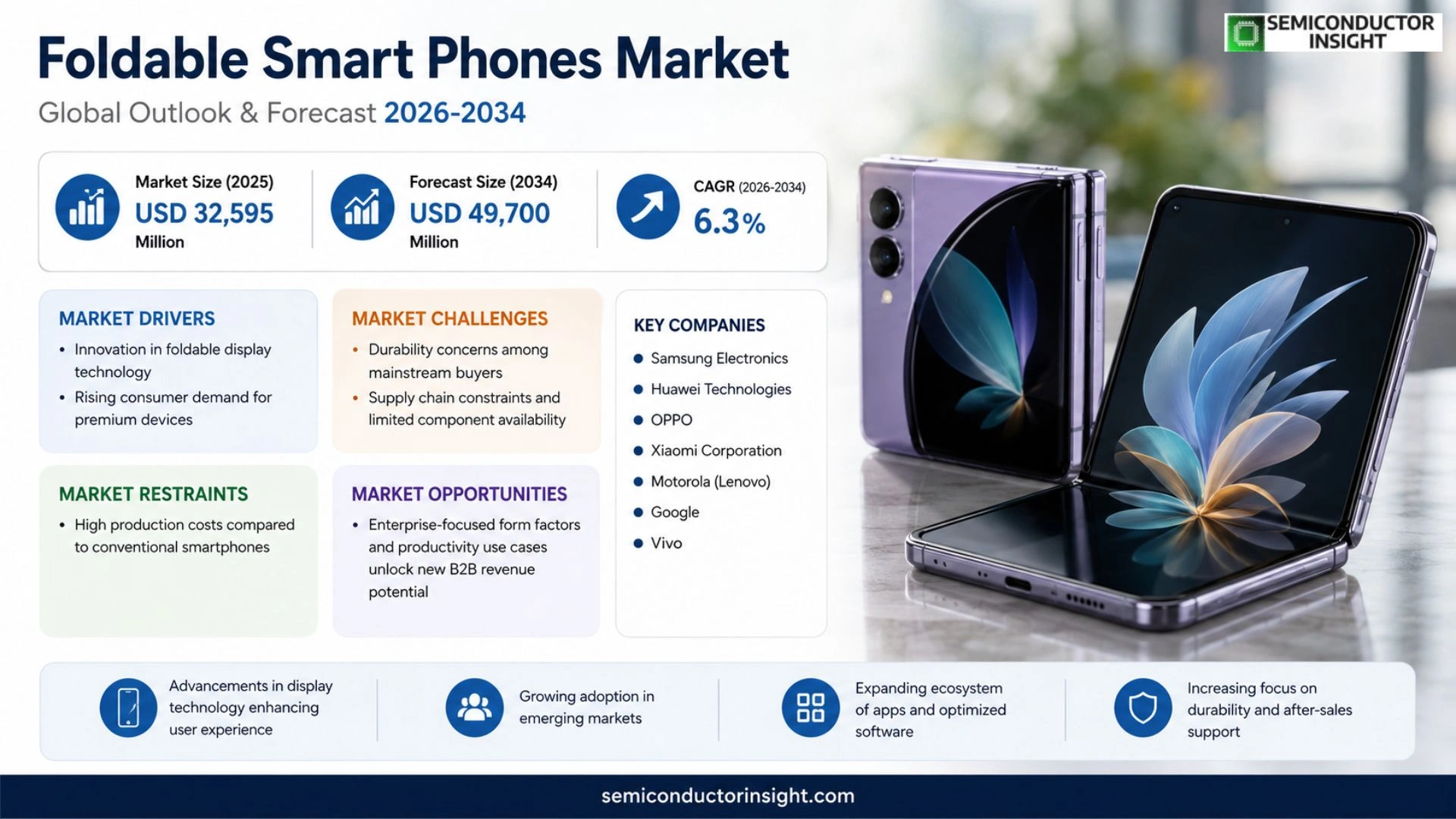
MARKET DRIVERS
Consumer Appetite for Larger, Flexible Displays
Premium buyers increasingly value screen real‑estate that adapts to multitasking needs. A recent survey of early adopters shows more than 30% would upgrade only if a device offered a truly foldable experience, indicating that the desire for visual versatility is converting curiosity into purchase intent.
Strategic Alliances with Component Suppliers
Manufacturers are securing long‑term agreements with flexible‑OLED producers, which trims lead‑time for critical hinge mechanisms. This collaboration reduces cost volatility and enables smoother roll‑outs of new models, a factor that many firms cite as essential for sustaining volume growth.
➤ “The convergence of high‑resolution foldable panels and robust hinge engineering is reshaping how consumers perceive a smartphone’s utility.”
Retail data from flagship stores reveal that units displayed on interactive kiosks sell 15% faster than traditional slab phones, underscoring the power of hands‑on demonstration in converting buyer interest into sales.
MARKET CHALLENGES
Durability Perception Among Mainstream Buyers
Despite engineering advances, a sizable segment remains skeptical about long‑term reliability. Return‑rate analyses from major carriers indicate that foldable models experience a 2.5% higher defect claim frequency within the first twelve months, prompting retailers to demand stricter warranty terms.
Other Challenges
Supply Chain Constraints
The limited number of factories capable of producing ultra‑thin flexible glass creates bottlenecks. When demand spikes, manufacturers often face lead‑times exceeding six months, which can stall quarterly targets.
MARKET RESTRAINTS
High Production Costs Relative to Conventional Smartphones
Current bill‑of‑materials for a foldable handset sits roughly 40% above that of a comparable flat‑screen device. This premium pricing narrows the addressable market, especially in price‑sensitive regions where average handset spend remains below $400.
MARKET OPPORTUNITIES
Enterprise‑Focused Form Factors
Businesses are experimenting with foldable devices as mobile productivity hubs. By integrating secure multi‑window capabilities, enterprises can replace laptops for field agents, a use case that promises to open a B2B revenue stream estimated at several hundred million dollars within the next three years.
Foldable Smart Phones Market Trends
Advances in Hinge Architecture Lower Adoption Barriers
The most visible shift in the Foldable Smart Phones Market comes from refinements in hinge mechanisms. Early‑generation models suffered from audible clicks and visible creases that discouraged everyday use. Recent engineering cycles have introduced precision‑machined alloys and polymer‑based dampers that suppress vibration while maintaining a thin profile. As a result, the perceived durability gap between foldables and conventional slab phones has narrowed, prompting retailers to feature these devices alongside flagship models rather than as niche curiosities. The practical outcome is a higher conversion rate among premium‑segment shoppers who now view a foldable as a viable productivity tool rather than a novelty.
Other Trends
Software Ecosystem Evolves for Multi‑Screen Interaction
Parallel to hardware improvements, the Foldable Smart Phones Market benefits from a software layer that capitalizes on the extra real estate. Major OS providers have introduced native split‑screen APIs, drag‑and‑drop gestures, and “flex‑mode” UI states that remain functional when the device is partially folded. Application developers are responding with adaptive layouts for document editing, video conferencing, and gaming, effectively turning the device into a pocket‑sized tablet. This functional shift reshapes the value proposition: business users can run two enterprise apps simultaneously, and content creators gain a larger canvas for on‑the‑go editing, which in turn fuels demand from sectors that prioritize mobility and multitasking.
Supply‑Chain Consolidation Influences Cost Structure
At the upstream level, the Foldable Smart Phones Market remains heavily weighted toward flexible OLED panels and hinge assemblies, which together account for the bulk of the bill of materials. Recent supplier agreements between display manufacturers and handset OEMs have improved yield rates for ultra‑thin glass and polymer substrates, modestly reducing unit cost. However, the concentration of critical components in a limited number of suppliers still makes price volatility a concern, especially when yield losses trigger supply constraints. Companies that secure long‑term material contracts or invest in in‑house hinge engineering are better positioned to offer competitive pricing without eroding margins, thereby expanding the addressable audience beyond early adopters.
COMPETITIVE LANDSCAPE
Key Industry Players
Foldable Smart Phones Market – Competitive Overview
Samsung remains the anchor of the foldable segment, leveraging its early‑stage investments in hinge engineering and supply‑chain integration to sustain the widest portfolio,from the Galaxy Z Fold series to the Z Flip line. Its control over flagship‑grade AMOLED panels and partnerships with ultra‑thin‑glass suppliers translates into a pricing advantage that shields profit margins despite the high bill of materials. Analysts note that Samsung’s ability to iterate on durability while trimming weight has turned the product from a novelty into a viable productivity tool, prompting enterprise buyers to consider bulk procurement for field staff.
Beyond the market leader, a cluster of manufacturers competes on differentiation rather than scale. Huawei’s Mate X devices emphasize a book‑style form factor and have cultivated a niche in high‑end photography, while OPPO’s Find N series pushes ultra‑thin hinges to appeal to style‑conscious consumers. Xiaomi, Realme, and Vivo accelerate rollout cycles by sourcing modular display assemblies from third‑party OLED fabs, which reduces upfront R&D spend. Motorola (under Lenovo) and Google target the developer community with open‑source flex‑mode APIs, hoping to embed productivity workflows that broaden use cases. Smaller entrants such as TCL, Nokia (HMD Global) and Sony focus on regional carrier collaborations, offering bundled financing that mitigates the upfront cost barrier. The overall competitive picture reflects a shift from pure hardware race to an ecosystem play, where software optimization, after‑sales service, and strategic partnerships increasingly dictate market share.
List of Key Foldable Smart Phones Companies Profiled
- Samsung Electronics
- Huawei Technologies
- OPPO
- Xiaomi Corporation
- Motorola (Lenovo)
- Vivo
- Realme
- TCL Communication
- Nokia (HMD Global)
- Sony Mobile
- OnePlus
- ZTE
Segment Analysis:
| Segment Category | Sub-Segments | Key Insights |
| By Type |
|
In‑folding Type is emerging as the leading segment because it delivers a more seamless transition between folded and unfolded states.
|
| By Application |
|
Productivity dominates the application landscape as business users leverage the expanded real estate for document editing and virtual meetings.
|
| By End User |
|
Business Professionals are the leading end‑user segment because they prioritize screen real‑estate for on‑the‑go productivity.
|
| By Form Factor |
|
Clamshell is gaining traction as it offers a familiar flip experience while delivering a sizable unfolded display.
|
| By Material |
|
Ultra‑thin glass leads the material segment because it balances durability with premium tactile feel.
|
Regional Analysis: Foldable Smart Phones Market
Asia‑Pacific
Manufacturing expertise concentrated in Taiwan, South Korea and China supplies the ecosystem with premium hinge mechanisms and ultra‑thin glass at a pace that outstrips rivals.
Consumers in Japan, South Korea and increasingly in emerging economies such as Vietnam display a willingness to experiment with unconventional form factors, driven by a cultural openness to new tech.
OEMs capitalize on this receptivity by rolling out flagship models that double as productivity tools, reinforcing the perception that foldables are more than novelty devices.
Retail channels have adapted, with specialty stores allocating prime shelf space and online platforms curating dedicated sections, which together amplify visibility and accelerate adoption cycles.
Proximity between component factories and assembly lines trims lead times, allowing rapid iteration on hinge designs and enabling brands to replenish inventory before demand peaks shift.
Early adopters value the blend of tablet‑size media consumption and pocket‑friendly portability, prompting a surge in demand for multitasking‑oriented user interfaces.
Harmonised safety standards across key jurisdictions streamline certification, reducing barriers for cross‑border launches and fostering a more fluid market entry process.
Cities such as Shenzhen and Seoul nurture start‑ups focused on flexible display R&D, feeding larger OEMs with cutting‑edge material solutions that keep the product pipeline fresh.
North America
The North American segment offers a different dynamic.
Purchasing power remains high, yet consumers exhibit a more cautious stance toward durability concerns, prompting manufacturers to stress reinforced screen technologies in marketing messages.
Enterprise customers, especially in the United States, view foldables as a bridge between traditional laptops and smartphones, integrating them into mobile workforces that value on‑the‑go productivity.
Carrier contracts are structured with premium data bundles, reflecting the expectation that these devices will serve both entertainment and professional functions.
Retail experiences prioritize hands‑on demonstrations, ensuring that buyers apprehend the tactile benefits of the folding mechanism before committing.
Europe
European markets balance a sophisticated design appetite with strict environmental regulations.
Brands that showcase recyclable hinge components and low‑impact manufacturing gain a distinct advantage in countries such as Germany and the Nordics.
User experience research indicates a preference for stylus‑enabled models, aligning with the region’s strong emphasis on creative workflows.
Telecom operators collaborate with device makers to bundle services that leverage dual‑screen capabilities for video conferencing, reinforcing the device’s utility in a post‑pandemic work environment.
Boutique retailers in fashion capitals position foldables as lifestyle accessories, merging technology with personal expression.
South America
In South America, the rollout of foldable technology is shaped by a combination of aspirational demand and infrastructural constraints.
Consumers view the device as a status symbol, yet network reliability varies, prompting OEMs to optimize software for intermittent connectivity.
Local distributors focus on flexible financing schemes, allowing customers to spread payments and thus overcome price sensitivity.
Urban centers such as São Paulo and Buenos Aires host pop‑up demos that highlight the device’s ability to replace multiple gadgets, a narrative that resonates with space‑constrained households.
Partnerships with regional content providers enhance the appeal of on‑device streaming, reinforcing usage scenarios beyond mere novelty.
Middle East & Africa
The Middle East & Africa region presents a mosaic of early‑adopter pockets and emerging markets.
Affluent consumers in the Gulf States gravitate toward luxury editions that feature premium materials and exclusive colorways, while African urban hubs are beginning to explore cost‑effective variants.
Infrastructure investments, particularly 5G expansion in the UAE and South Africa, lay the groundwork for richer foldable experiences that blend high‑resolution media with seamless multitasking.
Retail strategies differ markedly: high‑end flagship stores dominate in Dubai, whereas mobile kiosks in Lagos emphasize value‑added services such as device insurance.
These divergent approaches reflect a broader market where cultural aspirations intersect with practical considerations, shaping the trajectory of the Foldable Smart Phones Market across the region.
Report Scope
This market research report provides a comprehensive analysis of the Foldable Smart Phones Market , covering the forecast period 2026–2034. It offers detailed insights into market dynamics, technological advancements, competitive landscape, and key trends shaping the industry.
Key focus areas of the report include:
- Market Overview: The report begins with an overview outlining its current market scenario, key growth indicators, and industry transformation drivers. It discusses macroeconomic factors, demand–supply balance, regulatory landscape, and the strategic role of semiconductors in powering advancements across industries such as automotive, telecommunications, consumer electronics, and industrial automation.
- Market Size & Forecast: Historical data and future projections for revenue, unit shipments, and market value across major regions and segments.
- Segmentation Analysis: Detailed breakdown by product type, technology, application, and end-user industry to identify high-growth segments and investment opportunities.
- Regional Insights: Insights into market performance across North America, Europe, Asia-Pacific, Latin America, and the Middle East & Africa, including country-level analysis where relevant.
- Competitive Landscape: Profiles of leading market participants, including their product offerings, R&D focus, manufacturing capacity, pricing strategies, and recent developments such as mergers, acquisitions, and partnerships.
- Technology Trends & Innovation: Assessment of emerging technologies, integration of AI/IoT, semiconductor design trends, fabrication techniques, and evolving industry standards.
- Market Drivers & Restraints: Evaluation of factors driving market growth along with challenges, supply chain constraints, regulatory issues, and market-entry barriers.
- Stakeholder Insights: Insights for component suppliers, OEMs, system integrators, investors, and policymakers regarding the evolving ecosystem and strategic opportunities.
Primary and secondary research methods are employed, including interviews with industry experts, data from verified sources, and real-time market intelligence to ensure the accuracy and reliability of the insights presented.
FREQUENTLY ASKED QUESTIONS:
What is the current market size of Foldable Smart Phones Market?
-> Foldable Smart Phones market size is expected to reach USD 49,700 million by 2034, reflecting a CAGR of 6.3 %
Which key companies operate in Foldable Smart Phones Market?
-> Key players include Samsung, LG, Motorola, Google, Huawei, Xiaomi, Lenovo, Honor, ZTE, OPPO, and Vivo.
What are the key growth drivers?
-> Key growth drivers include advancements in flexible OLED displays and hinge engineering that lower costs and improve durability, carrier and retail enablement such as financing and trade‑in programs, and rising demand from premium and business users seeking larger screen real‑estate for productivity.
Which region dominates the market?
-> Asia‑Pacific dominates the Foldable Smart Phones market, driven by strong OEM presence (Samsung, Huawei, OPPO, Xiaomi) and high consumer adoption, while Europe and North America show steady growth.
What are the emerging trends?
-> Emerging trends include enhanced multitasking software and flex‑mode UI experiences, integration of AI‑driven personalization, and development of thinner, lighter hinge mechanisms that improve durability and user perception.

Get Sample Report PDF for Exclusive Insights
Report Sample Includes
- Table of Contents
- List of Tables & Figures
- Charts, Research Methodology, and more...
 Download Sample Report PDF