
Market Insights
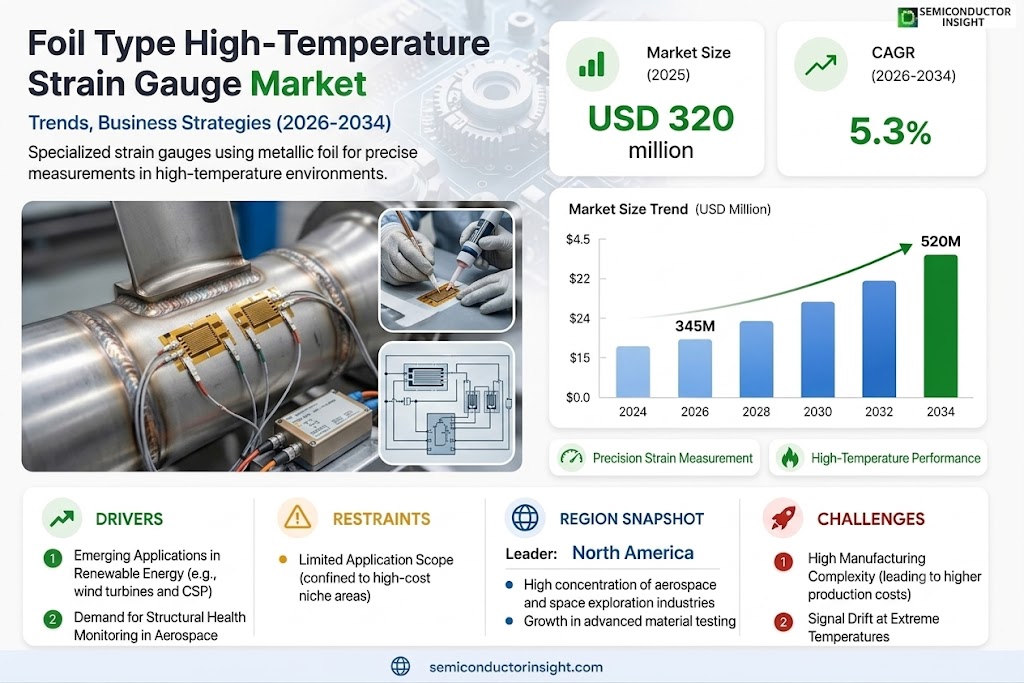
Global Foil Type High-Temperature Strain Gauge Market size was valued at USD 320 million in 2025. The market is projected to grow from USD 345 million in 2026 to USD 520 million by 2034, exhibiting a CAGR of 5.3% during the forecast period.
A foil type high-temperature strain gauge is a sensor device used to measure material strain in high-temperature environments, typically above 200°C. These gauges consist of thin metallic foil patterns bonded to a flexible backing material, capable of withstanding extreme thermal conditions while maintaining measurement accuracy. They are widely used in aerospace, energy, and industrial applications where structural integrity monitoring under thermal stress is critical.
The market growth is driven by increasing demand from the aerospace sector for engine component monitoring and rising adoption in power generation infrastructure. However, challenges such as signal drift at ultra-high temperatures and competition from alternative sensing technologies may restrain growth. Key manufacturers are investing in advanced materials like platinum-tungsten alloys to improve temperature stability and measurement precision.
MARKET DRIVERS
Growing Demand in Aerospace & Heavy Industries
Foil Type High-Temperature Strain Gauge Market is witnessing steady growth due to increasing demand from aerospace, automotive, and energy sectors. These gauges provide precise strain measurement in extreme conditions, making them indispensable for structural health monitoring in jet engines and turbines.
Advancements in Material Science
Recent improvements in alloy compositions and bonding techniques have enhanced the durability and accuracy of foil type high-temperature strain gauges. Manufacturers are investing in R&D to develop gauges capable of withstanding temperatures exceeding 1000°C.
Stringent safety regulations in industrial applications further drive adoption, as these gauges enable real-time monitoring of critical infrastructure under thermal stress.
MARKET CHALLENGES
High Manufacturing Complexity
Producing foil type high-temperature strain gauges requires specialized materials and precise fabrication processes, leading to higher production costs. This limits adoption among small and medium enterprises with budget constraints.
Other Challenges
Signal Drift at Extreme Temperatures
Maintaining measurement accuracy becomes increasingly difficult as temperatures approach operational limits, requiring sophisticated compensation techniques.
Installation Difficulties
Proper adhesion of foil gauges to test surfaces at high temperatures demands specialized installation procedures and trained personnel.
MARKET RESTRAINTS
Limited Application Scope
While foil type high-temperature strain gauges excel in specific environments, their usage remains confined to niche applications that justify their higher cost compared to conventional strain measurement solutions.
MARKET OPPORTUNITIES
Emerging Applications in Renewable Energy
The growing renewable energy sector presents significant opportunities for foil type high-temperature strain gauges, particularly in monitoring wind turbine components and concentrated solar power systems exposed to thermal cycling.
Development of Next-Generation Materials
Research into novel composite materials and nanotechnology applications could expand the temperature range and improve the performance characteristics of foil type high-temperature strain gauges.
Foil Type High-Temperature Strain Gauge Market Trends
Increasing Demand in Aerospace and Energy Sectors
Foil Type High-Temperature Strain Gauge Market is experiencing significant growth driven by rising applications in aerospace and energy industries. These sensors are critical for monitoring structural integrity in extreme environments, particularly in jet engines and power generation equipment. Manufacturers are focusing on improving durability and accuracy to meet stringent industry requirements.
Other Trends
Advancements in Material Science
Recent developments in metallurgical compositions have enabled Foil Type High-Temperature Strain Gauges to withstand temperatures exceeding 1000°C. This has expanded their usage in chemical processing plants and metallurgical applications where traditional sensors previously failed.
Regional Market Developments
North America and Asia-Pacific regions are leading the Foil Type High-Temperature Strain Gauge adoption, with China’s aerospace sector showing particularly strong growth. European manufacturers are innovating with fiber optic variants that offer enhanced precision for specialized industrial applications.
Competitive Landscape Shifts
Key players like HBM, Vishay, and Kyowa are investing in R&D to develop next-generation strain gauges with wireless capabilities. The market is seeing increased collaboration between sensor manufacturers and end-users to create application-specific solutions.
Regulatory Impact on Market Growth
Stringent safety regulations in the energy sector are mandating the use of high-temperature strain monitoring systems, creating sustained demand. The International Aerospace Quality Group’s revised standards are expected to further drive the adoption of advanced Foil Type High-Temperature Strain Gauges in aircraft components.
COMPETITIVE LANDSCAPE
Key Industry Players
Strategic Positioning of Foil Type High-Temperature Strain Gauge Manufacturers
Global Foil Type High-Temperature Strain Gauge Market is led by established measurement technology specialists like HBM and Vishay, which collectively hold significant market share through advanced R&D and extensive industry applications. The competitive landscape remains moderately concentrated, with the top five players accounting for nearly 45% market revenue in 2025. These leaders have strengthened their positions through patented foil gauge technologies capable of operating above 400°C, along with strategic partnerships with aerospace and energy sector clients.
Several Asian manufacturers such as China Aerospace Science and Technology Corporation and AVIC Electrical Measurement are gaining traction through government-backed aerospace programs and cost-competitive solutions. Niche players like Kyowa and KOA specialize in customized strain gauge solutions for extreme environments, while industrial automation giants ABB and Siemens leverage their cross-industry presence to integrate strain gauges into broader monitoring systems. The market sees ongoing technological innovation in metallurgical compositions and installation techniques to enhance high-temperature performance.
List of Key Foil Type High-Temperature Strain Gauge Companies Profiled
- HBM Test and Measurement
- Vishay Precision Group
- Kyowa Electronic Instruments
- China Aerospace Science and Technology Corporation
- AVIC Electrical Measurement Co., Ltd.
- ABB Measurement & Analytics
- Siemens Process Instrumentation
- Schneider Electric
- KOA Corporation
- NMB Technologies Corporation
- Omega Engineering
- TML – Tokyo Measuring Instruments Lab
- Hottinger Brüel & Kjær
- Zemic Europe
- Micro-Measurements (Vishay)
Segment Analysis:
| Segment Category | Sub-Segments | Key Insights |
| By Type |
|
Resistance Strain Gauge dominates the market due to:
|
| By Application |
|
Aerospace represents the most demanding application segment because:
|
| By End User |
|
OEMs account for the largest demand share as:
|
| By Technology |
|
Advanced Composite Materials show strongest growth momentum due to:
|
| By Temperature Range |
|
300°C-600°C range demonstrates strongest industry focus as:
|
Regional Analysis: Foil Type High-Temperature Strain Gauge Market
North America
The U.S. aerospace sector’s push for next-generation aircraft has increased demand for foil type strain gauges that perform reliably in engine monitoring systems under extreme thermal cycling conditions.
Growing investments in geothermal and nuclear power plants across Canada are creating new opportunities for high-temperature strain measurement solutions in critical infrastructure monitoring applications.
Established sensor manufacturers in the Great Lakes region have developed proprietary foil alloys and bonding techniques specifically optimized for high-temperature strain gauge performance.
Military modernization programs are driving specialized requirements for ruggedized foil strain gauges capable of withstanding the thermal shocks experienced in hypersonic vehicle testing.
Europe
Europe maintains strong demand for high-temperature foil strain gauges, particularly in the automotive and industrial sectors. German engineering firms lead in developing strain measurement solutions for high-performance engine testing. Strict EU regulations on industrial emissions monitoring have increased installations in exhaust systems and combustion chambers. Collaborative research projects across Western Europe focus on improving the thermal stability of foil-type sensors.
Asia-Pacific
The Asia-Pacific region shows the fastest growth in the Foil Type High-Temperature Strain Gauge Market, driven by expanding aerospace and power generation sectors. Japan’s sophisticated manufacturing base produces specialized strain gauges for nuclear applications, while South Korea’s shipbuilding industry requires durable sensors for engine monitoring. Emerging industrial corridors in India are adopting these solutions for process equipment monitoring.
Middle East & Africa
Infrastructure development in the Middle East creates niche opportunities for high-temperature strain gauges in oil & gas refining and petrochemical applications. The UAE’s focus on aerospace manufacturing is generating demand for thermal-resistant measurement solutions. African markets are gradually adopting these technologies for geothermal energy projects and mining equipment monitoring.
South America
Brazil’s aerospace and energy sectors drive limited but growing demand for high-temperature foil strain gauges. Localized manufacturing of industrial equipment in Argentina and Chile is creating opportunities for sensor integration in process control systems operating under thermal stress conditions.
Report Scope
This market research report provides a comprehensive analysis of the Foil Type High-Temperature Strain Gauge Market, covering the forecast period 2025–2034. It offers detailed insights into market dynamics, technological advancements, competitive landscape, and key trends shaping the industry.
Key focus areas of the report include:
- Market Overview: The report begins with an overview outlining its current market scenario, key growth indicators, and industry transformation drivers. It discusses macroeconomic factors, demand-supply balance, regulatory landscape, and the strategic role of strain gauges in high-temperature applications across industries such as aerospace, energy, chemical materials, and others.
- Market Size & Forecast: Historical data and future projections for revenue, unit shipments, and market value across major regions and segments.
- Segmentation Analysis: Detailed breakdown by product type, technology, application, and end-user industry to identify high-growth segments and investment opportunities.
- Regional Insights: Insights into market performance across North America, Europe, Asia, South America, and Middle East & Africa, including country-level analysis where relevant.
- Competitive Landscape: Profiles of leading market participants, including their product offerings, R&D focus, manufacturing capacity, pricing strategies, and recent developments such as mergers, acquisitions, and partnerships.
- Technology Trends & Innovation: Assessment of emerging technologies, material advancements, fabrication techniques, and evolving industry standards.
- Market Drivers & Restraints: Evaluation of factors driving market growth along with challenges, supply chain constraints, regulatory issues, and market-entry barriers.
- Stakeholder Insights: Insights for component suppliers, OEMs, system integrators, investors, and policymakers regarding the evolving ecosystem and strategic opportunities.
Primary and secondary research methods are employed, including interviews with industry experts, data from verified sources, and real-time market intelligence to ensure the accuracy and reliability of the insights presented.
FREQUENTLY ASKED QUESTIONS:
What is the current market size of Foil Type High-Temperature Strain Gauge Market?
-> Foil Type High-Temperature Strain Gauge Market size was valued at USD 320 million in 2025. The market is projected to grow from USD 345 million in 2026 to USD 520 million by 2034, exhibiting a CAGR of 5.3% during the forecast period.
Which key companies operate in Foil Type High-Temperature Strain Gauge Market?
-> Key players include HBM, Vishay, Kyowa, China Aerospace Science and Technology Corporation, AVIC Electrical Measurement, ABB, Siemens, Schneider Electric, KOA, NMB, among others.
What are the key growth drivers?
-> Key growth drivers include increasing demand from aerospace and energy sectors, technological advancements in strain gauge materials, and rising applications in high-temperature environments.
Which region dominates the market?
-> Asia is expected to be a key growth region, with China projected to reach USD million by 2034, while North America remains a significant market with the U.S. estimated at USD million in 2025.
What are the emerging trends?
-> Emerging trends include development of fiber optic strain gauges, increasing adoption in chemical material applications, and advancements in sensor integration with IoT systems.

Get Sample Report PDF for Exclusive Insights
Report Sample Includes
- Table of Contents
- List of Tables & Figures
- Charts, Research Methodology, and more...
 Download Sample Report PDF


