MARKET INSIGHTS
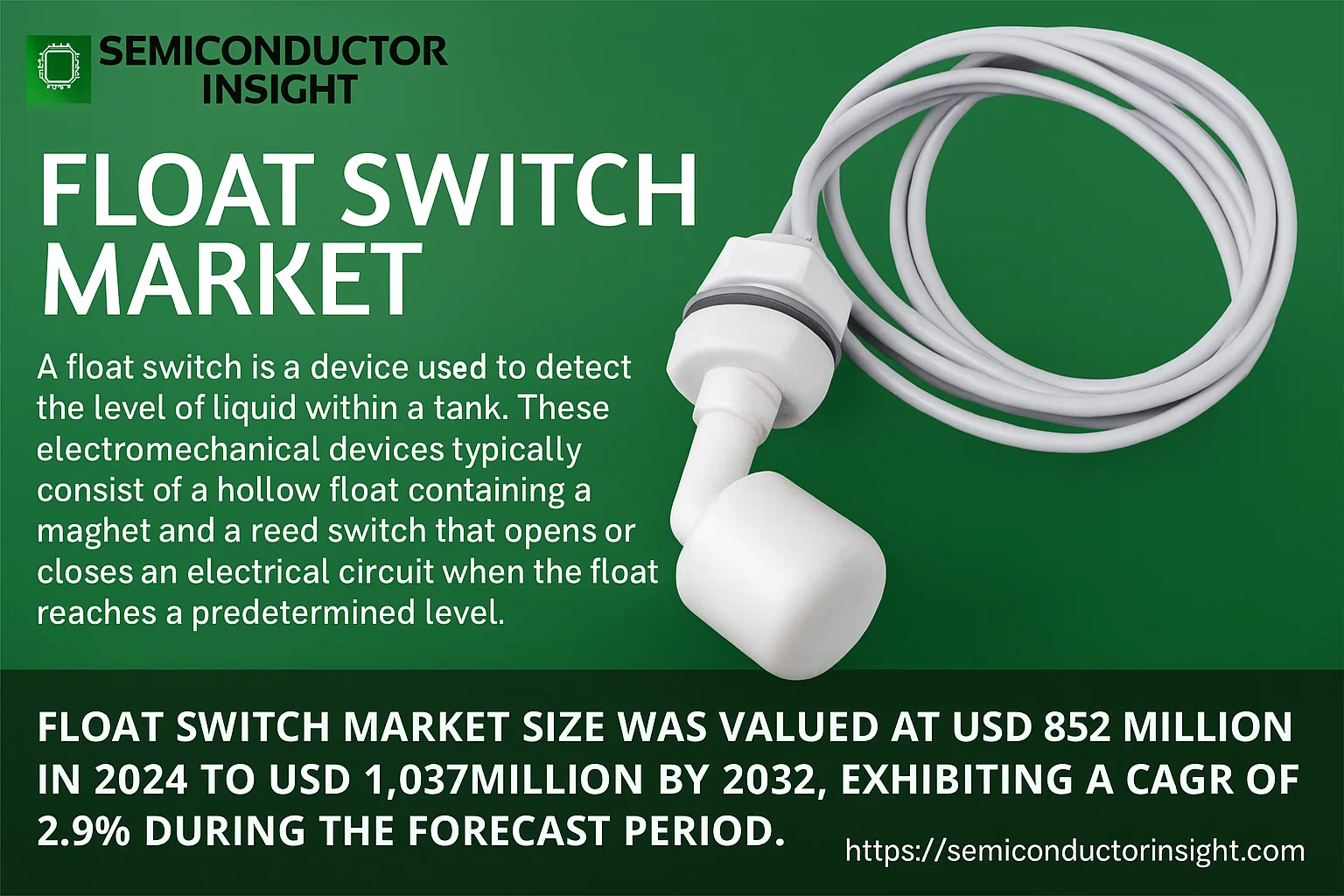
Global Float Switch Market size was valued at USD 852 million in 2024 to USD 1,037 million by 2032, exhibiting a CAGR of 2.9% during the forecast period.
A float switch is a device used to detect the level of liquid within a tank. These electromechanical devices typically consist of a hollow float containing a magnet and a reed switch that opens or closes an electrical circuit when the float reaches a predetermined level. The switch may be used to control pumps, activate indicators, trigger alarms, or interface with other industrial control systems across various applications.
The market is experiencing steady growth driven by increasing demand from water and wastewater treatment facilities, expanding industrial automation, and stringent regulations for liquid level monitoring in process industries. Europe represents the largest regional market with approximately 46% share, while the United States follows with about 23% market share. Key players including GEMS, SJE-Rhombus, WIKA Group, Emerson, and E+H dominate the competitive landscape, with the top three companies collectively occupying around 21% of the global market share. While traditional applications continue to drive demand, emerging opportunities in smart manufacturing and IoT-enabled monitoring systems are creating new growth avenues for advanced float switch technologies.
MARKET DRIVERS
Expansion of Water and Wastewater Treatment Infrastructure
Global investments in upgrading and expanding water and wastewater treatment facilities are a primary driver for the float switch market. These switches are essential components for level monitoring and pump control in tanks, sumps, and basins. Government initiatives aimed at improving sanitation and ensuring water security are fueling this demand, particularly in developing regions.
Industrial Automation and Process Control
The push for Industry 4.0 and smarter manufacturing processes is increasing the adoption of float switches for reliable, low-cost level sensing. They are widely used in industries such as oil & gas, chemicals, and food & beverage to prevent overfills, control pumps, and ensure operational safety. The simplicity and reliability of float switches make them a preferred choice for many basic monitoring applications.
Furthermore, stringent safety regulations mandating the use of level detection devices in industrial equipment to prevent spills and accidents are compelling manufacturers to integrate float switches, thereby driving market growth.
MARKET CHALLENGES
Competition from Advanced Sensor Technologies
Float Switch Market faces significant competition from more advanced, non-contact level sensing technologies such as ultrasonic, radar, and optical sensors. These alternatives often offer higher accuracy, digital communication capabilities, and require less maintenance, appealing to customers seeking sophisticated process control solutions.
Other Challenges
Limitations in Specific Applications
Float switches can be prone to issues like sticking, fouling, and mechanical failure, especially in applications involving viscous fluids, slurries, or corrosive media. This limits their suitability for certain demanding environments and can lead to higher total cost of ownership due to maintenance needs.
Price Sensitivity
The market is highly price-competitive, particularly for standard mechanical float switches. This price pressure can squeeze profit margins for manufacturers and may slow investment in product innovation.
MARKET RESTRAINTSMaturity of the Product Segment
The basic mechanical float switch is a mature technology with limited scope for radical innovation. This maturity can lead to market saturation in certain application areas, restraining overall growth rates as customers may see little reason to frequently replace existing, reliable units.
Economic Volatility Impacting Industrial Investment
Economic downturns and uncertainty can cause delays or cancellations in industrial capital expenditure projects, including those in water treatment, manufacturing, and construction. Since float switches are often specified for new installations or upgrades, a reduction in industrial investment directly restrains market expansion.
MARKET OPPORTUNITIES
Development of Smart and Connected Float Switches
There is a significant opportunity to integrate float switches with IoT capabilities, enabling remote monitoring, predictive maintenance alerts, and data logging. By adding connectivity and smart features, manufacturers can differentiate their products, add value, and tap into the growing demand for industrial IoT solutions.
Growth in Renewable Energy Applications
The expansion of renewable energy sectors, particularly biofuels and hydropower, presents new application areas for float switches. They are used for level control in feedstock tanks, filtration systems, and reservoir management, creating a promising growth avenue as the world transitions to cleaner energy sources.
Focus on Customized Solutions for Niche Applications
Developing customized float switches with specific materials, form factors, or switching mechanisms for challenging environments such as high-temperature, high-pressure, or highly corrosive applications allows manufacturers to target high-margin niche markets less susceptible to price-based competition.
Float Switch Market Trends
Steady Growth Fueled by Industrial Applications
Global Float Switch Market continues on a path of steady growth, with its valuation projected to increase from USD 852 million in 2024 to USD 1037 million by 2032, representing a compound annual growth rate (CAGR) of 2.9%. This consistent expansion is largely driven by the device’s critical function in detecting liquid levels across a diverse range of industries. Float switches are indispensable components in pumps, indicators, and alarm systems, ensuring operational efficiency and safety. The demand is underpinned by ongoing industrial automation and the need for reliable, cost-effective level sensing solutions in process control.
Other Trends
Regional Market Dominance
Europe currently holds the dominant position in the global Float Switch Market, accounting for approximately 46% of the total market share. This leadership is attributed to the region’s stringent industrial safety regulations and advanced manufacturing base. North America, specifically the USA, follows as the second-largest market with a share of about 23%, supported by significant activity in the oil & gas and water treatment sectors. The Asia-Pacific region is viewed as a high-growth market, fueled by rapid industrialization and infrastructure development in countries like China and India.
Segmentation by Application and Type
The market is segmented by application, with key sectors including Oil & Gas, Chemical Industry, Water/Wastewater Processing, Food & Beverage, and Boiler Control. The Water/Wastewater Processing segment represents a major application area due to global emphasis on water conservation and treatment. In terms of product types, the market is divided into Top-Mounted, Side-Mounted, and Special Type float switches, each catering to specific installation requirements and tank configurations.
Consolidated Competitive Landscape
The Float Switch Market features a competitive landscape with a plurality of international and regional players. Key manufacturers include GEMS, SJE-Rhombus, WIKA Group, Emerson, and E+H, among others. The market is moderately fragmented, with the top three companies collectively occupying approximately 21% of the market share. Competition is based on product reliability, technological innovation, price, and global distribution networks. Recent trends involve strategic developments such as product launches and mergers & acquisitions as companies strive to expand their market presence and technological capabilities.
COMPETITIVE LANDSCAPE
Key Industry Players
A Fragmented Market Led by Established Instrumentation Giants
Global float switch market is characterized by a large number of participants, leading to a fragmented competitive environment. This market is led by established global players in instrumentation and process control such as GEMS (part of Fortive), SJE-Rhombus, WIKA Group, Emerson Electric Co., and Endress+Hauser (E+H). These leading companies hold significant market share due to their extensive product portfolios, strong brand recognition, global distribution networks, and focus on technological innovation for applications in critical industries like oil & gas, chemical, and water/wastewater processing. The competitive landscape is driven by factors including product reliability, customization capabilities, and the ability to meet diverse international standards. Despite the presence of major players, the top three companies collectively occupied only about 21% of the market share in 2024, indicating a high level of fragmentation with substantial opportunities for other competitors.
Beyond the market leaders, a host of significant regional and specialized manufacturers compete effectively by targeting specific application niches or offering cost-competitive solutions. Companies like Magnetrol International (a part of AMETEK) are strong in level measurement technology, while Dwyer Instruments offers a broad range of pressure, flow, and level controls. Numerous players from Asia, such as Zhejiang Huanli, Fine Tek, and Towa Seiden, have gained considerable market presence by providing reliable products at competitive price points, catering to a wide range of industrial and commercial applications. Other notable competitors include Kobold, Baumer, Nivelco, and RIKO Float, each contributing to the market’s diversity with specialized products for boiler control, food and beverage, and other industrial sectors.
List of Key Float Switch Companies Profiled
- GEMS (Fortive)
- SJE-Rhombus
- WIKA Group
- Emerson Electric Co.
- Endress+Hauser (E+H)
- Zhejiang Huanli
- ATMI
- Dwyer Instruments
- Magnetrol International (AMETEK)
- RIKO Float
- Fine Tek
- Kobold
- Nivelco
- Baumer
- YOUNGJIN
Segment Analysis:
| Segment Category | Sub-Segments | Key Insights |
| By Type |
|
Top-Mounted Type is considered the leading segment due to its widespread applicability across numerous standard tank designs, offering straightforward installation and reliable performance for general-purpose liquid level detection tasks. The Side-Mounted Type presents a strong alternative for applications with specific space constraints or side-access requirements, finding significant use in compact systems. Meanwhile, the Special Type segment addresses niche and highly demanding applications that require custom solutions for corrosive media, high-pressure environments, or unique operational parameters, representing a critical segment for specialized industrial needs. |
| By Application |
|
Water/Wastewater Processing represents the leading application segment, driven by extensive global infrastructure needs for clean water supply and environmental management, where float switches are essential for pump control and alarm systems in treatment plants and reservoirs. The Oil & Gas Industry is a major consumer, relying on robust and reliable float switches for level monitoring in tanks and separators, often requiring explosion-proof certifications. The Chemical Industry demands highly specialized switches constructed from materials resistant to aggressive substances, while the Food & Beverage sector prioritizes switches that meet stringent hygiene standards. Boiler Control applications utilize float switches for low-water cutoff safety functions. |
| By End User |
|
Industrial Manufacturing stands as the leading end-user segment, encompassing a vast range of industries from chemicals to food production, all requiring precise liquid level control for process efficiency and safety. The Municipal & Utility Sector is a dominant force, driven by continuous investment in public water and wastewater treatment infrastructure, where float switches are critical components for managing large-scale systems. The Commercial & Residential Buildings segment utilizes float switches in applications such as sump pumps, water tanks, and HVAC systems, representing a steady market driven by construction and maintenance activities. |
| By Technology |
|
Mechanical Float Switches remain the leading technology segment due to their simplicity, reliability, cost-effectiveness, and ease of maintenance, making them the preferred choice for a vast majority of standard applications. The adoption of Electronic/Non-Contact Switches is growing steadily, particularly in scenarios requiring higher precision, digital integration with control systems, or where there is no direct contact with the liquid, such as in aggressive chemical environments. Hybrid Systems that combine mechanical robustness with electronic signaling capabilities are emerging to meet the demand for smarter, more versatile level detection solutions. |
| By Material |
|
Stainless Steel is the leading material segment, prized for its excellent corrosion resistance, durability, and ability to withstand high pressures and temperatures, making it suitable for the demanding conditions of the oil & gas, chemical, and food processing industries. Plastic/Polypropylene switches are widely used in cost-sensitive and less corrosive applications like water and wastewater treatment, offering good chemical resistance at a lower price point. Other Specialized Alloyssuch as Hastelloy or Teflon-coated components cater to the most aggressive media in specialized chemical processes, representing a critical high-value niche. |
Regional Analysis: Float Switch Market
The dense concentration of manufacturing facilities across the Asia-Pacific region creates a constant, high-volume demand for float switches used in cooling systems, tanks, and processing equipment. The push towards Industry 4.0 and automation in countries like Japan and South Korea is also integrating more sophisticated level control into production lines.
Massive ongoing infrastructure projects, particularly in water treatment plants, desalination facilities, and public water supply systems, are key drivers. Governments are prioritizing these projects to support growing urban populations, directly fueling the adoption of float switches for pump control and overflow prevention.
Agriculture remains a cornerstone of many economies in the region. Float switches are essential for managing water levels in irrigation reservoirs, storage tanks, and aquaculture systems. This widespread agricultural application provides a stable and significant market segment that is less susceptible to economic fluctuations.
A highly competitive local manufacturing ecosystem keeps product costs competitive while ensuring a steady supply. This allows for quick adaptation to market demands and the development of cost-effective solutions tailored to the specific needs of diverse industries within the region, from simple mechanical switches to more advanced versions.
North America
The North American float switch market is characterized by a high degree of technological maturity and stringent regulatory standards, particularly in the water treatment and oil & gas sectors. Demand is strongly driven by the need for reliable level sensing in municipal water systems, industrial process control, and environmental protection applications. The region has a strong focus on replacing aging infrastructure with more efficient and reliable components, including advanced float switches with enhanced durability and communication capabilities. The presence of major end-user industries and a culture of proactive maintenance supports a steady market. Furthermore, strict safety regulations governing liquid containment in chemical processing and fuel storage create a non-discretionary demand for certified level control devices.
Europe
Europe’s market is influenced by robust environmental directives and a well-established industrial base, particularly in Germany, France, and Italy. The region shows significant demand from the water and wastewater industry, driven by EU-wide regulations aimed at water conservation and pollution control. There is also strong uptake in the food & beverage and pharmaceutical sectors, where hygiene and precision are paramount, favoring high-quality float switches. The market is transitioning towards smart devices that can integrate with IoT platforms for predictive maintenance and remote monitoring. While growth is steady, it is often tempered by the high penetration of existing systems and a slower rate of new industrial facility construction compared to emerging markets.
South America
The float switch market in South America is growing, fueled primarily by investments in mining, oil extraction, and agricultural infrastructure. Countries like Brazil and Chile are key contributors, where float switches are critical for controlling water levels in mining operations and managing large-scale irrigation projects. The market is price-sensitive, with a preference for durable and cost-effective solutions that can withstand harsh operational environments. Development is somewhat uneven, often linked to the economic stability and public investment cycles of individual countries. The need for basic level control in expanding urban water systems also presents ongoing opportunities for market growth.
Middle East & Africa
This region presents a market with distinct drivers, centered heavily around the oil & gas industry and water scarcity challenges. In the Gulf Cooperation Council (GCC) countries, float switches are essential for various applications in petrochemical plants and desalination facilities, which are critical to the region’s economy and water supply. In Africa, the market is more nascent, with growth potential linked to development in agriculture and gradual improvements in water infrastructure. The harsh climatic conditions demand robust and reliable switches. Market development varies significantly, with advanced demand in oil-rich nations and more basic, growing demand in other parts of Africa focused on essential water management.
Report Scope
This market research report provides a comprehensive analysis of the Float Switch Market , covering the forecast period 2025–2032. It offers detailed insights into market dynamics, technological advancements, competitive landscape, and key trends shaping the industry.
Key focus areas of the report include:
- Market Overview: The report begins with an overview outlining its current market scenario, key growth indicators, and industry transformation drivers. It discusses macroeconomic factors, demand–supply balance, regulatory landscape, and the strategic role of semiconductors in powering advancements across industries such as automotive, telecommunications, consumer electronics, and industrial automation.
- Market Size & Forecast: Historical data and future projections for revenue, unit shipments, and market value across major regions and segments.
- Segmentation Analysis: Detailed breakdown by product type, technology, application, and end-user industry to identify high-growth segments and investment opportunities.
- Regional Insights: Insights into market performance across North America, Europe, Asia-Pacific, Latin America, and the Middle East & Africa, including country-level analysis where relevant.
- Competitive Landscape: Profiles of leading market participants, including their product offerings, R&D focus, manufacturing capacity, pricing strategies, and recent developments such as mergers, acquisitions, and partnerships.
- Technology Trends & Innovation: Assessment of emerging technologies, integration of AI/IoT, semiconductor design trends, fabrication techniques, and evolving industry standards.
- Market Drivers & Restraints: Evaluation of factors driving market growth along with challenges, supply chain constraints, regulatory issues, and market-entry barriers.
- Stakeholder Insights: Insights for component suppliers, OEMs, system integrators, investors, and policymakers regarding the evolving ecosystem and strategic opportunities.
Primary and secondary research methods are employed, including interviews with industry experts, data from verified sources, and real-time market intelligence to ensure the accuracy and reliability of the insights presented.
FREQUENTLY ASKED QUESTIONS:
What is the current market size of Float Switch Market?
-> Float Switch Market size was valued at USD 852 million in 2024 to USD 1,037 million by 2032, exhibiting a CAGR of 2.9% during the forecast period..
Which key companies operate in Float Switch Market?
-> Key players include GEMS, SJE-Rhombus, WIKA Group, Emerson, E+H, Zhejiang Huanli, ATMI, Dwyer, Magnetrol, RIKO Float, Fine Tek, Kobold, Nivelco, Baumer, YOUNGJIN, Towa Seiden, Madison, SMD Fluid Controls, Besta, Hy Control, Emco Control, XiFulai, Zhejiang KRIPAL, among others.
What are the key growth drivers?
-> Key growth drivers include increasing demand from key applications such as water/wastewater processing, oil & gas industry, and chemical industry, alongside ongoing industrial automation trends.
Which region dominates the market?
-> Europe is the largest Float Switch Market with about 46% market share.
What is a Float Switch?
-> A float switch is a device used to detect the level of liquid within a tank. The switch may be used in a pump, an indicator, an alarm, or other devices.

Get Sample Report PDF for Exclusive Insights
Report Sample Includes
- Table of Contents
- List of Tables & Figures
- Charts, Research Methodology, and more...