
Market Insights
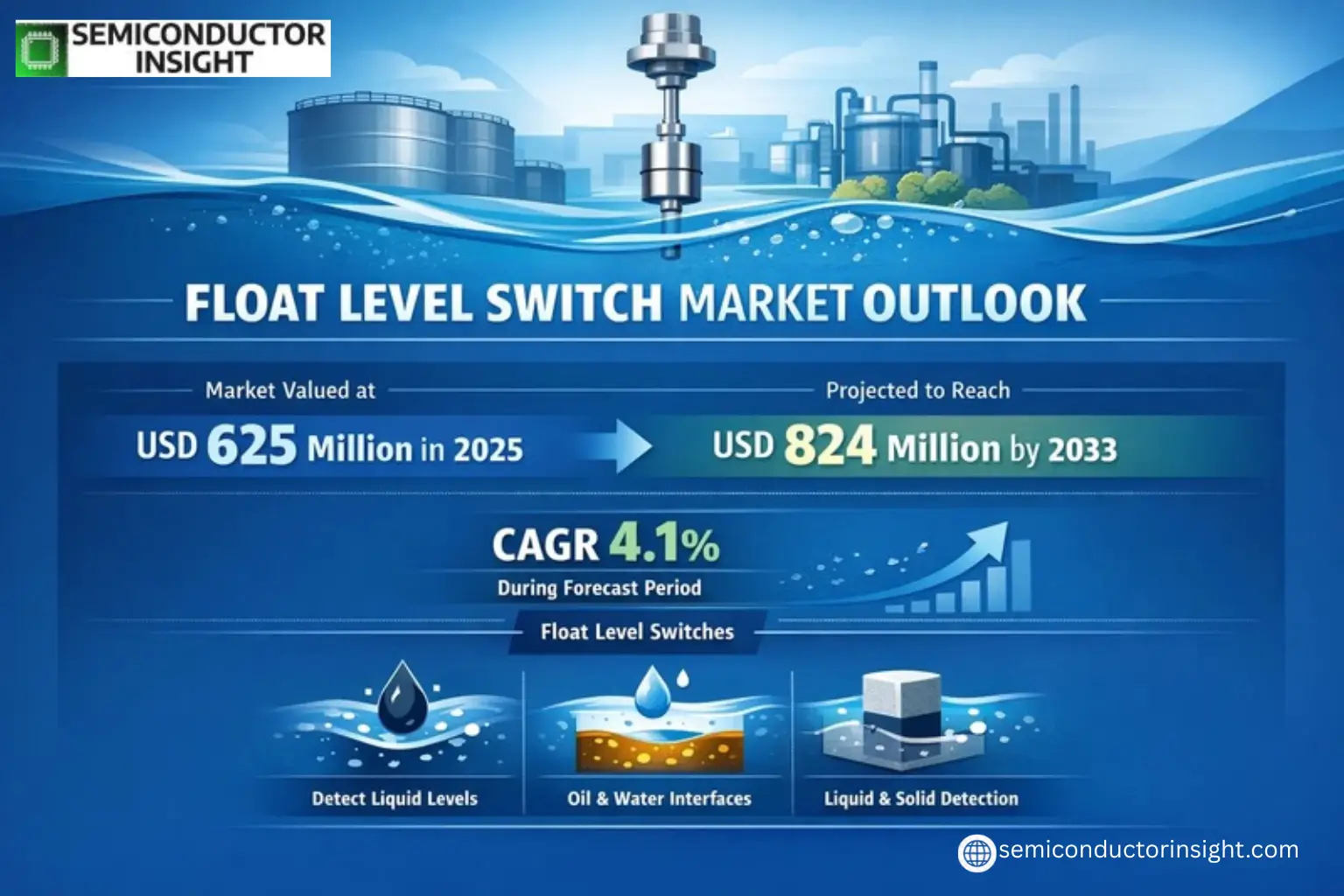
Global Float Level Switch Market was valued at USD 625 million in 2025 and is projected to reach USD 824 million by 2033, exhibiting a CAGR of 4.1% during the forecast period.
Float Level Switches are devices designed to detect liquid levels or interfaces between liquids, such as oil and water, or between liquids and solids. These switches are widely used in applications like flow line monitoring, heaters, furnaces, and other liquid container monitoring systems. The technology operates on a simple mechanical principle where a buoyant float rises or falls with the liquid level, triggering an electrical switch.
The market growth is driven by increasing industrial automation across sectors like oil & gas, chemical processing, and water treatment. Europe and North America currently dominate the market with a combined share of approximately 60%, while Asia-Pacific shows promising growth potential due to rapid industrialization. The top-mounted type segment holds over 60% market share due to its reliability in various industrial applications. Key players including GEMS, Emerson, and WIKA Group collectively account for more than 70% of global sales revenue.
MARKET DRIVERS
Growing Industrial Automation Demand
Float Level Switch Market is experiencing significant growth driven by increasing adoption of industrial automation across sectors like oil & gas, water treatment, and chemical processing. Automated systems rely heavily on precise level monitoring, where Float Level Switches provide cost-effective and reliable solutions. Global industrial automation market is projected to grow at 9% CAGR, directly boosting demand for level sensing technologies.
Stringent Safety Regulations
Regulatory requirements in process industries are mandating improved safety measures, including reliable liquid level detection. Float Level Switches help prevent overflows, leaks, and equipment damage, making them essential for compliance with standards like API 2350 for overfill prevention. This regulatory push is creating sustained demand across multiple verticals.
The water and wastewater treatment sector accounts for over 30% of float level switch applications, with urbanization and infrastructure development projects fueling this demand globally.
MARKET CHALLENGES
Competition from Advanced Technologies
Float Level Switches face growing competition from ultrasonic and radar level sensors that offer non-contact measurement. While float switches maintain advantages in cost and simplicity, their market share is under pressure in applications requiring higher precision or harsh environment performance.
Other Challenges
Material Compatibility Issues
Selecting appropriate materials for float switches remains challenging in corrosive or high-temperature applications, requiring specialized alloys that increase product costs significantly.
Maintenance Requirements
Mechanical wear in float switches leads to higher maintenance needs compared to solid-state alternatives, particularly in applications with frequent level fluctuations or viscous liquids.
MARKET RESTRAINTS
Price Sensitivity in Emerging Markets
While Float Level Switches are among the most economical level detection solutions, price sensitivity in developing regions limits adoption of premium variants with enhanced features. This restraint is particularly evident in the agricultural and small-scale industrial sectors where basic mechanical switches dominate.
Limited Accuracy for Some Applications
The inherent mechanical nature of float switches imposes accuracy limitations compared to electronic sensors. This restraint affects adoption in precision applications such as pharmaceutical manufacturing and high-value chemical processing.
MARKET OPPORTUNITIES
Smart Float Switch Development
Integration of IoT capabilities and wireless communication presents significant growth potential for the Float Level Switch Market. Smart float switches with remote monitoring features are gaining traction in large-scale industrial facilities, creating a premium product segment growing at 18% annually.
Expansion in Renewable Energy Sector
The renewable energy sector, particularly biogas plants and solar thermal systems, requires reliable level detection for various liquids. Float Level Switches are finding new applications in these growing industries, with deployment expected to increase by 22% over the next five years.
Float Level Switch Market Trends
Steady Growth Projected for Float Level Switch Market
Global Float Level Switch market is experiencing consistent growth, valued at USD 625 million in 2025 with projections reaching USD 824 million by 2033. This represents a compound annual growth rate of 4.1% during the forecast period. The market expansion is driven by increasing industrial automation and demand for reliable liquid level monitoring across key verticals.
Other Trends
Dominance of Key Players and Regional Markets
Six major manufacturers including GEMS, SJE-Rhombus, and WIKA Group collectively hold over 70% of the global Float Level Switch market share. Europe and North America remain dominant regions, accounting for approximately 60% of total market revenue. This concentration reflects established industrial infrastructure and stringent safety regulations in these regions.
Product and Application Segmentation
Top-mounted float switches maintain market leadership with over 60% share due to their reliability in critical applications. The oil & gas and chemical industries are primary end-users, representing more than half of total demand. These sectors require robust level detection for process control and safety compliance, driving continued adoption of float switch technology.
Emerging Opportunities
Water/wastewater processing and food & beverage applications show increasing potential, with growing focus on environmental regulations and process automation. Manufacturers are developing specialized switches with enhanced materials and connectivity features to serve these evolving market needs while maintaining reliability in harsh operating conditions.
Future Market Considerations
The industry faces challenges including price competition and the need for product innovations to address diverse application requirements. However, ongoing industrialization in emerging markets and the integration of IoT capabilities present significant growth opportunities for Float Level Switch providers in the coming years.
COMPETITIVE LANDSCAPE
Key Industry Players
Dominance of Top 6 Players in the Global Float Level Switch Market
Global Float Level Switch Market is highly consolidated, with the top six players holding over 70% market share. GEMS, SJE-Rhombus, and WIKA Group lead the industry with their extensive product portfolios and strong distribution networks. Emerson and Endress+Hauser (E+H) follow closely, leveraging their advanced technological capabilities in industrial automation. These established players primarily serve the oil & gas and chemical industries, which account for more than 50% of the market demand.
Niche players like Zhejiang Huanli and Magnetrol have carved out strong positions in regional markets with specialized offerings. Emerging Asian manufacturers such as Fine Tek and Zhejiang KRIPAL are gaining traction through cost-effective solutions for water treatment and food processing applications. Europe and North America remain the largest markets, but Asia-Pacific is witnessing faster growth due to increasing industrialization.
List of Key Float Level Switch Companies Profiled
- GEMS
- SJE-Rhombus
- WIKA Group
- Emerson
- Endress+Hauser (E+H)
- Zhejiang Huanli
- ATMI
- Dwyer
- Magnetrol
- RIKO Float
- Fine Tek
- Kobold
- Nivelco
- Baumer
- Towa Seiden
Segment Analysis:
| Segment Category | Sub-Segments | Key Insights |
| By Type |
|
Top-mounted Type dominates the Float Level Switch Market due to its widespread adoption in industrial settings.
|
| By Application |
|
Oil & Gas Industry remains the largest application segment for Float Level Switches.
|
| By End User |
|
Industrial Manufacturing accounts for the majority of float level switch demand.
|
| By Mounting Configuration |
|
Vertical Mount configuration is most prevalent in industrial applications.
|
| By Material |
|
Stainless Steel dominates material preferences for Float Level Switches.
|
Regional Analysis: Float Level Switch Market
Municipal water systems across the U.S. and Canada are upgrading aging infrastructure with smart Float Level Switches featuring wireless monitoring capabilities, driving premium product demand through 2030.
Rising adoption of automated liquid level control in fracking operations and storage terminals boosts sales of explosion-proof float switches designed for hazardous zones in hydrocarbon processing.
Strict FDA compliance requirements accelerate development of hygienic Float Level Switches with 3-A sanitary certifications for dairy, beverage, and pharmaceutical manufacturing applications.
Biofuel production facilities and solar thermal plants increasingly incorporate multi-point float switches for precise fluid level management in sustainable energy generation systems.
Europe
Europe maintains strong float level switch demand driven by EU directives on industrial equipment safety and water conservation. Germany’s mechanical engineering sector produces high-precision switches for chemical processing, while Scandinavian countries lead in marine-grade applications. Circular economy policies accelerate adoption in recycling plants and wastewater recovery systems. Stricter ATEX certification requirements create barriers for non-European manufacturers but ensure premium pricing for compliant products.
Asia-Pacific
Rapid industrialization fuels Float Level Switch Market growth across Southeast Asia’s emerging economies. China dominates regional production with cost-competitive offerings, while Japan leads in high-reliability designs for earthquake-prone areas. India’s expanding chemical manufacturing sector drives demand for corrosion-resistant switches. Water scarcity concerns in Middle Eastern countries boost adoption in desalination plants, though price sensitivity remains a key market characteristic.
South America
Mining operations and agriculture drive float switch requirements across Andean nations, with Chile and Peru as growth hotspots. Brazil’s oil refineries and ethanol plants utilize specialized switches for biofuel applications. Economic volatility sometimes delays capital expenditures on instrumentation upgrades, but replacement demand remains steady across industrial facilities.
Middle East & Africa
Gulf Cooperation Council countries invest heavily in float switches for oil storage terminals and petrochemical complexes. South Africa’s mining sector and North African water projects sustain stable demand. Market fragmentation exists between premium imports for oil/gas applications and budget switches for basic water monitoring needs.
Report Scope
This market research report provides a comprehensive analysis of the Float Level Switch Market , covering the forecast period 2025–2033. It offers detailed insights into market dynamics, technological advancements, competitive landscape, and key trends shaping the industry.
Key focus areas of the report include:
- Market Overview: The report begins with an overview outlining its current market scenario, key growth indicators, and industry transformation drivers. It discusses macroeconomic factors, demand–supply balance, regulatory landscape, and the strategic role of Float Level Switches in liquid level monitoring across industries such as oil & gas, chemical processing, water treatment, and food & beverage.
- Market Size & Forecast: Historical data and future projections for revenue, unit shipments, and market value across major regions and segments.
- Segmentation Analysis: Detailed breakdown by product type, technology, application, and end-user industry to identify high-growth segments and investment opportunities.
- Regional Insights: Insights into market performance across North America, Europe, Asia-Pacific, Latin America, and the Middle East & Africa, including country-level analysis where relevant.
- Competitive Landscape: Profiles of leading market participants, including their product offerings, R&D focus, manufacturing capacity, pricing strategies, and recent developments such as mergers, acquisitions, and partnerships.
- Technology Trends & Innovation: Assessment of emerging technologies, integration of IoT in liquid level monitoring, and evolving industry standards.
- Market Drivers & Restraints: Evaluation of factors driving market growth along with challenges, supply chain constraints, regulatory issues, and market-entry barriers.
- Stakeholder Insights: Insights for component suppliers, OEMs, system integrators, investors, and policymakers regarding the evolving ecosystem and strategic opportunities.
Primary and secondary research methods are employed, including interviews with industry experts, data from verified sources, and real-time market intelligence to ensure the accuracy and reliability of the insights presented.
FREQUENTLY ASKED QUESTIONS:
What is the current market size of Float Level Switch Market?
-> Float Level Switch Market was valued at USD 625 million in 2025 and is projected to reach USD 824 million by 2033, exhibiting a CAGR of 4.1% during the forecast period.
Which key companies operate in Float Level Switch Market?
-> Key players include GEMS, SJE-Rhombus, WIKA Group, Emerson, E+H, and Zhejiang Huanli, among others. The top 6 players hold over 70% of global market share.
What are the key applications of Float Level Switches?
-> Key applications include Oil & Gas Industry (30% share), Chemical Industry (20% share), Water/Wastewater Processing, Food & Beverage, and Boiler Control.
Which region dominates the market?
-> Europe and North America are the main markets, occupying about 60% of the global market share.
What is the most common product type?
-> Top-mounted Type is the dominant product type, holding over 60% market share.

Get Sample Report PDF for Exclusive Insights
Report Sample Includes
- Table of Contents
- List of Tables & Figures
- Charts, Research Methodology, and more...
 Download Sample Report PDF


