Flexible Hybrid Electronics Market Insights
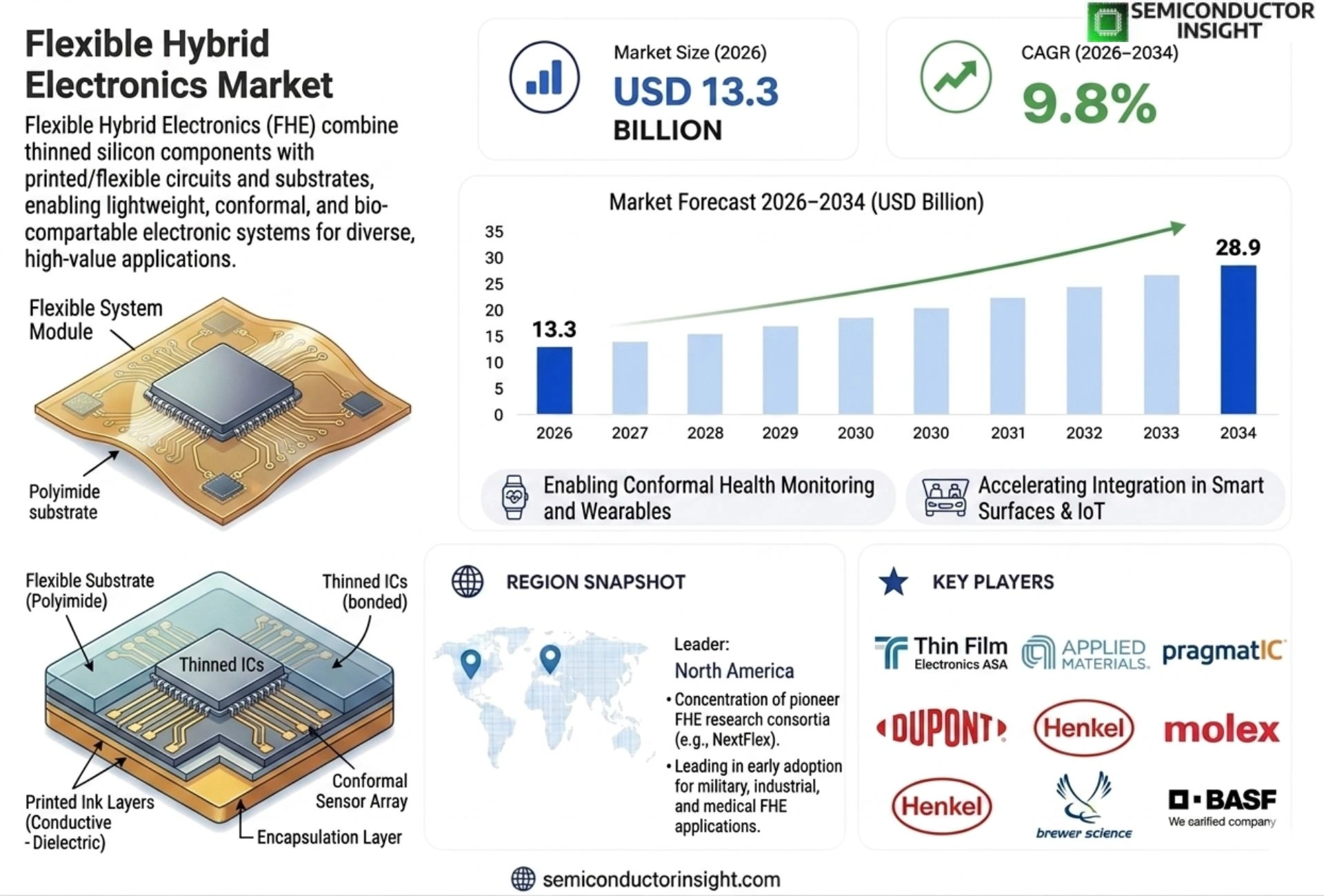
Global Flexible Hybrid Electronics Market size was valued at USD 12.5 billion in 2025. The market is projected to grow from USD 13.3 billion in 2026 to USD 28.9 billion by 2034, exhibiting a CAGR of 9.8% during the forecast period.
Flexible hybrid electronics combine traditional silicon‑based integrated circuits with stretchable or bendable substrates such as polyimide or thermoplastic polyurethane, enabling electronic functions on surfaces that can conform, fold or stretch while maintaining high performance.
The market is experiencing rapid growth due to several factors, including rising demand for wearable health monitors, expansion of Internet‑of‑Things (IoT) devices in smart textiles.
MARKET DRIVERS
Rising Demand for Wearable Devices
Flexible Hybrid Electronics Market is being propelled by the rapid adoption of wearable health monitors, smart textiles, and flexible displays. Consumers seek devices that conform to the body, offering comfort while delivering real‑time data, which drives manufacturers to invest in thin‑film sensors and stretchable circuits.
Advancements in Material Science
Breakthroughs in conductive polymers, graphene inks, and low‑temperature processing enable large‑area roll‑to‑roll production. These materials reduce mechanical fatigue and improve reliability, allowing new form‑factors that were previously unattainable for traditional rigid electronics.
➤ “Hybrid flexibility combined with high performance is reshaping product design across consumer and industrial sectors.”
In addition, the push for environmentally friendly manufacturing techniques aligns with corporate sustainability goals, further accelerating growth Flexible Hybrid Electronics Market.
MARKET CHALLENGES
Manufacturing Complexity
Integrating delicate organic layers with conventional silicon components requires precise alignment and temperature control, leading to longer cycle times and higher defect rates. Small‑batch production remains expensive compared with established silicon processes.
Other Challenges
Regulatory Hurdles
Medical and automotive applications must meet stringent safety certifications, which adds testing costs and can delay time‑to‑market for innovative flexible products.
MARKET RESTRAINTS
High Production Costs
The need for specialized equipment, such as precision laminators and vacuum deposition tools, raises capital expenditure. Coupled with low yields in early‑stage fabrication, cost pressures limit the ability of smaller firms to compete.
Supply Chain Constraints
Critical raw materials like silver nanowires and stretchable substrates face supply bottlenecks, especially when demand spikes in unrelated sectors such as flexible solar panels.
Limited Standardization
Absence of industry‑wide design rules and testing protocols creates interoperability issues, deterring OEMs from committing large volumes to flexible hybrid solutions.
MARKET OPPORTUNITIES
Growth in Healthcare Applications
Flexible sensors that monitor cardiac rhythm, glucose levels, and motion are gaining clinical acceptance, opening a sizable segment for Flexible Hybrid Electronics Market as hospitals adopt personalized monitoring systems.
Expansion in Automotive Sector
Automakers are exploring conformal electrodes for smart interiors and edge‑lighting systems, where curvature and durability are paramount. This creates lucrative contracts for suppliers capable of meeting automotive‑grade reliability.
Emerging IoT Integration
Embedding flexible hybrid modules into smart packaging, environmental sensors, and wear‑compatible IoT nodes enables ubiquitous data collection, positioning the market for sustained long‑term expansion.
Flexible Hybrid Electronics Market Trends
Wearable Health Monitoring
Flexible Hybrid Electronics Market is being shaped by the rapid adoption of wearable health monitors that require conformal, high‑performance circuitry. Advances in stretchable substrate materials such as polyimide and thermoplastic polyurethane enable sensors to attach directly to skin or fabric while preserving signal integrity. Manufacturers are integrating these hybrid platforms into continuous glucose monitors, cardiac rhythm trackers, and motion‑analysis patches, creating products that can endure daily flexing without degradation. This trend is reinforced by increasing consumer awareness of preventive health, prompting device makers to prioritize ergonomics and data accuracy. As a result, design cycles have shortened, and supply chains are adapting to source both silicon chips and flexible interconnects in parallel.
Other Trends
Smart Textile Integration
WithFlexible Hybrid Electronics Market, smart textile applications represent a second major growth vector. By embedding hybrid circuits into woven fibers, garment manufacturers can produce jackets that monitor temperature, humidity, and biometric signals in real time. The technology leverages low‑profile antennas and thin‑film batteries that conform to the garment’s drape, eliminating the need for rigid modules. Pilot projects in athletic apparel and occupational safety gear have demonstrated measurable improvements in user comfort and data reliability. Production methods such as roll‑to‑roll printing and laser‑direct structuring are being scaled to meet demand, allowing large‑volume manufacturers to embed functionality without compromising textile aesthetics.
Flexible Energy Harvesting
Energy autonomy is emerging as a decisive factor for Flexible Hybrid Electronics Market, prompting investment in flexible energy‑harvesting solutions. Researchers are embedding piezoelectric polymers and thin‑film photovoltaics into the same substrate that carries the active circuitry, enabling devices to capture kinetic motion or ambient light. This integration reduces reliance on traditional batteries and extends operational lifespans for remote sensors and wearable devices. Early field trials in logistics tracking tags and sports equipment have shown that harvested power can sustain low‑energy communication modules for weeks, supporting the broader industry shift toward self‑powered, maintain‑less electronics. The convergence of harvesting technologies with hybrid circuitry is expected to unlock new use cases across healthcare, industrial IoT, and consumer wearables.
COMPETITIVE LANDSCAPE
Key Industry Players
Flexible Hybrid Electronics Market: Navigating a Rapidly Evolving Competitive Terrain Driven by Wearable Technology, IoT Integration, and Advanced Substrate Innovation
Flexible Hybrid Electronics Market is characterized by a dynamic and increasingly competitive landscape, with a blend of established semiconductor giants, specialized printed electronics firms, and agile start-ups vying for strategic positioning. Leading the competitive space, companies such as General Electric, Honeywell International, and 3M Company leverage their vast R&D capabilities, diversified product portfolios, and established supply chain networks to maintain significant market presence. These incumbents are heavily investing in next-generation FHE solutions that integrate silicon-based integrated circuits onto flexible substrates such as polyimide and thermoplastic polyurethane, targeting high-growth end-use sectors including wearable health monitoring, smart textiles, and industrial IoT applications. Strategic partnerships, mergers, and collaborative development agreements with academic institutions and government-backed research programs , particularly under initiatives such as the FlexTech Alliance in the United States , are further intensifying competitive differentiation among top-tier players.
Beyond the dominant players, a robust ecosystem of niche and emerging competitors is reshaping Flexible Hybrid Electronics Market by focusing on specialized application segments. Companies including Bbend Labs, Brewer Science, and Carestream Health are carving out competitive advantages through proprietary materials science, novel deposition technologies, and tailored FHE solutions for medical wearables, defense electronics, and consumer devices. Meanwhile, firms such as Molex LLC and Vorbeck Materials are advancing conductive ink formulations and stretchable interconnect technologies that address critical manufacturing scalability challenges. The combined competitive pressure from these specialized players is accelerating innovation cycles, reducing unit costs, and expanding the addressable market, ultimately reinforcing the sector’s projected trajectory from USD 13.3 billion in 2026 to USD 28.9 billion by 2034 at a CAGR of 9.8%.
List of Key Flexible Hybrid Electronics Companies Profiled
- General Electric Company
- Honeywell International Inc.
- 3M Company
- Molex LLC
- Brewer Science Inc.
- Bend Labs Inc.
- Carestream Health Inc.
- Vorbeck Materials Corp.
- DuPont de Nemours Inc.
- Panasonic Corporation
- Samsung Electro-Mechanics Co., Ltd.
- Flex Ltd.
- Jabil Inc.
- Novatek Microelectronics Corp.
- MC10 Inc.
Segment Analysis:
| Segment Category | Sub-Segments | Key Insights |
| By Type |
|
Organic Thin‑Film
|
| By Application |
|
Wearable Health Monitors
|
| By End User |
|
Consumer Electronics
|
| By Technology |
|
Conductive Ink Printing
|
| By Market Driver |
|
Demand for Miniaturization
|
Regional Analysis: North America
United States
The aerospace and defense sectors are actively exploring the integration of flexible electronics for applications such as conformal sensors, lightweight displays, and smart armor. The ability of FHE to withstand extreme conditions and conform to complex geometries makes it particularly well-suited for these demanding environments.
The automotive industry is witnessing increasing interest in FHE for applications like flexible displays integrated into dashboards, conformable sensors for structural health monitoring, and printable electronics for customized vehicle components. The demand for lightweight and adaptable electronic systems is a key driver in this segment.
The healthcare sector is a significant adopter of FHE, utilizing it in wearable health monitors, implantable sensors for continuous patient monitoring, and flexible diagnostic devices. The biocompatibility and conformability of FHE are crucial factors in these applications.
Flexible displays, wearable devices, and smart accessories are driving adoption of FHE in consumer electronics. The ability to create bendable and adaptable devices opens up new design possibilities and enhances user experience.
Europe
Europe represents a substantial and maturing market for Flexible Hybrid Electronics. Driven by strong government support for research and development, particularly within the European Union’s Horizon initiatives, the region is witnessing significant advancements in FHE technologies. Key application areas include automotive, healthcare, and industrial automation. European players are focusing on developing sustainable and eco-friendly FHE solutions, aligning with the region’s broader environmental objectives. Business strategies often emphasize collaboration between research institutions and industry partners, fostering a vibrant innovation ecosystem. The focus on high-quality manufacturing and stringent regulatory standards further shapes the European FHE market. The demand for energy-efficient and miniaturized electronic components is a key driver of growth.
Asia-Pacific
Asia-Pacific is emerging as the fastest-growing market for Flexible Hybrid Electronics, propelled by rapid industrialization and increasing investment in technology. Countries like China, Japan, and South Korea are leading the charge, with significant government initiatives supporting the development and manufacturing of FHE. The automotive and consumer electronics sectors are major consumers of FHE in this region. Business strategies often involve localized manufacturing and strong partnerships with regional players. The focus on cost-effective production and mass adoption is a key characteristic of the Asia-Pacific FHE market. The expanding IoT infrastructure and the growth of smart cities are further fueling demand.
South America
Flexible Hybrid Electronics Market in South America is at an earlier stage of development compared to North America, Europe, and Asia-Pacific. However, increasing investments in infrastructure and manufacturing are creating opportunities for growth. Key application areas include agriculture, healthcare, and industrial applications. The demand for cost-effective and adaptable electronic solutions is driving adoption. Business strategies often involve adapting technologies to meet the specific needs of the regional market. Government initiatives focused on technological advancement are expected to further stimulate market growth.
Middle East & Africa
The Middle East & Africa region presents a promising but relatively nascent market for Flexible Hybrid Electronics. Growing investments in infrastructure development, particularly in areas like smart cities and renewable energy, are creating opportunities for FHE applications. The automotive and aerospace sectors are also showing increasing interest in flexible electronics. Business strategies often involve partnerships with international technology providers and a focus on localized manufacturing. The demand for robust and adaptable electronic systems in challenging environmental conditions is a key driver in this region.
Report Scope
This market research report provides a comprehensive analysis of the Flexible Hybrid Electronics Market , covering the forecast period 2026–2034. It offers detailed insights into market dynamics, technological advancements, competitive landscape, and key trends shaping the industry.
Key focus areas of the report include:
- Market Overview: The report begins with an overview outlining its current market scenario, key growth indicators, and industry transformation drivers. It discusses macroeconomic factors, demand–supply balance, regulatory landscape, and the strategic role of semiconductors in powering advancements across industries such as automotive, telecommunications, consumer electronics, and industrial automation.
- Market Size & Forecast: Historical data and future projections for revenue, unit shipments, and market value across major regions and segments.
- Segmentation Analysis: Detailed breakdown by product type, technology, application, and end-user industry to identify high-growth segments and investment opportunities.
- Regional Insights: Insights into market performance across North America, Europe, Asia-Pacific, Latin America, and the Middle East & Africa, including country-level analysis where relevant.
- Competitive Landscape: Profiles of leading market participants, including their product offerings, R&D focus, manufacturing capacity, pricing strategies, and recent developments such as mergers, acquisitions, and partnerships.
- Technology Trends & Innovation: Assessment of emerging technologies, integration of AI/IoT, semiconductor design trends, fabrication techniques, and evolving industry standards.
- Market Drivers & Restraints: Evaluation of factors driving market growth along with challenges, supply chain constraints, regulatory issues, and market-entry barriers.
- Stakeholder Insights: Insights for component suppliers, OEMs, system integrators, investors, and policymakers regarding the evolving ecosystem and strategic opportunities.
Primary and secondary research methods are employed, including interviews with industry experts, data from verified sources, and real-time market intelligence to ensure the accuracy and reliability of the insights presented.
FREQUENTLY ASKED QUESTIONS:
What is the current market size of Flexible Hybrid Electronics Market?
-> Flexible Hybrid Electronics Market was valued at USD 12.5 billion in 2025 and is expected to reach USD 28.9 billion by 2034, reflecting a CAGR of 9.8% over the forecast period.
Which key companies operate Flexible Hybrid Electronics Market?
-> Key players include DuPont, Samsung Electronics, Flex Ltd., Toppan Printing, and Rohm Co., Ltd.
What are the key growth drivers?
-> Key growth drivers include rising demand for wearable health monitors, expansion of Internet‑of‑Things (IoT) devices in smart textiles, and increasing adoption of stretchable and printable electronic technologies.
Which region dominates the market?
-> Asia‑Pacific is the fastest‑growing region, while Europe remains a dominant market due to strong industrial adoption.
What are the emerging trends?
-> Emerging trends include integration of AI/IoT for smart flexible sensors, development of biodegradable stretchable substrates, and advances in printed circuit manufacturing techniques.

Get Sample Report PDF for Exclusive Insights
Report Sample Includes
- Table of Contents
- List of Tables & Figures
- Charts, Research Methodology, and more...
 Download Sample Report PDF