MARKET INSIGHTS
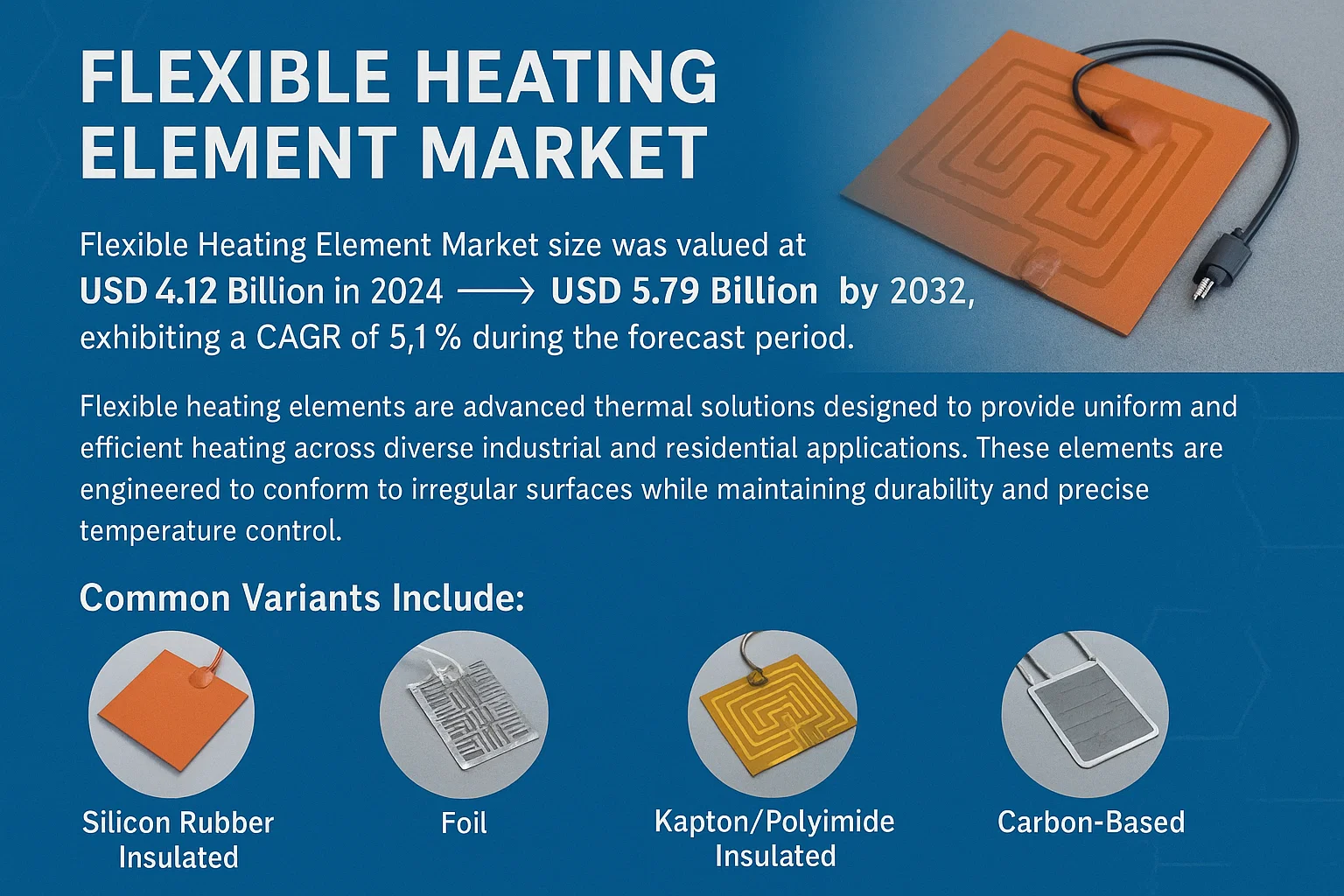
Global Flexible Heating Element Market size was valued at USD 4.12 billion in 2024 to USD 5.79 billion by 2032, exhibiting a CAGR of 5.1% during the forecast period.
Flexible heating elements are advanced thermal solutions designed to provide uniform and efficient heating across diverse industrial and residential applications. These elements are engineered to conform to irregular surfaces while maintaining durability and precise temperature control. Common variants include silicon rubber insulated, foil, Kapton/polyimide insulated, and carbon-based heating elements, each tailored for specific operational requirements.
The market growth is driven by increasing demand from key industries such as food processing, semiconductors, and pharmaceuticals, where precision heating is critical. Furthermore, technological advancements in material science have enhanced the efficiency and lifespan of these elements. Major players like NIBE Element, Watlow, and Chromalox collectively hold approximately 25% of the global market share, leveraging innovations such as IoT-enabled heating solutions to maintain competitive advantage.
MARKET DRIVERS
Rising Demand from Automotive and Aerospace Industries
The increasing need for lightweight and efficient heating solutions in electric vehicles (EVs) and aircraft interiors is a primary growth driver. EV manufacturers are integrating flexible heating elements for battery thermal management and cabin comfort systems.
Expansion of Wearable Technology and Smart Textiles
The wearable technology market’s rapid growth, particularly in health monitoring and performance sports, requires flexible heating elements that can be integrated into fabrics without compromising comfort or functionality.
➤ The global smart textiles market is projected to reach $5.5 billion by 2026, driving demand for integrated heating solutions.
Additionally, the increasing adoption of Internet of Things (IoT) devices in smart homes and industrial settings creates new opportunities for customized heating solutions.
MARKET CHALLENGES
High Initial Costs and Manufacturing Complexity
The production of flexible heating elements often requires specialized materials like silver nanowires or carbon nanotubes, which remain expensive. This creates a barrier for small and medium enterprises (SMEs) looking to enter the market.
Other Challenges
Technical Limitations in Extreme Environments
Maintaining consistent performance across varying temperatures and humidity levels remains challenging, particularly for outdoor or automotive applications where reliability is critical.
MARKET RESTRAINTS
Limited Standardization Across Industries
The absence of universal standards for flexible heating element specifications creates fragmentation. Different applications require different performance metrics, making it difficult for manufacturers to achieve economies of scale without industry-wide standardization.
MARKET OPPORTUNITIES
Emerging Applications in Medical and Rehabilitation Equipment
The healthcare sector’s growing demand for wearable medical devices and therapeutic heating pads presents significant opportunities. The physical therapy market alone is expected to reach $145 billion by 2028, creating substantial demand for advanced heating solutions.
Furthermore, the push toward renewable energy integration requires innovative heating solutions for solar panels and wind turbines to prevent icing, opening new market segments.
Flexible Heating Element Market Trends
Market Expansion Fueled by Industrial Automation
The global flexible heating element market continues to experience robust growth, primarily driven by increasing automation across industrial sectors. These elements provide precise temperature control in applications ranging from semiconductor manufacturing to food processing equipment. The market reached $4.12 billion in 2024 and is projected to reach $5.78 billion by 2032, with a CAGR of 5.1% during this period.
Other Trends
Rising Demand for Energy-Efficient Solutions
Manufacturers are increasingly focusing on developing energy-efficient heating elements that minimize power consumption while maintaining performance. The shift toward sustainable manufacturing practices has accelerated adoption of advanced heating technologies. Industries are investing in these solutions to reduce operational costs and meet environmental regulations, with energy-efficient models capturing significant market share.
Regional Market Developments
North America and Europe continue to lead in market share, owing to their advanced manufacturing sectors and stringent quality standards. However, Asia-Pacific regions are experiencing the fastest growth rate due to expanding industrial base and increasing foreign investments. Europe maintains strong presence in specialized applications, particularly in pharmaceutical and semiconductor industries, while North American market benefits from technological innovations and R&D investments.
Key Players and Market Concentration
The market features several established players including NIBE Element, Minco, and Watlow, who collectively hold significant market share. Competition remains intense with companies focusing on product innovation and geographic expansion. Recent developments include partnerships between heating element manufacturers and industrial equipment producers to develop integrated solutions. Market leaders continue to invest in research and development to maintain technological edge.
COMPETITIVE LANDSCAPE
Key Industry Players
[Market leaders and their competitive positioning]
The flexible heating element market is dominated by established global players offering comprehensive thermal solutions across multiple industries. NIBE Element and Minco lead with extensive product portfolios covering industrial, commercial, and residential applications. Watlow and Chromalox maintain strong market positions through technological innovation and global distribution networks.
Specialized manufacturers like Winkler GmbH and Hotset focus on niche applications with customized solutions. OMEGA Engineering and Zoppas maintain strong presence in temperature control systems, while Honeywell and Holroyd Components offer integrated thermal management solutions. Emerging players like Heatron and Electricfor are expanding market reach through competitive pricing and regional specialization.
List of Key Flexible Heating Element Companies
- NIBE Element
- Minco Products Inc.
- Watlow Electric Manufacturing Company
- Chromalox Inc.
- Winkler GmbH
- Hotset GmbH
- OMEGA Engineering Inc.
- Zoppas Industries
- Holroyd Components Ltd.
- Honeywell International Inc.
- Friedr. Freek GmbH
- Heatron Inc.
- Electricfor Group
- Wattco Inc.
- Horn GmbH
- Bucan Limited
- Durex Industries
- THERMELEC LIMITED
Segment Analysis:
| Segment Category | Sub-Segments | Key Insights |
| By Type |
|
Polymer-based heating elements are gaining traction due to their flexibility and lightweight nature, while carbon-based solutions dominate high-temperature applications due to superior thermal conductivity. |
| By Application |
|
Wearable technology applications dominate demand due to the rise of smart clothing and health monitoring devices, while industrial applications show steady growth due to increased automation and equipment modernization. |
| By End User |
|
Healthcare and medical sectors show the highest growth rate due to increasing adoption in therapeutic devices and patient monitoring systems, while the consumer electronics sector remains the largest market segment by volume due to smart wearables proliferation. |
| By Heating Technology |
|
Carbon nanotube technology offers the most efficient heat distribution and rapid response times, while resistive heating elements maintain dominance due to lower production costs and established manufacturing processes. |
| By Region |
|
Asia Pacific markets demonstrate the strongest adoption rates due to manufacturing concentration and growing consumer electronics markets, while North American markets show the highest growth in specialized applications like medical devices and aerospace. |
Regional Analysis: Flexible Heating Element Market
North American medical device manufacturers increasingly integrate flexible heating elements into wearable health monitors and therapeutic devices, driving market growth through innovative applications that require precise thermal management and patient comfort.
The region’s robust aerospace sector demands flexible heating elements for de-icing systems and cabin comfort, with manufacturers developing thinner, more efficient solutions that withstand extreme conditions while maintaining consistent performance.
North American consumers and industries prioritize energy-efficient solutions, driving adoption of flexible heating elements in smart home systems and industrial processes where precise temperature control reduces overall energy consumption.
The automotive sector incorporates flexible heating elements into smart seats, steering wheels, and battery thermal management systems, with North American manufacturers leading in electric vehicle applications.
Europe
Europe shows strong growth in flexible heating elements driven by automotive electrification and smart home adoption. German and French manufacturers lead in developing thin, efficient heating solutions for luxury vehicles and smart buildings. Environmental regulations push innovation toward energy-efficient heating solutions with minimal environmental impact.
Asia-Pacific
Asia-Pacific experiences rapid growth due to expanding electronics manufacturing and infrastructure development. Countries like South Korea and Japan drive innovation in flexible heating for consumer electronics, while India and Southeast Asian nations show increasing demand for industrial and automotive applications.
South America
South American market focuses primarily on Brazil and Argentina, where growing industrial sectors adopt flexible heating elements for manufacturing processes and energy applications. Market growth remains moderate but steady with emphasis on cost-effective solutions.
Middle East & Africa
The region shows emerging potential in flexible heating elements, particularly in Gulf Cooperation Council countries where oil and gas industries require specialized heating solutions. African markets gradually adopt these technologies in industrial applications with focus on durability and performance in harsh environments.
Report Scope
This market research report provides a comprehensive analysis of the Flexible Heating Element Market, covering the forecast period 2025-2032. It offers detailed insights into market dynamics, technological advancements, competitive landscape, and key trends shaping the industry.
Key focus areas of the report include:
- Market Overview: The report begins with an overview outlining its current market scenario, key growth indicators, and industry transformation drivers. It discusses macroeconomic factors, demand-supply balance, regulatory landscape, and the strategic role of heating solutions in powering advancements across industries such as food processing, semiconductor manufacturing, pharmaceutical production, and industrial automation.
- Market Size & Forecast: Historical data and future projections for revenue, unit shipments, and market value across major regions and segments.
- Segmentation Analysis: Detailed breakdown by product type, technology, application, and end-user industry to identify high-growth segments and investment opportunities.
- Regional Insights: Insights into market performance across North America, Europe, Asia-Pacific, Latin America, and the Middle East & Africa, including country-level analysis where relevant.
- Competitive Landscape: Profiles of leading market participants, including their product offerings, R&D focus, manufacturing capacity, pricing strategies, and recent developments such as mergers, acquisitions, and partnerships.
- Technology Trends & Innovation: Assessment of emerging technologies, integration of IoT and smart heating solutions, fabrication techniques, and evolving industry standards.
- Market Drivers & Restraints: Evaluation of factors driving market growth along with challenges, supply chain constraints, regulatory issues, and market-entry barriers.
- Stakeholder Insights: Insights for component suppliers, OEMs, system integrators, investors, and policymakers regarding the evolving ecosystem and strategic opportunities.
Primary and secondary research methods are employed, including interviews with industry experts, data from verified sources, and real-time market intelligence to ensure the accuracy and reliability of the insights presented.
FREQUENTLY ASKED QUESTIONS:
What is the current market size of Flexible Heating Element Market?
-> The global Flexible Heating Element Market was valued at USD 4122 million in 2024 and is projected to reach USD 5787 million by 2032.
What is the growth rate of Flexible Heating Element Market?
-> The market is expected to grow at a CAGR of 5.1% during the forecast period 2024-2032.
Which key companies operate in Flexible Heating Element Market?
-> Key players include NIBE Element, Minco, Watlow, Chromalox, Winkler GmbH, Hotset, OMEGA, Zoppas, Holroyd Components, Honeywell, Friedr. Freek, Heatron, Electricfor, Wattco, Horn, Bucan, Durex Industries, and THERMELEC LIMITED among others.
What are the key growth drivers?
-> Key growth drivers include increasing demand for energy-efficient heating solutions, growth in industrial automation, and rising adoption in food processing and pharmaceutical industries.
Which region dominates the market?
-> North America and Europe are the largest markets currently, while Asia-Pacific is expected to show the highest growth rate during the forecast period.

Get Sample Report PDF for Exclusive Insights
Report Sample Includes
- Table of Contents
- List of Tables & Figures
- Charts, Research Methodology, and more...