
MARKET INSIGHTS
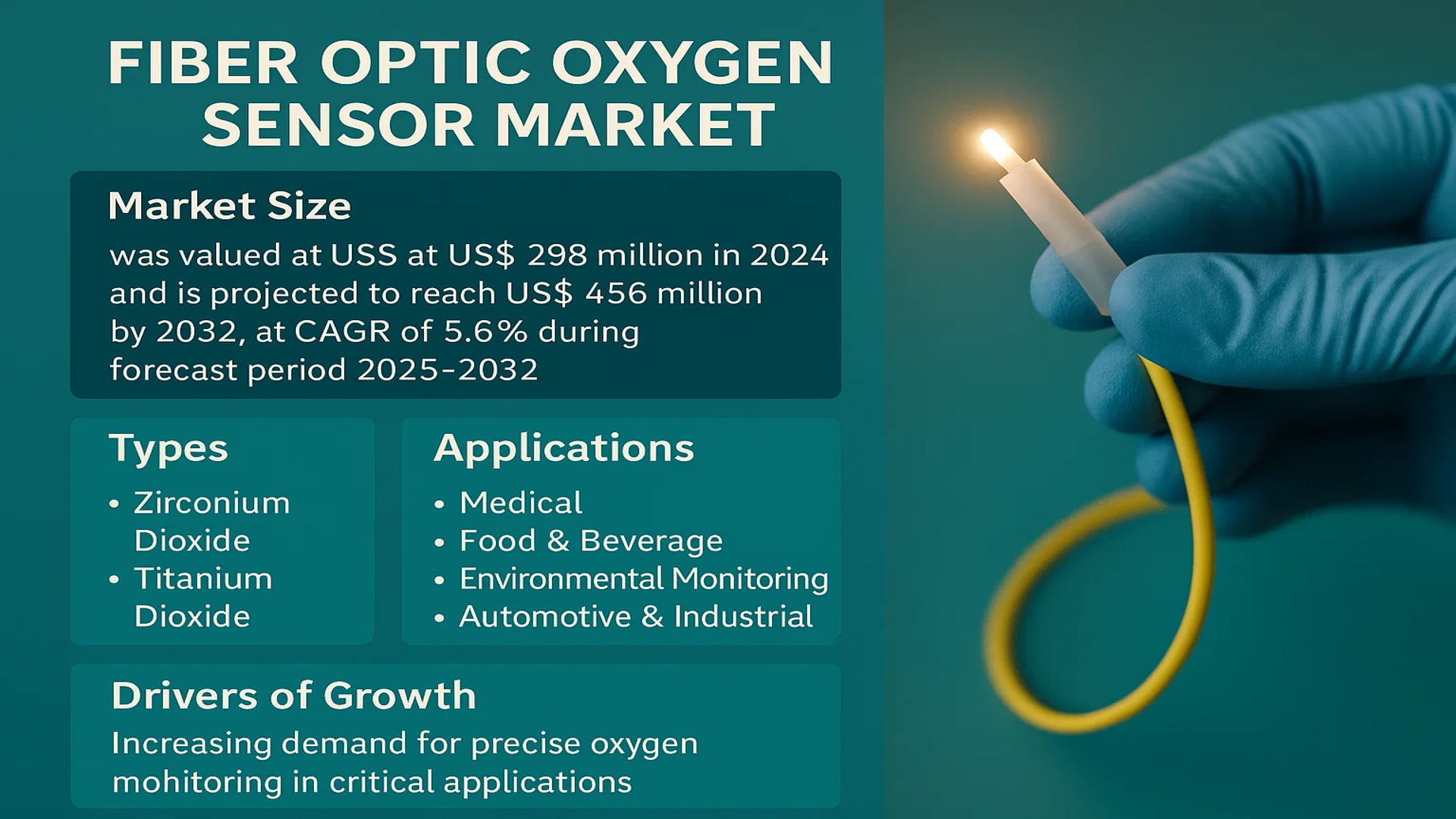
The global Fiber Optic Oxygen Sensor Market size was valued at US$ 298 million in 2024 and is projected to reach US$ 456 million by 2032, at a CAGR of 5.6% during the forecast period 2025-2032.
Fiber optic oxygen sensors are advanced analytical devices that measure oxygen concentration in various environments using optical sensing techniques. These sensors utilize luminescence quenching technology, where oxygen molecules interact with a specialized chemical coating on the fiber tip, causing measurable changes in light properties. The sensors are categorized by material types including Zirconium Dioxide, Titanium Dioxide, and others, with applications spanning medical, food and beverage, environmental monitoring, automotive, and industrial sectors.
The market growth is driven by increasing demand for precise oxygen monitoring in critical applications like medical diagnostics and bioprocessing, where traditional electrochemical sensors face limitations. Furthermore, stringent environmental regulations and growing industrial automation are accelerating adoption. Recent technological advancements, such as miniaturization and improved signal processing algorithms, are expanding application possibilities. Leading players like Endress+Hauser AG and Mettler Toledo are investing heavily in R&D to enhance sensor performance and reliability.
MARKET DYNAMICS
MARKET DRIVERS
Growing Demand for Accurate Oxygen Monitoring in Healthcare to Drive Market Expansion
The global healthcare sector’s increasing reliance on precise oxygen level monitoring is a primary driver for fiber optic oxygen sensor adoption. These sensors play a critical role in patient monitoring systems, especially in critical care units and surgical applications where real-time oxygen measurement is vital. The global medical oxygen monitoring devices market is expected to grow annually by over 7%, with fiber optic sensors capturing an increasing share due to their electromagnetic interference immunity and ability to provide continuous monitoring. Recent advancements in neonatal care have particularly driven demand, with these sensors becoming standard in neonatal intensive care units worldwide.
Stringent Environmental Regulations Boosting Industrial Applications
Environmental protection agencies worldwide are implementing stricter regulations on industrial emissions, particularly in monitoring oxygen levels in exhaust gases and combustion processes. Fiber optic oxygen sensors offer distinct advantages in harsh industrial environments where traditional sensors fail, including resistance to corrosive chemicals and extreme temperatures. The power generation sector accounts for nearly 40% of industrial sensor applications, with cement and chemical processing industries showing the fastest adoption rates. These sensors enable compliance with emission standards while reducing maintenance costs through their longevity and stability.
Advances in Sensor Technology Accelerating Market Penetration
Recent technological breakthroughs in fluorescence quenching techniques and nanotechnology-based sensing materials have significantly enhanced the performance of fiber optic oxygen sensors. Modern sensors now achieve response times under one second with accuracy levels within 0.1% of the measured value. The development of multi-parameter sensing fibers capable of simultaneously measuring oxygen, pH, and temperature has opened new application areas in biotechnology and pharmaceutical manufacturing. These innovations have reduced sensor costs by approximately 30% over the past five years, making them more accessible to mid-sized enterprises.
MARKET RESTRAINTS
High Initial Investment Costs Limiting Widespread Adoption
Despite their advantages, fiber optic oxygen sensors face adoption barriers due to their significantly higher initial costs compared to conventional electrochemical sensors. A complete fiber optic monitoring system typically costs 50-70% more than traditional alternatives, making price-sensitive industries hesitant to upgrade. Small and medium-sized enterprises, particularly in developing regions, often cannot justify the investment despite long-term operational savings. The specialized installation requirements and need for trained personnel further increase the total cost of ownership, slowing market growth in cost-conscious segments.
Technical Complexities in Calibration and Maintenance
Fiber optic oxygen sensors require more sophisticated calibration procedures than conventional sensors, often needing specialized equipment and controlled environments. The calibration process can be time-consuming, with some industrial models requiring up to 24 hours for proper setup. Maintenance challenges are particularly pronounced in continuous monitoring applications where sensor drift can affect measurement accuracy. While automated calibration systems have emerged, their implementation adds to system complexity and cost, creating reluctance among users with limited technical expertise.
Low Awareness in Emerging Markets Constraining Growth
In many developing regions, awareness about the advantages of fiber optic oxygen sensors remains limited, with most end-users continuing to rely on traditional technologies. The technology’s benefits are often overshadowed by its perceived complexity, with many potential users unaware of recent improvements in user-friendliness. This knowledge gap is particularly wide in food packaging and agricultural applications, where cost-driven decision making dominates. Despite representing nearly 60% of the global population, emerging markets currently account for less than 20% of fiber optic oxygen sensor sales.
MARKET CHALLENGES
Intense Competition from Alternative Sensing Technologies
Fiber optic oxygen sensors face strong competition from electrochemical and zirconia-based sensors that have dominated the market for decades. These established technologies benefit from widespread industry familiarity, with many existing systems designed specifically for traditional sensor integration. Optical sensor manufacturers must overcome significant inertia in industries where equipment lifespans often exceed 10-15 years. Even with superior technical specifications, convincing operators to replace functional legacy systems remains an uphill battle requiring extensive demonstration of return on investment.
Lack of Standardization Across Product Offerings
The fiber optic oxygen sensor market currently lacks uniform technical standards, leading to compatibility issues between different manufacturers’ products. This fragmentation creates uncertainty for end-users regarding long-term support and replacement part availability. Variations in optical probe designs, connector types, and communication protocols force customers into vendor lock-in situations. The absence of industry-wide calibration standards also makes performance comparisons between competing products difficult, complicating purchasing decisions and slowing adoption rates.
Supply Chain Vulnerabilities for Specialty Materials
Key components of fiber optic oxygen sensors, including rare-earth doped glasses and specialty polymers, face supply chain vulnerabilities that can disrupt production. Recent geopolitical tensions have highlighted dependence on limited sources for these critical materials, with lead times for certain optical components extending beyond six months in some cases. The specialized nature of these materials also makes finding alternative suppliers challenging, potentially limiting manufacturers’ ability to scale production during periods of high demand.
MARKET OPPORTUNITIES
Expanding Applications in Renewable Energy Sector
The rapid growth of hydrogen fuel cell technology presents significant opportunities for fiber optic oxygen sensors, which are ideally suited for monitoring oxygen purity in hydrogen production and fuel cell operation. With global investments in hydrogen infrastructure projected to exceed $300 billion by 2030, sensor manufacturers have a timely opportunity to develop specialized solutions for this emerging sector. Similarly, biogas production facilities increasingly require robust oxygen monitoring systems, creating another high-growth application area where fiber optic sensors outperform conventional alternatives.
Development of Smart Sensor Networks for Industry 4.0
The integration of fiber optic oxygen sensors into industrial IoT platforms represents a major growth opportunity as manufacturers embrace Industry 4.0 initiatives. Modern sensors equipped with digital interfaces and onboard diagnostics can provide valuable process data for predictive maintenance systems. The ability to network multiple sensors over long distances using existing fiber optic infrastructure gives these systems a distinct advantage in large-scale industrial facilities. Early adopters in pharmaceutical manufacturing have reported 30-40% reductions in maintenance costs through such implementations.
Untapped Potential in Food Safety and Smart Packaging
Increasing food safety regulations and consumer demand for freshness indicators are creating opportunities in the food packaging sector, where fiber optic oxygen sensors can detect package leaks and monitor modified atmosphere packaging. The global active and intelligent packaging market is growing at over 8% annually, with oxygen sensing representing one of the fastest-growing segments. Miniaturized sensor designs now enable integration directly into packaging materials, opening possibilities for consumer-facing quality indicators in premium food products.
FIBER OPTIC OXYGEN SENSOR MARKET TRENDS
Increasing Demand for Real-Time Oxygen Monitoring in Medical Applications
The fiber optic oxygen sensor market is experiencing substantial growth due to the rising demand for real-time oxygen monitoring in medical applications such as respiratory therapy and intensive care units (ICUs). These sensors offer high accuracy, stability, and resistance to electromagnetic interference, making them indispensable in critical healthcare settings. With the global aging population and increasing prevalence of respiratory diseases, the adoption of fiber optic oxygen sensors in hospitals and clinics is projected to rise significantly. Innovations in sensor miniaturization and biocompatibility enhancements further improve their usability in implantable and wearable medical devices.
Other Trends
Advancements in Industrial and Environmental Monitoring
Beyond healthcare, fiber optic oxygen sensors are gaining traction in industrial processes and environmental monitoring. Industries such as wastewater treatment, oil & gas, and semiconductor manufacturing rely on precise oxygen level measurements to ensure process efficiency and safety. Environmental monitoring agencies also favor these sensors for their durability in harsh conditions and minimal maintenance requirements. For example, deep-sea oxygen monitoring for marine research benefits from the sensors’ long-term stability, allowing scientists to gather continuous data without frequent recalibration.
Integration of IoT and Smart Sensing Technologies
The integration of Internet of Things (IoT) and smart sensing technologies is revolutionizing the fiber optic oxygen sensor market. Smart sensors equipped with wireless data transmission enable remote monitoring across multiple industries, including agriculture and food storage. In precision agriculture, fiber optic oxygen sensors help optimize controlled environment agriculture (CEA) by maintaining optimal oxygen levels in soil and hydroponic systems. Additionally, food and beverage manufacturers leverage these sensors for modified atmosphere packaging (MAP), extending shelf life while ensuring product quality compliance. As IoT adoption accelerates, the demand for fiber optic oxygen sensing solutions is set to rise, driven by their connectivity and automation capabilities.
COMPETITIVE LANDSCAPE
Key Industry Players
Market Leaders Adapt to Growing Demand for High-Precision Oxygen Sensing Solutions
The global fiber optic oxygen sensor market features a mix of established multinational corporations and specialized manufacturers, all competing to capture market share in this high-growth segment. Endress+Hauser AG emerges as a dominant force, leveraging its extensive process instrumentation expertise and global distribution network across industrial and healthcare sectors. The company’s 2024 product launch of the Liquiline CM82 optical oxygen transmitter demonstrates its commitment to innovation in this space.
Mettler Toledo and AMETEK maintain strong positions through their diversified analytical instrumentation portfolios, particularly in pharmaceutical and biotechnology applications. Their R&D investments in miniaturized sensor technology have yielded patented oxygen sensing solutions with improved response times below 0.5 seconds – a critical performance metric for sensitive applications.
The competitive landscape continues to evolve as mid-sized specialists gain traction. PyroScience, known for its ultra-high precision fiber optic sensors, recently expanded production capacity to meet growing research and environmental monitoring demand. Similarly, SST Sensing has strengthened its position through strategic partnerships with automation solution providers, integrating its oxygen sensors into larger industrial control systems.
While the top five companies collectively hold approximately 42% of global market revenue in 2024 (based on market surveys), smaller innovators are carving out niches. Unisense‘s focus on microsensor technology for scientific research and IDIL Fibres Optiques‘ development of harsh-environment sensors illustrate how specialization drives competition in specific application segments.
List of Key Fiber Optic Oxygen Sensor Companies Profiled
- Endress+Hauser AG (Switzerland)
- Barben Analytical (U.S.)
- Michell Instruments (UK)
- Ocean Insight (U.S.)
- IDIL Fibres Optiques (France)
- SST Sensing (UK)
- Southland Sensing Ltd. (UK)
- Unisense (Denmark)
- Shenzhen ISweek Ltd (China)
- Sea & Sun Technology (Germany)
- Redondo Optics (U.S.)
- Getamo (Finland)
- PyroScience (Germany)
- Mettler Toledo (U.S.)
- Idronaut (Italy)
- AMETEK (U.S.)
- Hamilton (U.S.)
- Xylem Group (U.S.)
- Aqualabo (France)
- LTH Electronics (Germany)
Segment Analysis:
By Type
Zirconium Dioxide Segment Holds Major Market Share Due to Its High Stability and Accuracy in Harsh Environments
The market is segmented based on type into:
- Zirconium Dioxide
- Titanium Dioxide
- Others
By Application
Medical Segment Leads Due to Critical Oxygen Monitoring Needs in Healthcare Settings
The market is segmented based on application into:
- Medical
- Food and Beverage
- Environmental Monitoring and Research
- Automotive
- Others
By End User
Industrial Sector Dominates with Growing Adoption in Process Control Applications
The market is segmented based on end user into:
- Pharmaceutical & Healthcare
- Industrial
- Research Institutions
- Others
By Technology
Fluorescence-based Sensors Gain Traction Due to Their High Sensitivity and Fast Response Time
The market is segmented based on technology into:
- Fluorescence-based Sensors
- Luminescence-based Sensors
- Others
Regional Analysis: Fiber Optic Oxygen Sensor Market
Asia-Pacific
The Asia-Pacific region dominates the global fiber optic oxygen sensor market, primarily due to rapid industrialization, increasing healthcare investments, and expanding environmental monitoring initiatives. China leads the market with substantial manufacturing capabilities and government-backed technological advancements in sensor technologies. Japan and South Korea follow closely, driven by their strong healthcare and automotive industries. India is emerging as a key growth market, fueled by urbanization and the expansion of smart manufacturing facilities. Challenges include price sensitivity and fragmented regulatory standards, but rising demand for real-time oxygen monitoring in medical and industrial applications continues to push adoption.
North America
North America is a significant market, with the U.S. accounting for the majority of regional revenue. Stringent regulations in healthcare (e.g., FDA compliance) and environmental protection (EPA standards) necessitate high-accuracy oxygen monitoring, driving demand for fiber optic sensors. The region also benefits from strong R&D investments, particularly in medical devices and automotive safety systems. Leading players like Mettler Toledo and AMETEK have a strong presence, leveraging advanced technologies such as zirconium dioxide-based sensors. However, high production costs and competition from other sensing technologies pose challenges.
Europe
Europe’s fiber optic oxygen sensor market is characterized by strict regulatory frameworks under EU directives, particularly in medical and environmental sectors. Germany, France, and the U.K. are key contributors, with applications ranging from bioreactor monitoring in pharmaceuticals to water quality assessment. The emphasis on sustainability and Industry 4.0 adoption has accelerated demand for energy-efficient sensing solutions. Companies like Endress+Hauser AG and Unisense lead innovation in this space, focusing on miniaturization and IoT integration. However, slower industrial growth compared to Asia could moderate expansion.
South America
In South America, Brazil and Argentina represent nascent but promising markets. Growth is driven by increasing healthcare infrastructure and environmental monitoring projects, albeit at a slower pace due to economic volatility. Fiber optic sensors are gradually replacing traditional electrochemical sensors in sectors like food packaging and wastewater treatment, though cost remains a barrier. Local manufacturing is limited, with most products imported from North America or Europe, creating opportunities for regional distributors.
Middle East & Africa
The MEA market is in early stages, with growth concentrated in GCC countries like Saudi Arabia and the UAE, where oil & gas and healthcare sectors are adopting fiber optic oxygen sensors for process control and patient monitoring. Africa’s market remains underpenetrated but shows potential in mining and water resource management. Limited local expertise and high import dependence hinder faster adoption, though infrastructure development initiatives could bolster demand in the long term.
Report Scope
This market research report provides a comprehensive analysis of the global and regional Fiber Optic Oxygen Sensor markets, covering the forecast period 2024–2032. It offers detailed insights into market dynamics, technological advancements, competitive landscape, and key trends shaping the industry.
Key focus areas of the report include:
- Market Size & Forecast: Historical data and future projections for revenue, unit shipments, and market value across major regions and segments.
- Segmentation Analysis: Detailed breakdown by product type (Zirconium Dioxide, Titanium Dioxide, Others), application (Medical, Food and Beverage, Environmental Monitoring and Research, Automotive, Others), and end-user industry to identify high-growth segments and investment opportunities.
- Regional Outlook: Insights into market performance across North America, Europe, Asia-Pacific, Latin America, and the Middle East & Africa, including country-level analysis where relevant.
- Competitive Landscape: Profiles of leading market participants, including their product offerings, R&D focus, manufacturing capacity, pricing strategies, and recent developments such as mergers, acquisitions, and partnerships.
- Technology Trends & Innovation: Assessment of emerging technologies, integration of IoT in oxygen sensing, advancements in fiber optic materials, and evolving industry standards.
- Market Drivers & Restraints: Evaluation of factors driving market growth along with challenges, supply chain constraints, regulatory issues, and market-entry barriers.
- Stakeholder Analysis: Insights for component suppliers, OEMs, system integrators, investors, and policymakers regarding the evolving ecosystem and strategic opportunities.
Primary and secondary research methods are employed, including interviews with industry experts, data from verified sources, and real-time market intelligence to ensure the accuracy and reliability of the insights presented.
FREQUENTLY ASKED QUESTIONS:
What is the current market size of Global Fiber Optic Oxygen Sensor Market?
->Fiber Optic Oxygen Sensor Market size was valued at US$ 298 million in 2024 and is projected to reach US$ 456 million by 2032, at a CAGR of 5.6% during the forecast period 2025-2032.
Which key companies operate in Global Fiber Optic Oxygen Sensor Market?
-> Key players include Endress+Hauser AG, Barben Analytical, Michell Instruments, Ocean Insight, IDIL Fibres Optiques, SST Sensing, Southland Sensing Ltd., Unisense, Shenzhen ISweek Ltd, Sea & Sun Technology, among others.
What are the key growth drivers?
-> Key growth drivers include increasing demand for precise oxygen measurement in medical applications, stringent environmental regulations, and adoption in food packaging and automotive industries.
Which region dominates the market?
-> North America holds the largest market share, while Asia-Pacific is expected to witness the highest growth during the forecast period.
What are the emerging trends?
-> Emerging trends include miniaturization of sensors, development of multi-parameter sensing systems, and increasing adoption in pharmaceutical applications.

Get Sample Report PDF for Exclusive Insights
Report Sample Includes
- Table of Contents
- List of Tables & Figures
- Charts, Research Methodology, and more...
 Download Sample Report PDF





