Market Insights
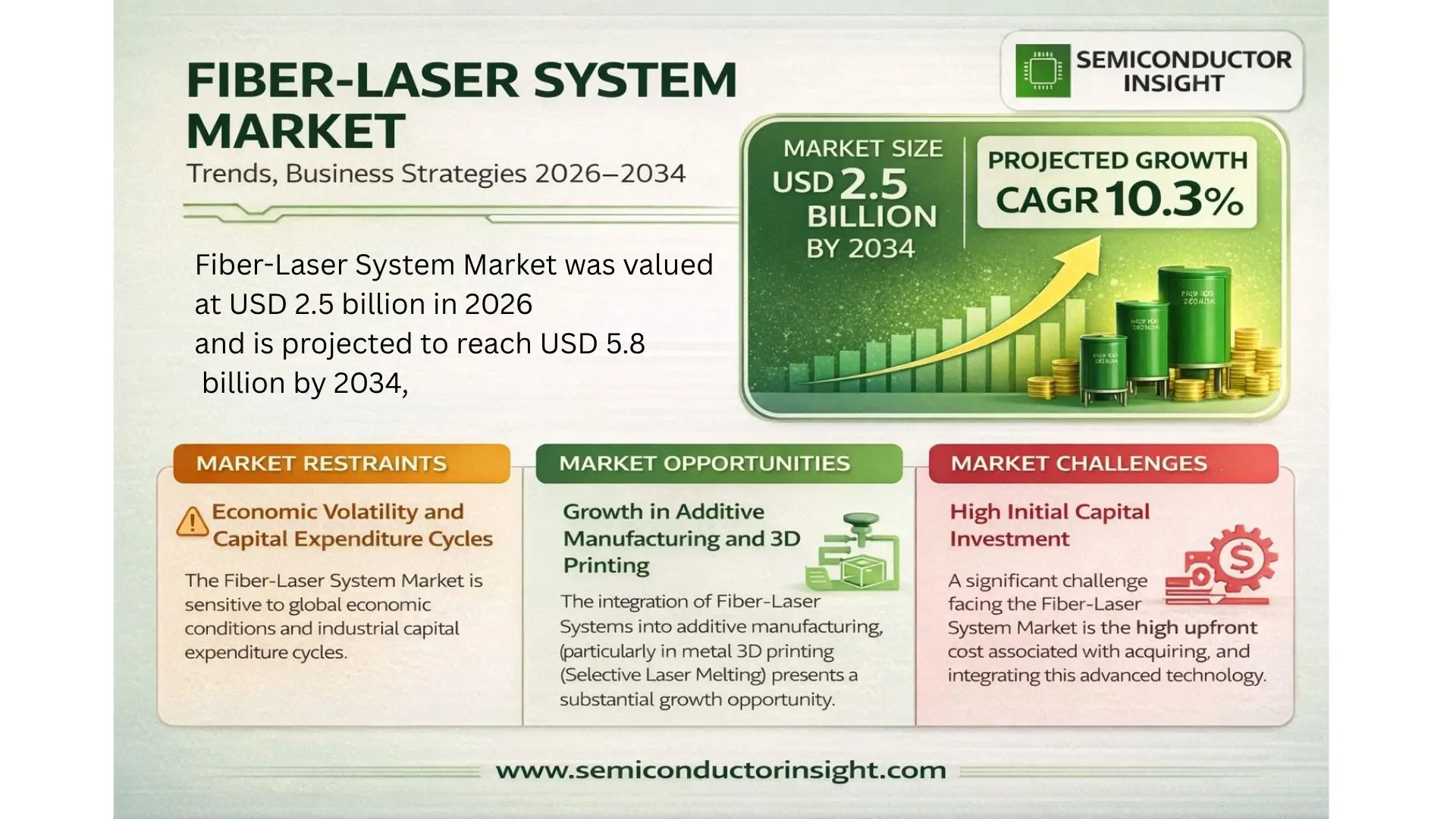
Global Fiber-Laser System Market was valued at USD 2.5 billion in 2026 and is projected to reach USD 5.8 billion by 2034, exhibiting a CAGR of 10.3% during the forecast period.
Fiber-Laser System Market is an advanced laser technology that utilizes optical fibers doped with rare-earth elements like ytterbium or erbium as the gain medium to produce high-intensity laser beams. These systems offer superior beam quality, energy efficiency, and operational stability compared to conventional solid-state or gas lasers, making them indispensable in precision manufacturing, telecommunications, and medical applications.
The market growth is driven by increasing demand for high-precision laser processing in industries such as automotive, aerospace, and electronics. Additionally, advancements in fiber-laser technology, including higher power outputs and improved wavelength flexibility, are expanding their adoption. Key players like IPG Photonics, TRUMPF, and Coherent are investing heavily in R&D to enhance system capabilities and cater to diverse industrial needs.
MARKET DRIVERS
Superior Performance and Efficiency
The expansion of the Fiber-Laser System Market is primarily driven by the technology’s superior performance characteristics compared to competing laser sources. Fiber lasers offer higher electrical efficiency, typically converting over 30% of electrical power into laser light, which translates to lower operational costs. They also provide excellent beam quality and stability, making them ideal for precision applications in manufacturing. The demand for faster, more reliable industrial processing equipment continues to propel adoption across various sectors.
Expansion in High-Power Applications
Growth is further accelerated by the expanding application of high-power Fiber-Laser Systems in heavy industries such as automotive, aerospace, and shipbuilding. These sectors utilize multi-kilowatt systems for cutting, welding, and cladding thick materials. The robustness and low maintenance requirements of fiber lasers make them a preferred choice for demanding production environments, supporting market growth with an estimated annual growth rate of approximately 8-10% in this segment.
The increasing miniaturization of electronics has also fueled demand for ultrafast fiber lasers in precision drilling, cutting, and marking. As manufacturers seek to improve product quality and production throughput, the intrinsic advantages of the Fiber-Laser System Market offerings ensure sustained growth momentum. This trend is expected to continue as new materials and complex geometries enter mainstream manufacturing.
MARKET CHALLENGES
High Initial Capital Investment
A significant challenge facing the Fiber-Laser System Market is the high upfront cost associated with acquiring and integrating this advanced technology. While operational costs are lower, the initial investment for high-power systems can be prohibitive for small and medium-sized enterprises (SMEs). This financial barrier can slow down market penetration in cost-sensitive segments and emerging economies, where budget constraints are a primary consideration for capital equipment purchases.
Other Challenges
Technical Complexity and Skilled Labor Shortage
The operation and maintenance of a sophisticated Fiber-Laser System require highly skilled technicians and engineers. A global shortage of personnel trained in photonics and advanced manufacturing technologies presents a bottleneck for widespread adoption. Companies must invest significantly in training and development to fully leverage the capabilities of their systems, adding to the total cost of ownership.
Competition from Alternative Technologies
Despite their advantages, fiber lasers face strong competition from well-established CO2 lasers and emerging technologies like direct diode lasers. In certain applications, such as non-metal processing, alternative systems can offer cost or performance benefits. This competitive pressure forces continuous innovation and price adjustments within the Fiber-Laser System Market to maintain its value proposition.
MARKET RESTRAINTS
Economic Volatility and Capital Expenditure Cycles
Fiber-Laser System Market is sensitive to global economic conditions and industrial capital expenditure cycles. During periods of economic downturn, manufacturers delay or cancel investments in new equipment, directly impacting the sales of high-value capital goods like fiber lasers. The cyclical nature of key end-user industries, such as automotive and construction, means demand for Fiber-Laser Systems can experience significant fluctuations, restraining steady market growth.
Intellectual Property and Patent Litigation
Ongoing intellectual property disputes and patent litigations among key players in the Fiber-Laser System Market can act as a restraint. These legal challenges can hinder innovation, increase operational costs for companies defending their patents, and potentially limit the availability of certain advanced technologies in different geographical regions, thereby fragmenting the market and slowing overall development.
Furthermore, the high cost of specialized components and raw materials, such as rare-earth dopants for the laser gain medium, can constrain profit margins for manufacturers. Any disruption in the supply chain for these critical materials poses a risk to production scalability and cost stability within the Fiber-Laser System Market.
MARKET OPPORTUNITIES
Growth in Additive Manufacturing and 3D Printing
The integration of Fiber-Laser Systems into additive manufacturing, particularly in metal 3D printing (Selective Laser Melting), presents a substantial growth opportunity. The precision and power of fiber lasers are ideal for creating complex, high-strength metal parts. As industries from healthcare to aerospace increasingly adopt additive manufacturing, the demand for reliable and efficient laser sources is expected to surge, opening new revenue streams for the Fiber-Laser System Market.
Expansion into Emerging Economies
Emerging economies in Asia-Pacific, Latin America, and Eastern Europe represent significant untapped potential for the Fiber-Laser System Market. Rapid industrialization, government initiatives supporting advanced manufacturing, and growing foreign direct investment in these regions are creating fertile ground for market expansion. As local industries modernize, the demand for advanced laser processing equipment is projected to increase markedly.
Advancements in ultrafast pulsed Fiber-Laser Systems are creating opportunities in new fields such as medical device manufacturing, microelectronics, and scientific research. These systems enable cold ablation and high-precision machining of delicate materials without thermal damage. The continuous innovation in laser parameters and application-specific solutions will likely drive the next wave of growth for the Fiber-Laser System Market.
Fiber-Laser System Market Trends
Expansion into High-Precision Manufacturing Sectors
A primary trend shaping the Fiber-Laser System Market is the accelerating adoption within high-precision manufacturing. Industries such as automotive, aerospace, and electronics increasingly favor fiber-laser systems for applications like cutting, welding, and micromachining due to their superior beam quality and accuracy. The capability to process materials with minimal heat-affected zones and high repeatability is critical for producing intricate components. This shift from traditional methods to advanced laser-based manufacturing is a dominant growth driver for the market, with demand projected to increase significantly over the coming years.
Other Trends
Adoption in Medical and Communication Technologies
Beyond manufacturing, the Fiber-Laser System Market is witnessing robust demand from the medical and communications sectors. In medicine, these systems are integral to advanced surgical instruments, particularly in ophthalmology and oncology, offering minimally invasive treatment options. In telecommunications, the deployment of 5G networks and expansion of data centers is fueling the need for high-speed, stable fiber lasers that ensure reliable data transmission. The versatility of the technology ensures its applicability continues to broaden.
Navigating Supply Chain and Cost Challenges
Despite strong growth, the Fiber-Laser System Market faces challenges related to supply chain resilience and cost pressures. The reliance on high-purity optical fibers and specialized dopants makes production vulnerable to global supply disruptions. Furthermore, the high initial investment for advanced fiber-laser systems can be a barrier for small and medium-sized enterprises, even as advancements aim to lower long-term operational costs. Market leaders are focused on diversifying supply sources and developing more cost-effective solutions to maintain growth momentum and market accessibility.
COMPETITIVE LANDSCAPE
Key Industry Players
A Highly Concentrated Market Led by Technology Innovators
Global Fiber-Laser System Market is characterized by a high degree of consolidation, with a few major multinational corporations dominating the revenue share. IPG Photonics stands as the undisputed market leader, leveraging its pioneering technology and extensive patent portfolio to maintain a significant competitive edge in high-power industrial applications. Following closely are established industrial giants such as TRUMPF and Coherent, which combine deep manufacturing expertise with integrated laser solutions to serve the automotive, aerospace, and heavy machinery sectors. The competitive structure is shaped by intense R&D investment, strategic mergers and acquisitions to expand technological capabilities, and a focus on developing systems with higher power, greater precision, and improved energy efficiency to meet evolving industrial demands.
Alongside the dominant players, a dynamic segment of specialized and regional manufacturers has carved out significant niches. Companies like Raycus Laser and Maxphotonics have strong positions, particularly in the Asia-Pacific region, offering cost-competitive solutions for material processing. Niche players such as NKT Photonics excel in specialized areas like high-performance single-frequency lasers for scientific and medical applications. Furthermore, companies including Keyence Corp. and Panasonic focus on integrated automation solutions where the fiber laser is a critical component of a larger system. This secondary tier of competitors drives innovation in specific applications and contributes to downward price pressure, increasing market accessibility for small and medium-sized enterprises.
List of Key Fiber-Laser System Companies Profiled
- IPG Photonics
- TRUMPF
- Coherent, Inc.
- Maxphotonics
- Raycus Laser
- Han’s Laser
- nLIGHT
- Jinan Acme
- HGTECH
- NKT Photonics
- FANUC
- Amplitude Laser
- Keyence Corp.
- Panasonic
- Opto Tech
Segment Analysis:
| Segment Category | Sub-Segments | Key Insights |
| By Type |
|
Rare earth doped emerges as the dominant segment due to:
|
| By Application |
|
Precision Manufacturing leads application segments with key advantages:
|
| By End User |
|
Industrial Manufacturing remains the primary end user segment because:
|
| By Power Range |
|
Medium Power dominates market demand due to:
|
| By Technology |
|
Continuous Wave technology maintains leadership position because:
|
Regional Analysis: Fiber-Laser System Market
Asia-Pacific
China’s fiber-laser system market thrives due to massive investments in automotive, aerospace, and consumer electronics manufacturing. Government initiatives like “Made in China 2025” drive adoption of high-powered laser systems for precision manufacturing.
Japan maintains competitive advantage through continuous innovation in fiber-laser technology, particularly for micro-processing applications. Japanese manufacturers focus on high-reliability systems for demanding industrial environments.
Countries like Vietnam, Thailand, and Malaysia are adopting fiber-laser systems as they develop their manufacturing bases. Foreign manufacturers establish production facilities with modern laser processing capabilities.
India shows growing demand for fiber-laser systems in automotive components and heavy engineering sectors. Government policies encouraging domestic manufacturing contribute to market expansion.
North America
The North American fiber-laser system market benefits from strong aerospace, defense, and automotive sectors. United States leads with substantial R&D investments and manufacturing modernization initiatives. Canadian manufacturers adopt fiber-laser technology for metal processing in energy and mining equipment sectors. The region sees growing preference for high-power fiber-laser systems with automation integration.
Europe
European fiber-laser system market maintains steady growth with emphasis on precision engineering applications. Germany dominates with its automotive and industrial machinery sectors requiring advanced laser solutions. Environmental regulations drive adoption of energy-efficient fiber-laser systems. European manufacturers focus on developing specialized laser systems for high-value industrial applications.
Middle East & Africa
The Middle Eastern market for fiber-laser systems grows through infrastructure development and oil & gas sector investments. UAE leads in industrial automation adoption. African adoption remains limited but shows potential in metal processing industries as manufacturing capabilities develop.
South America
Brazil represents the largest South American market for fiber-laser systems, particularly in automotive parts production. Regional growth slowed by economic volatility but maintains potential in metal fabrication industries. Local manufacturers gradually upgrade to fiber-laser technology for competitive advantages.
Report Scope
This market research report provides a comprehensive analysis of the Fiber-Laser System Market, covering the forecast period 2025–2034. It offers detailed insights into market dynamics, technological advancements, competitive landscape, and key trends shaping the industry.
Key focus areas of the report include:
- Market Overview: The report begins with an overview outlining its current market scenario, key growth indicators, and industry transformation drivers. It discusses macroeconomic factors, demand-supply balance, regulatory landscape, and the strategic role of fiber-laser systems in powering advancements across industries such as precision manufacturing, medical, and communications.
- Market Size & Forecast: Historical data and future projections for revenue, unit shipments, and market value across major regions and segments.
- Segmentation Analysis: Detailed breakdown by product type, technology, application, and end-user industry to identify high-growth segments and investment opportunities.
- Regional Insights: Insights into market performance across North America, Europe, Asia-Pacific, Latin America, and the Middle East & Africa, including country-level analysis where relevant.
- Competitive Landscape: Profiles of leading market participants, including their product offerings, R&D focus, manufacturing capacity, pricing strategies, and recent developments such as mergers, acquisitions, and partnerships.
- Technology Trends & Innovation: Assessment of emerging technologies, integration of AI/IoT, fiber-laser system design trends, fabrication techniques, and evolving industry standards.
- Market Drivers & Restraints: Evaluation of factors driving market growth along with challenges, supply chain constraints, regulatory issues, and market-entry barriers.
- Stakeholder Insights: Insights for component suppliers, OEMs, system integrators, investors, and policymakers regarding the evolving ecosystem and strategic opportunities.
Primary and secondary research methods are employed, including interviews with industry experts, data from verified sources, and real-time market intelligence to ensure the accuracy and reliability of the insights presented.
FREQUENTLY ASKED QUESTIONS:
What is the current market size of Fiber-Laser System Market?
-> Fiber-Laser System Market was valued at USD 2.5 billion in 2026 and is projected to reach USD 5.8 billion by 2034, exhibiting a CAGR of 10.3% during the forecast period.
Which key companies operate in Fiber-Laser System Market?
-> Key players include Maxphotonics, IPG Photonics, Semikron, FANUC, Jinan Acme, Raycus Laser, HGTECH, Han’s Laser, Opto Tech, Panasonic, Hanslaser, TRUMPF, Concept Laser GmbH, Laser Systems Inc., Universal Laser Systems Inc., Vermont Inc., Keyence Corp. of America, and Control Micro Systems Inc., among others.
What are the key growth drivers?
-> Key growth drivers include high efficiency, low energy consumption, long lifespan, and demand from precision manufacturing, medical, and communications sectors.
Which region dominates the market?
-> Asia is the fastest-growing region, particularly driven by demand from China, Japan, and South Korea.
What are the emerging trends?
-> Emerging trends include advancements in high-power and high-precision fiber-laser systems, government support for green manufacturing, and applications in 5G network infrastructure.
Get Sample Report PDF for Exclusive Insights
Report Sample Includes
- Table of Contents
- List of Tables & Figures
- Charts, Research Methodology, and more...
 Download Sample Report PDF