MARKET INSIGHTS
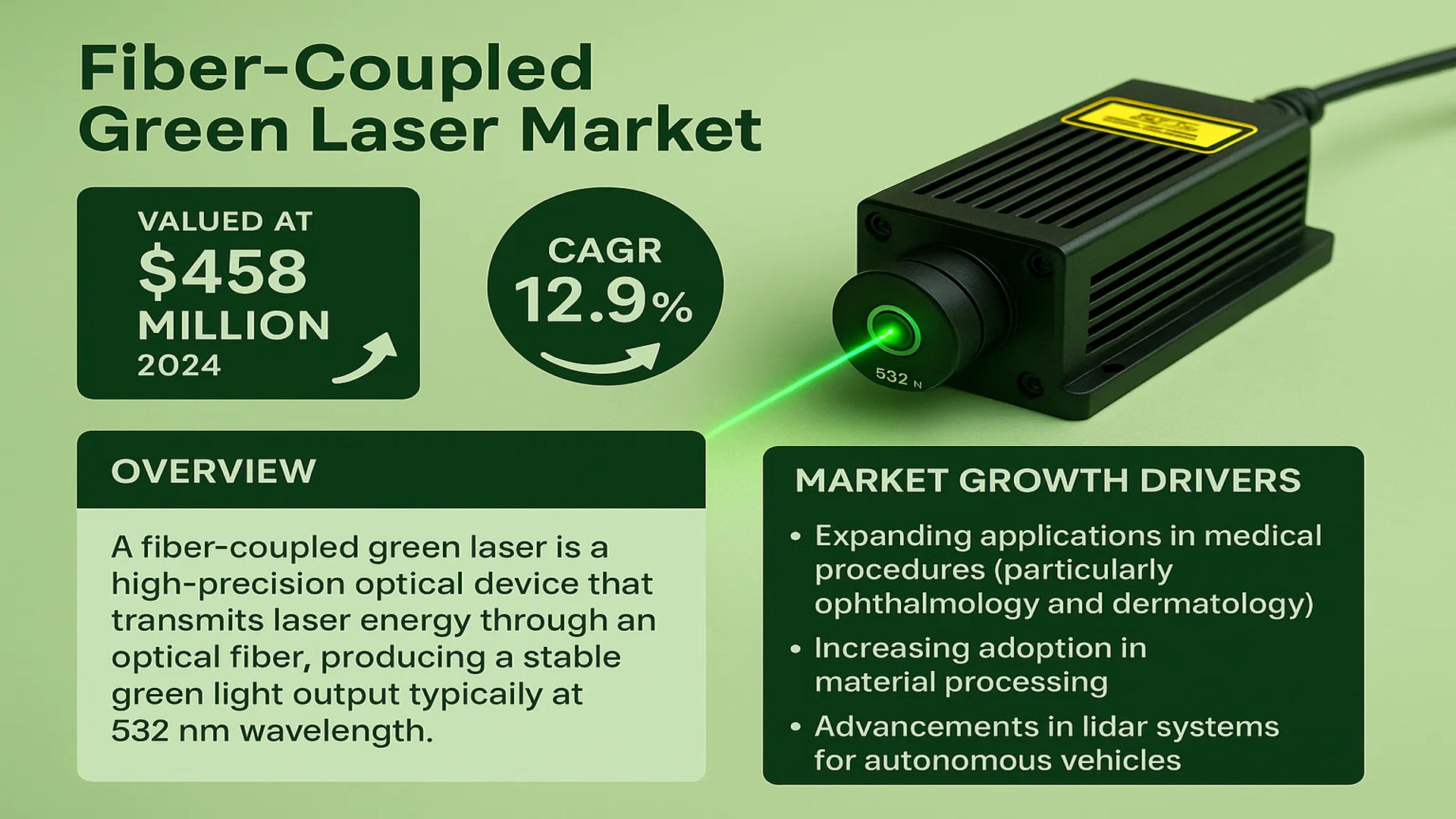
The global Fiber-Coupled Green Laser Market was valued at 458 million in 2024 and is projected to reach US$ 1060 million by 2032, at a CAGR of 12.9% during the forecast period.
A fiber-coupled green laser is a high-precision optical device that transmits laser energy through an optical fiber, producing a stable green light output typically at 532 nm wavelength. These systems utilize frequency doubling technology (second harmonic generation) to convert near-infrared lasers into visible green light while maintaining beam quality through fiber optic transmission. This technology enables efficient energy delivery to hard-to-reach areas, making it indispensable for applications requiring high spatial resolution or remote operation.
The market growth is driven by expanding applications in medical procedures (particularly ophthalmology and dermatology), increasing adoption in material processing, and advancements in lidar systems for autonomous vehicles. The U.S. currently dominates market share, while China is emerging as the fastest-growing regional market due to rapid industrial automation. Key manufacturers like IPG Photonics and Coherent are investing heavily in developing higher-power fiber-coupled green lasers with improved beam quality, further propelling market expansion.
MARKET DYNAMICS
MARKET DRIVERS
Expanding Applications in Medical and Industrial Sectors Accelerate Market Growth
The fiber-coupled green laser market is experiencing robust growth, primarily driven by increasing adoption across medical, industrial, and scientific applications. In the medical field, these lasers are indispensable for precise surgical procedures, particularly in ophthalmology and dermatology, where their high precision and minimal thermal damage improve patient outcomes. The global medical laser market, a key consumer of fiber-coupled green lasers, has shown consistent growth with a projected CAGR exceeding 9% through 2030. Industrial applications, including material processing and micromachining, benefit from the superior beam quality and stability of these lasers in cutting, welding, and drilling operations. Furthermore, emerging applications in LiDAR systems for autonomous vehicles and 3D printing are creating new demand streams.
Technological Advancements in Laser Efficiency Drive Market Expansion
Continuous improvements in laser diode and fiber optic technologies are significantly enhancing the performance metrics of fiber-coupled green lasers. Modern systems now achieve conversion efficiencies exceeding 30%, a substantial improvement from previous generations. This efficiency gain reduces operational costs and energy consumption, making these lasers more economically viable for commercial applications. Additionally, advancements in frequency-doubling techniques using nonlinear optical crystals have enabled more compact and reliable systems. Increased investments in R&D by leading market players are further accelerating these technological innovations. For instance, recent developments in high-power diode-pumped solid-state (DPSS) lasers have opened new possibilities in industrial cutting applications where both power and precision are critical requirements.
Growing Demand for High-Precision Optical Components Strengthens Market Position
The optical industry’s increasing need for high-precision components is creating significant opportunities for fiber-coupled green lasers. These lasers are particularly valuable in applications requiring micron-level accuracy, such as semiconductor inspection, holography, and optical alignment. The global semiconductor industry, which relies heavily on precision laser systems for wafer inspection and microfabrication, represents a major growth avenue. Additionally, the expanding field of quantum computing is driving demand for stable laser sources in quantum entanglement experiments. The combination of their superior beam quality, wavelength stability, and fiber-optic delivery makes these lasers the preferred choice for critical optical applications where performance cannot be compromised.
MARKET RESTRAINTS
High Initial Investment and Maintenance Costs Limit Market Penetration
While fiber-coupled green lasers offer superior performance characteristics, their adoption faces constraints due to significant capital and operating expenses. The sophisticated optical components required for frequency doubling and fiber coupling contribute to system costs that can be prohibitive for small and medium enterprises. Maintaining optimal performance also demands regular servicing by specialized technicians, adding to the total cost of ownership. In price-sensitive markets, particularly in developing regions, these cost factors significantly slow market penetration. Moreover, the need for temperature stabilization and vibration isolation in high-precision applications further escalates implementation costs, potentially pushing users toward less expensive alternatives where absolute precision is not critical.
Technical Challenges in Power Scaling Pose Implementation Barriers
Scaling fiber-coupled green lasers to higher power levels presents substantial technical hurdles that constrain market growth. Thermal effects become increasingly problematic at higher outputs, potentially degrading beam quality and reducing component lifespan. Nonlinear effects in both the frequency conversion process and the fiber delivery system can introduce instabilities that compromise performance. These challenges are particularly acute in industrial applications that demand both high power and long-term reliability. While recent advances in cooling systems and novel optical materials have mitigated some of these issues, thermal management remains a persistent challenge that affects both system complexity and cost-effectiveness. Additionally, maintaining single-mode operation at elevated power levels requires precise engineering that pushes the boundaries of current manufacturing capabilities.
Regulatory Compliance and Safety Concerns Add Operational Complexity
The fiber-coupled green laser market faces regulatory barriers related to laser safety standards and classification requirements. Compliance with international standards such as IEC 60825 and FDA regulations necessitates extensive testing and certification processes that can delay product launches. Safety concerns become particularly acute in medical applications where laser systems must meet stringent performance and reliability criteria before receiving approval for clinical use. These regulatory requirements not only increase time-to-market but also add substantial costs to product development. Furthermore, workplace safety considerations require specialized training for operators and additional safety equipment, factors that can discourage adoption in industries where laser expertise is not part of core competencies.
MARKET OPPORTUNITIES
Emerging Applications in Green Photonics Present Growth Potential
The expanding field of green photonics is creating new opportunities for fiber-coupled green laser manufacturers. Areas such as horticultural lighting, where specific green wavelengths influence plant growth and morphology, represent an innovative application segment. Research suggests optimal green light spectra can enhance photosynthesis in certain plant species while reducing energy consumption compared to broad-spectrum lighting. Additionally, emerging applications in biomedical imaging, particularly in fluorescence microscopy and flow cytometry, are driving demand for stable green laser sources. The development of novel photodynamic therapy techniques that utilize green wavelengths for selective tissue activation further expands potential medical applications. As these specialized applications mature, they promise to open substantial new markets beyond traditional laser applications.
Strategic Partnerships and Vertical Integration Strengthen Market Position
Collaborations between laser manufacturers and end-user industries are creating synergistic opportunities for market expansion. Many leading companies are forming strategic alliances with medical device manufacturers and industrial automation providers to develop application-specific laser solutions. Vertical integration strategies, where laser producers acquire or partner with fiber optic component suppliers, are helping to secure supply chains and reduce production costs. These partnerships also facilitate co-development of customized solutions that address specific application challenges. For instance, collaborations with autonomous vehicle developers are yielding specialized LiDAR solutions that leverage the unique advantages of fiber-coupled green lasers in adverse weather conditions. Such strategic initiatives are expected to accelerate technology adoption across diverse industry verticals.
Miniaturization Trends Create Demand for Compact Laser Solutions
The drive toward miniaturization across multiple industries is generating demand for compact, yet powerful fiber-coupled green laser systems. Portable medical devices, handheld industrial tools, and space-constrained scientific instrumentation all require laser sources that combine high performance with small form factors. Advances in integrated photonics and micro-optics are enabling manufacturers to reduce system sizes while maintaining or improving optical performance. This trend aligns particularly well with the needs of field-deployable systems and point-of-care medical devices where space and weight are critical considerations. The ability to deliver green laser light through thin, flexible fibers to remote locations continues to be a unique advantage that differentiates fiber-coupled solutions in applications where conventional laser configurations are impractical.
MARKET CHALLENGES
Intense Competition from Alternative Laser Technologies Pressures Margins
The fiber-coupled green laser market faces significant competitive pressure from alternative laser technologies that continue to improve in performance and cost-effectiveness. Direct diode green lasers are emerging as viable competitors, particularly in applications that can tolerate slightly lower beam quality. Similarly, advancements in ultrafast laser technology are encroaching on traditional green laser applications in precision machining. This intensifying competition is putting downward pressure on pricing and profit margins, forcing manufacturers to continually innovate while controlling production costs. Maintaining technological differentiation becomes increasingly challenging as competing technologies bridge the performance gap, requiring ongoing investment in research and development to preserve market position.
Supply Chain Vulnerabilities Impact Production Stability
Global supply chain disruptions present ongoing challenges for fiber-coupled green laser manufacturers, particularly concerning specialized optical components. Nonlinear crystals for frequency doubling, high-quality laser diodes, and precision fiber optic components all face periodic shortages that can disrupt production schedules. Geopolitical factors affecting the availability of rare-earth materials and export controls on advanced optical technologies further complicate supply chain management. These vulnerabilities necessitate careful inventory planning and often force manufacturers to maintain higher stock levels of critical components, increasing working capital requirements. Additionally, the specialized nature of many components limits alternative sourcing options, exacerbating the impact of any supply chain interruptions.
Workforce Shortages in Laser Technology Hinder Industry Growth
The specialized nature of fiber-coupled green laser technology requires a workforce with advanced optical and photonics expertise, creating a talent bottleneck that constrains market expansion. The short supply of engineers and technicians proficient in both laser physics and optical fiber technology limits production capacity and slows new product development cycles. Educational institutions are struggling to produce sufficient graduates with the specialized skills needed in this niche field, leading to intense competition for qualified personnel. This skills gap is particularly acute in emerging markets where local expertise in advanced laser technologies remains limited. Without significant investment in workforce development programs and technical education, the industry’s growth potential may remain constrained by human resource limitations.
FIBER-COUPLED GREEN LASER MARKET TRENDS
Expanding Applications in Medical and Industrial Sectors Drive Market Growth
The global fiber-coupled green laser market is experiencing significant momentum due to increasing adoption across multiple industries. Medical applications, particularly in dermatology and ophthalmology, are accelerating demand, with these lasers being preferred for precision procedures like tattoo removal and retinal photocoagulation. Industrial use cases, including micro-machining and material processing, are further propelling growth, as green lasers offer superior beam quality for fine material ablation. The market, valued at $458 million in 2024, is projected to grow at a compound annual growth rate (CAGR) of 12.9% to reach $1,060 million by 2032, driven by advancements in laser efficiency and manufacturing scalability.
Other Trends
Technological Advancements in Fiber Laser Systems
Continuous improvements in fiber-coupled green laser technology, especially in frequency doubling efficiency and thermal management, are enhancing performance while reducing costs. Innovations in nonlinear optical materials have improved conversion rates of infrared laser sources to high-power green wavelengths, making these systems more energy-efficient. Single-mode fiber-coupled lasers, which currently dominate the market share, are seeing rapid developments to achieve higher power outputs with stable beam quality, ideal for precision applications in semiconductor manufacturing and biomedical research.
Rising Demand in Emerging Markets
Emerging economies in Asia, particularly China and India, are witnessing substantial growth in fiber-coupled green laser adoption due to expanding industrial and research infrastructure. The Chinese market is projected to reach $million by 2032, driven by government investments in high-tech industries and increasing local production capabilities. Key manufacturers are establishing regional production facilities to capitalize on lower operational costs and growing domestic demand. This regional expansion is complemented by strategic partnerships between academic institutions and private enterprises to develop next-generation laser technologies for specialized applications.
COMPETITIVE LANDSCAPE
Key Industry Players
Market Leaders Expand Technological Capabilities Through Innovation and Strategic Growth
The global fiber-coupled green laser market exhibits a dynamic competitive landscape, characterized by a mix of established industry leaders and emerging innovators. With a projected CAGR of 12.9% between 2024 and 2032, companies are actively enhancing their portfolios through technological advancements and strategic expansions to capitalize on growing demand across medical, optical, and industrial applications.
IPG Photonics currently dominates the market, leveraging its proprietary fiber laser technology and robust manufacturing capabilities. The company’s vertically integrated supply chain provides a competitive edge in cost efficiency and rapid product development cycles. Similarly, Coherent maintains strong market presence through its expertise in photonics solutions and frequent product launches in high-power laser segments.
Mid-sized players including Thorlabs and Hamamatsu Photonics are gaining traction by focusing on specialized applications. Thorlabs’ strength lies in research-grade laser systems, while Hamamatsu continues to excel in compact, precision laser solutions for medical devices. Both companies are investing heavily in R&D; Hamamatsu allocated approximately 15% of its revenue to research initiatives in 2023.
The competitive landscape is further diversified by regional specialists such as China’s Shenzhen Gongda Laser and Japan’s Lumibird, who are expanding globally through competitive pricing and customization capabilities. Meanwhile, European manufacturers like TRUMPF and Laserline maintain technological leadership in industrial laser applications through continuous innovation in fiber-coupled solutions.
List of Key Fiber-Coupled Green Laser Manufacturers
- IPG Photonics (U.S.)
- Hamamatsu Photonics (Japan)
- Coherent (U.S.)
- Thorlabs (U.S.)
- TRUMPF (Germany)
- Laserline GmbH (Germany)
- Lumibird (France)
- Logan Laser (China)
- Shenzhen Gongda Laser (China)
- Shanghai Boson Technology (China)
Segment Analysis:
By Type
Single Mode Fiber Coupled Lasers Segment Leads Due to Superior Beam Quality and Precision
The market is segmented based on type into:
- Single Mode Fiber Coupled Lasers
- High beam quality and coherence
- Ideal for precision applications
- Multimode Fiber-Coupled Lasers
- Higher power output capacity
- Wider beam profile applications
By Application
Medical Industry Segment Dominates with Growing Adoption in Surgical and Therapeutic Applications
The market is segmented based on application into:
- Optical Industry
- Laser displays and projection systems
- Precision optical testing
- Food Industry
- Food packaging and marking
- Quality inspection systems
- Medical Industry
- Laser surgery and therapy
- Dermatology and ophthalmology
- Others
- Scientific research
- LIDAR systems
By Technology
Fiber Laser Technology Gains Traction Due to Energy Efficiency and Reliability
The market is segmented based on technology into:
- Fiber Laser Technology
- Semiconductor Laser Technology
- Solid-State Laser Technology
By Power Output
Medium Power Lasers (1-10W) Show Widespread Applications Across Industries
The market is segmented based on power output into:
- Low Power (<1W)
- Medium Power (1-10W)
- High Power (>10W)
Regional Analysis: Fiber-Coupled Green Laser Market
Asia-Pacific
The Asia-Pacific region dominates the global Fiber-Coupled Green Laser market, driven by robust industrial growth and technological advancements in key economies like China, Japan, and South Korea. China, in particular, accounts for the largest market share due to massive investments in laser-based manufacturing and medical applications. The country’s ‘Made in China 2025’ initiative is accelerating adoption of high-end laser technologies across electronics and automotive sectors. Meanwhile, Japan’s strong optical industry and South Korea’s semiconductor boom contribute significantly to demand for precision laser systems. Emerging markets like India and Southeast Asian nations are also witnessing increased uptake, particularly in medical and scientific applications, though cost sensitivity remains a challenge for premium products.
North America
North America represents the second-largest market, with the U.S. accounting for over 70% of regional demand. The region benefits from strong R&D investments in defense, healthcare, and aerospace applications where fiber-coupled green lasers are essential for precision tasks. Stringent healthcare regulations are driving adoption of medical-grade lasers, while defense applications like LIDAR systems receive substantial government funding. Canada’s growing photonics industry and Mexico’s expanding manufacturing base contribute to regional diversity. However, high equipment costs and competition from alternative technologies pose moderate growth restraints in certain segments.
Europe
Europe maintains a technologically advanced market characterized by strong demand from automotive, healthcare, and research sectors. Germany leads regional consumption, utilizing these lasers extensively in industrial cutting and medical procedures. The region’s focus on green technology aligns well with energy-efficient fiber-coupled solutions. EU research funding programs like Horizon Europe support laser innovation in scientific applications. While Western Europe shows mature adoption, Eastern European markets exhibit growth potential, particularly in industrial automation. Compliance with strict EU regulatory standards presents both a challenge and quality benchmark for manufacturers.
South America
The South American market shows moderate but steady growth, with Brazil and Argentina as primary consumers. Mining and agriculture applications drive demand for LIDAR systems, while medical adoption remains limited to urban healthcare centers. Economic volatility and currency fluctuations impact capital equipment purchases, though increasing foreign investment in manufacturing is gradually expanding the industrial laser user base. Localized production remains minimal, with most supply imported from North America, Europe, and increasingly from China.
Middle East & Africa
This emerging market shows promise with infrastructure development and healthcare modernization projects, particularly in GCC countries. The UAE and Saudi Arabia deploy green lasers in oil/gas exploration and medical tourism facilities, while South Africa leads in scientific research applications. Limited local technical expertise and high import dependence restrain growth, though strategic initiatives to diversify economies beyond oil are creating new opportunities for laser technology adoption in manufacturing and construction sectors.
Report Scope
This market research report provides a comprehensive analysis of the Global Fiber-Coupled Green Laser Market, covering the forecast period 2024–2032. It offers detailed insights into market dynamics, technological advancements, competitive landscape, and key trends shaping the industry.
Key focus areas of the report include:
- Market Size & Forecast: Historical data and future projections for revenue, unit shipments, and market value across major regions and segments. The Global Fiber-Coupled Green Laser market was valued at USD 458 million in 2024 and is projected to reach USD 1060 million by 2032, growing at a CAGR of 12.9%.
- Segmentation Analysis: Detailed breakdown by product type (Single Mode Fiber Coupled Lasers, Multimode Fiber-Coupled Lasers), application (Optical Industry, Food Industry, Medical Industry, Others), and end-user industry to identify high-growth segments and investment opportunities.
- Regional Outlook: Insights into market performance across North America, Europe, Asia-Pacific, Latin America, and the Middle East & Africa, including country-level analysis. The U.S. market size is estimated at USD million in 2024, while China is projected to reach USD million.
- Competitive Landscape: Profiles of leading market participants, including their product offerings, R&D focus, manufacturing capacity, pricing strategies, and recent developments such as mergers, acquisitions, and partnerships. Key players include IPG Photonics, Hamamatsu Photonics, Coherent, Thorlabs, TRUMPF, and Laserline.
- Technology Trends & Innovation: Assessment of emerging technologies, integration of fiber laser advancements, frequency doubling techniques, and evolving industry standards in laser applications.
- Market Drivers & Restraints: Evaluation of factors driving market growth such as increasing demand in medical and optical industries, along with challenges like high costs and regulatory compliance.
- Stakeholder Analysis: Insights for component suppliers, OEMs, system integrators, investors, and policymakers regarding the evolving ecosystem and strategic opportunities in fiber-coupled laser technologies.
Primary and secondary research methods are employed, including interviews with industry experts, data from verified sources, and real-time market intelligence to ensure the accuracy and reliability of the insights presented.
FREQUENTLY ASKED QUESTIONS:
What is the current market size of Global Fiber-Coupled Green Laser Market?
-> Fiber-Coupled Green Laser Market was valued at 458 million in 2024 and is projected to reach US$ 1060 million by 2032, at a CAGR of 12.9% during the forecast period.
Which key companies operate in Global Fiber-Coupled Green Laser Market?
-> Key players include IPG Photonics, Hamamatsu Photonics, Coherent, Thorlabs, TRUMPF, Laserline, Lumibird, Logan Laser, Shenzhen Gongda Laser, and Shanghai Boson Technology.
What are the key growth drivers?
-> Key growth drivers include rising demand in medical applications, advancements in laser technology, and increasing adoption in optical and industrial applications.
Which region dominates the market?
-> North America holds a significant market share, while Asia-Pacific is expected to witness the fastest growth during the forecast period.
What are the emerging trends?
-> Emerging trends include miniaturization of laser devices, integration with AI for precision applications, and development of energy-efficient green lasers.

Get Sample Report PDF for Exclusive Insights
Report Sample Includes
- Table of Contents
- List of Tables & Figures
- Charts, Research Methodology, and more...