MARKET INSIGHTS
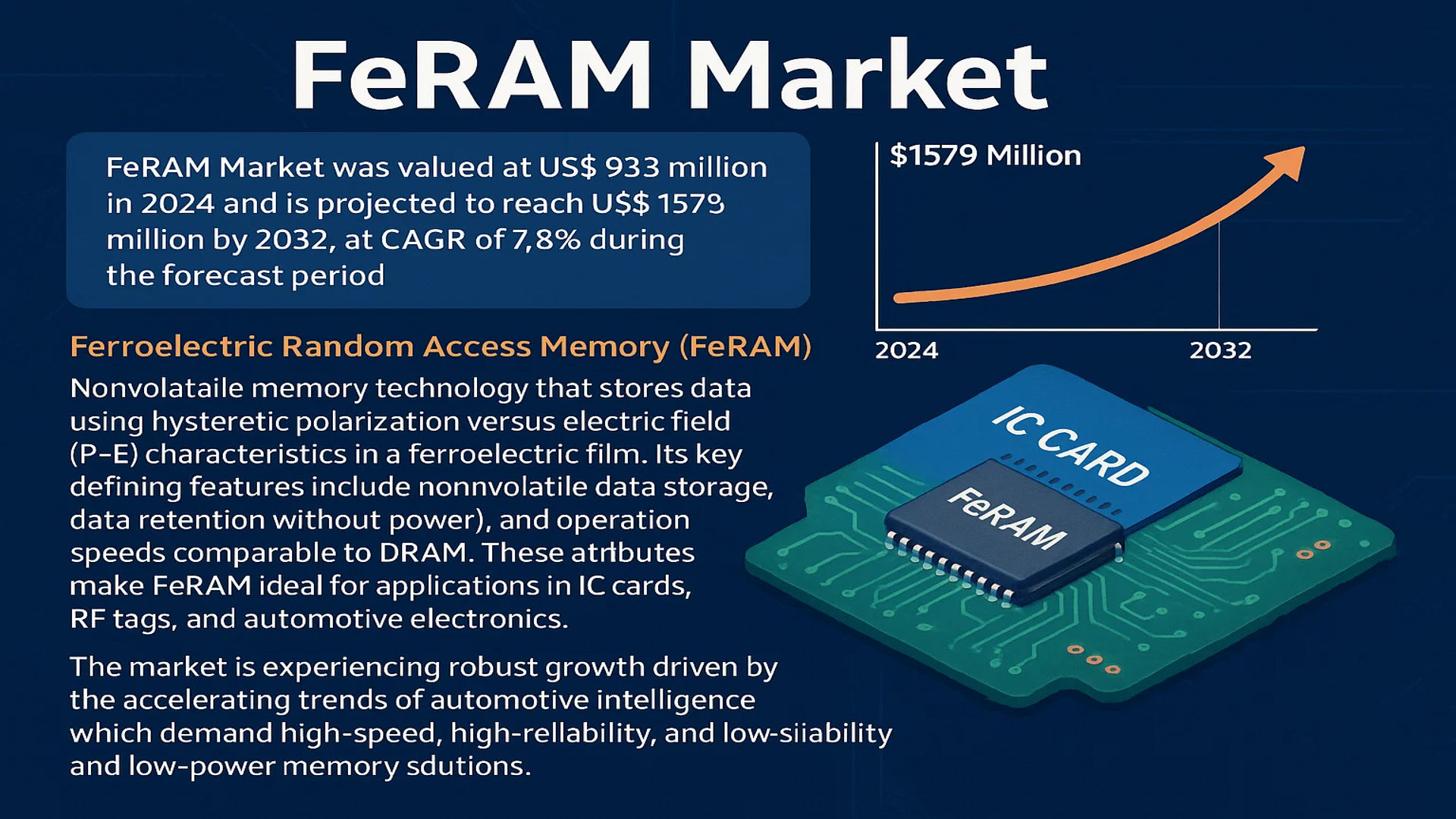
The global FeRAM Market was valued at 933 million in 2024 and is projected to reach US$ 1579 million by 2032, at a CAGR of 7.8% during the forecast period.
Ferroelectric Random Access Memory (FeRAM) is a nonvolatile memory technology that stores data using hysteretic polarization versus electric field (P-E) characteristics in a ferroelectric film. Its key defining features include nonvolatile data storage (data retention without power), the lowest power consumption among semiconductor memories, and operation speeds comparable to DRAM. These attributes make FeRAM ideal for applications in IC cards, RF tags, and increasingly, automotive electronics.
The market is experiencing robust growth driven by the accelerating trends of automotive intelligence and electrification, which demand high-speed, high-reliability, and low-power memory solutions. The automotive electronics and charging piles segment held a significant 27% market share in 2024 and is projected to grow at a CAGR of approximately 9.6%. While the market is currently dominated by RAMXEED and Infineon, which collectively held about 90% market share in 2023, increased competition from emerging players is expected to foster product differentiation and price competitiveness in the coming years.
MARKET DYNAMICS
MARKET DRIVERS
Accelerated Adoption in Automotive Electronics to Drive FeRAM Market Growth
The automotive electronics sector is emerging as a primary growth catalyst for the FeRAM market, driven by the global transition toward electric vehicles (EVs) and advanced driver-assistance systems (ADAS). FeRAM’s non-volatile nature, high endurance, and low power consumption make it ideal for critical automotive applications such as data logging, event recording, and sensor data storage. The automotive industry’s increasing demand for reliable memory solutions that can operate in extreme temperatures and harsh environments aligns perfectly with FeRAM’s technical advantages. With the production of electric vehicles projected to exceed 30 million units annually by 2030, the need for robust memory components in battery management systems, infotainment systems, and autonomous driving modules continues to expand significantly.
Expansion of IoT and Edge Computing Applications to Boost Market Expansion
The proliferation of Internet of Things (IoT) devices and edge computing infrastructure represents another major driver for FeRAM adoption. Unlike traditional flash memory, FeRAM offers fast write speeds, low power operation, and high reliability—critical characteristics for IoT endpoints that require frequent data recording with minimal energy consumption. The global IoT market is experiencing exponential growth, with installed devices expected to surpass 30 billion units by 2030, creating substantial demand for efficient memory solutions. FeRAM’s capability to perform write operations at speeds comparable to SRAM while maintaining non-volatile storage makes it particularly suitable for real-time data processing in smart sensors, industrial automation systems, and wearable devices where power efficiency and data integrity are paramount.
Growing Demand in Medical Devices and Industrial Automation to Fuel Market Development
Medical electronics and industrial automation applications are driving significant FeRAM market growth due to increasing requirements for reliable data storage in critical systems. Medical devices such as patient monitors, implantable devices, and diagnostic equipment require memory that combines non-volatility with high write endurance and radiation resistance. FeRAM’s architecture provides these capabilities without the wear-out mechanisms found in flash memory, making it suitable for applications where data integrity is essential. Similarly, industrial automation systems increasingly utilize FeRAM for program storage, parameter saving, and data logging in programmable logic controllers (PLCs), robotics, and process control equipment. The industrial automation market’s compound annual growth rate of approximately 8.5% creates sustained demand for robust memory solutions that can operate reliably in demanding industrial environments.
MARKET CHALLENGES
High Production Costs and Manufacturing Complexities to Challenge Market Penetration
Despite its technical advantages, FeRAM faces significant challenges related to production costs and manufacturing complexities. The specialized materials and processes required for ferroelectric capacitor fabrication result in higher manufacturing costs compared to conventional memory technologies. The integration of lead zirconate titanate (PZT) or other ferroelectric materials within standard CMOS processes requires additional masking steps and specialized equipment, increasing overall production expenses. These cost factors become particularly challenging in price-sensitive consumer electronics markets where manufacturers seek to minimize bill-of-materials costs. While automotive and industrial applications can tolerate higher component costs due to their critical nature, the broader adoption of FeRAM in consumer products remains constrained by economic factors.
Other Challenges
Technology Scaling Limitations
FeRAM faces physical scaling challenges as semiconductor technology nodes continue to shrink below 28nm. The ferroelectric properties that enable data storage can degrade at extremely small feature sizes, creating technical barriers to density increases. While emerging materials such as hafnium oxide-based ferroelectrics show promise for improved scalability, current implementations struggle to match the density roadmap of competing technologies like MRAM and PCRAM. This scaling limitation restricts FeRAM’s addressable market in applications requiring very high memory densities, confining its primary use cases to specialized applications where its unique characteristics provide compelling advantages over alternative technologies.
Competition from Emerging Memory Technologies
The competitive landscape presents another significant challenge as alternative non-volatile memory technologies continue to advance. Magnetic RAM (MRAM), phase-change memory (PCM), and resistive RAM (ReRAM) are all progressing toward commercialization with improving performance characteristics and decreasing costs. These technologies often benefit from larger research and development investments from major semiconductor companies, creating competitive pressure on FeRAM suppliers. The memory market’s tendency toward standardization and economies of scale further disadvantages niche technologies that haven’t achieved critical mass in high-volume applications, creating ongoing challenges for market expansion beyond specialized segments.
MARKET RESTRAINTS
Limited Density Capabilities and Storage Capacity to Restrain Market Growth
FeRAM technology currently faces inherent limitations regarding storage density and maximum capacity compared to mainstream memory technologies. While flash memory continues to scale to higher densities following Moore’s Law, FeRAM’s structural requirements for ferroelectric capacitors impose practical limits on density improvement. The current market predominantly features devices in the 4KB to 2MB range, with larger capacities remaining technically challenging and economically impractical. This density constraint restricts FeRAM’s applicability in data-intensive applications such as mass storage, multimedia devices, and computing systems requiring large memory arrays. As applications increasingly demand higher storage capacities within the same physical footprint, FeRAM’s density limitations become a significant restraining factor for broader market adoption.
Supply Chain Constraints and Limited Manufacturing Capacity to Hinder Market Expansion
The FeRAM market experiences supply-side constraints due to limited manufacturing capacity and specialized production requirements. Unlike conventional memory technologies produced in massive volumes by multiple foundries worldwide, FeRAM manufacturing remains concentrated among few specialized suppliers with dedicated production lines. This limited manufacturing base creates potential supply chain vulnerabilities and reduces flexibility in responding to demand fluctuations. The specialized materials and processes required for FeRAM production further complicate capacity expansion, as establishing new production facilities requires significant capital investment and technical expertise. These supply chain characteristics create barriers to rapid market growth and make the technology susceptible to production disruptions and longer lead times compared to more established memory technologies.
Technical Complexity and Design Integration Challenges to Slow Market Adoption
Design integration challenges present another significant restraint for FeRAM market growth. Engineers designing FeRAM into new systems must account for its unique electrical characteristics, including specific voltage requirements, polarization switching behavior, and interface considerations. These technical complexities often require specialized design expertise and additional validation efforts compared to more conventional memory technologies. The learning curve associated with FeRAM integration can deter design engineers from adopting the technology, particularly in projects with tight development schedules or limited engineering resources. Furthermore, the availability of development tools, reference designs, and technical support for FeRAM remains more limited than for established memory technologies, creating additional barriers for designers evaluating the technology for new applications.
MARKET OPPORTUNITIES
Emerging Applications in Artificial Intelligence and Machine Learning to Create New Growth Avenues
The rapid advancement of artificial intelligence and machine learning applications presents significant opportunities for FeRAM technology. Edge AI devices require memory solutions that combine non-volatility with fast write capabilities and low power consumption—characteristics that align well with FeRAM’s strengths. The need for instant-on capability in AI processors, combined with requirements for frequent parameter updates and inference data logging, creates ideal use cases for FeRAM implementation. As edge AI deployment accelerates across consumer, industrial, and automotive segments, the demand for specialized memory optimized for AI workloads continues to grow. FeRAM’s architectural advantages position it favorably for capturing market share in this expanding application space, particularly in applications where reliability and power efficiency outweigh pure density considerations.
Advancements in Material Science and Manufacturing Technologies to Enable Market Expansion
Ongoing research and development in ferroelectric materials and manufacturing processes creates substantial opportunities for addressing current market limitations. Recent breakthroughs in hafnium oxide-based ferroelectric materials show promise for improved scalability and compatibility with advanced CMOS processes. These material advancements could enable higher-density FeRAM devices while reducing manufacturing complexities and costs. Additionally, developments in 3D integration techniques and novel capacitor structures offer pathways for increasing storage capacity without proportionally increasing chip area. The continuous improvement in process technologies and material characteristics provides the foundation for expanding FeRAM’s addressable market into applications that previously required alternative memory technologies due to density or cost constraints.
Increasing Focus on Energy Efficiency and Sustainability to Drive Market Development
The global emphasis on energy efficiency and environmental sustainability creates favorable conditions for FeRAM adoption across multiple sectors. FeRAM’s low power operation characteristics make it particularly suitable for battery-powered devices and energy-conscious applications. In consumer electronics, the demand for longer battery life continues to drive component selection toward more efficient technologies. Similarly, industrial and infrastructure applications increasingly prioritize energy efficiency for both operational cost reduction and environmental compliance. FeRAM’s ability to reduce system power consumption by eliminating the need for periodic refresh operations and reducing write energy compared to flash memory positions it advantageously in markets where energy efficiency represents a key selection criterion. This alignment with broader sustainability trends creates expanding opportunities across multiple application segments.
FeRAM MARKET TRENDS
Automotive Electrification and Intelligence Driving Market Expansion
The global FeRAM market is experiencing significant growth, primarily driven by the accelerating trends of automotive electrification and intelligence. With the proliferation of electric vehicles (EVs) and advanced driver-assistance systems (ADAS), the demand for high-reliability, low-power, non-volatile memory solutions has surged. FeRAM’s unique characteristics, including fast write speeds (comparable to DRAM), extremely low power consumption, and exceptional endurance exceeding 10^14 read/write cycles, make it ideally suited for critical automotive applications. These include data logging for black boxes, storing calibration data for sensors, and managing power control units where frequent writes are necessary. The automotive electronics and charging station segment, which accounted for approximately 27% of the market in 2024, is projected to grow at a CAGR of around 9.6%, underscoring its role as a primary growth engine for the entire FeRAM industry.
Other Trends
Capacity Scaling and Technological Breakthroughs
While medium and low-capacity FeRAM (4K-256K) currently dominates the market with an anticipated 68% share by 2032, a clear trend toward higher-density products is emerging. Manufacturers are actively pursuing technological breakthroughs to move beyond the 2-megabit threshold, a significant barrier in the past. This development is crucial for tapping into new, high-value markets such as enterprise storage, advanced medical imaging equipment, and next-generation telecommunications infrastructure. The ability to offer higher capacities will enable FeRAM to compete more directly with other non-volatile memories in a broader range of applications, moving beyond its traditional stronghold in niche, high-write-cycle scenarios.
Intensifying Competitive Landscape and Geographic Shifts
The competitive dynamics of the FeRAM market are evolving. While the market has historically been concentrated, with two players holding a combined share of nearly 90% in 2023, this dominance is being challenged. The high growth potential is attracting new entrants, particularly from the Asia-Pacific region, who are leveraging product differentiation and competitive pricing strategies. This is leading to increased R&D investment from established players to maintain their technological edge. Furthermore, the geographic consumption pattern is shifting, with the Asia-Pacific region expected to exhibit the highest growth rate due to its robust electronics manufacturing base, strong government support for semiconductor independence, and the rapid adoption of smart technologies across its industrial and consumer sectors.
COMPETITIVE LANDSCAPE
Key Industry Players
Leading Manufacturers Focus on Innovation and Strategic Expansion to Maintain Market Dominance
The global FeRAM market exhibits a highly concentrated competitive structure, dominated by a few established semiconductor giants while witnessing the gradual emergence of specialized manufacturers. This concentration is primarily because FeRAM technology requires significant expertise in ferroelectric materials and advanced semiconductor processes, creating high barriers to entry. RAMXEED (formerly Fujitsu Semiconductor) and Infineon Technologies AG collectively command a staggering share of the market, a position solidified through decades of research, extensive patent portfolios, and deep-rooted relationships with major automotive and industrial clients. Their leadership is not just in volume but in setting industry standards for reliability and performance, particularly for automotive-grade components.
While the market is top-heavy, competition is intensifying as other significant players leverage their broader technological capabilities. Texas Instruments, for instance, applies its vast analog and embedded processing experience to integrate FeRAM into more comprehensive system-on-chip (SoC) solutions, especially for metering and automotive applications. Similarly, ROHM Co., Ltd. (through its subsidiary Lapis Semiconductor) competes by focusing on ultra-low-power FeRAM variants, targeting the growing Internet of Things (IoT) and wearable technology segments. Their strategy often involves offering FeRAM as a part of a broader portfolio of power management and semiconductor solutions.
The competitive dynamics are further evolving with the entry of companies from the Asia-Pacific region. Wuxi Smart Memories represents this new wave of competitors, aiming to capture market share by offering cost-competitive alternatives and focusing on the high-growth domestic Chinese market, which is a major consumer of electronics and automotive components. These emerging players are investing heavily in R&D to close the technology gap and are expected to compete aggressively on price, which could pressure margins industry-wide over the forecast period.
Furthermore, the strategic focus of all key players is sharply aligned with market megatrends. The rapid electrification and automation of the automotive sector, which demands non-volatile memory with high endurance and fast write speeds, is a primary battleground. Consequently, market leaders are channeling investments into developing higher-density FeRAM products (above 2M) and forming strategic partnerships with Tier-1 automotive suppliers and charging infrastructure manufacturers to secure long-term supply agreements and co-develop customized solutions.
List of Key FeRAM Companies Profiled
- RAMXEED (Former Fujitsu) (Japan)
- Infineon Technologies AG (Germany)
- Texas Instruments Incorporated (U.S.)
- ROHM Co., Ltd. (Lapis Semiconductor) (Japan)
- Wuxi Smart Memories Technology Co., Ltd. (China)
Segment Analysis:
By Memory Size
4K to 256K Segment Dominates the Market Owing to High Technological Maturity and Widespread Use in Automotive and Industrial Applications
The market is segmented based on memory size into:
- 4K to 256K
- 512K to 2M
- Above 2M
By Application
Automotive Electronics and Charging Piles Segment Leads Due to Accelerated Adoption in Vehicle Intelligence and Electrification
The market is segmented based on application into:
- Automotive Electronics and Charging Piles
- Instruments and Meters
- Industrial Automation
- Medical
- Telecommunication
- Consumer Electronics
- Others
By End User
Automotive Industry is the Primary End User Driven by Demand for High-Reliability, Low-Power Memory Solutions
The market is segmented based on end user into:
- Automotive Manufacturers
- Industrial Equipment Manufacturers
- Medical Device Companies
- Consumer Electronics Brands
- Telecommunication Infrastructure Providers
Regional Analysis: FeRAM Market
Asia-Pacific
The Asia-Pacific region dominates the global FeRAM market, accounting for over 55% of total consumption in 2024. This leadership is driven by robust manufacturing ecosystems, particularly in China, Japan, and South Korea, which are home to major semiconductor foundries and electronics OEMs. The region’s massive automotive and consumer electronics sectors are primary adopters of FeRAM technology, especially in the 4K-256K memory segment. China’s push for semiconductor self-sufficiency, exemplified by initiatives like the “Made in China 2025” policy, is accelerating local FeRAM production capabilities. Furthermore, the rapid expansion of electric vehicle infrastructure and smart meter deployments across India and Southeast Asian nations is fueling sustained demand for low-power, non-volatile memory solutions. However, intense price competition and the prevalence of established alternative memories like EEPROM and NOR Flash in cost-sensitive applications present ongoing challenges to wider FeRAM adoption.
North America
North America represents a significant and technologically advanced market for FeRAM, characterized by high-value applications in automotive electronics, medical devices, and industrial automation. The presence of key players like Texas Instruments and a strong R&D focus, particularly in the United States, drives innovation in higher-density FeRAM chips (512K to 2M and above). Stringent data integrity and reliability requirements in sectors such as aerospace, defense, and healthcare create a natural fit for FeRAM’s inherent advantages. Recent U.S. legislation, including the CHIPS and Science Act, which allocates funding for domestic semiconductor research and manufacturing, is expected to indirectly benefit the FeRAM ecosystem by bolstering the overall advanced memory landscape. The region’s market growth is tempered by the higher cost of FeRAM compared to some incumbents, limiting its use to applications where its technical benefits are absolutely critical.
Europe
Europe’s FeRAM market is mature and steadily growing, underpinned by a strong industrial base and leading automotive manufacturers in Germany, France, and Italy. The region’s focus on energy efficiency and green technology aligns perfectly with FeRAM’s ultra-low power consumption profile, making it a preferred choice for smart energy meters, automotive sensor modules, and industrial IoT devices. Strict EU regulations on data retention and product longevity in critical systems further support the adoption of reliable non-volatile memories. Companies like Infineon, headquartered in Germany, are pivotal in supplying FeRAM solutions to the continent’s automotive and industrial sectors. While the market is well-established, growth is methodical rather than explosive, as engineers carefully evaluate FeRAM against other non-volatile options for each specific application based on a strict cost-benefit analysis.
South America
The FeRAM market in South America is nascent but shows potential for gradual growth. The region’s developing industrial automation and telecommunications infrastructure present opportunities for FeRAM adoption, particularly in applications requiring data logging and configuration storage in challenging environments. Brazil and Argentina are the most active markets, though economic volatility and currency fluctuations often prioritize lower-cost memory solutions, hindering the widespread adoption of more advanced but premium-priced technologies like FeRAM. The market is primarily served by global distributors and relies on imports, with limited local design-in activity. Growth is expected to be slow but steady, tracking the region’s broader economic development and industrialization efforts.
Middle East & Africa
The FeRAM market in the Middle East & Africa is in its very early stages of development. Demand is primarily driven by imported electronic products and equipment used in the oil & gas, telecommunications, and infrastructure sectors. Countries like Israel, Turkey, and the UAE, with more advanced technological bases, show the most promise for early adoption in niche applications such as medical equipment and payment systems. However, the market faces significant headwinds, including a lack of local semiconductor manufacturing, limited awareness of FeRAM technology among design engineers, and a strong preference for the lowest-cost components. Market development is expected to be a long-term process, following the region’s overall technological advancement and economic diversification.
Report Scope
This market research report provides a comprehensive analysis of the global and regional Ferroelectric RAM (FeRAM) market, covering the forecast period 2025–2032. It offers detailed insights into market dynamics, technological advancements, competitive landscape, and key trends shaping the industry.
Key focus areas of the report include:
- Market Size & Forecast: Historical data and future projections for revenue, unit shipments, and market value across major regions and segments.
- Segmentation Analysis: Detailed breakdown by memory size, application, and end-user industry to identify high-growth segments and investment opportunities.
- Regional Outlook: Insights into market performance across North America, Europe, Asia-Pacific, Latin America, and the Middle East & Africa, including country-level analysis where relevant.
- Competitive Landscape: Profiles of leading market participants, including their product offerings, R&D focus, manufacturing capacity, pricing strategies, and recent developments such as mergers, acquisitions, and partnerships.
- Technology Trends & Innovation: Assessment of emerging technologies, integration with AI/IoT systems, semiconductor design trends, fabrication techniques, and evolving industry standards.
- Market Drivers & Restraints: Evaluation of factors driving market growth along with challenges, supply chain constraints, regulatory issues, and market-entry barriers.
- Stakeholder Analysis: Insights for component suppliers, OEMs, system integrators, investors, and policymakers regarding the evolving ecosystem and strategic opportunities.
Primary and secondary research methods are employed, including interviews with industry experts, data from verified sources, and real-time market intelligence to ensure the accuracy and reliability of the insights presented.
FREQUENTLY ASKED QUESTIONS:
What is the current market size of Global FeRAM Market?
-> FeRAM Market was valued at 933 million in 2024 and is projected to reach US$ 1579 million by 2032, at a CAGR of 7.8% during the forecast period.
Which key companies operate in Global FeRAM Market?
-> Key players include RAMXEED (Former Fujitsu), Infineon, Texas Instruments, ROHM (Lapis), and Wuxi Smart Memories, among others.
What are the key growth drivers?
-> Key growth drivers include accelerating automotive electrification, demand for low-power non-volatile memory, growth in industrial automation, and expansion of IoT devices.
Which region dominates the market?
-> Asia-Pacific dominates the market, driven by strong semiconductor manufacturing presence in Japan, South Korea, and China, while North America shows significant growth in automotive and industrial applications.
What are the emerging trends?
-> Emerging trends include development of higher capacity FeRAM chips (above 2M), integration with AI edge computing devices, adoption in smart grid systems, and expansion in medical electronics applications.

Get Sample Report PDF for Exclusive Insights
Report Sample Includes
- Table of Contents
- List of Tables & Figures
- Charts, Research Methodology, and more...
 Download Sample Report PDF