Fanless Embedded System Market Insights
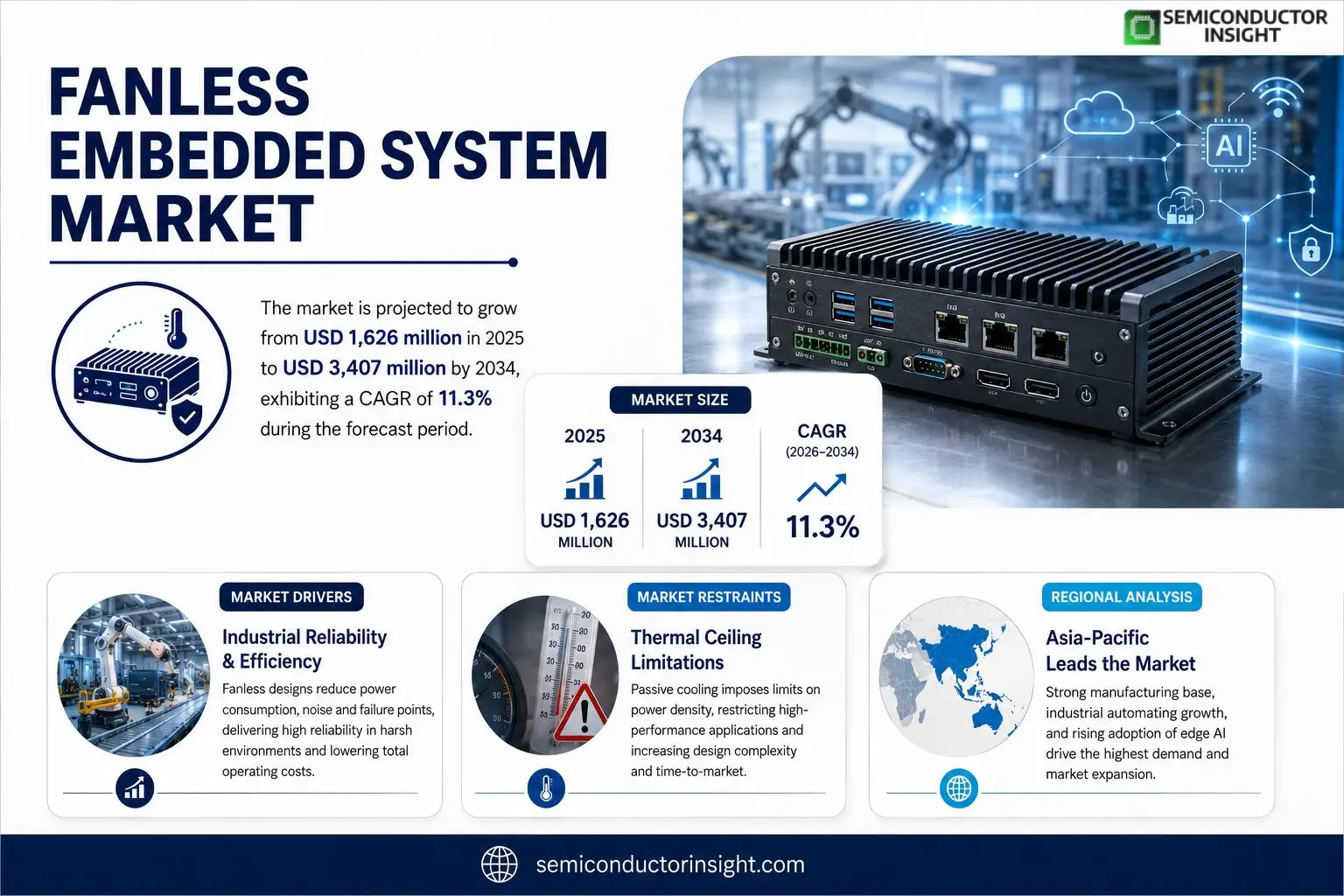
Fanless Embedded System market size was valued at USD 1626 million in 2025 and is projected to reach USD 3407 million by 2034, exhibiting a CAGR of 11.3% during the forecast period.
A fanless embedded system is an integrated computing platform built for industrial sites and edge deployments. Its core value lies in delivering stable control, data acquisition, protocol conversion, machine‑vision processing, and local AI inference without active cooling, thanks to reinforced chassis thermal design, wide‑temperature and wide‑voltage support, shock‑resistant construction, and rich industrial I/O. Main form factors have expanded from compact box PCs to DIN‑rail systems, rugged embedded computers, industrial IoT gateways, vehicle/rail computers, and edge AI computers. Typical processors include Intel Core/N‑series, ARM SoCs, and NVIDIA Jetson platforms combined with multiple LAN, USB, COM, CAN, M.2, wireless options and optional PoE or PCIe expansion.
MARKET DRIVERS
Thermal Efficiency Gains
Customers in data‑center and edge‑computing environments are increasingly favoring designs that eliminate active cooling. By removing fans, manufacturers reduce both power consumption and acoustic emissions, which translates into lower operating costs and easier installation in noise‑sensitive facilities. This shift enhances system reliability because fewer moving parts mean fewer failure points, a factor that resonates strongly with OEMs seeking longer product lifecycles.
Industrial Reliability Demands
Industries such as transportation, aerospace, and oil & gas operate under harsh temperature fluctuations and vibration. A fanless architecture delivers a sealed enclosure that resists dust ingress and moisture, aligning with stringent certification requirements. Companies that prioritize uptime are therefore allocating a larger share of their procurement budget to fanless solutions, recognizing the downstream savings from reduced maintenance windows.
➤ Design engineers report that eliminating the fan assembly can shrink bill of materials by up to 12 %, while also simplifying thermal‑management validation cycles.
Collectively, these forces are reshaping the competitive landscape: vendors that integrate low‑thermal‑resistance heat‑pipes and advanced chassis alloys are capturing early‑adopter contracts, positioning themselves to benefit from the broader move toward silent, energy‑efficient hardware.
MARKET CHALLENGES
Supply Chain Volatility
shortages of high‑performance aluminum alloys and specialty thermal interface materials have introduced lead‑time extensions that strain project schedules. Manufacturers must now hold higher inventory buffers, which erodes the cost advantage traditionally associated with fanless designs. The uncertainty surrounding raw‑material availability forces procurement teams to renegotiate terms, often at premium rates.
Other Challenges
Regulatory Scrutiny
Environmental regulations in the EU and North America increasingly penalize devices that cannot demonstrate low‑heat‑dissipation profiles. While fanless units inherently produce less waste heat, they must still meet stringent EMC and safety standards, requiring additional testing that elevates development expenditures.
Cost Sensitivity
Mid‑range market segments remain highly price‑aware. Although the absence of a fan reduces component count, the need for premium heat‑spreader solutions can raise the unit cost, making it difficult for manufacturers to compete on price against conventional, fan‑cooled alternatives in cost‑driven categories.
MARKET RESTRAINTS
Thermal Ceiling Limitations
Fanless configurations have an upper bound on permissible power density. Applications that exceed this thermal envelope must revert to active cooling, limiting the appeal of fanless designs for high‑performance compute modules. Design teams consequently face trade‑offs between processing capability and thermal safety, which can delay product roll‑outs.Moreover, the engineering effort required to model passive heat‑dissipation accurately adds schedule risk. Companies lacking mature simulation capabilities frequently encounter iteration loops that extend time‑to‑market, reinforcing the perception that fanless solutions are suited only for niche, low‑power use cases.
MARKET OPPORTUNITIES
Emerging Edge‑AI Deployments
Edge‑AI devices demand compact, rugged hardware that can operate unattended for extended periods. Fanless platforms, with their silent operation and reduced power draw, align perfectly with autonomous surveillance cameras, smart sensors, and portable analytics units. Companies that bundle AI acceleration chips with optimized passive‑cooling chassis are poised to win contracts in smart‑city and industrial‑IoT projects.In parallel, the growth of 5G micro‑data centers creates a demand for densely packed compute nodes that can be installed in constrained indoor spaces. Fanless Embedded System Market stands to benefit as operators seek modules that maintain thermal stability without the logistical overhead of fan maintenance, delivering an attractive value proposition for telecom equipment providers.
Fanless Embedded System Market Trends
Shift Toward Edge AI Integration
The most visible evolution in Fanless Embedded System Market is the migration from pure data‑acquisition platforms toward edge‑intelligent nodes. Manufacturers now routinely embed ARM‑based SoCs, Intel N‑series, and NVIDIA Jetson modules that can execute inference on the device itself. This change is driven by the need to reduce latency in machine‑vision stations, autonomous mobile robots and railway monitoring units where a cloud round‑trip would compromise real‑time decision making. By processing sensor streams locally, system integrators lower bandwidth costs and improve reliability in harsh environments. The implication for OEMs is a redesign of product roadmaps to include AI‑accelerated cores, software imaging tools and remote‑management layers that were previously optional.
Other Trends
Expansion of Form Factors for Industrial Connectivity
While compact box PCs remain dominant in legacy automation lines, the product catalogue has broadened to DIN‑rail modules, rugged gateway boxes and vehicle‑rated computers. This diversification mirrors the growing variety of deployment sitesfrom factory floors to on‑site substations and moving trains. Each new form factor retains the fanless thermal architecture but adds field‑friendly mounting options, expanded M.2 slots and PoE capability, thereby simplifying installation and service cycles. For distributors, the broadened SKU base translates into higher cross‑sell potential, while system integrators benefit from a more modular approach that aligns hardware selection with specific environmental constraints.
Growing Security and Lifecycle Demands
Regulatory pressure, exemplified by Europe’s Cyber Resilience Act, is reshaping procurement criteria for edge devices. Buyers now require TPM chips, signed firmware updates and guaranteed long‑life component supply. Vendors that can certify compliance and offer extended maintenance contracts are positioning themselves as preferred partners for high‑value sectors such as energy, transportation and defense. Consequently, the market is seeing a rise in bundled offerings that combine hardware, secure‑boot software stacks and cloud‑edge management platforms. Companies that fail to embed these capabilities risk losing contracts to competitors that present a turnkey, security‑first solution.
COMPETITIVE LANDSCAPE
Key Industry Players
Fanless Embedded System Market: Competitive Overview
Advantech remains the de‑facto anchor of the fanless segment, leveraging its deep Taiwanese board‑design heritage and a broad portfolio that spans compact box PCs, DIN‑rail units and rugged edge AI computers. The firm’s ability to combine Intel N‑series CPUs with optional NVIDIA Jetson modules, together with an evergreen long‑life supply strategy, allows it to serve system integrators seeking both stability and the latest AI acceleration. AAEON and ADLINK follow closely, each differentiating through modular gateway architectures and aggressive certification programs that satisfy the heightened security expectations of European and North‑American buyers. The top‑tier players dominate the high‑volume corridors of factory automation and equipment connectivity, where reliability and predictable thermal performance are non‑negotiable.Beyond the three giants, a constellation of niche innovators is reshaping the value chain. Companies such as Winmate and Axiomtek focus on ruggedized vehicle and rail solutions, embedding wide‑temperature designs that address the strict vibration tolerances of railway operators. Smaller ODMsSECO, Vecow, and Cincozeconcentrate on bespoke expansion options, offering M.2, PoE and TPM integrations that appeal to OEMs needing rapid customization. Meanwhile, Asian specialists like OnLogic and Portwell are pushing edge AI adoption by bundling pre‑installed Jetson modules with remote‑management software, creating a compelling proposition for robotics firms and AMR manufacturers. The collective effort of these players broadens the ecosystem, ensuring that end‑users can select a partner aligned with either scale, specialization or regional support.
List of Key Fanless Embedded System Companies Profiled
- Advantech
- AAEON
- ADLINK
- Winmate
- Axiomtek
- SECO
- Vecow
- Cincoze
- OnLogic
- Portwell
- IEI Integration
- Neousys
- Acrosser
- Jetway Information
- Arbor Technology
Segment Analysis:
| Segment Category | Sub-Segments | Key Insights |
| By Type |
|
Industrial IoT Gateway
|
| By Application |
|
Factory Automation
|
| By End User |
|
Industrial OEMs
|
| By Technology |
|
NVIDIA Jetson
|
| By Service Model |
|
Integrated Software Imaging
|
Regional Analysis: Fanless Embedded System Market
North America
Leading silicon vendors are embedding advanced heat‑spreading layers directly into package substrates, allowing designers to meet higher power densities without compromising the fan‑less premise. This shift unlocks new form‑factors for autonomous vehicles and industrial IoT gateways, where space and reliability are paramount.
Recent disruptions have prompted OEMs to diversify component sources, favoring domestic fabs and qualified secondary suppliers. The resulting multi‑sourced strategy reduces lead‑time volatility and safeguards the uninterrupted flow of fan‑less modules to critical projects.
Stringent emissions and electromagnetic compatibility rules in the United States and Canada drive adoption of fan‑less designs, which inherently produce lower acoustic noise and fewer moving parts, simplifying compliance pathways for a wide range of applications.
Enterprises deploying edge analytics are gravitating toward fan‑less solutions to lower total cost of ownership. The reduced maintenance burden aligns with the operational models of remote sites, where service visits are expensive and downtime intolerable.
Europe
European manufacturers are capitalising on the region’s strong standards framework to embed fan‑less technologies into high‑precision medical imaging and railway signalling equipment. Collaborative research programmes between universities and industrial consortia are delivering proprietary thermal‑interface materials that extend device lifespans. Meanwhile, the growing emphasis on sustainability prompts system integrators to select fan‑less modules for their lower energy draw, supporting broader carbon‑reduction commitments across the continent.
Asia‑Pacific
In Asia‑Pacific, rapid expansion of smart‑factory deployments fuels demand for rugged, low‑maintenance computing platforms. Local semiconductor players are leveraging cost‑effective manufacturing bases to offer fan‑less solutions at competitive price points, attracting mid‑size automation firms. Alongside, rising defense spending in several economies accelerates adoption in unmanned aerial and naval systems, where reliability under harsh environmental conditions is non‑negotiable.
South America
South American markets are experiencing a modest but steady uptake of fan‑less embedded systems, driven largely by agricultural technology firms seeking durable field devices resistant to dust and humidity. Regional supply chains are gradually maturing, with increasing imports of specialized thermal management components complementing domestic assembly capabilities. The trend encourages local OEMs to differentiate their offerings through tailored enclosure designs that meet tropical operating conditions.
Middle East & Africa
The Middle East & Africa region is witnessing early‑stage interest in fan‑less platforms for oil‑field monitoring and renewable‑energy installations where high ambient temperatures challenge conventional cooling. Partnerships between multinational vendors and regional integrators focus on ruggedisation strategies that combine advanced enclosure sealing with passive cooling techniques. As infrastructure projects expand, the market is poised to grow beyond niche applications toward broader industrial adoption.
Report Scope
This market research report provides a comprehensive analysis of the Fanless Embedded System Market , covering the forecast period 2026–2034. It offers detailed insights into market dynamics, technological advancements, competitive landscape, and key trends shaping the industry.
Key focus areas of the report include:
- Market Overview: The report begins with an overview outlining its current market scenario, key growth indicators, and industry transformation drivers. It discusses macroeconomic factors, demand–supply balance, regulatory landscape, and the strategic role of semiconductors in powering advancements across industries such as automotive, telecommunications, consumer electronics, and industrial automation.
- Market Size & Forecast: Historical data and future projections for revenue, unit shipments, and market value across major regions and segments.
- Segmentation Analysis: Detailed breakdown by product type, technology, application, and end-user industry to identify high-growth segments and investment opportunities.
- Regional Insights: Insights into market performance across North America, Europe, Asia-Pacific, Latin America, and the Middle East & Africa, including country-level analysis where relevant.
- Competitive Landscape: Profiles of leading market participants, including their product offerings, R&D focus, manufacturing capacity, pricing strategies, and recent developments such as mergers, acquisitions, and partnerships.
- Technology Trends & Innovation: Assessment of emerging technologies, integration of AI/IoT, semiconductor design trends, fabrication techniques, and evolving industry standards.
- Market Drivers & Restraints: Evaluation of factors driving market growth along with challenges, supply chain constraints, regulatory issues, and market-entry barriers.
- Stakeholder Insights: Insights for component suppliers, OEMs, system integrators, investors, and policymakers regarding the evolving ecosystem and strategic opportunities.
Primary and secondary research methods are employed, including interviews with industry experts, data from verified sources, and real-time market intelligence to ensure the accuracy and reliability of the insights presented.
FREQUENTLY ASKED QUESTIONS:
What is the current market size of Fanless Embedded System Market?
-> Fanless Embedded System Market was valued at USD 1626 million in 2025 and is expected to reach USD 3407 million by 2034 at a CAGR of 11.3%.
Which key companies operate in Fanless Embedded System Market?
-> Key players include Advantech, AAEON, ADLINK, Winmate, Acrosser, Kontron Europe GmbH, OnLogic, Inc., SECO S.p.A., Syslogic AG, Eurotech S.p.A., among others.
What are the key growth drivers?
-> Key growth drivers include increased adoption of edge AI, demand for reliable industrial control without active cooling, expansion of factory automation, and growth in intelligent transportation and remote site monitoring.
Which region dominates the market?
-> Asia provides the largest volume opportunity driven by manufacturing upgrades, while Europe and North America sustain higher‑value demand in transportation, energy, utilities, and security‑sensitive deployments.
What are the emerging trends?
-> Emerging trends include integration of Jetson‑based edge AI computing, enhanced security compliance with regulations such as the EU Cyber Resilience Act, and bundled services like long‑life supply, remote device management, and customized ODM solutions.
Get Sample Report PDF for Exclusive Insights
Report Sample Includes
- Table of Contents
- List of Tables & Figures
- Charts, Research Methodology, and more...
 Download Sample Report PDF