DIN-rail Embedded System Market Insights
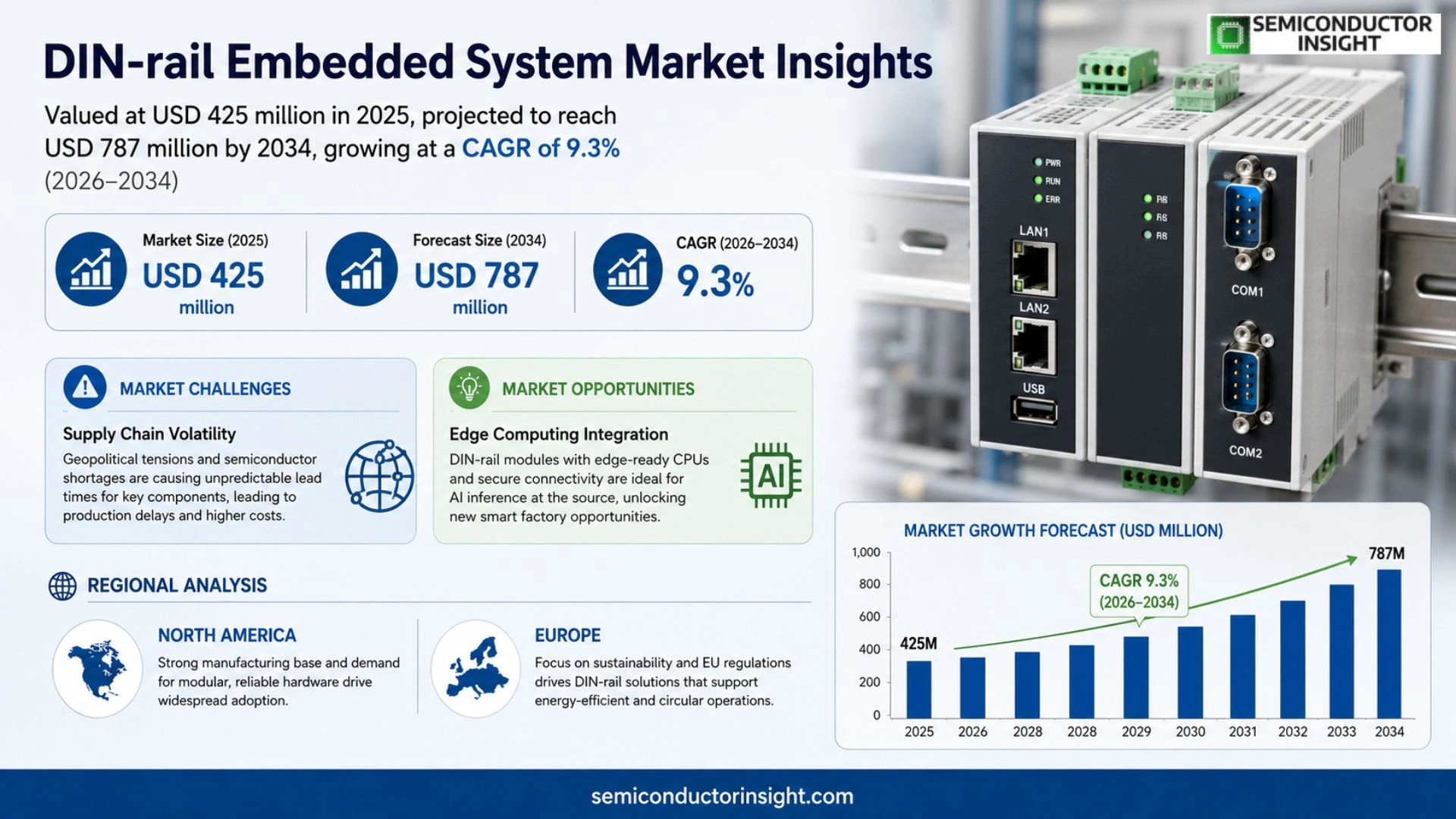
Global DIN-rail Embedded System market was valued at USD 425 million in 2025. The market will increase to USD 787 million by 2034, reflecting a CAGR of 9.3 % over the forecast horizon.
A DIN-rail embedded system is an industrial‑grade edge computing and control platform mounted on a standard 35 mm DIN rail. It consolidates functions traditionally spread across PLCs, gateways, industrial PCs and protocol converters into a single compact unit that fits inside a control cabinet, delivering data acquisition, protocol bridging, local processing, device control, remote maintenance and cloud connectivity in environments constrained by space, wiring density, dust, vibration and electromagnetic interference. Official specifications highlight fan‑less designs, wide‑temperature and voltage ranges, front‑access I/O, serial ports, industrial Ethernet, USB, digital I/O, CAN, PoE or fieldbus interfaces, and modular expansion via M.2 or Mini PCIe.
The market gains momentum because manufacturers seek to add edge‑computing capability without enlarging cabinet footprints or increasing wiring complexity. While entry‑level devices rely on low‑power ARM or x86 processors for gateway functions, higher‑end models integrate machine‑vision cameras, AI inference engines and high‑speed networking to act as real‑time decision nodes on the factory floor. Regional supply patterns show Taiwanese firms leading in product breadth, Chinese vendors emphasizing cost‑effective protocol access, and Japanese/Korean companies focusing on IoT edge controllers. These dynamics suggest sustained growth as industries such as energy management, transportation infrastructure and smart manufacturing expand their demand for compact yet powerful edge solutions.
MARKET DRIVERS
Industrial Automation Adoption
The surge in automated production lines across manufacturing hubs has amplified the need for compact, reliable control hardware. DIN-rail Embedded System Market players benefit from factories seeking modules that can be mounted directly on standard rail systems, cutting installation time and floor‑space usage. This shift reduces mechanical wear points, which translates into lower total‑ownership cost for end users.
Regulatory Compliance Pressure
Stricter safety and electromagnetic‑compatibility (EMC) standards in Europe and North America compel equipment manufacturers to choose solutions that are pre‑certified for DIN‑rail environments. Vendors that embed compliance testing into their design‑to‑delivery workflow capture a larger share of contracts that would otherwise be awarded to legacy chassis‑based providers.
➤ Integrated design reduces wiring complexity and downtime, delivering measurable productivity gains for plant operators.
Beyond compliance, the ability to cascade multiple modules on a single rail enables scalable system upgrades without major civil works. Companies that position their portfolios as plug‑and‑play extensions of existing infrastructure are seeing faster repeat orders and stronger customer loyalty within DIN-rail Embedded System Market.
MARKET CHALLENGES
Supply Chain Volatility
Recent geopolitical tensions and semiconductor shortages have introduced lead‑time unpredictability for core microcontroller cores used in DIN‑rail units. Manufacturers that lack diversified sourcing strategies face production bottlenecks, which can erode margins and delay critical plant retrofits.
Other Challenges
Component Cost Escalation
The rising price of power‑MOSFETs and isolation transformers directly inflates the bill of materials for DIN‑rail enclosures. End users, especially in price‑sensitive sectors such as water treatment, are tightening capital‑expenditure budgets, forcing vendors to justify premium pricing through demonstrable reliability gains.
MARKET RESTRAINTS
Installation Skill Gap
The specialized wiring techniques required for DIN‑rail mounting are not universally taught in traditional electrician curricula. Consequently, system integrators often rely on a limited pool of certified technicians, which can slow project timelines and raise labor costs for OEMs.
Additionally, legacy facilities that were originally wired for panel‑mount solutions encounter retro‑fit hurdles. The need to remodel existing racks to accommodate rail tracks adds an upfront capital outlay that can deter investment, especially in mature industrial parks.
MARKET OPPORTUNITIES
Edge Computing Integration
Edge analytics demand processing power at the source, and the compact footprint of DIN‑rail modules makes them ideal hosts for AI inference engines. Companies that embed edge‑ready CPUs and secure communication stacks into their rail‑mounted offerings are positioning themselves to capture the next wave of smart‑factory investments.
Parallel to edge deployment, the rise of predictive maintenance platforms creates a market for modular sensor hubs that can be slotted onto existing rails without interrupting operations. By bundling condition‑monitoring interfaces with the core controller, suppliers can unlock recurring revenue streams through software‑as‑a‑service contracts tied to DIN-rail Embedded System Market.
DIN-rail Embedded System Market Trends
Edge‑Intelligence Integration Within Standardized Cabinets
DIN-rail Embedded System Market is witnessing a decisive re‑orientation as the classic rail‑mount form factor evolves from a simple conduit for protocol conversion into a compact hub for edge‑computing. By embedding low‑power x86 or ARM cores together with fan‑less thermal designs, manufacturers enable real‑time data aggregation, local control loops, and even machine‑vision inference without enlarging the control cabinet. Front‑access I/O modules, wide‑temperature and wide‑voltage ratings, and isolated interfaces allow the same enclosure to host legacy fieldbus connections alongside high‑speed Ethernet and AI accelerators. This convergence trims wiring bundles, curtails installation time, and translates into measurable reductions in downtime during routine maintenance. Suppliers are increasingly packaging a base hardware platform with interchangeable software images and protocol libraries, turning each sale into a recurring services opportunity rather than a single hardware transaction.
Other Trends
Modular Expansion and Interface Density
One of the clearest signals of market maturation is the rise of modular expansion kits that let end users augment core functionality on demand. Standard DIN‑rail units now expose spare PCIe lanes, M.2 slots, and configurable I/O buses, enabling add‑on cards for CAN, PoE, or specialized fieldbus protocols to be installed without redesigning the cabinet layout. This plug‑in approach aligns with the broader industry move toward “right‑size” solutions, where the same base unit can serve a low‑end data‑gateway role in one plant and a high‑throughput vision node in another. Regional analysis shows Taiwanese manufacturers leading the breadth of module combinations, while Chinese suppliers emphasize cost‑effective vertical adapters. Japanese and Korean firms focus on secure boot and certification depth, positioning their offerings for regulated sectors such as energy and transportation.
Supply‑Side Competitive Realignment
From a strategic standpoint, the competitive landscape is reshaping around ecosystem construction rather than pure silicon performance. Companies that can bundle hardware with long‑term firmware support, field‑specific protocol stacks, and rapid customization services are extracting higher margins. The shift also pressures vendors to invest in certification programs and ruggedization testing, because customers now evaluate the total lifecycle cost of a DIN‑rail solution as a service platform. As edge deployment expands beyond traditional automation into smart‑grid monitoring, railway signaling, and building‑management networks, DIN-rail Embedded System Market is poised to become a foundational element of many digital‑infrastructure rollouts, reinforcing its relevance across multiple industry verticals.
COMPETITIVE LANDSCAPE
Key Industry Players
DIN‑rail Embedded System Market – Competitive Overview
The market is dominated by a handful of tier‑one manufacturers that combine extensive product portfolios with global support networks. Advantech Co., Ltd., leveraging its Taiwanese engineering base, offers a broad spectrum of fan‑less, wide‑temperature modules that address both low‑power gateway needs and high‑performance edge AI use cases. AAEON Technology Inc. differentiates itself through a tight coupling of hardware and proprietary software stacks, allowing system integrators to accelerate deployment in factory‑floor control cabinets. Moxa Inc., rooted in the United States, concentrates on ruggedized communication gateways and emphasizes industrial certifications that reduce downtime in harsh environments. These three firms capture a sizable share of revenue by standardising core platforms while extracting margin from customized I/O, protocol libraries, and long‑term service contracts.
Beyond the leaders, a fragmented group of specialist players enriches the ecosystem with niche capabilities. ARBOR Technology Corp. and Cincoze Co., Ltd. focus on compact ARM‑based nodes optimized for energy‑management and transportation applications. CONTEC Co., Ltd. and Darveen Technology Ltd. provide cost‑effective entry‑level devices that excel in protocol bridging for legacy PLC environments. Companies such as DFI, ICOP Technology Inc., and IEI Integration add value through modular expansion options and field‑bus expertise, catering to regional demand in Mainland China and Southeast Asia. Smaller innovators like JHCTECH, JWIPC Technology Co., Ltd., M2I Corporation, and Neousys Technology Inc. experiment with edge AI acceleration and machine‑vision add‑ons, creating pockets of high‑margin opportunity for customers seeking differentiated functionality.
List of Key DIN‑rail Embedded System Companies Profiled
- Advantech Co., Ltd.
- AAEON Technology Inc.
- Moxa Inc.
- ARBOR Technology Corp.
- Axiomtek
- Cincoze Co., Ltd.
- CONTEC Co., Ltd.
- Darveen Technology Ltd.
- DFI
- ICOP Technology Inc.
- IEI Integration
- JHCTECH
- JWIPC Technology Co., Ltd.
- M2I Corporation
- Neousys Technology Inc.
Segment Analysis:
| Segment Category | Sub-Segments | Key Insights |
| By Type |
|
Connectivity Nodes
|
| By Application |
|
Industrial Automation
|
| By End User |
|
System Integrators
|
Regional Analysis: DIN-rail Embedded System Market
North America
Manufacturing plants across the United States and Canada are refitting legacy PLC racks with smart DIN‑rail modules, seeking tighter loop control and predictive maintenance. The shift reflects a broader appetite for plug‑and‑play solutions that reduce engineering overhead while delivering real‑time diagnostics.
Recent revisions to safety standards emphasize intrinsic safety for hazardous zones, prompting vendors to certify DIN‑rail enclosures for ATEX and IECEx compliance. This regulatory pressure is reshaping design priorities toward sealed, explosion‑proof housing.
The region’s diversified supplier network has mitigated component shortages that affected other continents. Strategic inventory buffers and near‑shoring initiatives enable manufacturers to maintain steady production schedules despite global logistics volatility.
Beyond traditional process control, developers are exploring DIN‑rail platforms for edge AI workloads in smart buildings and renewable‑energy substations, leveraging the compact form factor to host lightweight inference engines.
Europe
European manufacturers are capitalising on the region’s strong sustainability agenda, integrating DIN‑rail Embedded System solutions that meet stringent EU circular‑economy directives. The emphasis on recyclability has spurred design cycles that prioritize modular component swaps over full‑system replacements, allowing end users to extend asset lifespans while staying compliant with the latest ecological assessments. Collaborative standards bodies are also harmonising communication protocols, which eases cross‑border deployments for multinational plant operators.
Asia‑Pacific
In Asia‑Pacific, rapid digitisation of legacy factories is fueling interest in DIN‑rail modules that can be retrofitted without extensive re‑engineering. Countries such as Japan and South Korea leverage their deep electronics expertise to produce custom ASICs optimized for rail‑mount configurations, delivering higher processing density at reduced power budgets. Meanwhile, emerging economies are adopting cost‑effective variants to upgrade ageing infrastructure, creating a tiered market where premium and budget solutions coexist.
South America
South American adopters are increasingly viewing DIN‑rail Embedded System platforms as a gateway to modernise aging process plants. Local OEMs partner with North American suppliers to localise assembly, thereby curbing import tariffs and aligning product specifications with regional climatic challenges. The focus lies on ruggedised enclosures that tolerate high humidity and temperature swings typical of the continent’s diverse industrial zones.
Middle East & Africa
The Middle East & Africa region is witnessing a strategic pivot toward resilient automation as oil‑field operations and new‑build renewable projects demand reliable, space‑efficient control hardware. DIN‑rail solutions are praised for their ability to withstand extreme heat while delivering deterministic performance. Joint ventures between regional system integrators and international chipset manufacturers are fostering a nascent ecosystem that tailors firmware updates to the unique telemetry needs of desert and offshore installations.
Report Scope
This market research report provides a comprehensive analysis of the DIN-rail Embedded System Market , covering the forecast period 2026–2034. It offers detailed insights into market dynamics, technological advancements, competitive landscape, and key trends shaping the industry.
Key focus areas of the report include:
- Market Overview: The report begins with an overview outlining its current market scenario, key growth indicators, and industry transformation drivers. It discusses macroeconomic factors, demand–supply balance, regulatory landscape, and the strategic role of semiconductors in powering advancements across industries such as automotive, telecommunications, consumer electronics, and industrial automation.
- Market Size & Forecast: Historical data and future projections for revenue, unit shipments, and market value across major regions and segments.
- Segmentation Analysis: Detailed breakdown by product type, technology, application, and end-user industry to identify high-growth segments and investment opportunities.
- Regional Insights: Insights into market performance across North America, Europe, Asia-Pacific, Latin America, and the Middle East & Africa, including country-level analysis where relevant.
- Competitive Landscape: Profiles of leading market participants, including their product offerings, R&D focus, manufacturing capacity, pricing strategies, and recent developments such as mergers, acquisitions, and partnerships.
- Technology Trends & Innovation: Assessment of emerging technologies, integration of AI/IoT, semiconductor design trends, fabrication techniques, and evolving industry standards.
- Market Drivers & Restraints: Evaluation of factors driving market growth along with challenges, supply chain constraints, regulatory issues, and market-entry barriers.
- Stakeholder Insights: Insights for component suppliers, OEMs, system integrators, investors, and policymakers regarding the evolving ecosystem and strategic opportunities.
Primary and secondary research methods are employed, including interviews with industry experts, data from verified sources, and real-time market intelligence to ensure the accuracy and reliability of the insights presented.
FREQUENTLY ASKED QUESTIONS:
What is the current market size of DIN-rail Embedded System Market?
-> DIN-rail Embedded System market will increase to USD 787 million by 2034, reflecting a CAGR of 9.3 % over the forecast horizon.
Which key companies operate in DIN-rail Embedded System Market?
-> Key players include AAEON Technology Inc., Advantech Co., Ltd., ARBOR Technology Corp., Axiomtek, Cincoze Co., Ltd., CONTEC Co., Ltd., Darveen Technology Ltd., DFI, ICOP Technology Inc., IEI Integration, JHCTECH, JWIPC Technology Co., Ltd., LEX Computech Co., Ltd., M2I Corporation, Moxa Inc., Neousys Technology Inc., NEXCOM International Co., Ltd., Portwell, Inc., Premio Inc., Shenzhen BLIoT Technology Co., Ltd., VSCOM, Winmate Inc., among others.
What are the key growth drivers?
-> Key growth drivers include industrial digitalization, edge AI adoption, modular expansion capabilities, and increasing demand for compact, fan‑less, high‑reliability computing inside control cabinets.
Which region dominates the market?
-> Asia holds the largest market share, driven by strong manufacturing bases in Taiwan, China, Japan, and South Korea, while Europe and North America also show significant adoption.
What are the emerging trends?
-> Emerging trends include integration of machine‑vision and AI inference on DIN‑rail platforms, modular I/O expansion, and the shift toward secure, OTA‑enabled firmware for remote maintenance.
Get Sample Report PDF for Exclusive Insights
Report Sample Includes
- Table of Contents
- List of Tables & Figures
- Charts, Research Methodology, and more...
 Download Sample Report PDF