
MARKET INSIGHTS
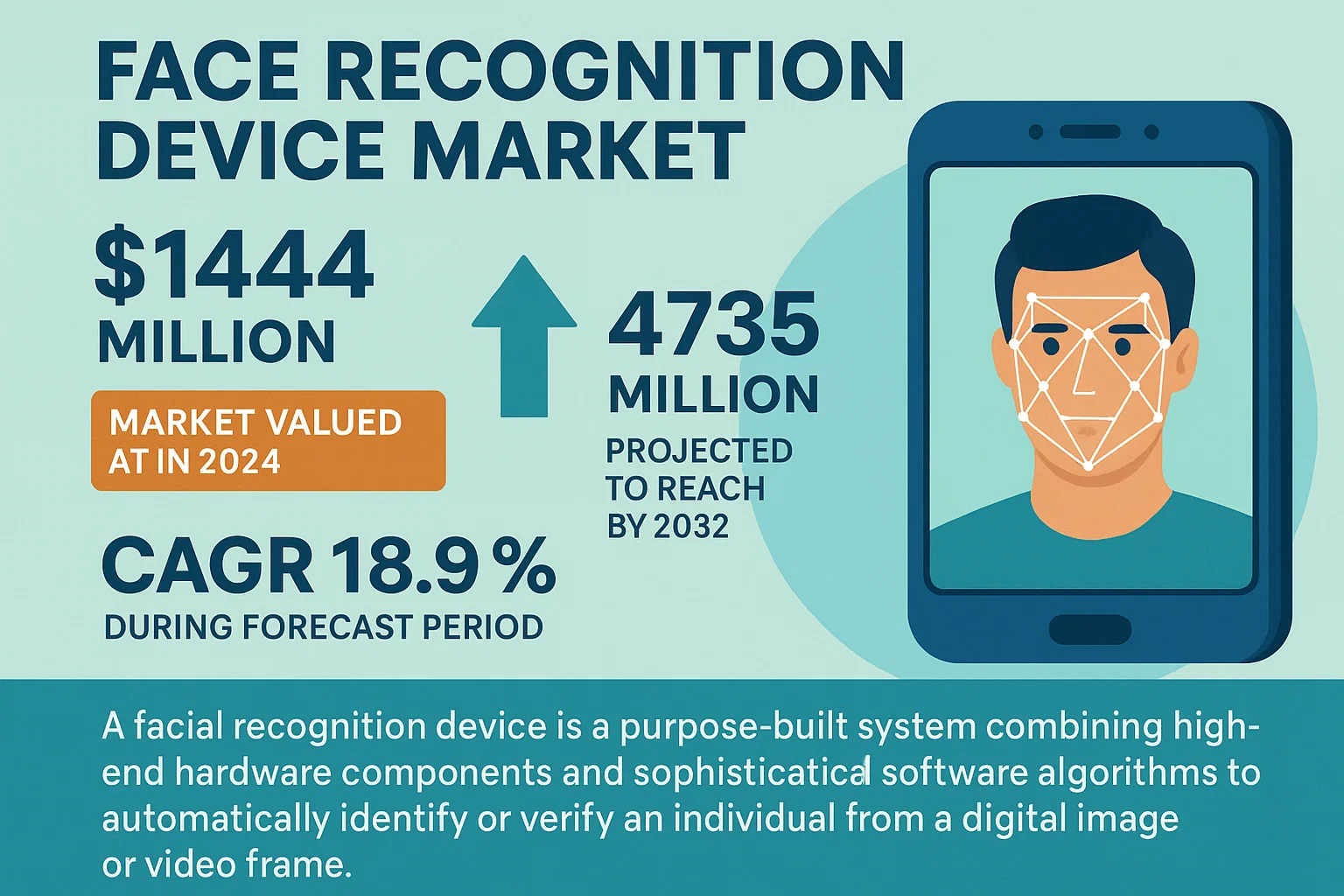
Global Face Recognition Device Market size was valued at USD 1.44 billion in 2024 to USD 4.74 billion by 2032, exhibiting a CAGR of 18.9% during the forecast period.
A facial recognition device is a purpose-built system combining high-end hardware components and sophisticated software algorithms to automatically identify or verify an individual from a digital image or video frame. These systems are integral to modern security and surveillance infrastructures, operating by comparing selected facial features from a given image with those stored in a database. The technology’s core function is biometric authentication, offering a contactless and efficient method for access control and identity verification.
The market is experiencing robust growth driven by escalating security concerns across various sectors, including government, transportation, and BFSI. Furthermore, the integration of artificial intelligence and machine learning has significantly enhanced the accuracy and speed of these systems, broadening their application scope. For instance, the transportation sector is the largest application segment, accounting for a significant share of the market, as airports and metro systems worldwide increasingly adopt this technology for streamlined passenger processing and enhanced security. Key players such as Cloudwalk, Dahua Technology, and IDEMIA are continuously innovating, with recent developments focusing on improving algorithmic accuracy in diverse lighting conditions and mitigating biases, which are critical for widespread, ethical adoption.
MARKET DRIVERS
Enhanced Security Requirements Across Multiple Sectors to Drive Market Expansion
The global face recognition device market is experiencing robust growth driven by escalating security needs across transportation, banking, and government sectors. Heightened security concerns following increased terrorism threats and identity fraud cases have accelerated adoption rates, with airports and border control agencies implementing biometric systems to enhance passenger processing and national security. The transportation sector alone accounts for over 35% of market applications, with major international airports deploying facial recognition for streamlined boarding processes and enhanced security screening. This technology reduces processing times by approximately 70% compared to traditional manual verification methods while improving accuracy rates to over 99% under optimal conditions.
Technological Advancements in AI and Machine Learning to Accelerate Adoption
Rapid advancements in artificial intelligence and deep learning algorithms are significantly enhancing facial recognition accuracy and processing speeds. Modern systems now achieve recognition accuracy rates exceeding 97% even in challenging lighting conditions, representing a substantial improvement from the 80-85% accuracy rates common five years ago. The integration of 3D facial recognition technology and infrared sensors has further improved performance in varying environmental conditions, making these systems more reliable for critical applications. Recent developments include real-time processing capabilities that can match faces against databases of millions of entries in under one second, enabling rapid identification in high-traffic environments such as transportation hubs and large-scale public events.
Growing Smart City Initiatives and Digital Transformation to Fuel Market Growth
Global smart city initiatives are driving substantial investments in facial recognition technology for urban security and management. Municipal governments worldwide are implementing integrated surveillance systems that incorporate facial recognition for law enforcement, traffic management, and public safety applications. The Asia-Pacific region, particularly China, leads in smart city deployments with facial recognition systems installed across major metropolitan areas. These systems help authorities monitor crowd movements, identify wanted individuals, and manage urban infrastructure more efficiently. The convergence of facial recognition with other smart city technologies such as IoT sensors and data analytics platforms is creating comprehensive urban management solutions that improve both security and operational efficiency.
➤ The global Face Recognition Device Market was valued at 1444 million in 2024 and is projected to reach US$ 4735 million by 2032, at a CAGR of 18.9% during the forecast period.
MARKET CHALLENGES
Privacy Concerns and Regulatory Scrutiny to Impede Market Development
The face recognition device market faces significant challenges regarding privacy protection and data security concerns. Increasing public awareness about personal data protection has led to heightened regulatory scrutiny and potential restrictions on facial recognition deployment. Several jurisdictions have implemented strict regulations governing biometric data collection and storage, requiring companies to obtain explicit consent and implement robust data protection measures. The European Union’s General Data Protection Regulation (GDPR) imposes stringent requirements on biometric data processing, including facial recognition, with potential fines reaching up to 4% of global annual turnover for non-compliance. These regulatory frameworks necessitate substantial investments in compliance infrastructure and data security measures.
Other Challenges
Technical Limitations in Diverse Conditions
Facial recognition systems continue to face technical challenges in diverse environmental conditions and with varying demographic groups. Performance accuracy can decrease significantly with changes in lighting, facial angles, occlusions such as masks or sunglasses, and aging effects. Studies have indicated varying accuracy rates across different demographic groups, raising concerns about potential algorithmic bias. These technical limitations require continuous research and development investments to improve algorithm robustness and ensure equitable performance across all user groups.
High Implementation and Maintenance Costs
The substantial capital investment required for facial recognition system implementation presents a significant barrier for many potential adopters. High-quality systems require specialized hardware including high-resolution cameras, infrared sensors, and powerful processing units, combined with sophisticated software platforms. Maintenance costs including software updates, system calibration, and technical support further add to the total cost of ownership. These financial considerations particularly affect smaller organizations and developing markets where budget constraints may limit adoption despite the potential security benefits.
MARKET RESTRAINTS
Accuracy and Reliability Concerns to Restrain Market Penetration
Despite technological advancements, concerns regarding system accuracy and reliability continue to restrain broader market adoption. False acceptance and false rejection rates, though improved, remain significant considerations for critical security applications. Environmental factors including lighting variations, camera angles, and subject movement can impact recognition accuracy, potentially leading to security breaches or operational inefficiencies. The need for high-quality image capture and processing infrastructure adds complexity to system deployment, particularly in outdoor or challenging environments. These reliability concerns necessitate extensive testing and validation procedures before deployment, increasing implementation timelines and costs.
MARKET OPPORTUNITIES
Emerging Applications in Retail and Healthcare to Create New Growth Avenues
The expansion of facial recognition technology into non-traditional sectors presents significant growth opportunities beyond security applications. Retail organizations are increasingly adopting facial recognition for customer analytics, personalized marketing, and loss prevention. The technology enables retailers to analyze customer demographics, track shopping patterns, and deliver targeted promotions, potentially increasing sales conversion rates by 15-20%. In healthcare, facial recognition is being utilized for patient identification, access control to restricted areas, and monitoring patient movements for safety purposes. These emerging applications diversify revenue streams and reduce market dependence on traditional security sectors.
Advancements in Edge Computing and 5G Connectivity to Enable New Capabilities
Technological developments in edge computing and 5G networks are creating opportunities for enhanced facial recognition capabilities. Edge computing allows processing to occur locally on devices rather than relying on cloud connectivity, reducing latency and improving response times for real-time applications. This approach also addresses data privacy concerns by minimizing external data transmission. The deployment of 5G networks provides the high-bandwidth, low-latency connectivity required for advanced facial recognition applications in mobile and IoT environments. These technological enablers are facilitating new use cases including mobile authentication, vehicle access control, and wearable security devices.
Increasing Public-Private Partnerships to Drive Large-Scale Deployments
Growing collaboration between government agencies and private technology companies is creating opportunities for large-scale facial recognition deployments. Public-private partnerships enable resource sharing, risk mitigation, and knowledge transfer that accelerates technology adoption. These collaborations often focus on critical infrastructure protection, border security, and law enforcement applications where both parties benefit from enhanced security capabilities. Joint development initiatives allow technology companies to access government expertise in security requirements while government agencies benefit from private sector innovation and scalability. Such partnerships typically result in comprehensive security solutions that address complex operational requirements while ensuring regulatory compliance and public acceptance.
Face Recognition Device Market Trends Integration of Artificial Intelligence and Machine Learning
Face recognition device manufacturers are increasingly incorporating advanced AI and machine learning algorithms to enhance recognition accuracy and speed. These technologies enable systems to achieve accuracy rates exceeding 99% in controlled environments, a significant improvement from the 85-90% range common five years ago. The integration allows devices to process complex facial patterns and adapt to variations in lighting, angles, and partial obstructions while maintaining high performance. Modern systems utilize deep neural networks trained on millions of facial images, enabling real-time processing with response times under one second even when comparing against databases of millions of entries. This trend is particularly prominent in Chinese and American technology firms, where R&D investments have increased by over 30% annually since 2022.
Other Trends
Expansion into Non-Traditional Applications
While security remains the primary application, face recognition devices are increasingly deployed in retail analytics, healthcare patient identification, and personalized marketing systems. Retailers use the technology to track customer demographics and shopping patterns, while hospitals employ it for patient identification and access control to restricted areas. The diversification reduces market dependency on traditional security sectors and creates new revenue streams. Industry leaders are forming partnerships with retail chains and healthcare providers to develop specialized solutions, with the non-security segment projected to grow at 22% annually through 2028.
Enhanced Privacy and Security Features
Recent technological advancements have enabled face recognition devices to incorporate enhanced privacy protection mechanisms directly into their architecture. Edge computing implementations now process biometric data locally rather than transmitting sensitive information to cloud servers, addressing primary privacy concerns. Modern systems also incorporate advanced encryption for both data transmission and storage, with some devices offering complete on-device processing that eliminates the need to store facial data externally. These developments respond to increasing regulatory scrutiny from regions such as the European Union, where GDPR compliance requires strict data handling protocols. Manufacturers are increasingly offering customizable privacy settings that allow organizations to balance security needs with individual privacy rights.
Standardization and Interoperability
The face recognition industry is moving toward standardized protocols and interfaces that enable interoperability between devices from different manufacturers. Industry groups have developed common data formats and communication protocols that allow integration with existing security infrastructure including access control systems, video management software, and identity databases. This trend reduces implementation costs and allows organizations to implement best-of-breed solutions rather than being locked into single-vendor ecosystems. Standardization also facilitates the integration of face recognition with other biometric technologies and emerging IoT ecosystems, particularly in smart city and industrial IoT applications.
COMPETITIVE LANDSCAPE
Key Industry Players
Leading global technology firms and specialized biometric companies dominate the face recognition device market
The global face recognition device market is dominated by several key players with strong technological capabilities and global reach. Chinese companies like Dahua Technology and Cloudwalk have established significant market share through extensive government contracts in security and surveillance applications, particularly in the Asia-Pacific region. These companies benefit from China’s massive public security expenditure and rapidly growing smart city initiatives. Western counterparts including IDEMia (France) and Aurora (US) maintain competitive positions through advanced research and development, strategic partnerships with government agencies, and a focus on ethical AI development and deployment. These companies typically offer comprehensive solutions that integrate hardware, software, and data analytics, creating an ecosystem approach that locks in customers and creates high entry barriers for new competitors.
Beyond the market leaders, the competitive landscape includes a diverse range of companies specializing in different aspects of face recognition technology. Japanese and Korean firms like NEC Corporation and Hanwha Techwin have established strong positions in high-precision access control systems, particularly in corporate and residential applications. European and American companies often focus on compliance with stringent data protection regulations like GDPR, while Chinese companies prioritize scalability and cost-effectiveness for mass deployment. The market also includes specialized startups focusing on niche applications such as emotion recognition, age estimation, or demographic analysis, though these typically represent smaller market shares compared to integrated solution providers.
List of Key Face Recognition Device Companies Profiled
- Cloudwalk (China)
- Dahua Technology (China)
- IDEMIA (France)
- NEC Corporation (Japan)
- Honeywell International Inc. (US)
- Aurora (US)
- Face++ (China)
- Insigma Group (China)
- Anviz (China)
- Hanwha Techwin (South Korea)
- Samsung SDS (South Korea)
- Thales Group (France)
- Cisco Systems, Inc. (US)
- Hikvision (China)
- Panasonic Corporation (Japan)
Segment Analysis:
| Segment Category | Sub-Segments | Key Insights |
| By Type |
|
3D Recognition dominates due to superior accuracy in mapping facial contours and depth perception, making it the preferred choice for high-security applications where precision is paramount. |
| By Application |
|
Access Control leads due to widespread adoption in corporate and government facilities where secure access is critical, supported by integration with existing security infrastructure and multi-factor authentication requirements. |
| By End User |
|
Government & Defense leads due to critical security requirements in national security, border control, and high-security facilities where accuracy and reliability are non-negotiable, driving continuous R&D investment. |
| By Technology |
|
AI & Machine Learning dominates through continuous learning algorithms that improve with usage, enabling adaptive threat detection and reducing false positives in diverse environmental conditions. |
| By Component |
|
Software algorithms lead due to the critical role of machine learning in improving accuracy rates and reducing false positives, while enabling interoperability with broader security ecosystems. |
Regional Analysis: Face Recognition Devices
Major cities across Asia are implementing face recognition as core infrastructure, with Beijing and Singapore leading in public transport payment systems. Underground subway systems utilize facial recognition for frictionless payment experiences. High-speed rail networks integrate facial checks for passenger identification. Municipal governments partner with technology firms to develop integrated urban surveillance networks.
Asian manufacturers lead in embedding facial recognition into smartphones, tablets, and smart home devices. Chinese and Korean companies develop advanced facial authentication for mobile payments and device security. The region dominates production of cameras and sensors specifically designed for facial recognition applications. Consumer electronics giants integrate facial recognition as standard feature in premium devices.
National digital identity programs drive adoption across Southeast Asia. India’s Aadhaar program incorporates facial authentication for citizen services. China’s social credit system implementation creates massive demand. Singapore’s immigration systems utilize advanced facial recognition gates. Government mandates for biometric verification in banking and telecommunications create sustained market growth.
Corporate sector adoption grows rapidly as multinational companies implement facial recognition for office access and data security. Financial institutions deploy the technology for customer authentication and fraud prevention. High-security facilities across the region increasingly mandate biometric verification. The concentration of manufacturing facilities creates demand for worker identification systems.
North America
North America maintains strong market presence through technological innovation and stringent security requirements. The United States leads in research and development of advanced facial recognition algorithms, with Silicon Valley companies developing next-generation authentication systems. Canada’s border control initiatives implement facial recognition technology for enhanced security. The region’s focus on privacy regulations creates demand for more sophisticated and secure implementations. North American companies lead in developing ethical frameworks and technical standards.
Europe
European markets prioritize privacy and data protection in their implementation of facial recognition technology. The General Data Protection Regulation (GDPR) shapes development toward more secure and transparent systems. European companies focus on developing privacy-compliant solutions for specific verticals like banking and border control. Northern European countries lead in implementing facial recognition for public services while maintaining strong data protection. The region shows growing acceptance in airport security and law enforcement applications with strict regulatory oversight.
Latin America
Latin American markets show growing adoption, particularly in Brazil and Mexico where urban security initiatives drive deployment. Major cities implement facial recognition in public transportation and law enforcement applications. Banking sectors adopt the technology for customer authentication and fraud prevention. Economic challenges have encouraged cost-effective implementations, though adoption rates vary significantly across countries. Regional security concerns drive implementation in border control applications.
Middle East & Africa
The Middle East shows significant investment in smart city initiatives incorporating facial recognition, particularly in the United Arab Emirates and Saudi Arabia. African markets show gradual adoption with South Africa and Nigeria leading in implementation for banking and urban security. Dubai International Airport features extensive facial recognition implementation. The region shows growing acceptance in border control and high-security facilities. Emerging markets present growth opportunities as technology costs decrease and implementation becomes more widespread.
Report Scope
This market research report provides a comprehensive analysis of the Face Recognition Device Market, covering the forecast period 2025–2032. It offers detailed insights into market dynamics, technological advancements, competitive landscape, and key trends shaping the industry.
Key focus areas of the report include:
- Market Overview: The report begins with an overview outlining its current market scenario, key growth indicators, and industry transformation drivers. It discusses macroeconomic factors, demand–supply balance, regulatory landscape, and the strategic role of semiconductors in powering advancements across industries such as automotive, telecommunications, consumer electronics, and industrial automation.
- Market Size & Forecast: Historical data and future projections for revenue, unit shipments, and market value across major regions and segments.
- Segmentation Analysis: Detailed breakdown by product type, technology, application, and end-user industry to identify high-growth segments and investment opportunities.
- Regional Insights: Insights into market performance across North America, Europe, Asia-Pacific, Latin America, and the Middle East & Africa, including country-level analysis where relevant.
- Competitive Landscape: Profiles of leading market participants, including their product offerings, R&D focus, manufacturing capacity, pricing strategies, and recent developments such as mergers, acquisitions, and partnerships.
- Technology Trends & Innovation: Assessment of emerging technologies, integration of AI/IoT, semiconductor design trends, fabrication techniques, and evolving industry standards.
- Market Drivers & Restraints: Evaluation of factors driving market growth along with challenges, supply chain constraints, regulatory issues, and market-entry barriers.
- Stakeholder Insights: Insights for component suppliers, OEMs, system integrators, investors, and policymakers regarding the evolving ecosystem and strategic opportunities.
Primary and secondary research methods are employed, including interviews with industry experts, data from verified sources, and real-time market intelligence to ensure the accuracy and reliability of the insights presented.
FREQUENTLY ASKED QUESTIONS:
What is the current market size of Face Recognition Device Market?
-> Face Recognition Device Market was valued at USD 1444 million in 2024 and is expected to reach USD 4735 million by 2032.
What is the growth rate of the Face Recognition Device Market?
-> The market is projected to grow at a CAGR of 18.9% from 2024 to 2032.
Which key companies operate in Face Recognition Device Market?
-> Key players include Dahua Technology, Cloudwalk, IDEMIA, NEC Corporation, and Huawei, among others.
What are the key growth drivers?
-> Key growth drivers include increasing security concerns, technological advancements in AI, and rising adoption in transportation and BFSI sectors.
Which region dominates the market?
-> Asia-Pacific is the largest market, accounting for the majority of global revenue, followed by North America and Europe.

Get Sample Report PDF for Exclusive Insights
Report Sample Includes
- Table of Contents
- List of Tables & Figures
- Charts, Research Methodology, and more...
 Download Sample Report PDF


