MARKET INSIGHTS
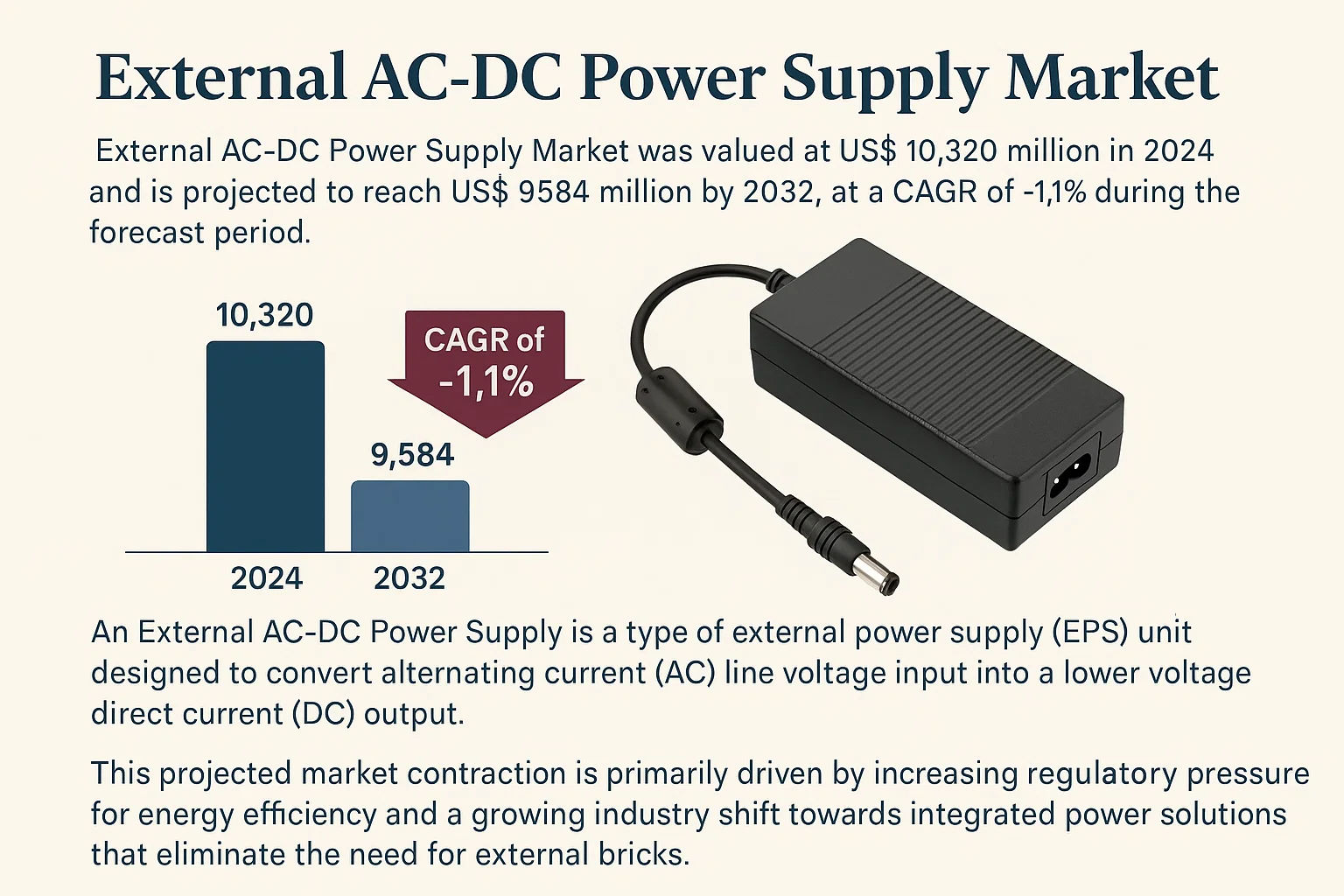
The global External AC-DC Power Supply Market was valued at 10320 million in 2024 and is projected to reach US$ 9584 million by 2032, at a CAGR of -1.1% during the forecast period.
An External AC-DC Power Supply is a type of external power supply (EPS) unit designed to convert alternating current (AC) line voltage input into a lower voltage direct current (DC) output. These devices are critical for powering a vast array of consumer electronics, IT equipment, and industrial applications, providing a safe and efficient method to deliver electric energy externally to a device.
This projected market contraction is primarily driven by increasing regulatory pressure for energy efficiency and a growing industry shift towards integrated power solutions that eliminate the need for external bricks. However, the market remains substantial due to the sheer volume of existing devices that require them. The market is highly concentrated, with the top two players, Delta (Eltek) and Lite-On Technology, collectively holding approximately 40% of the global market share. Geographically, China dominates as the main production and consumption hub, accounting for about 50% of the global market. In terms of product segmentation, low-power units (Up to 10W) are the predominant type, representing nearly 60% of the market, largely driven by their use in mobile phones and other portable electronics. The Mobile Communications sector is the leading application segment, holding a significant share of about 40%.
MARKET DYNAMICS
MARKET DRIVERS
Proliferation of Portable Electronic Devices to Drive Market Growth
The exponential growth in portable electronic devices is significantly driving the external AC-DC power supply market. With over 6.8 billion smartphone users globally and increasing adoption of tablets, laptops, and wearable devices, the demand for efficient power conversion solutions continues to rise. These devices require reliable external power supplies for charging and operation, creating sustained market demand. The mobile communications segment alone accounts for approximately 40% of the total market share, demonstrating the critical role of power supplies in this sector. Furthermore, the trend toward device miniaturization and the need for compact, efficient power solutions are pushing manufacturers to develop advanced external power supplies with higher power density and improved thermal management.
Stringent Energy Efficiency Regulations to Boost Market Development
Global energy efficiency standards and regulations are compelling manufacturers to develop more efficient external power supplies. Regulatory bodies worldwide have implemented stringent requirements, with the latest standards mandating efficiency levels exceeding 87% at full load and reducing no-load power consumption to less than 75 mW. These regulations are driving innovation in power supply design, particularly in the dominant up to 10W segment which represents approximately 60% of the market. Manufacturers are investing in advanced semiconductor technologies and improved circuit topologies to meet these requirements while maintaining cost competitiveness. The continuous evolution of energy efficiency standards ensures ongoing market refresh cycles as older, less efficient power supplies are replaced with compliant versions.
Expansion of IoT and Smart Home Ecosystems to Fuel Demand
The rapid expansion of Internet of Things (IoT) devices and smart home ecosystems is creating substantial growth opportunities for external AC-DC power supplies. The global IoT market is projected to connect over 30 billion devices by 2030, each requiring reliable power conversion solutions. Smart home applications including security systems, smart speakers, and connected appliances are driving demand for specialized power supplies with specific voltage requirements and form factors. This segment requires power supplies that can operate efficiently across varying load conditions while maintaining electromagnetic compatibility. The consumer electronics segment, representing a significant portion of the market, is experiencing particularly strong growth due to these trends, with manufacturers developing specialized power solutions for emerging IoT applications.
MARKET RESTRAINTS
Market Saturation and Price Competition to Constrain Growth
The external AC-DC power supply market faces significant constraints from market saturation and intense price competition. With the market projected to decline from US$ 10,320 million in 2024 to US$ 9,584 million by 2032, representing a compound annual growth rate of -1.1%, manufacturers are operating in an increasingly challenging environment. The high level of market consolidation, where the top two players control approximately 40% of the global market share, creates barriers for new entrants and limits pricing flexibility. Additionally, the mature nature of many application segments means that replacement demand rather than new device adoption is driving sales, further constraining market expansion opportunities.
Technical Limitations in High-Power Applications to Restrict Market Expansion
Technical challenges in developing efficient high-power external AC-DC power supplies are restraining market growth in certain segments. While the up to 10W category dominates with approximately 60% market share, applications requiring higher power levels face significant design constraints. Power supplies in the 100W-250W range must address complex thermal management issues, electromagnetic interference challenges, and efficiency optimization problems. These technical hurdles increase development costs and time-to-market, making it difficult for manufacturers to compete effectively in higher-power segments. The industrial and telecom/datacom applications, which often require higher power levels, consequently represent smaller market shares due to these technical limitations and the associated higher product costs.
Supply Chain Vulnerabilities and Component Shortages to Impede Production
Global supply chain disruptions and semiconductor component shortages are creating significant restraints for external AC-DC power supply manufacturers. The industry relies heavily on specialized components including power semiconductors, transformers, and capacitors, which have experienced extended lead times and price volatility. These supply chain challenges have increased manufacturing costs by an estimated 15-20% over recent years, compressing profit margins and delaying product deliveries. The concentration of semiconductor manufacturing in specific geographic regions further exacerbates these vulnerabilities, particularly affecting manufacturers who lack diversified supplier networks. These constraints are particularly challenging for smaller manufacturers who cannot leverage economies of scale to secure component supplies.
MARKET OPPORTUNITIES
Emergence of GaN and SiC Technologies to Create New Market Opportunities
The adoption of Gallium Nitride (GaN) and Silicon Carbide (SiC) semiconductor technologies is creating significant opportunities for advanced external AC-DC power supplies. These wide-bandgap semiconductors enable power supplies that are up to 30% more efficient and 50% smaller than conventional silicon-based designs. The market for GaN-based power devices is growing at approximately 25% annually, driven by demand for higher efficiency and power density. Manufacturers developing power supplies utilizing these technologies can target premium market segments including high-end computing, professional audio/video equipment, and medical devices where performance advantages justify higher price points. The transition to these advanced semiconductor technologies represents a key opportunity for market differentiation and value creation.
Expansion in Medical and Industrial Applications to Drive Specialty Segment Growth
Specialized applications in medical and industrial sectors present substantial growth opportunities for external AC-DC power supply manufacturers. The medical device segment requires power supplies meeting stringent safety standards including IEC 60601-1 certification, isolation requirements, and low leakage current specifications. This segment commands premium pricing with profit margins typically 20-30% higher than consumer applications. Similarly, industrial applications require robust power supplies capable of operating in harsh environments with wide temperature ranges and enhanced reliability. The increasing automation of industrial processes and the growth of medical technology adoption in emerging markets are driving demand in these specialty segments, offering manufacturers opportunities to diversify beyond traditional consumer applications.
Development of Wireless Power Solutions to Open New Market Frontiers
The evolution of wireless power technologies is creating new opportunities for external AC-DC power supply manufacturers. While currently representing a smaller market segment, wireless power and charging applications are growing at approximately 35% annually. The development of standards such as Qi wireless charging has created a stable platform for product development, while emerging technologies including radio frequency energy harvesting and resonant wireless power transfer offer future growth potential. Manufacturers who can integrate wireless power capabilities with traditional AC-DC conversion functions are positioned to capture value in this emerging segment. The convergence of wired and wireless power solutions represents a strategic opportunity for companies to expand their product portfolios and address evolving customer requirements.
MARKET CHALLENGES
Environmental Regulations and Material Restrictions to Challenge Compliance
The external AC-DC power supply industry faces significant challenges complying with evolving environmental regulations and material restrictions. Regulations including the Restriction of Hazardous Substances (RoHS) directive and Registration, Evaluation, Authorisation and Restriction of Chemicals (REACH) requirements impose strict limitations on materials used in power supply manufacturing. Compliance with these regulations requires extensive testing, documentation, and often material substitutions that can affect product performance and cost. The recent expansion of these regulations to include additional substance restrictions has increased compliance costs by an estimated 12-18% for manufacturers. Additionally, conflicting regulatory requirements across different geographic regions create complexity for global manufacturers who must develop region-specific product variations.
Rapid Technological Obsolescence to Pressure Product Lifecycles
The rapid pace of technological change presents significant challenges for external AC-DC power supply manufacturers. The average product lifecycle has decreased from approximately 5-7 years to 3-4 years as device technologies evolve and new power requirements emerge. This accelerated obsolescence requires manufacturers to maintain aggressive research and development programs while managing inventory risks associated with shorter product lifecycles. The need to support legacy products while developing new solutions creates additional complexity and cost pressures. Furthermore, the integration of digital control technologies and communication capabilities in modern power supplies requires manufacturers to develop new competencies in software development and digital interface design, representing both a challenge and opportunity for industry transformation.
Geographic Market Concentration to Create Strategic Vulnerabilities
The high geographic concentration of the external AC-DC power supply market creates strategic challenges for manufacturers. China dominates the global market with approximately 50% share, creating dependencies on both manufacturing infrastructure and market demand from this region. This concentration creates vulnerabilities related to trade policies, currency fluctuations, and regional economic conditions. Manufacturers must navigate complex international trade relationships while maintaining competitive positioning across diverse geographic markets. The recent trend toward supply chain regionalization and the emphasis on supply chain resilience are forcing manufacturers to reconsider their geographic footprints and develop more diversified manufacturing and sourcing strategies. These strategic realignments require significant capital investment and operational restructuring, presenting both challenges and opportunities for market participants.
EXTERNAL AC-DC POWER SUPPLY MARKET TRENDS
Global Market Consolidation and Efficiency Standards Drive Innovation
The global external AC-DC power supply market is undergoing significant transformation, driven by stringent international energy efficiency regulations and market consolidation. While the overall market is projected to experience a slight contraction, falling from a valuation of 10,320 million USD in 2024 to an estimated 9,584 million USD by 2032, this trend masks a critical shift towards higher-value, more efficient products. Regulatory frameworks like the European Union’s Ecodesign Directive and the U.S. Department of Energy’s Level VI standards are compelling manufacturers to innovate beyond traditional designs. This has led to a surge in the development of products with higher power density, improved no-load consumption—often below 75mW—and enhanced power factor correction. The market is increasingly bifurcated, with cost-competitive, high-volume production dominating the under 10W segment, which holds approximately 60% of the market, while specialized, higher-margin units are gaining traction in industrial and medical applications. This dynamic creates both challenges for broad-line suppliers and opportunities for niche players focused on advanced technological solutions.
Other Trends
Proliferation of Mobile and IoT Devices Fuels Demand for Low-Power Units
The relentless growth in mobile communications and the Internet of Things (IoT) ecosystem continues to be the primary engine for the external power supply market. The mobile communications segment alone accounts for roughly 40% of global application share, a dominance fueled by the annual shipment of over 1.4 billion smartphones worldwide, each requiring at least one charger. This massive volume solidifies the position of the Up to 10W category as the dominant type. However, the landscape is evolving beyond simple phone chargers. The expansion of IoT, encompassing everything from smart home devices and wearables to industrial sensors, demands a vast array of specialized, compact, and energy-efficient external power supplies. This trend is further amplified by the rollout of 5G networks, which necessitates new infrastructure and compatible power solutions for a wide range of network equipment and devices, ensuring sustained demand within this core application segment.
Geographical Shift and Supply Chain Reconfiguration
China’s role as the manufacturing epicenter, responsible for approximately 50% of global production, is being recalibrated due to geopolitical tensions, trade policies, and a strategic push for supply chain resilience. While China remains the undisputed main market and production hub, there is a noticeable trend towards geographical diversification. Manufacturers and OEMs are actively exploring alternative manufacturing bases in Southeast Asia, notably Vietnam and Thailand, and are reconsidering nearshoring options in Mexico for the North American market. This reconfiguration is not just about mitigating risk; it is also driven by the need to reduce logistical costs and lead times. Furthermore, regions like Europe and North America are seeing increased investment in the production of higher-value, specialized power supplies for medical, industrial, and aerospace applications, sectors where proximity to end-users and stringent certification requirements outweigh pure cost considerations. This geographical rebalancing is a defining trend that will shape the competitive landscape and sourcing strategies for years to come.
COMPETITIVE LANDSCAPE
Key Industry Players
Leading Manufacturers Focus on Efficiency and Miniaturization to Maintain Market Position
The global external AC-DC power supply market exhibits a semi-consolidated structure, characterized by the presence of several established multinational corporations and numerous smaller regional players. Delta Electronics (Eltek) and Lite-On Technology collectively command a significant portion of the market, holding an estimated 40% revenue share in 2024. Their dominance is largely attributed to massive production scales, extensive global distribution networks, and deep-rooted relationships with major OEMs across the consumer electronics and computing sectors, particularly in the Asia-Pacific region.
While the market is experiencing a slight overall contraction, companies like Mean Well and TDK Lambda continue to hold substantial shares. Their growth is sustained by a strong focus on the industrial and medical application segments, which demand highly reliable and efficient power solutions. These companies invest heavily in research and development to produce more compact, energy-efficient, and compliant power supplies that meet stringent international standards.
Furthermore, strategic initiatives such as geographical expansion into emerging markets and targeted mergers and acquisitions are key tactics employed by leading players to consolidate their market presence. For instance, acquisitions allow companies to quickly integrate new technologies and broaden their customer base.
Meanwhile, other significant participants, including Salcomp and Chicony Power, are strengthening their positions by capitalizing on the high-volume, cost-sensitive mobile communications segment. They compete aggressively on pricing and manufacturing efficiency, often leveraging their production facilities in China, which accounts for approximately 50% of global production. Their strategy involves continuous optimization of supply chains and production processes to offer competitive solutions for high-volume applications like smartphone chargers.
List of Key External AC-DC Power Supply Companies Profiled
- Delta Electronics (Eltek) (Taiwan)
- Lite-On Technology (Taiwan)
- Acbel Polytech Inc. (Taiwan)
- Salcomp (Finland)
- Chicony Power Technology Co., Ltd. (Taiwan)
- Emerson (Artesyn Embedded Technologies) (U.S.)
- Flextronics International Ltd. (Singapore)
- Mean Well Enterprises Co., Ltd. (Taiwan)
- TDK Lambda Corporation (Japan)
- Phihong Technology Co., Ltd. (Taiwan)
- FSP Group (Taiwan)
Segment Analysis:
By Type
Up to 10W Segment Dominates the Market Due to High Demand from Mobile Devices
The market is segmented based on type into:
- Up to 10W
- 11W-50W
- 51W-100W
- 100W-250W
By Application
Mobile Communications Segment Leads Due to Proliferation of Smartphones and IoT Devices
The market is segmented based on application into:
- Computer & Office
- Mobile Communications
- Consumer Electronics
- Telecom/Datacomm
- Industrial
- Medical
- LED Lighting
- Wireless Power & Charging
- Military & Aerospace
By Power Efficiency
High-Efficiency Models Gain Traction Due to Energy Conservation Regulations
The market is segmented based on power efficiency into:
- Standard Efficiency
- High Efficiency
- Premium Efficiency
By Sales Channel
OEM Segment Maintains Strong Position Through Direct Manufacturer Relationships
The market is segmented based on sales channel into:
- Original Equipment Manufacturer (OEM)
- Aftermarket
Regional Analysis: External AC-DC Power Supply Market
Asia-Pacific
The Asia-Pacific region dominates the global External AC-DC Power Supply market, accounting for approximately 50% of total market share, with China alone representing the world’s largest manufacturing and consumption hub. This dominance is driven by massive electronics production, particularly in mobile communications and consumer electronics sectors. The region benefits from extensive manufacturing ecosystems, cost-effective production capabilities, and strong supply chain integration. While the global market faces a slight contraction (CAGR of -1.1%), Asia-Pacific maintains relative stability due to ongoing demand from smartphone manufacturers, IoT device producers, and industrial automation sectors. However, increasing environmental regulations and energy efficiency standards are pushing manufacturers toward more efficient designs.
North America
North America represents a mature but technologically advanced market for External AC-DC Power Supplies, characterized by stringent energy efficiency standards such as the U.S. Department of Energy’s Level VI and California Energy Commission (CEC) requirements. The market is shifting toward higher efficiency, lower standby power consumption units, particularly in applications such as data centers, medical equipment, and industrial automation. While overall market growth is constrained by device miniaturization and integrated power solutions, demand remains stable for specialized applications including medical devices (requiring FDA compliance) and high-reliability industrial systems. The region shows particular strength in higher wattage segments (51W-250W) where quality and reliability outweigh cost considerations.
Europe
Europe’s market is heavily influenced by environmental directives including the EU Ecodesign Directive and ErP Lot 8 regulations, which mandate improved energy efficiency and reduced standby power consumption. The region shows strong demand for external power supplies in industrial applications, medical devices, and telecommunications equipment. Germany, the U.K., and France represent the largest national markets, driven by their advanced manufacturing sectors and high standards for product quality and safety (CE marking requirements). The market is characterized by a shift toward modular and configurable power solutions, with growing emphasis on circular economy principles including repairability and recyclability.
South America
South America represents an emerging market with growth potential constrained by economic volatility and import dependencies. Brazil and Argentina account for the majority of regional demand, primarily driven by consumer electronics and telecommunications applications. Market development is challenged by currency fluctuations, import restrictions, and limited local manufacturing capabilities. However, increasing mobile device penetration and infrastructure development projects provide opportunities for market expansion. The region shows price sensitivity, with preference for cost-effective solutions in the lower wattage segments (up to 50W), though this is gradually shifting toward more efficient designs as energy costs rise.
Middle East & Africa
The Middle East & Africa region presents a developing market with growth opportunities in telecommunications infrastructure, LED lighting, and consumer electronics. The UAE, Saudi Arabia, and South Africa represent the most developed markets, driven by urbanization and infrastructure investments. The region shows particular potential for higher-wattage power supplies supporting telecommunications infrastructure and industrial equipment. However, market development faces challenges including price sensitivity, limited local manufacturing, and varying regulatory standards across countries. The market is gradually evolving toward more energy-efficient solutions as electricity costs rise and environmental awareness increases.
Report Scope
This market research report provides a comprehensive analysis of the global External AC-DC Power Supply market, covering the forecast period 2025–2032. It offers detailed insights into market dynamics, technological advancements, competitive landscape, and key trends shaping the industry.
Key focus areas of the report include:
- Market Size & Forecast: Historical data and future projections for revenue, unit shipments, and market value across major regions and segments.
- Segmentation Analysis: Detailed breakdown by power rating, application, and end-user industry to identify high-growth segments and investment opportunities.
- Regional Outlook: Insights into market performance across North America, Europe, Asia-Pacific, Latin America, and the Middle East & Africa, including country-level analysis where relevant.
- Competitive Landscape: Profiles of leading market participants, including their product offerings, R&D focus, manufacturing capacity, pricing strategies, and recent developments such as mergers, acquisitions, and partnerships.
- Technology Trends & Innovation: Assessment of emerging technologies, energy efficiency standards, power density improvements, and evolving regulatory requirements.
- Market Drivers & Restraints: Evaluation of factors driving market growth along with challenges, supply chain constraints, regulatory issues, and market-entry barriers.
- Stakeholder Analysis: Insights for component suppliers, OEMs, system integrators, investors, and policymakers regarding the evolving ecosystem and strategic opportunities.
Primary and secondary research methods are employed, including interviews with industry experts, data from verified sources, and real-time market intelligence to ensure the accuracy and reliability of the insights presented.
FREQUENTLY ASKED QUESTIONS:
What is the current market size of Global External AC-DC Power Supply Market?
-> External AC-DC Power Supply Market was valued at 10320 million in 2024 and is projected to reach US$ 9584 million by 2032, at a CAGR of -1.1% during the forecast period.
Which key companies operate in Global External AC-DC Power Supply Market?
-> Key players include Delta(Eltek), Lite-On Technology, Acbel Polytech, Salcomp, Chicony Power, Emerson(Artesyn), Flextronics, Mean Well, TDK Lambda, Phihong, and FSP Group, among others.
What are the key growth drivers?
-> Key growth drivers include increasing demand for consumer electronics, expansion of telecommunications infrastructure, and adoption of energy-efficient power solutions.
Which region dominates the market?
-> Asia-Pacific dominates the market, with China alone accounting for approximately 50% of global market share.
What are the emerging trends?
-> Emerging trends include development of GaN-based power supplies, increased focus on energy efficiency standards, and integration of smart charging technologies.

Get Sample Report PDF for Exclusive Insights
Report Sample Includes
- Table of Contents
- List of Tables & Figures
- Charts, Research Methodology, and more...
 Download Sample Report PDF