EV Traction Inverter Semiconductor Market Insights
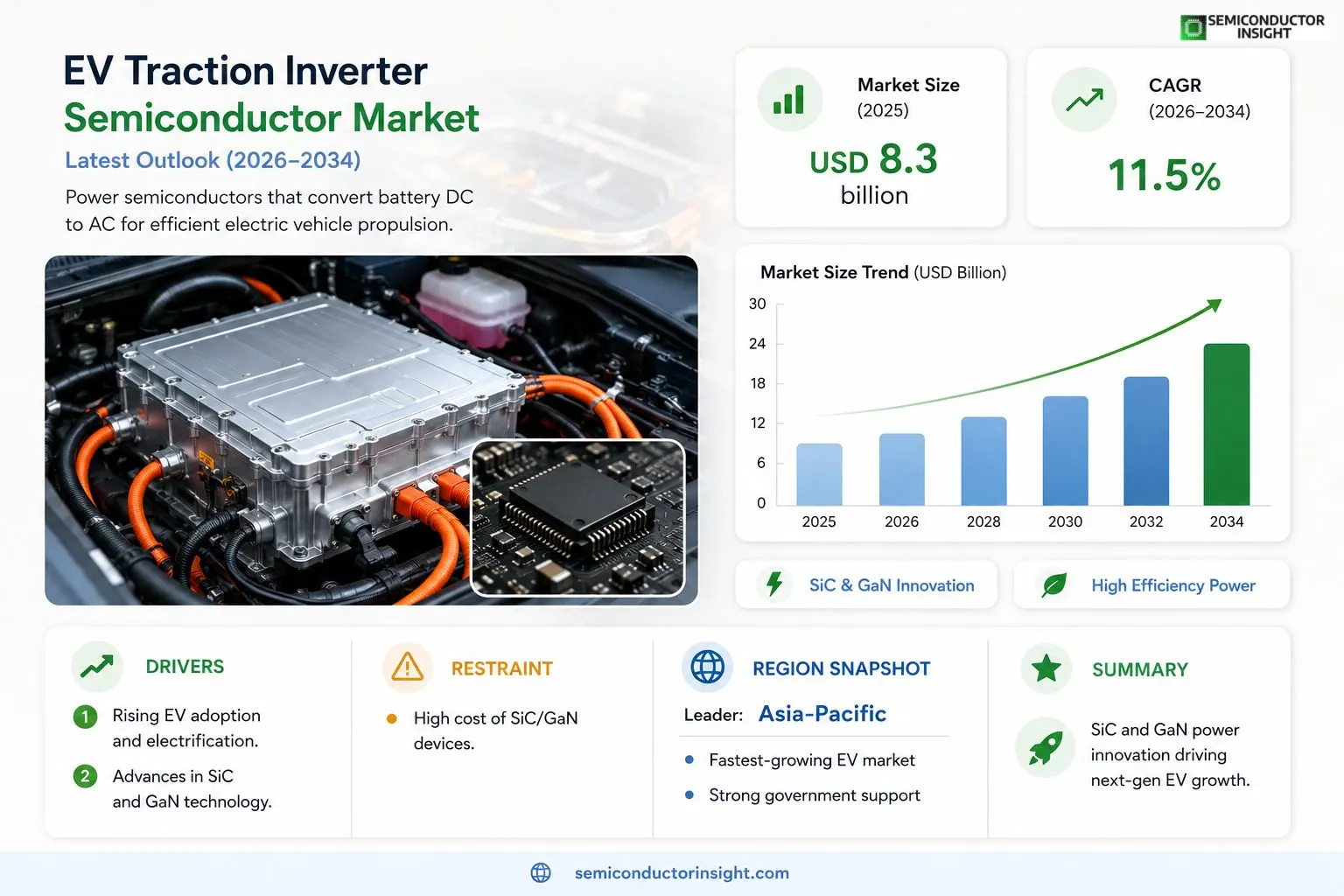
Global EV traction inverter semiconductor market size was valued at USD 8.3 billion in 2025. The market is projected to grow from USD 9.1 billion in 2026 to USD 23.7 billion by 2034, exhibiting a CAGR of approximately 11.5% during the forecast period.
EV traction inverter semiconductors are high‑performance power devicesprimarily silicon‑carbide (SiC) and gallium‑nitride (GaN) MOSFETs or IGBTsthat convert the battery’s direct current into variable‑frequency alternating current required to drive electric‑vehicle propulsion motors efficiently.The market is experiencing rapid expansion because of stringent emissions regulations worldwide, escalating vehicle electrification targets set by governments, and the push for higher energy‑density batteries that demand more efficient power conversion. Furthermore, advances in SiC/GaN technology are reducing system weight and improving thermal performance, prompting OEMs such as Tesla and Volkswagen to qualify these semiconductors for next‑generation models. Key playersincluding Infineon Technologies, STMicroelectronics, Texas Instruments, and ON Semiconductorare accelerating R&D investments and forming strategic alliances; for example, Infineon partnered with BMW in March 2024 to co‑develop SiC modules optimized for high‑power EV platforms.
MARKET DRIVERS
Increasing Electrification of Transportation
The rapid adoption of electric vehicles worldwide is driving demand for higher‑performance power conversion solutions. As EV traction inverter semiconductor market expands, manufacturers are seeking semiconductor devices that can deliver greater efficiency and compact designs to extend vehicle range.
Advancements in Wide‑Bandgap Materials
Silicon‑carbide (SiC) and gallium‑nitride (GaN) technologies are becoming mainstream in traction inverters, offering lower switching losses and higher thermal tolerance. These breakthroughs enable vehicle platforms to achieve 30%‑40% improvements in power density compared with traditional silicon devices.
➤ The market is projected to exceed $10 billion by 2030, reflecting a compound annual growth rate above 15%.
Regulatory incentives across major economies, including tax rebates and zero‑emission mandates, are further accelerating investments in next‑generation inverter semiconductors, cementing a robust growth trajectory for the sector.
MARKET CHALLENGES
Cost Sensitivity in Mass‑Market EVs
Despite performance gains, the high material cost of SiC and GaN devices remains a barrier. Automakers targeting price‑competitive models must balance cost efficiency with the desire for longer range, limiting rapid price reductions for EV traction inverter semiconductor market.
Other Challenges
Supply Chain Constraints
Limited wafer production capacity and the concentration of key substrate suppliers create bottlenecks that can delay product launches and increase lead times for manufacturers.
MARKET RESTRAINTS
Thermal Management Limitations
High power densities generate significant heat, challenging existing cooling architectures. Over‑reliance on traditional thermal solutions can reduce reliability and escalate system costs, restraining broader adoption of advanced inverter semiconductors.
MARKET OPPORTUNITIES
Growth in Autonomous Vehicle Platforms
The emergence of Level 4/5 autonomous driving requires high‑precision, low‑latency power electronics to support sensor suites and compute units. This creates a substantial opportunity for EV traction inverter semiconductor market to develop specialized, high‑reliability components that meet these demanding applications.
EV Traction Inverter Semiconductor Market Trends
Accelerating Adoption of SiC and GaN Power Devices
EV traction inverter semiconductor market is witnessing a rapid shift toward silicon‑carbide (SiC) and gallium‑nitride (GaN) technologies. These wide‑bandgap semiconductors deliver higher efficiency, lower thermal losses, and reduced system weight compared with traditional silicon solutions. OEMs such as Tesla and Volkswagen have qualified SiC modules for next‑generation models, citing improvements in range and battery‑pack utilization. The technology transition is also supported by manufacturing scale‑up, which is driving cost parity with legacy devices and encouraging broader integration across vehicle platforms.
Other Trends
Regulatory Pressures and Energy‑Density Targets
Stringent emissions standards worldwide are compelling vehicle makers to adopt more efficient power conversion architectures. Governments are setting aggressive electrification targets that require higher energy‑density batteries, and these batteries demand inverter semiconductors capable of handling higher voltages with minimal losses. As a result, manufacturers are redesigning powertrains to incorporate SiC and GaN devices that meet both regulatory compliance and performance benchmarks. This regulatory drive is reinforcing the market’s momentum by creating a consistent demand pipeline across multiple regions.
Strategic Partnerships and R&D Intensification
Leading players such as Infineon Technologies, STMicroelectronics, Texas Instruments, and ON Semiconductor are deepening R&D investments and forming strategic alliances to accelerate product development. Notably, Infineon’s collaboration with BMW in early 2024 to co‑develop high‑power SiC modules exemplifies the trend toward joint engineering programs that shorten time‑to‑market. These partnerships enable shared risk, pooled expertise, and faster qualification cycles, ultimately strengthening EV traction inverter semiconductor market’s capacity to meet evolving automotive requirements.
COMPETITIVE LANDSCAPEKey Industry Players
Global Competitive Dynamics in EV Traction Inverter Semiconductors
EV traction inverter semiconductor market is principally shaped by a handful of large‑scale manufacturers that dominate SiC and GaN power device supply chains. Infineon Technologies leads the segment with its wide‑range SiC MOSFET and module portfolio, leveraging strategic alliances such as the 2024 partnership with BMW to co‑develop high‑power SiC modules for premium EV platforms. STMicroelectronics and Texas Instruments follow closely, offering both IGBT and SiC solutions that address cost‑sensitive volume production while maintaining efficiency gains. ON Semiconductor provides a robust GaN offering that targets fast‑charging and high‑frequency inverter topologies, positioning itself as a key enabler for next‑generation automotive architectures. Collectively, these firms command the bulk of the $8.3 billion market size recorded in 2025 and are driving the projected CAGR of 11.5 % through aggressive R&D investment and scaling of silicon‑carbide wafer capacity.Beyond the tier‑one leaders, a diverse set of niche players contributes specialized expertise and broadens the technology landscape. ROHM Semiconductor and NXP Semiconductors focus on integrated GaN power stages that cater to compact inverter designs for city‑car EVs. Mitsubishi Electric and Fuji Electric bring legacy IGBT experience while accelerating SiC migration for high‑power trucks. Renesas Electronics and Toshiba supplement the market with mixed‑signal and high‑voltage driver ICs that enhance inverter control precision. Microchip Technology, Wolfspeed (Cree), and GlobalFoundries add depth in GaN epitaxy and advanced packaging, enabling OEMs to pursue lighter, more thermally efficient power converters. This competitive depth ensures continuous innovation and mitigates supply‑chain risk across the rapidly expanding EV traction inverter semiconductor ecosystem.
List of Key EV Traction Inverter Semiconductor Companies Profiled
- Infineon Technologies
- STMicroelectronics
- Texas Instruments
- ON Semiconductor
- ROHM Semiconductor
- NXP Semiconductors
- Mitsubishi Electric
- Fuji Electric
- Renesas Electronics
- Toshiba
- Microchip Technology
- Wolfspeed (Cree)
- GlobalFoundries
Segment Analysis:
| Segment Category | Sub-Segments | Key Insights |
| By Type |
|
Silicon‑Carbide (SiC) devices are recognized as the leading technology due to:
|
| By Application |
|
Passenger electric vehicles dominate the application landscape because:
|
| By End User |
|
OEMs exert the greatest influence on market direction owing to:
|
Regional Analysis: North America
United States
Stringent emission standards and various financial incentives for EV purchases are significantly boosting demand for EV traction inverter semiconductors in the United States. Policies promoting domestic semiconductor manufacturing further support market growth.
The shift towards electrification by major automotive manufacturers is a primary driver. The increasing complexity and sophistication of EV powertrains necessitate advanced semiconductor solutions for efficient power conversion.
Securing a stable and resilient supply chain for critical semiconductor components remains a key focus. Diversification of sourcing and strategic partnerships are vital for mitigating risks.
The adoption of SiC and GaN semiconductors is enabling higher power density, improved efficiency, and enhanced thermal management in EV traction inverters. This is a critical factor in extending vehicle range and performance.
Europe
The European market for EV Traction Inverter Semiconductors is experiencing substantial growth, propelled by ambitious electrification targets set by various European Union member states. Stringent emission regulations and supportive government policies are driving demand for electric vehicles across the continent. The automotive industry in Europe is actively transitioning to electric powertrains, creating significant opportunities for semiconductor suppliers. Business strategies in Europe often emphasize collaboration with leading automotive manufacturers and a strong focus on energy efficiency and environmental sustainability. The continent is witnessing increasing investment in battery technology and charging infrastructure, further bolstering the demand for advanced power electronics.
Asia-Pacific
Asia-Pacific presents the largest and fastest-growing market for EV Traction Inverter Semiconductors. China, in particular, is the dominant force, driven by massive government support for EV adoption and a thriving domestic EV manufacturing industry. Other key markets in the region include Japan, South Korea, and India. The rapid expansion of the EV market is fueled by increasing urbanization, rising disposable incomes, and growing environmental awareness. The region is witnessing intense competition among semiconductor manufacturers, with both domestic and international players vying for market share. Business strategies in Asia-Pacific often involve establishing local manufacturing facilities and forging strong partnerships with regional automotive OEMs. The focus is on cost competitiveness and rapid innovation to meet the evolving needs of the EV market.
South America
The South American market for EV Traction Inverter Semiconductors is still in its nascent stages but is expected to witness significant growth in the coming years. Brazil and Argentina are the leading markets, driven by increasing urbanization and rising environmental concerns. Government initiatives to promote electric mobility are gradually gaining momentum. The automotive industry in the region is in the early phases of electrification, with a limited number of EV models currently available. Business strategies in South America often focus on adapting to local market conditions and building strong relationships with early adopters of electric vehicles. The cost of EV traction inverter semiconductors remains a key barrier to widespread adoption.
Middle East & Africa
The Middle East and Africa represent a promising but relatively underdeveloped market for EV Traction Inverter Semiconductors. The demand for electric vehicles is slowly increasing, driven by government initiatives to diversify energy sources and reduce reliance on fossil fuels. Countries like the UAE, Saudi Arabia, and South Africa are actively investing in EV infrastructure. The automotive industry in the region is still largely focused on internal combustion engine vehicles, but the shift towards electrification is gaining traction. Business strategies in the Middle East and Africa often involve focusing on niche applications such as electric buses and commercial vehicles. The high temperatures and challenging environmental conditions in some parts of the region pose unique challenges for EV traction inverter semiconductors.
Report Scope
This market research report provides a comprehensive analysis of the EV Traction Inverter Semiconductor Market , covering the forecast period 2026–2034. It offers detailed insights into market dynamics, technological advancements, competitive landscape, and key trends shaping the industry.
Key focus areas of the report include:
- Market Overview: The report begins with an overview outlining its current market scenario, key growth indicators, and industry transformation drivers. It discusses macroeconomic factors, demand–supply balance, regulatory landscape, and the strategic role of semiconductors in powering advancements across industries such as automotive, telecommunications, consumer electronics, and industrial automation.
- Market Size & Forecast: Historical data and future projections for revenue, unit shipments, and market value across major regions and segments.
- Segmentation Analysis: Detailed breakdown by product type, technology, application, and end-user industry to identify high-growth segments and investment opportunities.
- Regional Insights: Insights into market performance across North America, Europe, Asia-Pacific, Latin America, and the Middle East & Africa, including country-level analysis where relevant.
- Competitive Landscape: Profiles of leading market participants, including their product offerings, R&D focus, manufacturing capacity, pricing strategies, and recent developments such as mergers, acquisitions, and partnerships.
- Technology Trends & Innovation: Assessment of emerging technologies, integration of AI/IoT, semiconductor design trends, fabrication techniques, and evolving industry standards.
- Market Drivers & Restraints: Evaluation of factors driving market growth along with challenges, supply chain constraints, regulatory issues, and market-entry barriers.
- Stakeholder Insights: Insights for component suppliers, OEMs, system integrators, investors, and policymakers regarding the evolving ecosystem and strategic opportunities.
Primary and secondary research methods are employed, including interviews with industry experts, data from verified sources, and real-time market intelligence to ensure the accuracy and reliability of the insights presented.
FREQUENTLY ASKED QUESTIONS:
What is the current market size of EV Traction Inverter Semiconductor Market?
-> EV traction inverter semiconductor market was valued at USD 8.3 billion in 2025 and is expected to reach USD 23.7 billion by 2034, representing a CAGR of approximately 11.5% during the forecast period.
Which key companies operate in EV Traction Inverter Semiconductor Market?
-> Key players include Infineon Technologies, STMicroelectronics, Texas Instruments, and ON Semiconductor, among others.
What are the key growth drivers?
-> Key growth drivers include stringent emissions regulations, aggressive vehicle electrification targets, and the demand for higher‑energy‑density batteries that require more efficient power conversion.
Which region dominates the market?
-> Asia-Pacific is the fastest‑growing region, while Europe remains a dominant market.
What are the emerging trends?
-> Emerging trends include advancements in SiC and GaN technologies, lightweight module designs, and integration of AI‑driven power‑management solutions.

Get Sample Report PDF for Exclusive Insights
Report Sample Includes
- Table of Contents
- List of Tables & Figures
- Charts, Research Methodology, and more...
 Download Sample Report PDF