EV On-Board Charger Semiconductor Market Insights
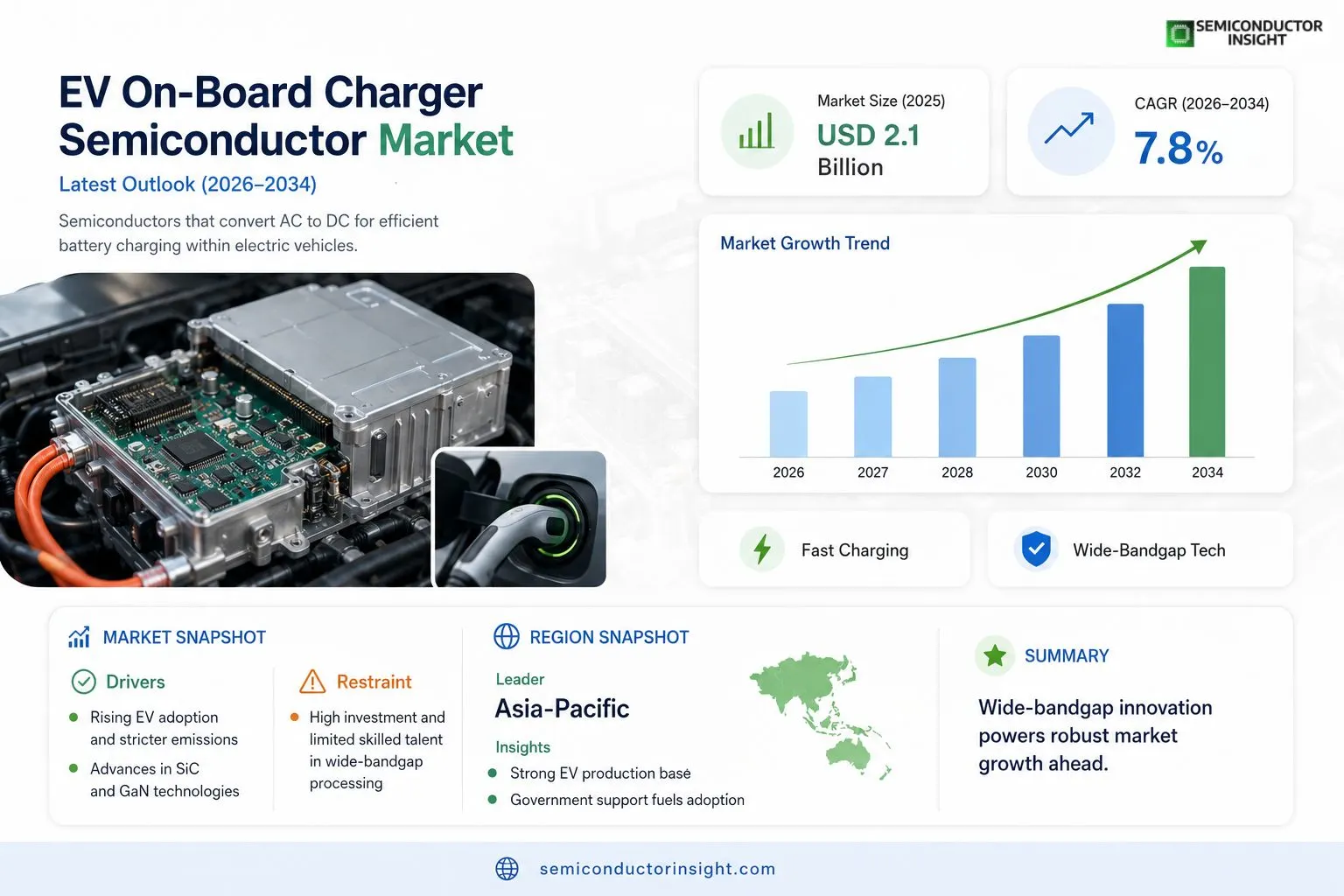
Global EV On-Board Charger Semiconductor Market size was valued at USD 2.1 billion in 2025. The market is projected to grow from USD 2.3 billion in 2026 to USD 7.4 billion by 2034, exhibiting a CAGR of approximately 7.8% during the forecast period.
EV on‑board charger semiconductors are power electronic components that convert alternating current from the grid to direct current suitable for battery charging within electric vehicles. These devices typically incorporate silicon‑carbide (SiC), gallium‑nitride (GaN) technologies, MOSFETs, IGBTs and driver ICs that enable higher efficiency, reduced weight and faster charging rates.The market is experiencing rapid growth because global electric‑vehicle registrations are accelerating, driven by stricter emissions regulations and expanding charging infrastructure. Furthermore, advances in wide‑bandgap semiconductor technology are lowering costs while improving performance, prompting automotive OEMs to adopt higher‑power on‑board chargers. Key players such as Infineon Technologies AG, Texas Instruments Inc., STMicroelectronics NV and NXP Semiconductors are investing heavily in R&D and strategic partnerships to capture this expanding opportunity.
MARKET DRIVERS
Rapid Electrification of Vehicle Fleets
EV On-Board Charger Semiconductor Market is being propelled by aggressive adoption of electric vehicles (EVs) across Asia‑Pacific, Europe and North America. Government incentives, stricter emission regulations, and falling battery costs are encouraging OEMs to integrate higher‑power charger modules, thereby increasing demand for advanced semiconductor components.
Advances in Wide‑Bandgap Materials
Developments in silicon‑carbide (SiC) and gallium‑nitride (GaN) technologies are delivering higher efficiency and reduced thermal footprints, which are critical for on‑board charger performance. OEMs are selecting these materials to achieve faster charging times while complying with stringent safety standards.
➤ Integration of smart‑grid communication protocols is creating new revenue streams for semiconductor suppliers, as chargers become interactive assets within the energy ecosystem.
Strategic partnerships between semiconductor firms and automotive manufacturers are accelerating product development cycles, ensuring that next‑generation on‑board chargers meet both performance and cost targets.
MARKET CHALLENGES
Supply Chain Volatility
Global shortages of raw silicon and specialized substrates have introduced lead‑time uncertainties for manufacturers of charger semiconductors. While demand continues to rise, constrained supply can delay new model launches and increase unit costs.
Other Challenges
Regulatory fragmentation across regions requires multiple design certifications, adding complexity and expense to product portfolios.
Cost Management Pressure
OEMs are negotiating tighter pricing structures, pushing semiconductor suppliers to optimize wafer yields and adopt cost‑effective manufacturing techniques without compromising reliability.
MARKET RESTRAINTS
High Capital Expenditure for New fabs
Establishing dedicated production lines for SiC and GaN devices demands multi‑hundred‑million‑dollar investments, which can deter new entrants and limit capacity expansion in the short term.Limited availability of skilled engineers versed in wide‑bandgap processing further restrains rapid scaling, as companies compete for a narrow talent pool.Moreover, the transition from legacy silicon solutions to advanced materials involves extensive re‑qualification, extending time‑to‑market for innovative charger architectures.
MARKET OPPORTUNITIES
Emergence of Bidirectional Charging
Vehicle‑to‑grid (V2G) capabilities are creating a new demand segment for on‑board chargers capable of both charging and feeding energy back to the grid. Semiconductor manufacturers that can deliver reliable bidirectional converters stand to capture significant market share.Another opportunity lies in the rollout of ultra‑fast charging networks, where chargers must handle power levels exceeding 250 kW. This trend drives the need for high‑efficiency, high‑temperature tolerant semiconductor devices.Finally, the growing prevalence of autonomous and shared mobility services is increasing fleet turnover rates, accelerating the demand for modular, upgradable charger solutions that can be retrofitted across multiple vehicle generations.
EV On-Board Charger Semiconductor Market Trends
Growth Driven by Wide‑Bandgap Technologies
EV On-Board Charger Semiconductor Market is experiencing a rapid acceleration as automakers adopt silicon‑carbide (SiC) and gallium‑nitride (GaN) devices to meet higher efficiency targets. These wide‑bandgap semiconductors reduce conversion losses, enable lighter charger architectures, and support fast‑charge capabilities that align with consumer expectations for reduced downtime. Market data shows that global registrations of electric vehicles are increasing at a pace that pressures charging systems to deliver more power without compromising reliability. As a result, OEMs are integrating higher‑rated on‑board chargers that rely on advanced MOSFETs and IGBTs, positioning the semiconductor supply chain for sustained expansion through 2034.
Other Trends
Cost Reduction Through Volume Production
Economies of scale are beginning to lower the unit cost of SiC and GaN modules, a development confirmed by recent pricing trends from major suppliers. Infineon Technologies AG and Texas Instruments Inc. have reported incremental cost declines of roughly 5 % year‑over‑year as fabs reach higher wafer yields. This pricing pressure is encouraging mid‑size OEMs to qualify premium charger designs earlier in the vehicle development cycle, effectively broadening the addressable base of EV On-Board Charger Semiconductor Market.
Regulatory Push and OEM Adoption
Stricter emissions standards across Europe, China, and North America are compelling manufacturers to increase on‑board charger power ratings to meet mandated electric‑range targets. In parallel, government incentives for fast‑charging infrastructure are stimulating demand for chargers capable of handling 150 kW and above. Leading players such as STMicroelectronics NV and NXP Semiconductors have announced strategic partnerships with vehicle platforms to co‑develop integrated driver ICs that simplify system integration. These regulatory and partnership dynamics collectively reinforce the upward trajectory of EV On-Board Charger Semiconductor Market, suggesting a robust growth environment through the next decade.
COMPETITIVE LANDSCAPEKey Industry Players
Competitive Landscape of EV On‑Board Charger Semiconductor Market
EV on‑board charger semiconductor Market is anchored by a few globally integrated manufacturers that control the majority of high‑power SiC and GaN product portfolios. Infineon Technologies AG leads the segment with a comprehensive range of SiC MOSFETs and driver ICs specifically tuned for 22 kW‑to‑150 kW on‑board chargers, leveraging its deep automotive heritage and extensive R&D investments. Texas Instruments Inc. complements the landscape with GaN power modules and highly integrated charger controller families that enable compact, efficient designs for mid‑range EVs. STMicroelectronics NV supplies a breadth of IGBT‑MOSFET hybrid devices and silicon‑based driver solutions, capitalising on its strong presence in European OEM supply chains. NXP Semiconductors rounds out the top tier by offering power management ICs and secure communication stacks that align with vehicle‑to‑grid (V2G) strategies. Collectively, these leaders shape a market structure where scale, technology breadth, and strategic OEM partnerships dominate, creating high entry barriers for newcomers.Beyond the primary tier, a vibrant cohort of niche players contributes specialised capabilities that enrich the competitive ecosystem. ON Semiconductor focuses on SiC Schottky diodes and discrete power switches tailored for cost‑sensitive models. Mitsubishi Electric supplies robust SiC power modules for heavy‑duty commercial EVs, leveraging its industrial power electronics legacy. Renesas Electronics delivers low‑voltage GaN transistors that target fast‑charge applications in compact vehicles. Rohm Co. provides a diversified catalogue of SiC MOSFETs and driver ICs with a strong emphasis on thermal performance. Analog Devices expands the value chain through precision current‑sense amplifiers and digital isolation solutions. Microchip Technology offers highly integrated charger controller ASICs that simplify board layouts. Melexis contributes automotive‑grade sensor interfaces that enable intelligent charger management. This diversified group sustains innovation pressure, addresses regional market nuances, and ensures a steady pipeline of next‑generation semiconductor technologies.
List of Key EV On‑Board Charger Semiconductor Companies Profiled
- Infineon Technologies AG
- Texas Instruments Inc.
- STMicroelectronics NV
- NXP Semiconductors
- ON Semiconductor
- Mitsubishi Electric
- Renesas Electronics
- Rohm Co., Ltd.
- Analog Devices Inc.
- Microchip Technology Inc.
- Melexis
Segment Analysis:
| Segment Category | Sub-Segments | Key Insights |
| By Type |
|
Silicon‑Carbide (SiC) Devices
|
| By Application |
|
Commercial Fleet Chargers
|
| By End User |
|
Original Equipment Manufacturers (OEMs)
|
| By Technology Trend |
|
Wide‑Bandgap Adoption
|
| By System Architecture |
|
Dual‑Stage Converters
|
Regional Analysis: North America
North America
Ongoing innovation in silicon carbide (SiC) and gallium nitride (GaN) semiconductors is significantly enhancing the efficiency and power handling capabilities of on-board chargers.
Government initiatives and private investments are accelerating the deployment of EV charging infrastructure across North America, creating a strong demand for on-board charger semiconductors.
The region is focusing on strengthening its semiconductor supply chain to ensure a stable and reliable flow of components for the growing EV market.
A mix of established semiconductor giants and emerging players are vying for market share, fostering innovation and driving down costs.
Europe
The European EV On-Board Charger Semiconductor Market is experiencing significant growth, spurred by stringent emissions regulations and ambitious electrification targets. Several European nations have pledged to phase out internal combustion engine vehicles, creating a favorable environment for the adoption of electric mobility. The demand for efficient and compact on-board charger semiconductors is increasing, driven by the growing popularity of electric vehicles across the continent. Key trends include the integration of advanced power electronics and the development of smart charging solutions.
Asia-Pacific
Asia-Pacific represents the largest and fastest-growing market for EV On-Board Charger Semiconductors, spearheaded by China’s rapid expansion of its EV industry. Government support and a large domestic market are fueling strong demand for these components. The region is witnessing the emergence of local semiconductor manufacturers and a growing emphasis on localized supply chains. The adoption of advanced charging technologies and the increasing production of EVs in countries like South Korea and Japan are further driving market growth.
South America
EV On-Board Charger Semiconductor Market in South America is in its nascent stages, but it holds significant potential for future growth. Increasing environmental awareness and government initiatives are driving the adoption of electric vehicles in countries like Brazil and Chile. The demand for on-board charger semiconductors is expected to rise as EV sales gain momentum. However, challenges such as limited charging infrastructure and high vehicle costs remain barriers to widespread adoption.
Middle East & Africa
The Middle East & Africa region presents a growing opportunity for EV On-Board Charger Semiconductor Market. Several countries in the region are implementing policies to promote electric vehicle adoption, driven by factors such as energy security concerns and increasing urbanization. The demand for on-board chargers is expected to increase steadily in the coming years. However, the lack of established charging infrastructure and the high cost of EVs currently pose challenges to market growth in this region.
Report Scope
This market research report provides a comprehensive analysis of the EV On-Board Charger Semiconductor Market , covering the forecast period 2026–2034. It offers detailed insights into market dynamics, technological advancements, competitive landscape, and key trends shaping the industry.
Key focus areas of the report include:
- Market Overview: The report begins with an overview outlining its current market scenario, key growth indicators, and industry transformation drivers. It discusses macroeconomic factors, demand–supply balance, regulatory landscape, and the strategic role of semiconductors in powering advancements across industries such as automotive, telecommunications, consumer electronics, and industrial automation.
- Market Size & Forecast: Historical data and future projections for revenue, unit shipments, and market value across major regions and segments.
- Segmentation Analysis: Detailed breakdown by product type, technology, application, and end-user industry to identify high-growth segments and investment opportunities.
- Regional Insights: Insights into market performance across North America, Europe, Asia-Pacific, Latin America, and the Middle East & Africa, including country-level analysis where relevant.
- Competitive Landscape: Profiles of leading market participants, including their product offerings, R&D focus, manufacturing capacity, pricing strategies, and recent developments such as mergers, acquisitions, and partnerships.
- Technology Trends & Innovation: Assessment of emerging technologies, integration of AI/IoT, semiconductor design trends, fabrication techniques, and evolving industry standards.
- Market Drivers & Restraints: Evaluation of factors driving market growth along with challenges, supply chain constraints, regulatory issues, and market-entry barriers.
- Stakeholder Insights: Insights for component suppliers, OEMs, system integrators, investors, and policymakers regarding the evolving ecosystem and strategic opportunities.
Primary and secondary research methods are employed, including interviews with industry experts, data from verified sources, and real-time market intelligence to ensure the accuracy and reliability of the insights presented.
FREQUENTLY ASKED QUESTIONS:
What is the current market size of EV On-Board Charger Semiconductor Market?
-> EV On-Board Charger Semiconductor Market was valued at USD 2.1 billion in 2025 and is expected to reach USD 7.4 billion by 2034, growing at a CAGR of approximately 7.8%.
Which key companies operate in EV On-Board Charger Semiconductor Market?
-> Key players include Infineon Technologies AG, Texas Instruments Inc., STMicroelectronics NV, and NXP Semiconductors.
What are the key growth drivers?
-> Key growth drivers include rising electric‑vehicle registrations, stricter emissions regulations, expanding charging infrastructure, and advances in wide‑bandgap semiconductor technologies (SiC, GaN).
Which region dominates the market?
-> The reference does not specify a single dominant region.
What are the emerging trends?
-> Emerging trends include silicon‑carbide (SiC) and gallium‑nitride (GaN) device adoption, integration of high‑efficiency MOSFETs and IGBTs, and ongoing R&D for higher‑power on‑board chargers.

Get Sample Report PDF for Exclusive Insights
Report Sample Includes
- Table of Contents
- List of Tables & Figures
- Charts, Research Methodology, and more...
 Download Sample Report PDF