Key Statistics
Key Takeaways
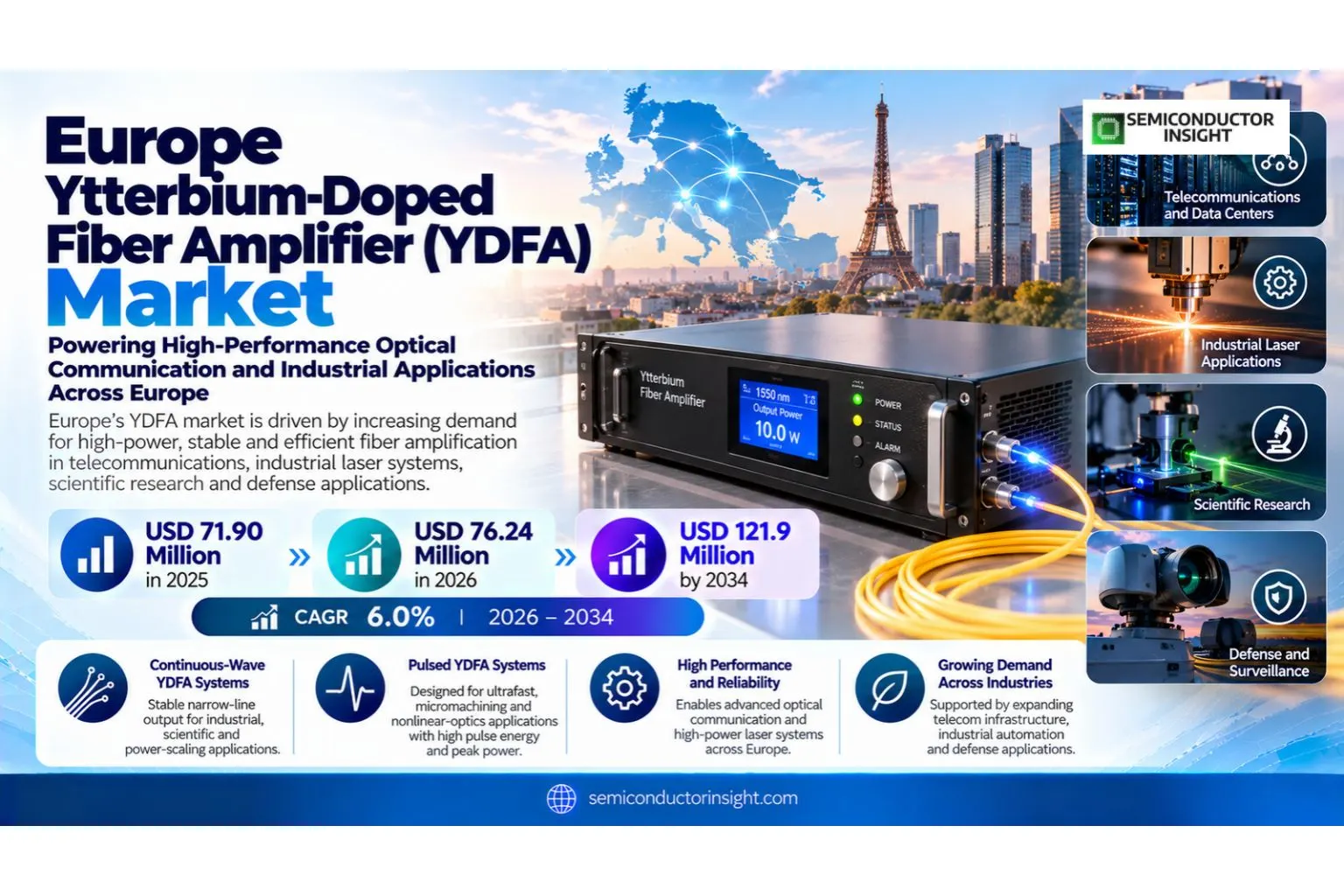
- The market is valued at USD 71.90 million in 2025 and is projected to reach USD 121.9 million by 2034, representing a 6.0% CAGR over 2026–2034.
- Ytterbium-Doped Pulsed Fiber Amplifier is a major product segment, while adjacent variants are expanding as performance, integration and cost requirements evolve.
- Sensing is a leading application area, supported by demand across Communication, Detection.
- Germany is the largest market in 2025 based on current demand, manufacturing concentration and ecosystem maturity.
Europe Ytterbium-Doped Fiber Amplifier (YDFA) Market Overview
Europe Ytterbium-Doped Fiber Amplifier (YDFA) systems use ytterbium-doped optical fiber as the gain medium to amplify signals around the 1µm wavelength band, typically between 1030 and 1070nm. The architecture offers high electrical-to-optical efficiency, strong beam quality and straightforward power scaling because heat is distributed along a long fiber geometry. Commercial adoption of Europe Ytterbium-Doped Fiber Amplifier (YDFA) products therefore depends on system-level productivity, integration requirements, reliability expectations and the economics of replacing established alternatives in real operating environments.
European demand is concentrated in industrial laser processing, scientific metrology, coherent sensing and specialized defense photonics rather than conventional telecom repeaters. The region also hosts important suppliers of ytterbium gain fiber, frequency-comb systems and high-power fiber amplifiers, creating a tightly connected photonics ecosystem. Suppliers that translate technical improvements into measurable gains in efficiency, uptime, cost, throughput or workflow simplicity are better positioned to win long-duration programs and repeat purchases.
Segment Analysis: By Type
Continuous-wave YDFA systems lead in industrial, scientific and power-scaling applications where stable narrow-line output is required, while pulsed amplifiers serve ultrafast, micromachining and nonlinear-optics applications where pulse energy and peak power are more important than average output alone. Within this segment, customers increasingly compare lifecycle support, qualification requirements, integration effort and total ownership cost rather than relying on a single specification or upfront price.
| Type | Market relevance |
|---|---|
| Ytterbium-Doped Pulsed Fiber Amplifier | High peak power and ultrafast systems. |
| Ytterbium-Doped Continuous Wave Fiber Amplifier | Largest stable-output industrial and scientific segment. |
Segment Analysis: By Application
Sensing and detection are major specialized applications because ytterbium amplification around 1.0–1.1µm supports lidar, spectroscopy and coherent optical measurement. Communication is more limited than erbium-amplifier use at 1550nm but remains relevant in specialty photonic links and laboratory systems. Within this segment, customers increasingly compare lifecycle support, qualification requirements, integration effort and total ownership cost rather than relying on a single specification or upfront price.
| Application | Market relevance |
|---|---|
| Sensing | Lidar, metrology and distributed sensing. |
| Communication | Specialty optical links and laboratories. |
| Detection | Coherent detection and defense sensing. |
| Others | Research, medical and nonlinear optics. |
Segment Analysis: By Output Power
Below-10W systems serve seed amplification and laboratory use, 10–100W products address metrology and specialty processing, and above-100W amplifiers support industrial and defense systems where fiber architecture allows scaling without sacrificing beam quality. Within this segment, customers increasingly compare lifecycle support, qualification requirements, integration effort and total ownership cost rather than relying on a single specification or upfront price.
| Output Power | Market relevance |
|---|---|
| Below 10W | Seed and laboratory amplification. |
| 10–100W | Mainstream scientific and industrial range. |
| Above 100W | High-power materials processing and defense. |
Segment Analysis: By End User
Industrial laser users drive the highest power demand, scientific and metrology customers value narrow linewidth and low noise, defense and sensing applications prioritize rugged coherent output, and telecom/photonics users focus on stable wavelength-specific amplification. Within this segment, customers increasingly compare lifecycle support, qualification requirements, integration effort and total ownership cost rather than relying on a single specification or upfront price.
| End User | Market relevance |
|---|---|
| Industrial Laser Systems | High-power industrial processing. |
| Scientific & Metrology | Frequency combs, spectroscopy and metrology. |
| Defense & Sensing | Lidar, targeting and coherent sensing. |
| Telecom & Photonics | Photonics laboratories and specialty networks. |
Regional Analysis
Germany is the largest national market by analyst assessment because of its industrial-laser, metrology and scientific-photonics base, while the United Kingdom, France, Netherlands and Nordic countries add strong sensing, defense and research demand across Europe. Regional share also reflects supplier depth, engineering support, manufacturing concentration and the speed at which new Europe Ytterbium-Doped Fiber Amplifier (YDFA) designs can move from evaluation into repeat deployment.
| Region | 2025 Position | Growth Outlook | Demand Profile |
|---|---|---|---|
| Germany | Largest | Strong | Industrial lasers and metrology led |
| United Kingdom | High-value specialist market | Moderate-strong | Defense, research and photonics led |
| France | Large technology market | Strong | Photonics, aerospace and industrial led |
| Nordics | Technology supply hub | Moderate-strong | Gain fiber and scientific photonics led |
| Rest of Europe | Specialty | Moderate | Research and industrial led |
Detailed Regional Blocks
Why is Germany important to this market?
Germany leads European demand through machine-tool manufacturing, precision metrology and photonics research. Menlo Systems and a dense laser ecosystem create high-value use for narrow-line and ultrafast ytterbium amplifiers. In Germany, procurement decisions also depend on service coverage, qualification resources, logistics and long-term availability, so ecosystem maturity can materially influence adoption even when core technology performance is similar.
| Country / Subregion | Role | Market Context |
|---|---|---|
| Germany | Largest national market | Industrial processing, metrology and research drive demand. |
- Menlo Systems offers the orange Yb fiber platform around 1040nm with high-power amplifier options above 10W.
- Its FC1000 frequency comb can be paired with single- or double-clad YDFA stages for higher output power.
- German users value long-term stability and low amplitude or phase noise in metrology systems.
Why is United Kingdom important to this market?
The United Kingdom supports YDFA demand through aerospace, defense, sensing and university photonics. Applications favor compact low-noise amplifiers and pulsed systems for lidar, nonlinear optics and coherent experiments. In United Kingdom, procurement decisions also depend on service coverage, qualification resources, logistics and long-term availability, so ecosystem maturity can materially influence adoption even when core technology performance is similar.
| Country / Subregion | Role | Market Context |
|---|---|---|
| United Kingdom | Defense and research hub | Universities and photonics firms support specialized amplifiers. |
- Fiber-based amplifiers are attractive where alignment stability and compact packaging matter.
- Defense sensing values narrow linewidth, low noise and robust polarization control.
- Research users frequently require custom wavelength, pulse or packaging options.
Why is France important to this market?
France is a major photonics market through aerospace, scientific instrumentation and industrial laser companies. Ytterbium amplifiers support lidar, materials processing and high-power research platforms. In France, procurement decisions also depend on service coverage, qualification resources, logistics and long-term availability, so ecosystem maturity can materially influence adoption even when core technology performance is similar.
| Country / Subregion | Role | Market Context |
|---|---|---|
| France | Aerospace and photonics hub | Industrial and defense applications support demand. |
- Lumibird and related European photonics groups maintain extensive fiber-laser and sensing portfolios.
- High-power ytterbium fiber architectures are used in directed-energy, lidar and industrial systems.
- European defense projects create long qualification cycles but high value per system.
Why is Nordics important to this market?
Denmark and neighboring Nordic countries are important to the supply side through NKT Photonics and specialty fiber technology. The region supports narrow-line amplifiers, frequency conversion and advanced sensing. In Nordics, procurement decisions also depend on service coverage, qualification resources, logistics and long-term availability, so ecosystem maturity can materially influence adoption even when core technology performance is similar.
| Country / Subregion | Role | Market Context |
|---|---|---|
| Denmark | Specialty fiber hub | NKT Photonics supplies Yb-doped gain fiber and laser systems. |
| Sweden | Defense and photonics niche | High-power fiber-laser applications create selective demand. |
- NKT’s Yb-doped fibers are designed for pulsed amplifier architectures with polarization-maintaining single-mode output.
- Fiber design influences power scaling, nonlinear threshold and beam quality as much as pump-diode power.
- The Nordic ecosystem combines specialty glass, fibers and high-performance photonics systems.
Why is Rest of Europe important to this market?
The Netherlands, Switzerland, Italy and other European markets add demand through universities, semiconductor equipment, precision manufacturing and photonics integrators. Volumes are smaller but application diversity is high. In Rest of Europe, procurement decisions also depend on service coverage, qualification resources, logistics and long-term availability, so ecosystem maturity can materially influence adoption even when core technology performance is similar.
| Country / Subregion | Role | Market Context |
|---|---|---|
| Netherlands | High-tech equipment and research | Precision photonics support specialized amplifiers. |
| Switzerland | Metrology and industrial niche | Scientific instrumentation creates premium demand. |
| Italy | Industrial laser use | Materials processing supports fiber-amplifier systems. |
- Ytterbium amplifiers are widely used as seed and booster stages in custom photonic systems.
- High-power users increasingly require Ethernet or digital interfaces for system integration.
- Customization remains important because wavelength, polarization and output power vary by experiment or machine.
Competitive Landscape
IPG Photonics, NKT Photonics, Menlo Systems, Lumibird/Keopsys, TOPTICA, Amplitude and specialist European photonics suppliers compete on output power, linewidth, noise, polarization stability, pulse format and OEM integration. The market favors engineering depth and customization over commodity scale.
| Company | Position | Relevant capability |
|---|---|---|
| IPG Photonics | Key participant | Ytterbium CW amplifiers from 1030–1070nm with output power up to kilowatt class. |
| NKT Photonics | Key participant | Specialty Yb-doped gain fibers and high-performance photonics platforms. |
| Menlo Systems | Key participant | Ytterbium femtosecond lasers and amplifier stages for frequency-comb, spectroscopy and scientific use. |
| Lumibird / Keopsys | Key participant | Competes through product breadth, integration capability, qualification and customer support. |
| TOPTICA Photonics | Key participant | Competes through product breadth, integration capability, qualification and customer support. |
| Amplitude | Key participant | Competes through product breadth, integration capability, qualification and customer support. |
| Fibercore | Key participant | Competes through product breadth, integration capability, qualification and customer support. |
| nLIGHT / Liekki | Key participant | Competes through product breadth, integration capability, qualification and customer support. |
Production Capacity Analysis
YDFA capacity depends on rare-earth-doped fiber preforms, precision fiber drawing, pump diodes, fiber combiners, isolators and control electronics. High-power and narrow-line products require careful suppression of nonlinear effects and thermal or modal instabilities. Scaling output without degrading consistency requires stable upstream materials, disciplined process control and final testing that catches performance drift before products reach high-value customer systems.
Europe maintains strong specialty-fiber and photonics manufacturing. Production is less constrained by raw volume than by engineering talent, specialty components and final optical test, especially for single-frequency or polarization-maintaining amplifiers. Second-source planning and regional technical support therefore become increasingly important as deployments expand and buyers seek supply continuity without repeating lengthy qualification work.
Market Dynamics
The market is shifting toward higher power and better coherence at the same time. Customers want more output without sacrificing beam quality, spectral purity or reliability, forcing suppliers to improve fiber design, pump architecture and thermal management. This is changing competitive behavior because vendors increasingly sell system-level value, workflow integration and lifecycle economics rather than an isolated component specification.
Ultrafast and frequency-comb systems create a parallel opportunity at lower average power but much higher technical value. These applications prioritize pulse quality, synchronization, low noise and turnkey automation rather than maximum wattage. Buyers consequently evaluate total ownership cost, qualification effort and roadmap stability across the life of a program instead of focusing only on initial purchase price.
Market Drivers
| Factor | Analyst Interpretation |
|---|---|
| Industrial laser adoption | Fiber amplifiers support high-efficiency precision processing. |
| Scientific metrology | Narrow-line high-stability amplifiers serve frequency-comb and spectroscopy systems. |
| Lidar and sensing | 1µm coherent sources are useful in ranging and detection. |
| Defense photonics | High-power fiber architectures support rugged sensing and directed-energy systems. |
Market Restraints
| Factor | Analyst Interpretation |
|---|---|
| Stimulated nonlinear effects | Power scaling can trigger SBS, SRS and modal instabilities. |
| Specialty component cost | PM fiber, combiners and isolators add significant system cost. |
| Customization burden | Many applications require unique wavelength and pulse specifications. |
| Competition from complete fiber lasers | Some users buy integrated laser systems rather than separate amplifiers. |
Market Opportunities
| Factor | Analyst Interpretation |
|---|---|
| Coherent beam combining | Narrow-line YDFA channels can scale aggregate power. |
| Frequency-comb power scaling | Amplifiers raise comb output for spectroscopy and nonlinear conversion. |
| High-power sensing | Long-range lidar and detection benefit from efficient fiber amplification. |
| OEM modules | Compact amplifier modules can be embedded into instruments and laser machines. |
Supply Chain Analysis
The value chain combines ytterbium-doped fiber, pump diodes, couplers, isolators, control electronics and optical packaging. Performance depends strongly on the gain fiber design and how pump light, heat and nonlinear effects are managed. Traceability and coordination between component suppliers, integrators and end users are important because failures found late in the chain can be far more expensive than the underlying part itself.
| Supply Chain Stage | Role in the Market |
|---|---|
| Yb-doped gain fiber | Specialty preforms and fiber determine efficiency and mode quality. |
| Pump diodes and combiners | Diode light is coupled into the gain fiber at high efficiency. |
| Amplifier integration | Isolators, controls and packaging create pulsed or CW systems. |
| OEM and scientific deployment | Amplifiers enter laser machines, sensors, frequency combs and research systems. |
Recent Developments
| Date | Development | Source |
|---|---|---|
| 2026 | IPG Photonics continues Ytterbium CW fiber amplifiers across 1030–1070nm with output power up to 4 kW and specialized single-frequency options. | IPG Photonics |
| 2026 | Menlo Systems' FC1000 platform supports optional single- and double-clad YDFA amplification stages at 1040nm for high-power frequency-comb output. | Menlo Systems |
| 2026 | NKT Photonics continues polarization-maintaining Yb-doped gain fibers designed for pulsed fiber-amplifier architectures. | NKT Photonics |
Report Scope & Segmentation
| Scope Item | Coverage |
|---|---|
| Base Year | 2025 |
| Estimated Year | 2026 |
| Forecast Period | 2026–2034 |
| 2025 Market Size | USD 71.90 million |
| 2026 Estimated Size | USD 76.24 million |
| 2034 Forecast Size | USD 121.9 million |
| CAGR (2026–2034) | 6.0% |
| Largest Market in 2025 | Germany |
| Category | Optoelectronics / Fiber Amplifiers / Europe |
| By Type | Ytterbium-Doped Pulsed Fiber Amplifier, Ytterbium-Doped Continuous Wave Fiber Amplifier |
| By Application | Sensing, Communication, Detection, Others |
| By Output Power | Below 10W, 10–100W, Above 100W |
| By End User | Industrial Laser Systems, Scientific & Metrology, Defense & Sensing, Telecom & Photonics |
Frequently Asked Questions
What is the 2025 market size of the Europe Ytterbium-Doped Fiber Amplifier (YDFA) market?
The market is valued at USD 71.90 million in 2025.
What is the projected 2034 market size of the Europe Ytterbium-Doped Fiber Amplifier (YDFA) market?
The market is projected to reach USD 121.9 million by 2034.
What is the CAGR of the Europe Ytterbium-Doped Fiber Amplifier (YDFA) market from 2026 to 2034?
The market is expected to expand at a CAGR of 6.0% during 2026–2034.
Which region leads the Europe Ytterbium-Doped Fiber Amplifier (YDFA) market?
Germany is the largest market in 2025 based on the current demand, manufacturing and deployment structure.
Which type segment is important in the Europe Ytterbium-Doped Fiber Amplifier (YDFA) market?
Ytterbium-Doped Pulsed Fiber Amplifier is a major segment, while adjacent product variants are gaining share as performance and integration requirements evolve.
What is the main application for Europe Ytterbium-Doped Fiber Amplifier (YDFA) products?
Sensing is a leading application, with additional growth coming from Communication, Detection.
What drives growth in the Europe Ytterbium-Doped Fiber Amplifier (YDFA) market?
Fiber amplifiers support high-efficiency precision processing.
What is a key restraint for the Europe Ytterbium-Doped Fiber Amplifier (YDFA) market?
Power scaling can trigger SBS, SRS and modal instabilities.
Which companies participate in the Europe Ytterbium-Doped Fiber Amplifier (YDFA) market?
Key participants include IPG Photonics, NKT Photonics, Menlo Systems, Lumibird / Keopsys, TOPTICA Photonics, alongside other specialized suppliers and system companies.
What technology trend is shaping the Europe Ytterbium-Doped Fiber Amplifier (YDFA) market?
Narrow-line YDFA channels can scale aggregate power.
Research Sources & Evidence Base
View research sources used for this overview.
- IPG Photonics — CW Fiber Amplifiers: Ytterbium amplifier wavelength range, power scaling and applications. Source
- Menlo Systems — FC1000: Optional YDFA amplification for optical frequency-comb systems. Source
- Menlo Systems — orange Ytterbium Fiber Laser: Current high-power femtosecond Yb platform and amplifier-seeding context. Source
- NKT Photonics — Ytterbium-Doped Gain Fiber: PM Yb gain-fiber architecture for pulsed amplifiers. Source

Get Sample Report PDF for Exclusive Insights
Report Sample Includes
- Table of Contents
- List of Tables & Figures
- Charts, Research Methodology, and more...
 Download Sample Report PDF