Europe AI Automotive Functional Safety Processor Market Insights
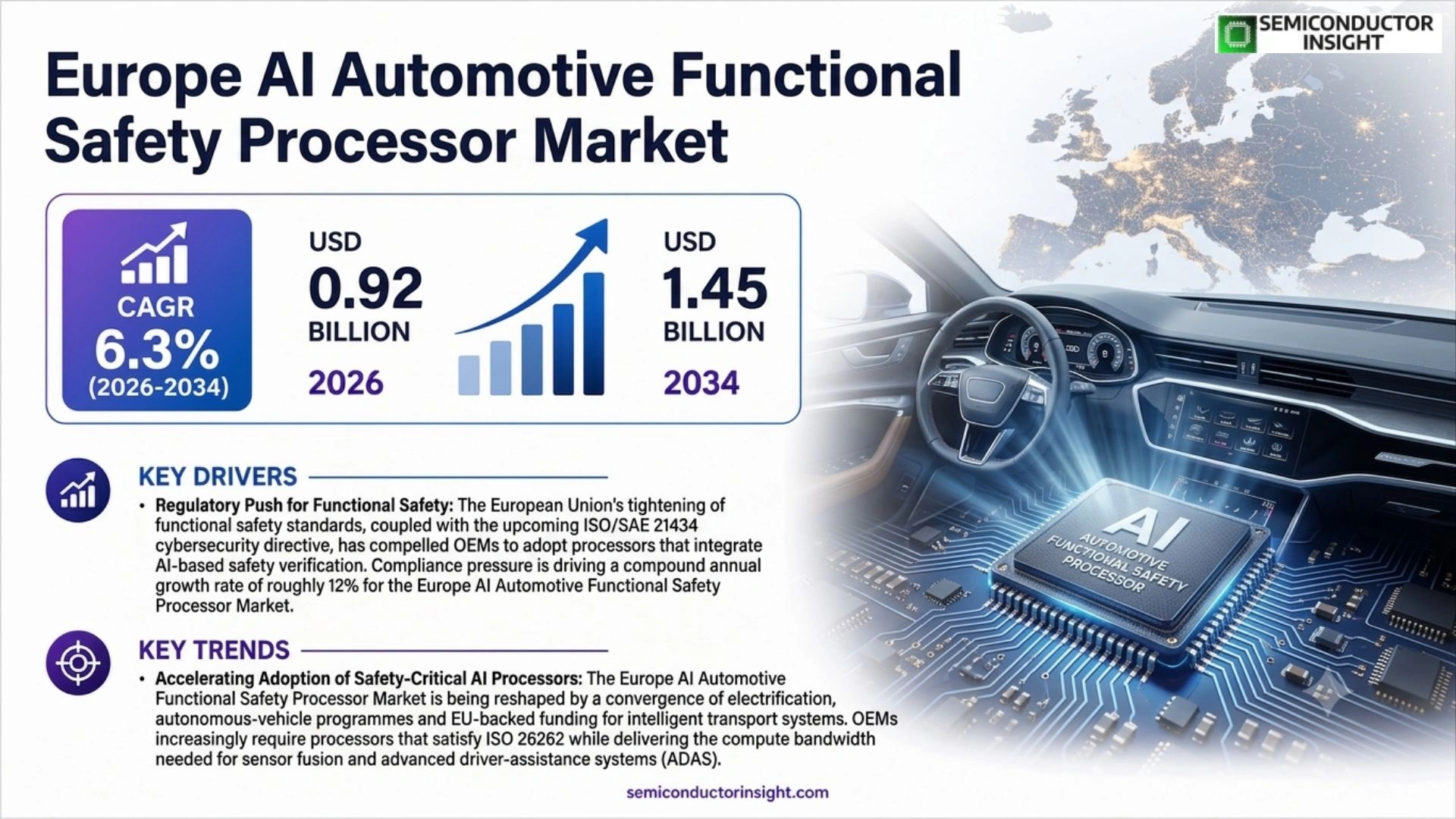
Global Europe AI Automotive Functional Safety Processor Market size was valued at USD 0.85 billion in 2025. The market is projected to grow from USD 0.92 billion in 2026 to USD 1.45 billion by 2034, exhibiting a CAGR of 6.3% during the forecast period.
AI automotive functional safety processors are specialized semiconductor solutions designed to meet ISO 26262 compliance while enabling advanced driver‑assistance systems (ADAS) and autonomous driving functions. These processors integrate high‑performance CPUs, GPUs, and dedicated safety cores that execute fault‑tolerant algorithms, manage sensor fusion, and enforce real‑time safety monitoring.
The market is gaining momentum because European automakers are accelerating electrification and autonomous vehicle programmes, supported by substantial EU funding for intelligent transport systems. At the same time, stricter regulatory requirements push OEMs toward certified safety processors. Leading suppliers such as NXP Semiconductors, Infineon Technologies, Renesas Electronics, and STMicroelectronics are expanding their portfolios through strategic partnerships and silicon‑based innovations.
MARKET DRIVERS
Regulatory Push for Functional Safety
The European Union’s tightening of functional safety standards, coupled with the upcoming ISO/SAE 21434 cybersecurity directive, has compelled OEMs to adopt processors that integrate AI‑based safety verification. Compliance pressure is driving a compound annual growth rate of roughly 12% for Europe AI Automotive Functional Safety Processor Market.
Shift Toward Autonomous Driving Features
Vehicle manufacturers are expanding Level‑2 and Level‑3 driver assistance systems, requiring hardware that can execute real‑time AI inference while meeting safety integrity levels (SIL). Advanced sensor fusion and predictive control algorithms are creating strong demand for specialized safety processors across Germany, France, and the UK.
➤ “By 2028, AI‑enabled safety processors are expected to power over 65% of new premium models launched in Europe.”
In parallel, the surge in electric vehicle (EV) adoption is boosting the need for compact, low‑power processors that can manage both powertrain control and safety functions, further reinforcing market momentum.
MARKET CHALLENGES
High Development Costs and Certification Timelines
Designing processors that satisfy both functional safety (ISO 26262) and emerging AI reliability metrics demands extensive validation cycles. Certification delays often extend product launch windows by 12‑18 months, raising capital requirements for suppliers.
Other Challenges
Talent Shortage in Safety‑Critical AI Engineering
The pool of engineers proficient in both automotive safety standards and AI model validation remains limited, causing recruitment premiums and potential skill gaps for new projects.
MARKET RESTRAINTS
Fragmented Supplier Landscape
European market is characterized by a multitude of niche vendors competing with established semiconductor giants. This fragmentation leads to inconsistent design ecosystems and longer integration times for automotive OEMs seeking a unified safety processor solution.
MARKET OPPORTUNITIES
Emerging AI‑Safety Co‑Design Platforms
Collaborative frameworks that allow AI algorithm developers and safety engineers to co‑design on a single silicon platform are gaining traction. Modular IP blocks and open standards promise faster time‑to‑market, positioning early adopters to capture a sizable share of Europe AI Automotive Functional Safety Processor Market.
Europe AI Automotive Functional Safety Processor Market Trends
Accelerating Adoption of Safety‑Critical AI Processors
Europe AI Automotive Functional Safety Processor Market is being reshaped by a convergence of electrification, autonomous‑vehicle programmes and EU‑backed funding for intelligent transport systems. OEMs increasingly require processors that satisfy ISO 26262 while delivering the compute bandwidth needed for sensor fusion and advanced driver‑assistance systems (ADAS). This dual requirement creates a clear preference for AI‑enabled safety cores that can run fault‑tolerant algorithms in real time, a factor reflected in the steady uplift in market activity observed since 2025.
Other Trends
Regulatory Landscape Tightens
European authorities have introduced stricter functional‑safety mandates that compel manufacturers to certify every electronic control unit against the latest ISO 26262 revisions. The result is a higher barrier to entry for non‑compliant silicon, prompting OEMs to source processors from suppliers with proven safety portfolios. This regulatory pressure accelerates the shift from legacy microcontrollers to integrated AI safety processors, reinforcing the market’s growth trajectory.
Strategic Partnerships Drive Portfolio Expansion
Leading suppliers such as NXP Semiconductors, Infineon Technologies, Renesas Electronics and STMicroelectronics are deepening collaborations with automotive OEMs and software firms. Joint development programs focus on embedding AI inference engines alongside dedicated safety cores, enabling a single chip to handle both perception workloads and safety monitoring. These alliances reduce time‑to‑market for next‑generation autonomous driving platforms and create a competitive edge for partners that can demonstrate end‑to‑end compliance.
In addition, Europe AI Automotive Functional Safety Processor Market benefits from a growing pool of specialized talent in semiconductor design and safety engineering across the region. Universities and research institutes are increasingly aligned with industry consortia, delivering innovations such as hardware‑assisted redundancy and predictive fault detection. The net effect is a robust pipeline of next‑generation devices that are both AI‑ready and safety‑certified, supporting the broader strategic objectives of European automotive manufacturers.
COMPETITIVE LANDSCAPE
Key Industry Players
Europe AI Automotive Functional Safety Processor Market Overview
European market is dominated by a handful of semiconductor leaders that have invested heavily in safety‑critical IP and ISO 26262 certification. NXP Semiconductors, Infineon Technologies, Renesas Electronics, and STMicroelectronics together capture the majority of volume, leveraging extensive automotive foundry capacity and deep collaborations with OEMs such as Volkswagen, BMW, and Stellantis. Their product portfolios integrate high‑performance CPU cores, GPU accelerators, and dedicated safety islands, enabling fault‑tolerant sensor‑fusion and real‑time monitoring required for advanced driver‑assistance and autonomous functions. The concentration of these large players creates a tiered supply chain where Tier‑1 system integrators rely on a small set of vetted silicon sources to meet stringent functional‑safety timelines.
Beyond the core quartet, several niche and emerging suppliers carve out specialized segments. Microchip Technology and ON Semiconductor focus on low‑power safety MCUs for electric‑power‑train control, while Analog Devices provides precision analog front‑ends that reinforce fault detection. Texas Instruments offers a broad line of automotive‑grade processors that blend safety cores with heterogeneous compute, and Qualcomm’s Snapdragon Automotive Platform introduces AI‑centric safety features for higher‑level autonomy. Bosch, while primarily a systems integrator, has entered the processor space through strategic joint ventures, adding further depth to the European ecosystem. These companies, though smaller in market share, drive innovation in compact form‑factors, cost‑optimized safety kernels, and next‑generation AI safety algorithms.
List of Key Automotive Functional Safety Processor Companies Profiled
- NXP Semiconductors
- Infineon Technologies
- Renesas Electronics
- STMicroelectronics
- Microchip Technology
- ON Semiconductor
- Analog Devices
- Texas Instruments
- Qualcomm Incorporated
- Bosch Automotive Electronics
- AMD (Automotive Division)
- MediaTek Inc.
Segment Analysis:
| Segment Category | Sub-Segments | Key Insights |
| By Type |
|
AI‑Enabled Safety Processors
|
| By Application |
|
Autonomous Driving
|
| By End User |
|
OEMs
|
| By Technology |
|
Neural Network Accelerators
|
| By Compliance Focus |
|
Combined Safety‑Security Solutions
|
Regional Analysis: Europe AI Automotive Functional Safety Processor Market
Europe
The European Union enforces a tightly‑woven set of functional safety directives that require processors to demonstrate deterministic behavior under all driving conditions, prompting manufacturers to embed safety‑critical AI modules that meet ISO‑26262 level‑2 or higher. Continuous updates to these standards ensure that AI‑enhanced safety functions remain compliant and reliable.
Leading OEMs across Germany, France, and Italy are accelerating the integration of AI processors to enable advanced lane‑keeping, pedestrian detection, and predictive crash mitigation, all while maintaining the highest safety integrity levels demanded by European markets.
European suppliers emphasize heterogeneous architectures that combine dedicated safety cores with AI accelerators, allowing real‑time perception algorithms to operate within pre‑qualified safety envelopes without compromising functional integrity.
The market features a blend of traditional silicon veterans and emerging AI specialists, each vying to secure design wins by offering processors that satisfy both safety certification and AI performance benchmarks demanded by European carmakers.
North America
North America displays a vigorous appetite for AI automotive safety processors, yet its regulatory approach is less prescriptive than Europe’s, focusing on performance benchmarks rather than deterministic safety proofs. OEMs in the United States and Canada leverage the flexibility of local standards to experiment with advanced perception capabilities, often integrating AI processors that prioritize high‑throughput neural inference for autonomous functions. The region’s strong venture capital ecosystem fuels startups that push the envelope on silicon efficiency, though market adoption is tempered by the need to align emerging technologies with forthcoming safety guidelines.
Asia‑Pacific
The Asia‑Pacific landscape is characterized by rapid growth in vehicle production and a burgeoning focus on safety‑critical AI functions. While regulatory mandates vary widely across countries, leading manufacturers in Japan, South Korea, and China are investing heavily in processor designs that blend AI acceleration with functional safety modules. Collaborative ventures between semiconductor firms and automotive giants aim to establish early safety certification pathways, positioning the region as a future hub for high‑volume AI safety processor deployment.
South America
South America’s automotive sector is gradually embracing AI safety processors, driven primarily by importers seeking to meet global safety expectations for exported vehicles. Regional regulations are evolving, and manufacturers are beginning to adopt European‑style functional safety standards as a market differentiator. The focus remains on cost‑effective solutions that can be integrated into existing vehicle platforms while delivering incremental safety enhancements through AI‑enabled features.
Middle East & Africa
In the Middle East and Africa, market penetration of AI automotive functional safety processors is emerging, spurred by growing demand for premium vehicles equipped with advanced driver‑assistance systems. Regulatory frameworks are in early development stages, leading OEMs to adopt European safety practices as a benchmark. Partnerships between local distributors and global silicon providers are facilitating technology transfer, enabling the region to gradually build the expertise required for widespread AI‑driven safety implementations.
Report Scope
This market research report provides a comprehensive analysis of the Europe AI Automotive Functional Safety Processor Market , covering the forecast period 2026–2034. It offers detailed insights into market dynamics, technological advancements, competitive landscape, and key trends shaping the industry.
Key focus areas of the report include:
- Market Overview: The report begins with an overview outlining its current market scenario, key growth indicators, and industry transformation drivers. It discusses macroeconomic factors, demand–supply balance, regulatory landscape, and the strategic role of semiconductors in powering advancements across industries such as automotive, telecommunications, consumer electronics, and industrial automation.
- Market Size & Forecast: Historical data and future projections for revenue, unit shipments, and market value across major regions and segments.
- Segmentation Analysis: Detailed breakdown by product type, technology, application, and end-user industry to identify high-growth segments and investment opportunities.
- Regional Insights: Insights into market performance across North America, Europe, Asia-Pacific, Latin America, and the Middle East & Africa, including country-level analysis where relevant.
- Competitive Landscape: Profiles of leading market participants, including their product offerings, R&D focus, manufacturing capacity, pricing strategies, and recent developments such as mergers, acquisitions, and partnerships.
- Technology Trends & Innovation: Assessment of emerging technologies, integration of AI/IoT, semiconductor design trends, fabrication techniques, and evolving industry standards.
- Market Drivers & Restraints: Evaluation of factors driving market growth along with challenges, supply chain constraints, regulatory issues, and market-entry barriers.
- Stakeholder Insights: Insights for component suppliers, OEMs, system integrators, investors, and policymakers regarding the evolving ecosystem and strategic opportunities.
Primary and secondary research methods are employed, including interviews with industry experts, data from verified sources, and real-time market intelligence to ensure the accuracy and reliability of the insights presented.
FREQUENTLY ASKED QUESTIONS:
What is the current market size of Europe AI Automotive Functional Safety Processor Market?
-> Europe AI Automotive Functional Safety Processor Market size is projected to grow from USD 0.92 billion in 2026 to USD 1.45 billion by 2034
Which key companies operate in Europe AI Automotive Functional Safety Processor Market?
-> Key players include NXP Semiconductors, Infineon Technologies, Renesas Electronics, and STMicroelectronics, among others.
What are the key growth drivers?
-> Key growth drivers include EU funding for intelligent transport, accelerating electrification programs, stricter functional safety regulations, and the rise of advanced driver‑assistance systems (ADAS).
Which region dominates the market?
-> Europe remains the dominant region, supported by strong automotive OEM presence and regulatory frameworks, while also witnessing rapid growth in other regions.
What are the emerging trends?
-> Emerging trends include integration of AI‑enhanced safety cores, sensor‑fusion architectures, and the development of next‑generation ISO 26262‑compliant silicon.
Get Sample Report PDF for Exclusive Insights
Report Sample Includes
- Table of Contents
- List of Tables & Figures
- Charts, Research Methodology, and more...
 Download Sample Report PDF