Environmental Sensors Market Insights
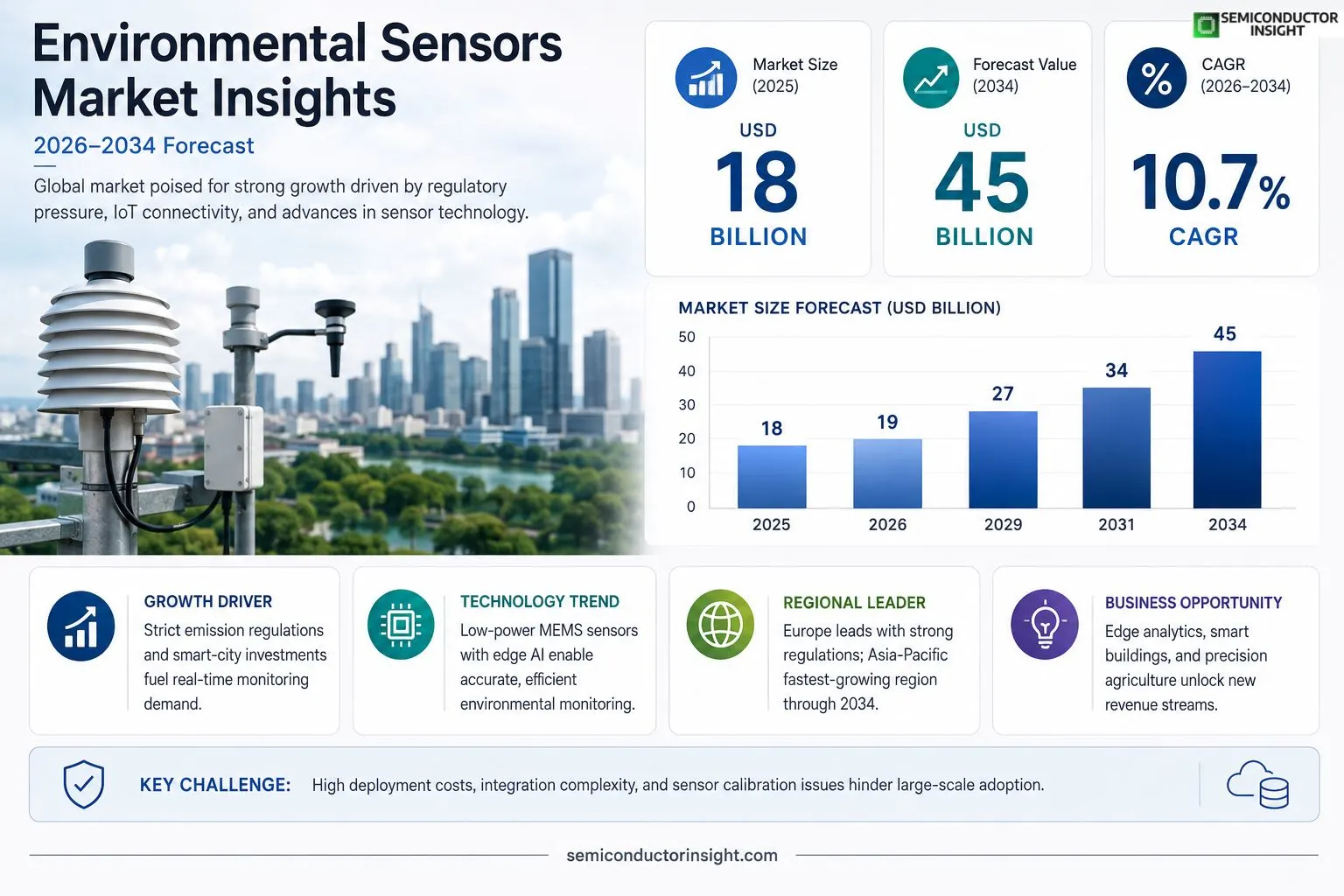
The global environmental sensors market size was valued at USD 18 billion in 2025. The market is projected to grow from USD 19 billion in 2026 to USD 45 billion by 2034, exhibiting a CAGR of 10.7% during the forecast period.
Environmental sensors are devices that detect physical, chemical or biological parameters such as temperature, humidity, air quality, gas concentration, radiation or particulate matter, converting them into measurable electrical signals for monitoring and control applications across industrial, automotive, smart‑city and consumer sectors.The market is experiencing rapid expansion because regulatory pressure on emissions, heightened awareness of climate change impacts and the proliferation of IoT connectivity are driving demand for real‑time monitoring solutions.
Furthermore, advances in low‑power MEMS technology and edge‑computing integration are reducing costs while improving accuracy.
Key players such as Siemens AG, Honeywell International Inc., Bosch Sensortec GmbH and Texas Instruments Incorporated are accelerating innovation through strategic partnerships and new product launches,for example, Bosch’s introduction of the SCD40 CO₂ sensor series in March 2024 underscores the focus on indoor‑air‑quality solutions.
MARKET DRIVERS
Rising Demand for Real‑Time Air Quality Monitoring
Environmental Sensors Market is being propelled by stricter government regulations on air pollution and the growing need for real‑time data in smart‑city initiatives. Municipalities are investing heavily in sensor networks to comply with emission standards, which creates a steady pipeline of contracts for manufacturers.
Industrial Automation and Safety Requirements
Manufacturers in chemicals, oil & gas, and food processing are integrating environmental sensors to meet occupational safety mandates. The push toward predictive maintenance further fuels adoption, as sensors provide early warnings of hazardous conditions, reducing downtime and liability.
➤ Companies that bundle sensors with cloud analytics platforms report up to 30% faster decision cycles for clients.
In addition, the expansion of IoT ecosystems across sectors creates cross‑selling opportunities, allowing sensor providers to leverage existing connectivity solutions and accelerate market penetration.
MARKET CHALLENGES
High Capital Expenditure for Large‑Scale Deployments
Deploying dense sensor networks requires significant upfront investment in hardware, installation, and calibration. This barrier is especially pronounced for small and mid‑size municipalities with limited budgets, slowing the overall rollout pace.
Other Challenges
Data Integration Complexity
Integrating sensor outputs with legacy SCADA systems and enterprise resource planning tools often demands custom middleware, increasing project timelines and costs.Moreover, limited interoperability standards across vendors can lead to fragmented data architectures, making it difficult for end‑users to achieve a unified view of environmental conditions.
MARKET RESTRAINTS
Sensor Calibration and Accuracy Issues
Maintaining calibration across thousands of deployed units is a logistical challenge. Drift in sensor accuracy can compromise data integrity, prompting regulators to demand more frequent verification and adding to operational costs.Furthermore, harsh environmental conditions,such as extreme temperatures, humidity, and corrosive gases,can degrade sensor performance, limiting their lifespan and driving higher replacement rates.These technical restraints raise the total cost of ownership, potentially deterring adoption in cost‑sensitive sectors.
MARKET OPPORTUNITIES
Growth of Edge‑Computing and AI Analytics
Embedding AI algorithms at the edge enables real‑time anomaly detection and predictive analytics, opening new revenue streams for sensor manufacturers that offer integrated hardware‑software solutions.
Emerging Applications in Agriculture and Renewable Energy
Precision agriculture increasingly relies on soil moisture, temperature, and gas sensors to optimize inputs, while renewable energy farms use environmental sensors to maximize yield and safety. Both sectors present untapped growth potential for Environmental Sensors Market.Strategic partnerships with cloud service providers and telecom operators can further accelerate market expansion by delivering seamless connectivity and data management services to end‑users.
Environmental Sensors Market Trends
Regulatory Drivers and IoT Integration
Environmental Sensors Market is being reshaped by tightening emission standards across Europe, North America and Asia‑Pacific. Governments are mandating continuous monitoring of air quality and industrial effluents, which compels manufacturers to embed certified sensors in process control systems. At the same time, the rapid expansion of IoT networks provides the connectivity backbone that allows real‑time data transmission from field devices to cloud analytics platforms. This convergence of policy pressure and ubiquitous connectivity creates a sustained demand for high‑reliability sensors that can operate with minimal latency and power consumption.
Other Trends
Advancements in MEMS Technology
Micro‑electromechanical systems (MEMS) have become the cornerstone of Environmental Sensors Market because they deliver precise measurements while consuming only microwatts of power. Recent low‑power MEMS designs incorporate on‑chip temperature compensation, which improves accuracy in harsh environments without the need for external calibration hardware. These technical gains are lowering the total cost of ownership for end users, encouraging wider adoption in automotive exhaust monitoring and portable personal exposure devices.
Edge Computing and Smart‑City Applications
Edge computing is increasingly embedded within sensor nodes to preprocess data before it reaches central servers. By performing noise filtering and threshold analysis at the edge, Environmental Sensors Market supports faster response times for smart‑city initiatives such as traffic‑related air quality alerts and adaptive ventilation in public buildings. Companies like Bosch Sensortec have introduced sensor modules that include built‑in AI inference engines, enabling on‑device decision‑making for indoor‑air‑quality control. This trend reduces bandwidth demand and enhances data privacy, which aligns with emerging regulations on data handling.
COMPETITIVE LANDSCAPEKey Industry Players
Environmental Sensors Market: Competitive Overview
Environmental Sensors Market is increasingly dominated by a handful of large, diversified technology firms that leverage deep R&D capabilities and global distribution networks. Siemens AG leads with its integrated air‑quality and industrial monitoring portfolio, while Honeywell International Inc. commands a broad suite of gas‑detection and humidity sensors that serve aerospace, automotive, and smart‑city projects. Bosch Sensortec GmbH has gained recognition for low‑power MEMS solutions, exemplified by the recent launch of the SCD40 CO₂ sensor series, which targets indoor‑air‑quality applications. Texas Instruments Incorporated complements this landscape by providing precision analog front‑ends and micro‑controller‑embedded sensor platforms that enable edge‑computing deployments across the IoT ecosystem. Collectively, these leaders shape market structure through strategic partnerships, high‑volume manufacturing, and continuous innovation, driving the projected CAGR of 10.7 % toward a $45 billion valuation by 2034.Beyond the tier‑one giants, a robust cohort of niche specialists contributes critical differentiation in sensor technology. Sensirion AG offers high‑accuracy humidity and temperature modules widely adopted in automotive climate control. AMS AG focuses on optical gas‑sensing ICs for environmental monitoring. STMicroelectronics supplies a comprehensive range of MEMS pressure and motion sensors that support wearable and industrial applications. TE Connectivity provides rugged, aerospace‑grade sensing elements for harsh environments. Additional innovators such as Figaro Engineering Inc., NXP Semiconductors, Analog Devices, Murata Manufacturing, and TDK play essential roles in delivering specialized solutions for niche market segments, reinforcing a competitive ecosystem that balances scale with specialization.
List of Key Environmental Sensors Companies Profiled
- Siemens AG
- Honeywell International Inc.
- Bosch Sensortec GmbH
- Texas Instruments Incorporated
- Sensirion AG
- AMS AG
- STMicroelectronics
- TE Connectivity
- Figaro Engineering Inc.
- NXP Semiconductors
- Analog Devices
- Murata Manufacturing Co., Ltd.
- TDK Corporation
Segment Analysis:
| Segment Category | Sub-Segments | Key Insights |
| By Type |
|
Air‑Quality Sensors
|
| By Application |
|
Smart‑Building Management
|
| By End User |
|
Smart‑City Authorities
|
| By Technology |
|
MEMS‑Based Sensors
|
| By Deployment |
|
Wireless Mesh Networks
|
Regional Analysis: North America
United States
The air quality monitoring segment in the United States is witnessing substantial growth, propelled by rising levels of pollution in urban areas and increased focus on public health. This includes deployment of sensors for particulate matter, ozone, nitrogen dioxide, and sulfur dioxide, essential for identifying pollution hotspots and public health risks.
With growing concerns about water scarcity and contamination, water quality assessment is a critical application area. Sensors used for monitoring parameters like pH, dissolved oxygen, turbidity, and heavy metals are increasingly deployed in rivers, lakes, and groundwater sources. Stringent regulations surrounding water discharge are a key driver for this segment.
Industries across the United States are increasingly adopting environmental sensors to ensure regulatory compliance and optimize operational efficiency. This involves monitoring emissions, wastewater discharge, and soil contamination to meet environmental standards and minimize environmental impact.
The agricultural sector utilizes environmental sensors for precision farming techniques, enabling optimized irrigation, fertilization, and pest control. Sensors monitor soil moisture, temperature, humidity, and nutrient levels to improve crop yields and reduce resource waste.
Europe
The European market for environmental sensors is characterized by a strong regulatory landscape and a high degree of environmental consciousness. Driven by the European Green Deal and stringent EU directives on emissions and resource management, the demand for these sensors is steadily increasing. Key applications include monitoring air and water quality, industrial emissions, and noise pollution. The market is particularly focused on energy efficiency and sustainable development, with a strong emphasis on smart city initiatives and circular economy models. Germany, France, and the UK are leading markets within Europe, with a significant number of research and development activities focused on innovative sensor technologies.
Asia-Pacific
The Asia-Pacific region presents a rapidly expanding market for environmental sensors, driven by rapid industrialization, urbanization, and increasing environmental concerns. Countries like China, India, and Japan are witnessing significant investments in environmental monitoring infrastructure. Key applications include air quality monitoring in heavily polluted urban areas, water quality assessment in rapidly developing regions, and industrial emissions control. Government initiatives focusing on sustainable development and pollution reduction are further fueling market growth. The adoption of IoT technologies is also accelerating in this region, facilitating real-time data collection and remote monitoring across diverse geographical locations.
South America
South America’s environmental sensor market is growing steadily, driven by increasing awareness of deforestation, pollution, and climate change impacts. Brazil, Argentina, and Chile are key markets, with a focus on monitoring deforestation in the Amazon rainforest, water quality in rivers and wetlands, and air quality in urban areas. Government initiatives promoting sustainable development and environmental protection are driving market demand. The agricultural sector is also a significant driver, with sensors used for precision farming and monitoring soil conditions.
Middle East & Africa
The Middle East and Africa represent a relatively nascent but rapidly growing market for environmental sensors. Increasing concerns about water scarcity, air pollution, and industrial emissions are driving demand. Countries like Saudi Arabia, UAE, and South Africa are witnessing significant investments in environmental monitoring infrastructure. Key applications include monitoring air quality in urban areas, water scarcity management in arid regions, and industrial emissions control. Government initiatives focusing on sustainable development and environmental protection are accelerating market growth.
Report Scope
This market research report provides a comprehensive analysis of the Environmental Sensors Market , covering the forecast period 2026–2034. It offers detailed insights into market dynamics, technological advancements, competitive landscape, and key trends shaping the industry.
Key focus areas of the report include:
- Market Overview: The report begins with an overview outlining its current market scenario, key growth indicators, and industry transformation drivers. It discusses macroeconomic factors, demand–supply balance, regulatory landscape, and the strategic role of semiconductors in powering advancements across industries such as automotive, telecommunications, consumer electronics, and industrial automation.
- Market Size & Forecast: Historical data and future projections for revenue, unit shipments, and market value across major regions and segments.
- Segmentation Analysis: Detailed breakdown by product type, technology, application, and end-user industry to identify high-growth segments and investment opportunities.
- Regional Insights: Insights into market performance across North America, Europe, Asia-Pacific, Latin America, and the Middle East & Africa, including country-level analysis where relevant.
- Competitive Landscape: Profiles of leading market participants, including their product offerings, R&D focus, manufacturing capacity, pricing strategies, and recent developments such as mergers, acquisitions, and partnerships.
- Technology Trends & Innovation: Assessment of emerging technologies, integration of AI/IoT, semiconductor design trends, fabrication techniques, and evolving industry standards.
- Market Drivers & Restraints: Evaluation of factors driving market growth along with challenges, supply chain constraints, regulatory issues, and market-entry barriers.
- Stakeholder Insights: Insights for component suppliers, OEMs, system integrators, investors, and policymakers regarding the evolving ecosystem and strategic opportunities.
Primary and secondary research methods are employed, including interviews with industry experts, data from verified sources, and real-time market intelligence to ensure the accuracy and reliability of the insights presented.
FREQUENTLY ASKED QUESTIONS:
What is the current market size of Environmental Sensors Market?
-> Environmental Sensors Market was valued at USD 18 billion in 2025 and is expected to reach USD 45 billion by 2034.
Which key companies operate in Environmental Sensors Market?
-> Key players include Siemens AG, Honeywell International Inc., Bosch Sensortec GmbH, and Texas Instruments Incorporated, among others.
What are the key growth drivers?
-> Key growth drivers include regulatory pressure on emissions, heightened climate‑change awareness, proliferation of IoT connectivity, advances in low‑power MEMS technology, and edge‑computing integration.
Which region dominates the market?
-> Europe holds a strong market share, while Asia‑Pacific is emerging as the fastest‑growing region driven by industrialization and smart‑city initiatives.
What are the emerging trends?
-> Emerging trends include integration of AI and IoT for smart monitoring, development of low‑power MEMS sensors, edge‑computing solutions, and indoor‑air‑quality sensor innovations such as CO₂ sensing series.

Get Sample Report PDF for Exclusive Insights
Report Sample Includes
- Table of Contents
- List of Tables & Figures
- Charts, Research Methodology, and more...