Market Insights
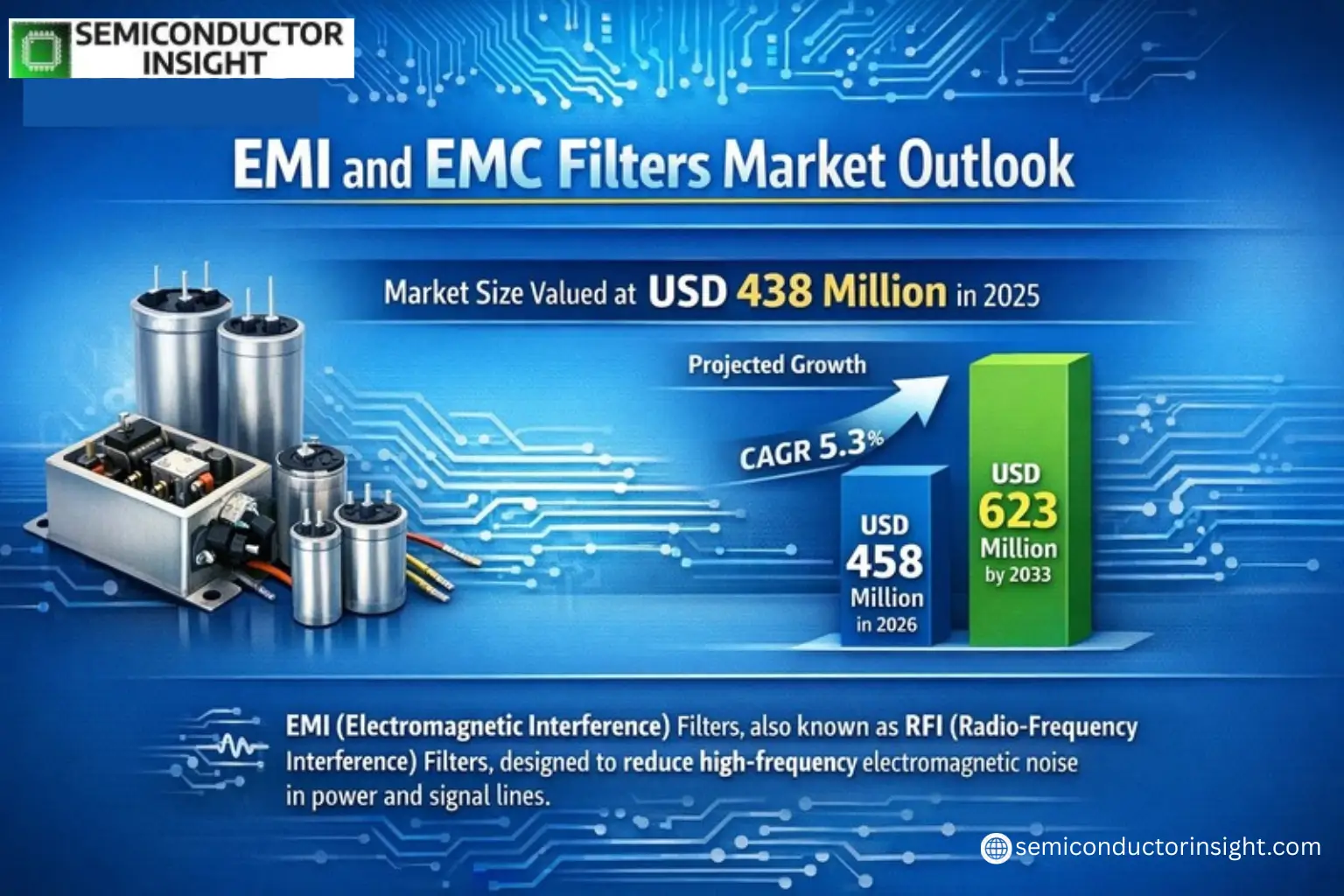
Global EMI and EMC Filters Market size was valued at USD 438 million in 2025. The market is projected to grow from USD 458 million in 2026 to USD 623 million by 2033, exhibiting a CAGR of 5.3% during the forecast period.
EMI (electromagnetic interference) filters, also known as RFI (radio-frequency interference) filters, are electrical devices designed to mitigate high-frequency electromagnetic noise present in power and signal lines. This noise, typically ranging from 9 kHz to 10 GHz, originates from various electronic devices such as motors, power supplies, inverters, and microprocessors. Without proper filtering, this interference can degrade signal transmission and impair the performance of electronic equipment. EMC (electromagnetic compatibility) filters ensure that devices operate without causing or being affected by electromagnetic disturbances.
The market growth is driven by increasing demand for electronic devices across industries like automotive, telecommunications, and consumer electronics. Stringent regulatory standards for electromagnetic compatibility further propel adoption. Key players such as Schaffner, TDK, and TE Connectivity dominate the market with a combined share of approximately 50%. The Asia-Pacific region leads with over 40% market share due to rapid industrialization.
MARKET DRIVERS
Rising Demand for Electromagnetic Compatibility Solutions
EMI and EMC Filters Market is witnessing significant growth driven by the increasing need for electromagnetic interference mitigation in electronic devices. Stringent regulatory standards across industries such as automotive, healthcare, and telecommunications are accelerating adoption. The market is projected to grow at a CAGR of 6.8% from 2023 to 2030.
Expansion of 5G Infrastructure
Widespread 5G deployment is creating substantial demand for advanced EMI and EMC Filters to maintain signal integrity. The growing complexity of electronic systems in base stations and IoT devices requires robust filtering solutions to prevent cross-frequency interference.
Emerging technologies like electric vehicles and renewable energy systems are further propelling market growth, with automotive applications expected to dominate revenue share through 2028.
MARKET CHALLENGES
High Development Costs for Custom Solutions
Designing application-specific EMI and EMC Filters for complex systems requires substantial R&D investment. Small and medium enterprises face difficulty competing with established players due to technical expertise requirements.
Other Challenges
Miniaturization Demands
Shrinking electronic components create engineering challenges for maintaining filter effectiveness while reducing physical footprint. The market requires continuous innovation to meet space constraints in modern devices.
MARKET RESTRAINTS
Supply Chain Disruptions Impacting Component Availability
EMI and EMC Filters Market faces constraints from global semiconductor shortages and raw material price volatility. Lead times for specialized filtering components have extended by 15-20% compared to pre-pandemic levels, affecting production schedules.
MARKET OPPORTUNITIES
Growth in Aerospace and Defense Applications
Increasing defense budgets worldwide are creating opportunities for high-performance EMI and EMC Filters in radar systems, avionics, and military communications. The sector is expected to grow at 8.2% CAGR through 2029, with North America leading regional adoption.
Smart Grid Infrastructure Development
Government investments in power grid modernization are driving demand for EMI/EMC solutions in smart meters, transformers, and renewable energy integration systems. Asia-Pacific represents the fastest-growing regional market, with China accounting for 42% of regional revenue.
EMI and EMC Filters Market Trends
Growth Projections and Key Market Segments
Global EMI and EMC Filters Market reached USD 438 million in 2025 and is projected to grow to USD 623 million by 2033, registering a CAGR of 5.3%. The Asia-Pacific region currently dominates with over 40% market share, followed by the Americas and Europe. Single-phase filters account for 60% of the market, with three-phase filters comprising the remaining 40%. Key applications include consumer electronics, automotive, and industrial automation sectors.
Other Trends
Regulatory Compliance Driving Innovation
Stringent EMC standards worldwide are compelling manufacturers to develop advanced filtering solutions. The increasing complexity of regulations across different regions adds design challenges but also creates opportunities for companies specializing in compliance-specific filters. Medical and military applications show particularly strict requirements for electromagnetic compatibility.
Technological Advancements Shaping Future Demand
Emerging technologies like 5G networks, electric vehicles, and renewable energy systems are creating new demand for specialized EMI/EMC filters. The automotive sector is experiencing particularly strong growth due to increasing electronic components in vehicles. Compact filter designs are becoming crucial as electronic devices continue to shrink in size while maintaining performance requirements.
Other Trends
Supply Chain and Competitive Landscape
The top five manufacturers hold approximately 50% of the global market share, with Schaffner, TDK, and TE Connectivity being key players. Tariff policies and regional economic conditions continue to impact supply chains, with some manufacturers shifting production to mitigate costs. The market shows resilience despite economic fluctuations, particularly in sectors like telecommunications and industrial automation.
COMPETITIVE LANDSCAPE
Key Industry Players
Global EMI and EMC Filters Market Dominated by Top 5 Players Holding 50% Share
Global EMI and EMC Filters Market features a consolidated competitive landscape, with Schaffner, TDK, Astrodyne TDI, TE Connectivity, and Schurter collectively commanding approximately 50% market share. These established players dominate due to their extensive product portfolios, strong R&D capabilities, and global distribution networks. Schaffner leads the market with its broad range of industrial-grade filters, while TDK leverages its expertise in electronic components to offer specialized solutions. The market structure shows tiered competition, with multinational corporations serving global OEMs and smaller regional players catering to niche applications.
Beyond the top five, numerous specialized manufacturers compete in specific segments. Spectrum Control focuses on high-reliability military/aerospace applications, while Delta Electronics and Enerdoor excel in power electronics filtration. The APAC region, contributing over 40% of global demand, has seen the emergence of competitive local players like Jianli Electronic and Yunpen Electronic offering cost-competitive alternatives. Recent years have witnessed strategic acquisitions, such as YAGEO’s purchase of KEMET, to strengthen market positions in automotive and industrial filtration segments.
List of Key EMI and EMC Filters Companies Profiled
- Schaffner
- TDK Corporation
- Astrodyne TDI
- TE Connectivity
- Schurter
- Spectrum Control
- COSEL
- Exxelia
- BLOCK Transformatoren-Elektronik
- Roxburgh EMC (DEM Manufacturing)
- Delta Electronics
- Curtis Industries
- Murrelektronik
- Ohmite Mfg Co
- Enerdoor
Segment Analysis:
| Segment Category | Sub-Segments | Key Insights |
| By Type |
|
Single Phase EMI/EMC Filters dominate the market due to their widespread use in consumer electronics and small appliances.
|
| By Application |
|
Automotive sector shows the strongest growth potential in EMI/EMC filter applications.
|
| By End User |
|
OEM segment represents the primary demand source for EMI/EMC filters.
|
| By Filter Design |
|
Modular filter designs are gaining significant market traction.
|
| By Technology |
|
Hybrid filter technology emerges as the most innovative solution.
|
Regional Analysis: Global EMI and EMC Filters Market
Rising factory automation across manufacturing sectors accelerates EMI filter deployment in Asia-Pacific. The need for interference-free operation of sensitive equipment in smart factories is driving premium filter solutions adoption.
Electric vehicle charging stations and battery management systems require robust EMC protection. China’s aggressive EV adoption policies are creating substantial demand for automotive-grade filters in the region.
5G rollout across Asian markets necessitates advanced EMI filtering for base stations and network equipment. Japan and South Korea lead in developing filters capable of handling higher frequency ranges.
Increasing healthcare investments are driving requirements for EMC-compliant medical devices. The region sees growing adoption of filters in diagnostic imaging and patient monitoring systems.
North America
The North American EMI and EMC Filters Market benefits from stringent regulatory standards and defense sector requirements. The U.S. maintains strong demand across aerospace, telecommunications, and healthcare verticals, with emphasis on high-reliability solutions. Canada shows growing adoption in renewable energy applications. Regional manufacturers focus on customized filter designs for critical infrastructure protection. The presence of major automotive OEMs and focus on vehicle electrification create additional growth avenues.
Europe
Europe maintains a technology leadership position in EMI and EMC filtration with strong emphasis on energy efficiency and sustainability. Germany leads industrial filter applications, while Nordic countries drive innovations for renewable energy systems. Strict EU directives on electromagnetic compatibility continue to shape market requirements. The automotive sector accounts for significant filter consumption, particularly for electric and hybrid vehicles entering mass production.
South America
South America’s EMI and EMC Filters Market is growing steadily, primarily driven by industrial modernization in Brazil and Argentina. Power infrastructure projects and expanding manufacturing bases create demand for basic to mid-range filtration solutions. The region shows potential in automotive and mining applications, though adoption rates lag behind developed markets due to cost sensitivity.
Middle East & Africa
The MEA region presents emerging opportunities in EMI and EMC filtration, led by infrastructure development in Gulf countries. Oil & gas applications dominate current demand, while smart city initiatives are creating new application areas. South Africa serves as the manufacturing and technology hub, with growing capabilities in producing standard filter solutions for regional markets.
Report Scope
This market research report provides a comprehensive analysis of the EMI and EMC Filters Market, covering the forecast period 2026–2033. It offers detailed insights into market dynamics, technological advancements, competitive landscape, and key trends shaping the industry.
Key focus areas of the report include:
- Market Overview: The report begins with an overview outlining its current market scenario, key growth indicators, and industry transformation drivers. It discusses macroeconomic factors, demand–supply balance, regulatory landscape, and the strategic role of EMI/EMC filters across industries such as automotive, telecommunications, consumer electronics, and industrial automation.
- Market Size & Forecast: Historical data and future projections for revenue, unit shipments, and market value across major regions and segments.
- Segmentation Analysis: Detailed breakdown by product type, technology, application, and end-user industry to identify high-growth segments and investment opportunities.
- Regional Insights: Insights into market performance across North America, Europe, Asia-Pacific, Latin America, and the Middle East & Africa, including country-level analysis where relevant.
- Competitive Landscape: Profiles of leading market participants, including their product offerings, R&D focus, manufacturing capacity, pricing strategies, and recent developments such as mergers, acquisitions, and partnerships.
- Technology Trends & Innovation: Assessment of emerging technologies, integration of AI/IoT, filter design trends, fabrication techniques, and evolving industry standards.
- Market Drivers & Restraints: Evaluation of factors driving market growth along with challenges, supply chain constraints, regulatory issues, and market-entry barriers.
- Stakeholder Insights: Insights for component suppliers, OEMs, system integrators, investors, and policymakers regarding the evolving ecosystem and strategic opportunities.
Primary and secondary research methods are employed, including interviews with industry experts, data from verified sources, and real-time market intelligence to ensure the accuracy and reliability of the insights presented.
FREQUENTLY ASKED QUESTIONS:
What is the current market size of EMI and EMC Filters Market?
-> EMI and EMC Filters Market size was valued at USD 438 million in 2025. The market is projected to grow from USD 458 million in 2026 to USD 623 million by 2033, exhibiting a CAGR of 5.3% during the forecast period.
Which key companies operate in EMI and EMC Filters Market?
-> Key players include Schaffner, TE Connectivity, TDK, Astrodyne TDI, Schurter, among others. The top five manufacturers hold about 50% market share.
What are the key growth drivers?
-> Key growth drivers include proliferation of electronic devices, stringent regulatory standards, technological advancements (5G, EVs), and miniaturization trends.
Which region dominates the market?
-> APAC is the largest market with over 40% share, followed by Americas and Europe.
What are the emerging trends?
-> Emerging trends include advanced filter materials, compact filter designs, and integration with next-gen technologies like IoT and renewable energy systems.

Get Sample Report PDF for Exclusive Insights
Report Sample Includes
- Table of Contents
- List of Tables & Figures
- Charts, Research Methodology, and more...
 Download Sample Report PDF