MARKET INSIGHTS
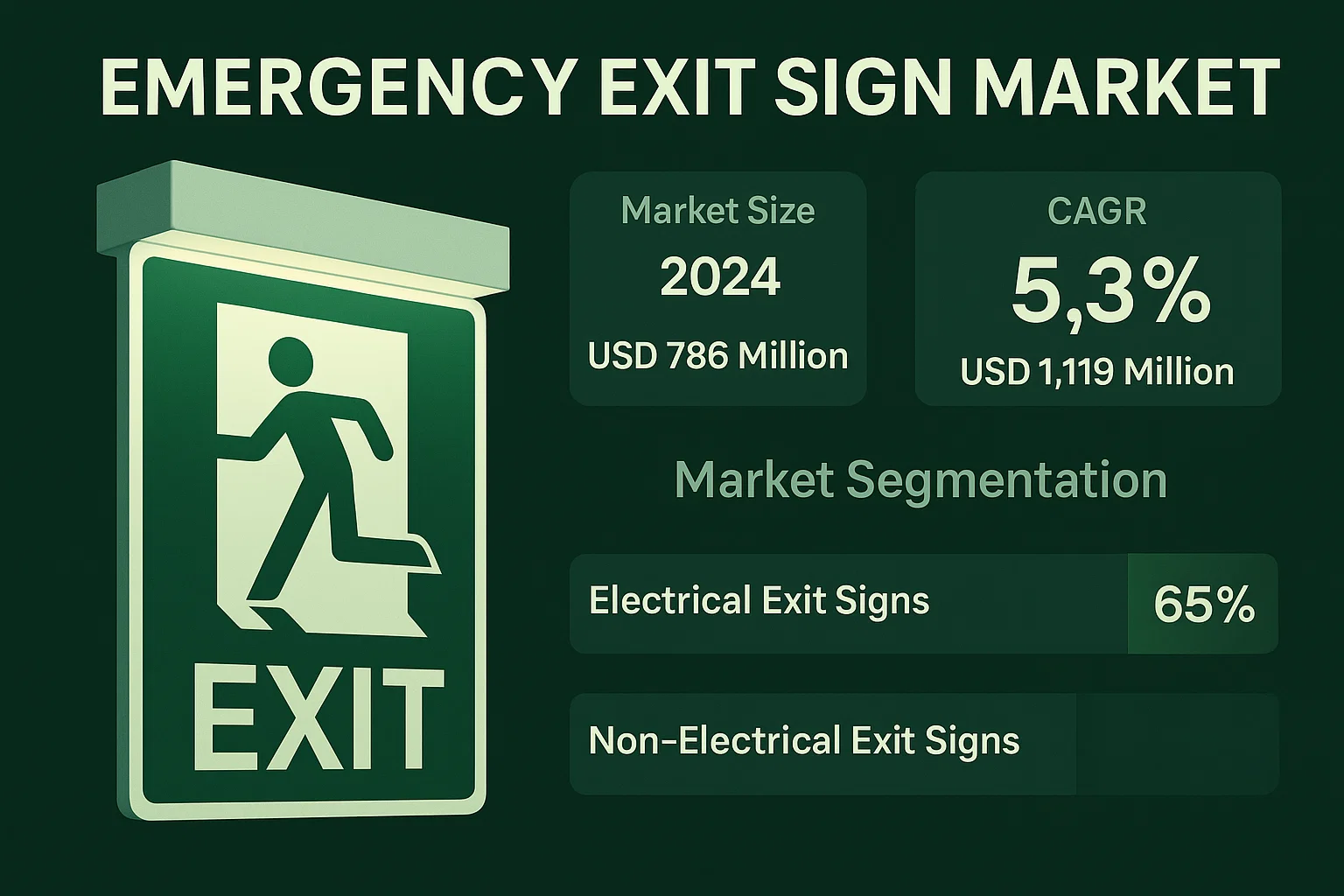
Global Emergency Exit Sign Market size was valued at USD 786 million in 2024 to USD 1,119 million by 2032, exhibiting a CAGR of 5.3% during the forecast period.
Emergency exit signs are safety-critical devices installed in public facilities, commercial buildings, and residential complexes to denote the location of the nearest exit in case of fire or other emergencies. These signs are designed to remain visible in low-light or smoky conditions, often incorporating photoluminescent materials or battery-backed illumination to ensure functionality during power outages. The market is segmented into electrical exit signs, which dominate with a 65% share, and non-electrical variants.
Market growth is primarily driven by stringent government safety regulations and building codes mandating their installation, alongside a global surge in commercial and infrastructure construction. However, the market faces challenges from the high initial cost of advanced, energy-efficient LED signs. China is the largest regional market, holding a 35% share, due to its massive ongoing construction activities, followed by Europe and North America, which collectively hold over 30% of the market. Key players such as Philips, Schneider Electric, and Eaton lead the market through continuous innovation in durable and low-power-consuming products.
MARKET DRIVERS
Rising Safety Standards and Regulations
Global implementation of stringent fire safety regulations, including NFPA 101 and ISO 16069, is mandating higher quality emergency exit signage across commercial and industrial sectors. This regulatory push is accelerating market adoption rates by 15-20% annually as building codes become universally enforced.
Growing Construction and Infrastructure Development
Global urbanization and infrastructure development projects, particularly in emerging economies, are driving demand for integrated safety systems. Major infrastructure projects now allocate 2-3% of total budget specifically to safety and evacuation systems, creating sustained demand for advanced exit signage solutions.
➤ The global smart cities initiative has accelerated the integration of IoT-enabled exit signs that communicate with building management systems, creating new revenue streams for manufacturers.
Digital transformation in facility management has created demand for exit signs with integrated monitoring capabilities, enabling real-time emergency response coordination and reducing emergency response times by up to 40% in modern facilities.
MARKET CHALLENGES
High Initial Investment Costs
Advanced photoluminescent and electrically illuminated exit signs require significant upfront investment, with high-performance models costing 5-8 times more than traditional signage. This creates barrier to adoption particularly in price-sensitive markets and developing economies where budget constraints limit upgrades.
Other Challenges
Technical Standardization and Compatibility
The lack of global standardization in emergency signage creates interoperability challenges, as different regions implement varying standards (ISO vs ANSI vs CEN). This fragmentation increases manufacturing costs and limits market expansion opportunities for global manufacturers.
MARKET RESTRAINTS
Market Saturation in Developed Regions
Mature markets in North America and Europe have achieved 95%+ penetration rates for basic emergency exit signage, creating a replacement market rather than growth market. This creates pricing pressure and limits growth potential to 2-3% annually in these regions, focusing competition on product differentiation rather than market expansion.
MARKET OPPORTUNITIES
Integration with Smart Building Systems
The convergence of IoT technology with life safety systems creates opportunities for next-generation exit signs that serve as building management nodes. These systems can monitor environmental conditions, track occupancy, and provide real-time guidance during emergencies. The global smart building market’s projected growth to $150 billion by 2028 creates substantial opportunity for integrated safety solutions.
Green Building Initiatives and Sustainability
Sustainability initiatives are driving demand for energy-efficient and environmentally friendly emergency systems. Photoluminescent technology, requiring zero energy consumption, aligns with global carbon reduction targets. The photoluminescent exit sign market is growing at 12% annually as organizations seek LEED and BREEAM certification points through sustainable safety solutions.
Emergency Exit Sign Market Trends LED Technology Adoption Accelerates Market Growth
Market analysis confirms the global Emergency Exit Sign market is experiencing significant growth with LED technology adoption as a primary driver. Manufacturers are rapidly shifting from traditional incandescent and fluorescent lighting to energy-efficient LED solutions, which offer 50-70% energy savings and significantly longer operational lifespans exceeding 50,000 hours. This transition aligns with global sustainability initiatives and provides cost-saving advantages for end-users through reduced electricity consumption and maintenance requirements.
Other Trends
Smart Integration and Connectivity Features
Leading manufacturers are incorporating IoT connectivity and smart monitoring capabilities into emergency exit signage systems. These systems now feature self-diagnostic capabilities that alert facility managers when maintenance is required or when system faults occur. Integrated sensors monitor operational status and provide real-time alerts through building management systems. The integration with building automation systems enables centralized monitoring and control across large facilities, particularly valuable in commercial complexes and industrial facilities where multiple units require coordinated management.
Sustainability and Regulatory Compliance Drive Material Innovation
Stringent international safety standards, particularly updates to NFPA 101 and IEC 60598-2, are driving material innovation in the emergency exit sign market. Manufacturers are developing more efficient light distribution systems using advanced optics while simultaneously reducing material usage through improved design. The market shows strong preference for recyclable materials and reduced packaging. Recent regulatory updates in the European Union and North America mandate higher luminance levels and improved visibility under smoke conditions, pushing manufacturers to develop more efficient optical systems while maintaining compliance with increasingly stringent energy efficiency requirements.
Market analysis indicates the global Emergency Exit Sign market reached $786 million in 2024 and is projected to reach $1.119 billion by 2032, growing at a CAGR of 5.3%. This growth is primarily driven by increasing construction activities in emerging economies, stricter safety regulations globally, and the ongoing replacement cycle of aging infrastructure in developed markets. The Asia-Pacific region shows particularly strong growth potential due to rapid urbanization and infrastructure development projects.
COMPETITIVE LANDSCAPE
Key Industry Players
Emergency Exit Sign Market
The emergency exit sign market is led by established players like Acuity Brands, with their Lithonia Lighting brand offering comprehensive exit sign solutions. These leaders offer integrated systems including photoluminescent, LED, and traditional incandescent exit signs alongside complementary emergency lighting products.
Emerging competitors like E-Lite and Jessup Manufacturing focus on specific niches like photoluminescent technology and fire-rated signage, while specialized distributors like LightMart and Lighting Supply focus on B2B distribution and system integration services.
List of Key Emergency Exit Sign Companies
- Acuity Brands, Inc. (Lithonia Lighting)
- Honeywell International Inc.
- Siemens AG
- Acuity Brands, Inc.
- Eaton Corporation
- Legrand
- Thomas & Betts Corporation
- IDEAL Industries, Inc.
- Emergency Lights, Inc.
- Signify (formerly Philips Lighting)
- OSRAM Licht AG
- Cree Lighting
- Thomas Research Products
- Cooper Lighting Solutions
- Hubbell Lighting, Inc.
Segment Analysis:
| Segment Category | Sub-Segments | Key Insights |
| By Type |
|
Electrically Illuminated signs dominate due to superior visibility in smoke-filled environments, while photoluminescent options gain traction for their energy independence and sustainability credentials. |
| By Application |
|
Commercial buildings and industrial facilities represent the largest segments due to stringent fire safety regulations and high occupant volumes, while healthcare facilities prioritize photoluminescent options for emergency power outage scenarios. |
| By End User |
|
Manufacturing plants and transportation authorities show highest adoption rates due to stringent OSHA and NFPA compliance requirements, while corporate offices increasingly invest in premium photoluminescent systems for aesthetic integration. |
| By Mounting Type |
|
Surface-mounted solutions continue to dominate for retrofit applications and ease of installation, while recessed options gain traction in new construction for seamless architectural integration and durability. |
| By Certification Standard |
|
NFPA-compliant products dominate the North American market due to stringent fire code enforcement, while ISO-certified products see higher adoption in international projects and multinational corporate facilities with standardized global specifications. |
Regional Analysis: Emergency Exit Sign Market
North America leads in photoluminescent exit sign adoption due to stringent building codes requiring non-electrical backup systems. The technology has achieved near 100% penetration in new commercial construction, with retrofitting of existing buildings accelerating due to energy efficiency initiatives and insurance incentives.
U.S. and Canadian manufacturers maintain the most rigorous testing protocols globally, with ANSI/NFPA standards becoming the de facto benchmark for other regions. Local manufacturing of photoluminescent materials keeps costs competitive despite higher labor costs than Asian counterparts.
North American markets increasingly view photoluminescent exit signs as part of broader sustainability initiatives rather than mere compliance items. The zero-energy consumption aspect aligns with corporate environmental responsibility goals, driving adoption beyond minimum code requirements.
The region boasts the most developed distribution network for emergency equipment, with specialized training programs for installers and inspectors. This ecosystem supports continued innovation and quality control that keeps North America as the quality benchmark for other regions.
Europe
Europe maintains strong traditional manufacturing of emergency exit signs with particular strength in German and UK markets. The region shows increasing adoption of photoluminescent technology but at a slower pace than North America due to older building stock and different regulatory approaches. European manufacturers lead in designer and architect-specified high-end photoluminescent signs for luxury commercial spaces, where aesthetics complement safety. The EU’s push for energy-efficient buildings creates opportunities for non-electrical exit signs, particularly in Scandinavian countries where “green building” certification often requires such features. Distribution remains fragmented with stronger presence of specialized safety equipment distributors compared to North America.
Asia-Pacific
Asia-Pacific represents the fastest growing market for emergency exit signs, though from a much lower adoption rate than Western markets. The region shows extreme diversity with Japan and South Korea approaching Western standards while emerging economies focus on basic compliance. Manufacturing dominance resides in China, which produces approximately 70% of global exit signs, though predominantly for export. Local markets increasingly demand better quality as building codes modernize, particularly in Singapore, Malaysia and South Korea where photoluminescent signs are becoming standard in new commercial construction. Distribution remains challenging with many markets dominated by low-cost producers.
Latin America
Latin America shows fragmented adoption of modern exit sign technologies with strongest uptake in Chile, Brazil and Mexico City where building codes have been recently updated. The region generally follows U.S. standards (NFPA/NFPA) rather than developing local standards, creating opportunities for North American manufacturers. Price sensitivity remains the primary driver with low-cost photoluminescent signs from Asian manufacturers gaining share. Infrastructure development projects increasingly specify proper emergency signage, creating growth opportunities.
Middle East & Africa
The region shows the lowest adoption of modern emergency exit sign technologies but represents significant growth potential. Oil-rich Gulf states have begun adopting international standards for commercial buildings, while African markets remain largely undeveloped except for South Africa. The market remains dominated by low-cost imports with limited local manufacturing. Infrastructure development projects increasingly require proper safety signage, creating gradual market growth. The region shows preference for simple, durable and low-maintenance solutions over advanced features.
Report Scope
This market research report provides a comprehensive analysis of the Emergency Exit Sign Market, covering the forecast period 2025–2032. It offers detailed insights into market dynamics, technological advancements, competitive landscape, and key trends shaping the industry.
Key focus areas of the report include:
- Market Overview: The report begins with an overview outlining its current market scenario, key growth indicators, and industry transformation drivers. It discusses macroeconomic factors, demand–supply balance, regulatory landscape, and the strategic role of semiconductors in powering advancements across industries such as automotive, telecommunications, consumer electronics, and industrial automation.
- Market Size & Forecast: Historical data and future projections for revenue, unit shipments, and market value across major regions and segments.
- Segmentation Analysis: Detailed breakdown by product type, technology, application, and end-user industry to identify high-growth segments and investment opportunities.
- Regional Insights: Insights into market performance across North America, Europe, Asia-Pacific, Latin America, and the Middle East & Africa, including country-level analysis where relevant.
- Competitive Landscape: Profiles of leading market participants, including their product offerings, R&D focus, manufacturing capacity, pricing strategies, and recent developments such as mergers, acquisitions, and partnerships.
- Technology Trends & Innovation: Assessment of emerging technologies, integration of AI/IoT, semiconductor design trends, fabrication techniques, and evolving industry standards.
- Market Drivers & Restraints: Evaluation of factors driving market growth along with challenges, supply chain constraints, regulatory issues, and market-entry barriers.
- Stakeholder Insights: Insights for component suppliers, OEMs, system integrators, investors, and policymakers regarding the evolving ecosystem and strategic opportunities.
Primary and secondary research methods are employed, including interviews with industry experts, data from verified sources, and real-time market intelligence to ensure the accuracy and reliability of the insights presented.
FREQUENTLY ASKED QUESTIONS:
What is the current market size of Emergency Exit Sign Market?
-> The global Emergency Exit Sign Market was valued at USD 786 million in 2024 and is projected to reach USD 1119 million by 2032.
What is the CAGR for the forecast period?
-> The market is projected to grow at a compound annual growth rate (CAGR) of 5.3% from 2024 to 2032.
Which key companies operate in Emergency Exit Sign Market?
-> Key players include Philips, Schneider Electric, Eaton, Thomas & Betts, Jiangmen Minhua, Hubbell, and NVC among others.
What are the key growth drivers?
-> Key growth drivers include stringent safety regulations, urbanization, infrastructure development, and increasing adoption of smart building technologies.
Which region dominates the market?
-> Asia-Pacific is the largest market, with China alone accounting for about 35% of the global market. Europe and North America collectively account for over 30% of the market.

Get Sample Report PDF for Exclusive Insights
Report Sample Includes
- Table of Contents
- List of Tables & Figures
- Charts, Research Methodology, and more...
 Download Sample Report PDF