MARKET INSIGHTS
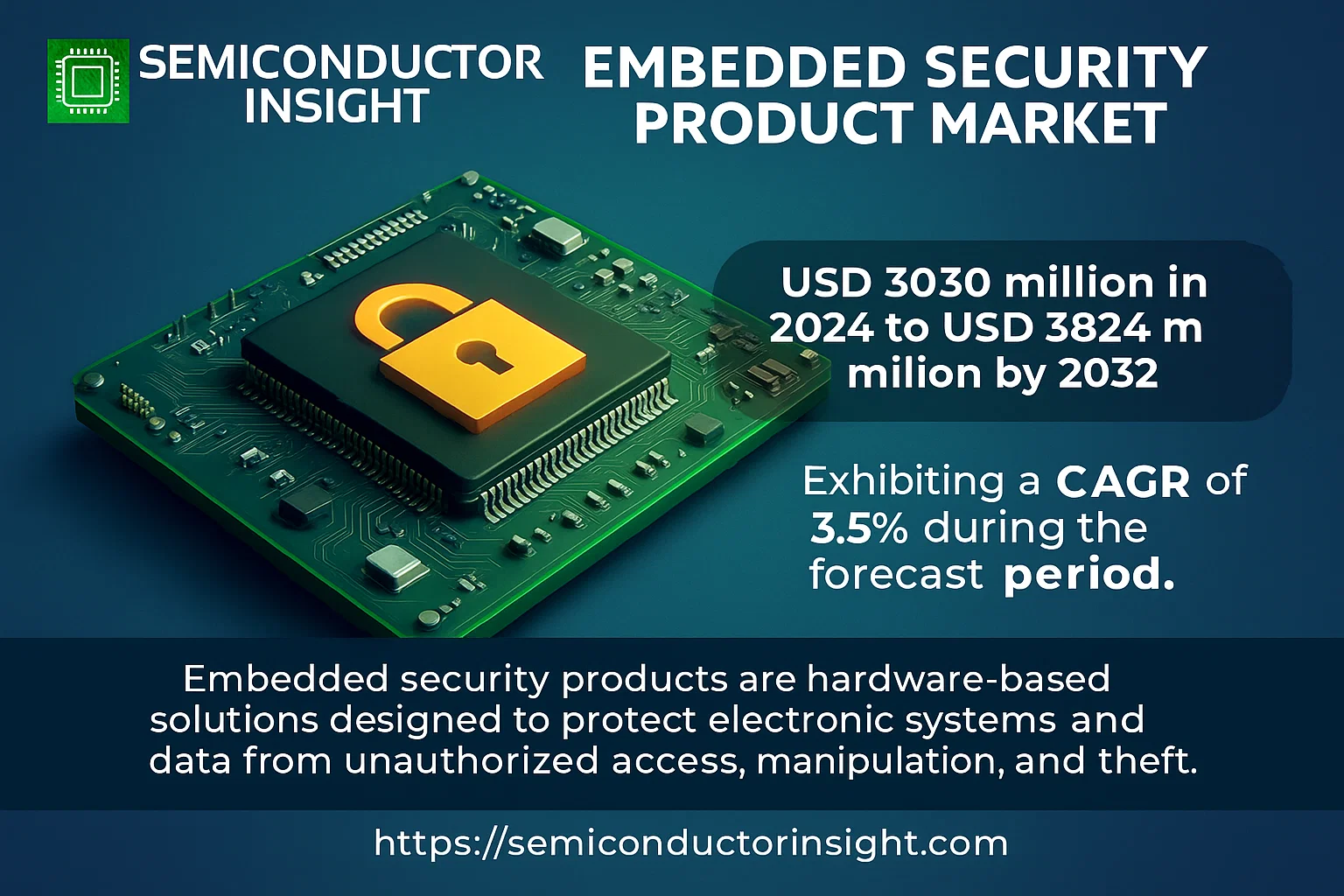
Global Embedded Security Product Market size was valued at USD 3030 million in 2024 to USD 3824 million by 2032, exhibiting a CAGR of 3.5% during the forecast period.
Embedded security products are hardware-based solutions designed to protect electronic systems and data from unauthorized access, manipulation, and theft. These components integrate directly into devices to provide a root of trust, enabling critical functions such as data encryption, secure authentication, and tamper resistance. The product landscape includes Secure Element and Embedded SIM (eSE & eSIM), Hardware Security Module (HSM), Trusted Platform Module (TPM), and Hardware Tokens.
The market is experiencing steady growth due to several factors, including the proliferation of connected IoT devices, stringent data protection regulations, and rising concerns over cyberattacks on critical infrastructure. Furthermore, the expansion of mobile payments and digital identities is contributing to market expansion. Initiatives by key players in the market are also expected to fuel growth; for instance, major semiconductor companies continuously launch new secure microcontrollers with enhanced cryptographic capabilities. NXP Semiconductors, Infineon Technologies, and STMicroelectronics are some of the key players that operate in the market with a wide range of portfolios.
MARKET DRIVERS
Proliferation of Connected Devices and IoT
The exponential growth of the Internet of Things (IoT), with projections exceeding 29 billion connected devices globally, is a primary driver. These devices, from smart home appliances to industrial sensors, require robust security solutions to protect against unauthorized access and data breaches.
Stringent Government Regulations and Standards
Increasingly stringent cybersecurity regulations, such as the EU’s Cyber Resilience Act and standards like the U.S. NIST framework, are compelling manufacturers to integrate advanced security features directly into hardware and firmware.
The surge in sophisticated cyberattacks targeting critical infrastructure and supply chains, including ransomware and state-sponsored threats, is forcing organizations to prioritize embedded security as a fundamental design principle rather than an add-on feature.
MARKET CHALLENGES
Balancing Security with Cost and Performance
A significant challenge is balancing the implementation of robust security features, which can increase production costs and potentially impact system performance (e.g., latency, power consumption), against the need for affordable and efficient end-products.
Other Challenges
Supply Chain Complexity and Hardware Vulnerabilities
The globalized nature of semiconductor manufacturing introduces vulnerabilities, as securing every stage of a complex supply chain against tampering and the insertion of counterfeit components is exceptionally difficult.
Shortage of Skilled Professionals
There is a persistent shortage of cybersecurity professionals with specialized expertise in hardware-level security, which slows down the development and deployment of advanced embedded security solutions.
MARKET RESTRAINTS
High Initial Investment and Complexity
The development and integration of advanced embedded security features, such as Hardware Security Modules (HSMs) and Root of Trust (RoT) technologies, require substantial upfront investment in R&D and specialized design expertise, which can be prohibitive for smaller manufacturers.
Fragmented Standards and Interoperability Issues
A lack of universally adopted, interoperable security standards across different industries and device types can create compatibility issues and hinder the widespread adoption of embedded security solutions.
MARKET OPPORTUNITIESExpansion in Automotive and Critical Infrastructure
The transition to connected and autonomous vehicles, along with the modernization of critical infrastructure like smart grids, represents a massive growth opportunity. These sectors demand the highest levels of security for functional safety and resilience against attacks.
Adoption of AI-Powered Security Solutions
Integrating artificial intelligence and machine learning into embedded systems for real-time threat detection and anomaly monitoring offers a significant opportunity to create more adaptive and proactive security solutions.
Growth of Secure Identity and Access Management
The increasing need for robust authentication in applications like secure payments, digital identities, and enterprise access control is driving demand for embedded security products such as secure elements and trusted platform modules.
Embedded Security Product Market Trends
Expansion Fueled by Pervasive Connectivity Concerns
Global Embedded Security Product Market is on a steady growth path, projected to increase from a valuation of 3030 million USD in 2024 to 3824 million USD by 2032, exhibiting a compound annual growth rate of 3.5%. This expansion is fundamentally driven by the escalating need to protect against identity theft, secure intellectual property, and safeguard financial transactions in an increasingly interconnected world. As systems from automobiles to the energy grid become smarter, they require robust embedded security to prevent unauthorized access and malicious attacks, creating sustained demand for products like Secure Elements and Hardware Security Modules.
Other Trends
Market Concentration and Regional Dominance
The market is characterized by a high degree of concentration, with the top three manufacturers—NXP Semiconductors, Infineon, and STMicroelectronics—collectively holding over 55% of the global market share. Geographically, the Asia-Pacific region stands as the largest market, accounting for more than 55% of global share, significantly outpacing the combined markets of Europe and North America, which together hold approximately 40%. This regional dominance is closely linked to the high volume of electronics manufacturing and the rapid adoption of connected devices and mobile payments in the region.
Segmentation Insights: Product and Application Trends
Product segmentation reveals a clear market leader: Embedded Secure Element (eSE) & Embedded SIM products command a dominant share of about 85% of the market. This underscores the critical role of these components in securing a vast array of connected devices, particularly in the Internet of Things (IoT) ecosystem. In terms of application, Mobile Secure Transactions represent the largest segment, followed by Authentication and Smart Cards. The prominence of mobile transactions highlights the consumer-driven demand for secure payment processing and data protection on smartphones and other portable devices, a trend that continues to shape product development and market strategy.
COMPETITIVE LANDSCAPE
Key Industry Players
A Market Dominated by Semiconductor Powerhouses
Global Embedded Security Product Market is characterized by a high degree of consolidation, with the top three manufacturers—NXP Semiconductors, Infineon, and STMicroelectronics—collectively commanding over 55% of the market share. This dominant position is built on their extensive portfolios of secure microcontrollers, hardware security modules, and trusted platform modules, which are critical for applications ranging from mobile secure transactions to automotive and industrial IoT. Their significant R&D investments and established relationships with major OEMs across diverse sectors create high barriers to entry, reinforcing their market leadership. The competition is largely technology-driven, focusing on enhancing chip-level security features, power efficiency, and integration capabilities to meet the evolving demands for protecting connected devices against sophisticated threats.
Beyond the dominant players, a tier of significant companies holds substantial market positions by specializing in specific niches or applications. Companies like Gemalto (now part of Thales) and IDEMIA are leaders in the embedded SIM (eSIM) and smart card security segments. Meanwhile, Microchip Technology, Renesas Electronics, and Samsung provide critical embedded security solutions for the automotive, industrial control, and consumer electronics markets. Other notable players, including Intel with its vPro platform featuring TPM, Nuvoton Technology, and regional leaders like China’s Huada Semiconductor, compete by offering cost-effective alternatives or catering to specific geographic and vertical market needs, ensuring a dynamic and competitive environment.
List of Key Embedded Security Product Companies Profiled
- NXP Semiconductors
- Infineon Technologies AG
- STMicroelectronics
- Gemalto (Thales Group)
- IDEMIA
- Microchip Technology Inc.
- Huada Semiconductor Co., Ltd.
- Maxim Integrated (Analog Devices)
- Renesas Electronics Corporation
- Samsung Electronics
- Intel Corporation
- Nuvoton Technology Corporation
Segment Analysis:
| Segment Category | Sub-Segments | Key Insights |
| By Type |
|
Secure Element and Embedded SIM leads the market due to its critical role in securing mobile transactions and IoT device identities. The foundational nature of these components for authenticating devices and protecting data in mobile phones and connected products creates immense and sustained demand. Their integration directly into device hardware provides a robust, tamper-resistant security layer that is essential for applications ranging from contactless payments to secure access control, making this segment the cornerstone of the embedded security ecosystem. |
| By Application |
|
Mobile Secure Transactions is the dominant application segment, fueled by the global expansion of digital payments, mobile banking, and e-commerce. The universal adoption of smartphones as primary devices for financial activities necessitates the highest levels of security to protect sensitive user data and prevent fraud. This application demands robust encryption and secure element technologies to ensure transaction integrity, driving continuous innovation and adoption of advanced embedded security solutions to keep pace with evolving cyber threats in the financial technology landscape. |
| By End User |
|
Consumer Electronics represents the most significant end-user segment, driven by the pervasive integration of security into smartphones, wearables, and smart home devices. The constant need to safeguard personal data, enable secure payments, and protect intellectual property within these high-volume products creates massive and consistent demand. Furthermore, the increasing connectivity of everyday devices expands the attack surface, compelling manufacturers to prioritize embedded security as a fundamental design requirement to maintain consumer trust and meet regulatory standards. |
| By Security Function |
|
Device Authentication is the leading function, serving as the first and most critical line of defense in networked systems. This function ensures that only authorized devices can connect to networks or communicate with each other, which is paramount for applications like vehicle access, industrial IoT, and secure network access. The growing sophistication of cyberattacks targeting device identities has elevated authentication from a desirable feature to an indispensable security layer, driving its central role in product development across all verticals. |
| By Integration Level |
|
Integrated into SoC/MCU is the dominant integration approach, favored for its optimal balance of performance, cost-effectiveness, and physical security. Integrating security directly into the main processor or microcontroller provides a hardened, tamper-resistant environment that is more secure than discrete components and more robust than purely software-based solutions. This trend is accelerated by the need for miniaturization in consumer electronics and the automotive industry, where space and power efficiency are critical design constraints alongside security requirements. |
Regional Analysis: Embedded Security Product Market
The market is heavily influenced by stringent government mandates and industry-specific standards in sectors like automotive, healthcare, and critical infrastructure. Regulations compel manufacturers to integrate certified security modules, creating a consistent and high-value demand for embedded security products that meet specific compliance benchmarks.
A dense network of leading universities, corporate research labs, and specialized security firms drives continuous innovation. This ecosystem focuses on next-generation threats, developing advanced solutions like hardware-based root of trust, secure boot, and tamper-resistant elements specifically for embedded systems.
Enterprises and government agencies in the region exhibit a mature understanding of cyber risks, demanding holistic security that is baked into the hardware of their IoT devices and critical systems. This pushes vendors beyond basic features towards integrated, lifecycle management of security credentials and updates.
North America hosts many of the world’s leading semiconductor companies and IP core providers. This allows for deep vertical integration of security, enabling security features to be designed directly into microcontrollers and systems-on-chip (SoCs), setting a high bar for product security from the ground up.
Europe
Europe represents a highly significant and mature market for embedded security, characterized by a strong regulatory framework spearheaded by the GDPR and upcoming legislation like the Cyber Resilience Act. This creates a compliance-driven demand for secure-by-design principles in connected products. The automotive industry, with its center of gravity in Germany, is a major adopter, mandating robust security for vehicle-to-everything (V2X) communication and electronic control units. The region also shows strong uptake in industrial IoT and smart energy applications, where functional safety and security are deeply intertwined. A collaborative approach between national cybersecurity agencies and industry bodies helps shape standards, fostering a market for certified and trusted embedded security solutions across the European Union.
Asia-Pacific
The Asia-Pacific region is the fastest-growing market for embedded security products, fueled by massive manufacturing output of consumer electronics, IoT devices, and telecommunications equipment. Countries like China, Japan, South Korea, and Taiwan are hubs for device production, where embedding security is increasingly becoming a prerequisite for global market access. While price sensitivity is high, growing awareness of cybersecurity threats and government initiatives to build secure digital infrastructure are driving adoption. The region is also witnessing significant growth in application-specific demands, such as security for automotive electronics in Japan and South Korea, and for industrial robots and smart city deployments across the region, creating diverse opportunities for embedded security vendors.
South America
The embedded security market in South America is in a developing phase, with growth primarily driven by the gradual digital transformation of key sectors like banking, telecommunications, and government services. Brazil is the largest market, where regulations for payment systems and data localization are beginning to incentivize the use of secure embedded elements in point-of-sale terminals and identification documents. The market faces challenges related to economic volatility and a less mature regulatory landscape compared to North America or Europe. However, increasing connectivity and the proliferation of mobile devices are creating a foundational need for basic hardware security features, presenting a growth trajectory for simpler, cost-effective embedded security solutions.
Middle East & Africa
The market in the Middle East & Africa is nascent but shows promising growth, particularly in the Gulf Cooperation Council (GCC) countries. Major investments in smart city projects, critical national infrastructure, and digital government services are creating demand for secure embedded systems. The oil and gas industry, a cornerstone of the regional economy, is also adopting Industrial IoT solutions that require robust embedded security for operational technology. In Africa, mobile money and fintech applications are key drivers, necessitating security in handheld devices and payment terminals. The market is characterized by project-based demand and partnerships with international technology providers to implement security standards tailored to regional priorities.
Report Scope
This market research report provides a comprehensive analysis of the Embedded Security Product Market, covering the forecast period 2025–2032. It offers detailed insights into market dynamics, technological advancements, competitive landscape, and key trends shaping the industry.
Key focus areas of the report include:
- Market Overview: The report begins with an overview outlining its current market scenario, key growth indicators, and industry transformation drivers. It discusses macroeconomic factors, demand–supply balance, regulatory landscape, and the strategic role of semiconductors in powering advancements across industries such as automotive, telecommunications, consumer electronics, and industrial automation.
- Market Size & Forecast: Historical data and future projections for revenue, unit shipments, and market value across major regions and segments.
- Segmentation Analysis: Detailed breakdown by product type, technology, application, and end-user industry to identify high-growth segments and investment opportunities.
- Regional Insights: Insights into market performance across North America, Europe, Asia-Pacific, Latin America, and the Middle East & Africa, including country-level analysis where relevant.
- Competitive Landscape: Profiles of leading market participants, including their product offerings, R&D focus, manufacturing capacity, pricing strategies, and recent developments such as mergers, acquisitions, and partnerships.
- Technology Trends & Innovation: Assessment of emerging technologies, integration of AI/IoT, semiconductor design trends, fabrication techniques, and evolving industry standards.
- Market Drivers & Restraints: Evaluation of factors driving market growth along with challenges, supply chain constraints, regulatory issues, and market-entry barriers.
- Stakeholder Insights: Insights for component suppliers, OEMs, system integrators, investors, and policymakers regarding the evolving ecosystem and strategic opportunities.
Primary and secondary research methods are employed, including interviews with industry experts, data from verified sources, and real-time market intelligence to ensure the accuracy and reliability of the insights presented.
FREQUENTLY ASKED QUESTIONS:
What is the current market size of Embedded Security Product Market?
-> Embedded Security Product Market size was valued at USD 3030 million in 2024 to USD 3824 million by 2032, exhibiting a CAGR of 3.5% during the forecast period.
Which key companies operate in Embedded Security Product Market?
-> Key players include NXP Semiconductors, Infineon, STMicroelectronics, Gemalto, IDEMIA, Microchip, among others. Global top three manufacturers hold a share over 55%.
What are the key growth drivers?
-> Key growth drivers include rising concerns about identity theft, intellectual property protection, and financial account and payment protection, along with the movement to “smarten” the energy grid which escalates demand for secure communications.
Which region dominates the market?
-> Asia-Pacific is the largest market, with a share over 55%, followed by Europe and North America, which collectively hold a share of about 40%.
What are the emerging trends?
-> Emerging trends include increased use of embedded processors for challenge and response authentication in applications like vehicle theft prevention, and the adoption of secure elements and embedded SIMs for mobile secure transactions.

Get Sample Report PDF for Exclusive Insights
Report Sample Includes
- Table of Contents
- List of Tables & Figures
- Charts, Research Methodology, and more...
 Download Sample Report PDF