Key Statistics
Key Takeaways
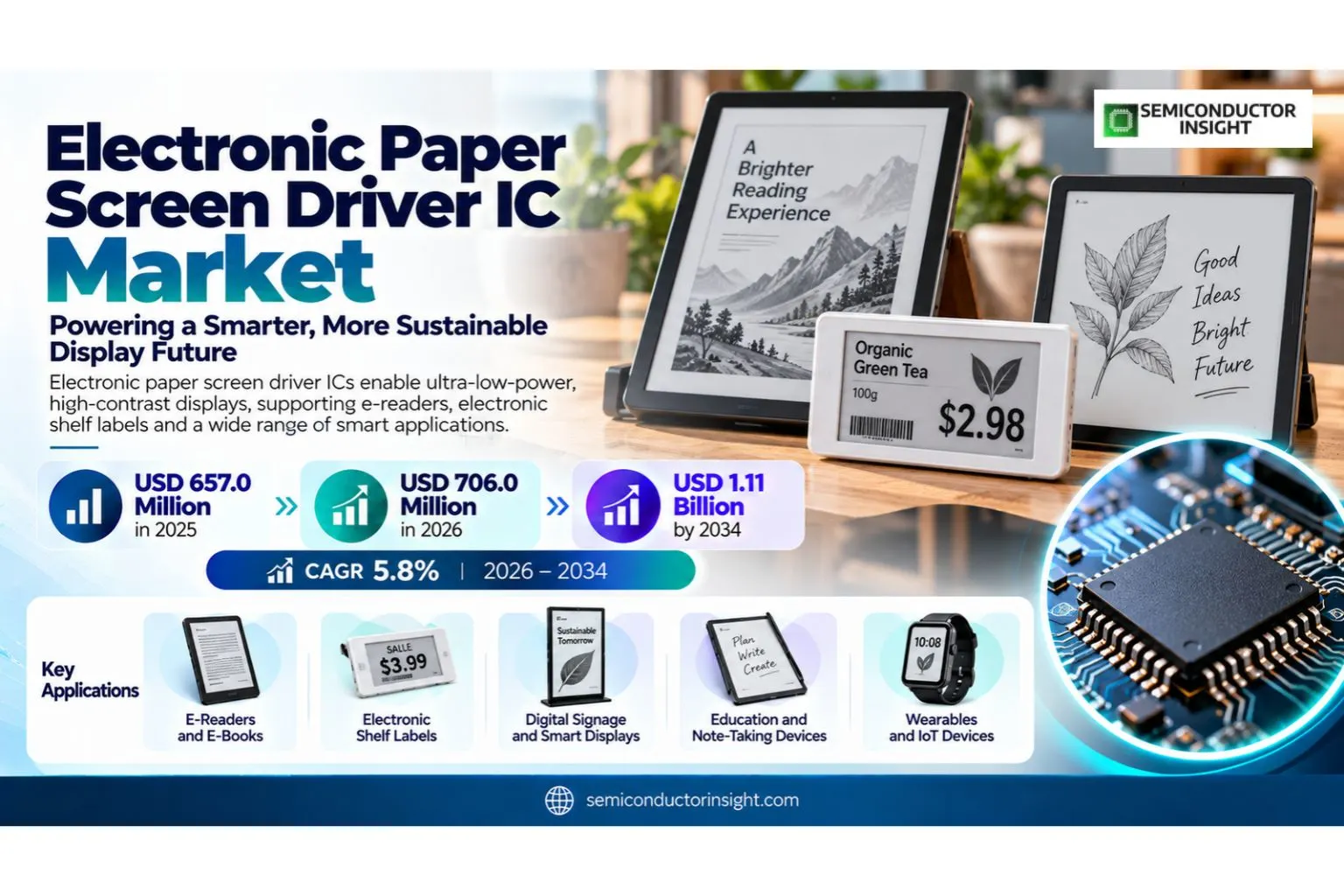
- The market is valued at USD 657.0 million in 2025 and is projected to reach USD 1.11 billion by 2034, representing a 5.8% CAGR over 2026–2034.
- Color Electronic Paper Driver IC is a major product segment, while adjacent variants are expanding as performance, integration and cost requirements evolve.
- Electronic Paper Tablet is a leading application area, supported by demand across Advertising Signs, Electronic Shelf Label.
- Asia Pacific is the largest market in 2025 based on current demand, manufacturing concentration and ecosystem maturity.
Electronic Paper Screen Driver IC Market Overview
Electronic Paper Screen Driver IC devices generate the precise waveforms, voltages and timing sequences needed to move charged pigment particles inside bistable e-paper panels. Because the image remains visible without continuous refresh power, these ICs are optimized for ultra-low-energy operation rather than the high frame rates associated with LCD or OLED display drivers.
The market is broadening as color e-paper improves and electronic shelf labels scale globally. Driver suppliers must support panel-specific waveforms, temperature compensation, grayscale or color control and power management. Greater integration with timing controllers and application processors can reduce device cost while improving refresh consistency and battery life. Suppliers that translate technical improvements into measurable gains in efficiency, uptime, cost, throughput or workflow simplicity are better positioned to win long-duration programs and repeat purchases.
Segment Analysis: By Type
Black-and-white driver ICs remain the largest installed base because monochrome e-readers and electronic shelf labels dominate unit shipments. Color driver ICs are the higher-growth opportunity as Gallery and Kaleido panels expand in education, signage and note-taking devices. Within this segment, customers increasingly compare lifecycle support, qualification requirements, integration effort and total ownership cost rather than relying on a single specification or upfront price.
| Type | Market relevance |
|---|---|
| Color Electronic Paper Driver IC | Higher-growth color e-paper opportunity. |
| Black & White Electronic Paper Driver IC | Largest mature installed base. |
Segment Analysis: By Application
Electronic shelf labels and tablets are the strongest applications because e-paper can hold static images with very low energy use while remaining readable in ambient light. Advertising and signage broaden demand where battery or solar-powered displays must operate for long periods. Within this segment, customers increasingly compare lifecycle support, qualification requirements, integration effort and total ownership cost rather than relying on a single specification or upfront price.
| Application | Market relevance |
|---|---|
| Electronic Paper Tablet | E-readers, note devices and education. |
| Advertising Signs | Public and commercial signage. |
| Electronic Shelf Label | Largest low-power retail application. |
| Others | Smart labels and specialist displays. |
Segment Analysis: By End User
Retail is the largest end-user group through ESL deployments, while consumer electronics drive e-readers and tablets. Education and enterprise applications are growing as color e-paper improves, and automotive use remains selective in labels, controls and low-power displays. Within this segment, customers increasingly compare lifecycle support, qualification requirements, integration effort and total ownership cost rather than relying on a single specification or upfront price.
| End User | Market relevance |
|---|---|
| Retail | ESL and price-label deployments. |
| Consumer Electronics | E-readers and portable devices. |
| Automotive | Low-power auxiliary displays. |
| Education & Enterprise | Digital learning and office devices. |
Segment Analysis: By Integration
Discrete driver ICs remain common in modular display designs, while SoCs with timing-controller functions reduce board area and simplify product development. Greater integration is especially valuable in e-readers and tablets where power, cost and form factor are tightly constrained. Within this segment, customers increasingly compare lifecycle support, qualification requirements, integration effort and total ownership cost rather than relying on a single specification or upfront price.
| Integration | Market relevance |
|---|---|
| Discrete Driver IC | Flexible multi-vendor display architecture. |
| SoC with TCON / Integrated Display Control | Lower component count and tighter power integration. |
Regional Analysis
Asia Pacific leads because Taiwan, China and South Korea concentrate e-paper panel manufacturing, driver IC design and electronic-device assembly. Europe is a major ESL deployment market, while North America contributes e-reader, retail and signage demand. Regional share also reflects supplier depth, engineering support, manufacturing concentration and the speed at which new Electronic Paper Screen Driver IC designs can move from evaluation into repeat deployment.
| Region | 2025 Position | Growth Outlook | Demand Profile |
|---|---|---|---|
| Asia Pacific | Largest | Strong | Panel manufacturing and driver IC design led |
| Europe | Large ESL market | Strong | Retail digitization led |
| North America | Large consumer and retail market | Strong | E-readers, signage and ESL led |
| South America | Emerging | Moderate | Retail and consumer led |
| Middle East & Africa | Developing | Moderate-strong | Retail, signage and enterprise led |
Detailed Regional Blocks
Why is Asia Pacific important to this market?
Asia Pacific dominates because E Ink and many display, module and semiconductor suppliers are based in Taiwan and China. Regional electronics manufacturing shortens the path from driver design to panel qualification and high-volume device assembly. In Asia Pacific, procurement decisions also depend on service coverage, qualification resources, logistics and long-term availability, so ecosystem maturity can materially influence adoption even when core technology performance is similar.
| Country / Subregion | Role | Market Context |
|---|---|---|
| Taiwan | Technology and driver hub | E Ink, Himax and other suppliers support the e-paper ecosystem. |
| China | Device and ESL manufacturing | Retail electronics and e-reader production drive volume. |
| South Korea | Display and IC ecosystem | Large semiconductor capability supports advanced drivers. |
- E Ink announced an expanded 2026 collaboration with MediaTek around an AI e-reader SoC with integrated Hardware TCON supporting Gallery and Kaleido color e-paper.
- Color e-paper raises driver complexity because more pigment states and waveform sequences must be controlled.
- Regional module integration supports rapid adoption in ESL and education devices.
Why is Europe important to this market?
Europe is a major demand center for electronic shelf labels because large retailers use e-paper to automate price changes and reduce manual labor. Driver IC demand is indirect but substantial because each deployed label contains display-control electronics. In Europe, procurement decisions also depend on service coverage, qualification resources, logistics and long-term availability, so ecosystem maturity can materially influence adoption even when core technology performance is similar.
| Country / Subregion | Role | Market Context |
|---|---|---|
| France | Large retail-ESL deployments | National retail chains support widespread adoption. |
| Germany | Retail and industrial market | Energy efficiency and automation support e-paper. |
| Nordic countries | Early digital-retail adopters | Connected shelf systems create demand. |
- ESL systems favor low-power drivers because labels may operate for years on small batteries.
- Color support expands use from simple pricing into promotions and category branding.
- Retail deployments require reliable wireless and display-control integration at very large node counts.
Why is North America important to this market?
North America combines a large e-reader installed base with growing retail digitization. Color note devices and smart signage create additional demand for more capable driver and controller ICs. In North America, procurement decisions also depend on service coverage, qualification resources, logistics and long-term availability, so ecosystem maturity can materially influence adoption even when core technology performance is similar.
| Country / Subregion | Role | Market Context |
|---|---|---|
| United States | Largest regional market | E-readers, retail and enterprise devices support demand. |
| Canada | Retail and education niche | Low-power display applications create growth. |
- Integrated display-control SoCs can reduce BOM and power in e-reader platforms.
- Retailers value e-paper where static information must remain visible during power loss or sleep.
- Education is a promising color e-paper segment because reflective displays reduce dependence on bright emissive screens.
Why is South America important to this market?
South America is an emerging market where ESL adoption starts with large retail chains and premium consumer e-readers. Brazil provides the largest addressable base. In South America, procurement decisions also depend on service coverage, qualification resources, logistics and long-term availability, so ecosystem maturity can materially influence adoption even when core technology performance is similar.
| Country / Subregion | Role | Market Context |
|---|---|---|
| Brazil | Largest regional opportunity | Retail automation and e-readers support demand. |
| Chile | Modern retail niche | ESL pilots and connected stores create growth. |
| Argentina | Selective consumer market | Demand remains price sensitive. |
- ESL economics improve where labor costs and price-change frequency are high.
- Most driver IC value enters the region inside finished labels or devices.
- Color e-paper remains a premium feature.
Why is Middle East & Africa important to this market?
Middle East and Africa demand is developing through modern retail, smart-city signage and premium e-readers. Gulf markets lead adoption because retail infrastructure and digital transformation investment are strong. In Middle East & Africa, procurement decisions also depend on service coverage, qualification resources, logistics and long-term availability, so ecosystem maturity can materially influence adoption even when core technology performance is similar.
| Country / Subregion | Role | Market Context |
|---|---|---|
| United Arab Emirates | Premium retail market | Smart stores and signage support e-paper. |
| Saudi Arabia | Retail digitization | Large modernization programs create opportunity. |
| South Africa | Regional retail hub | ESL adoption is selective but growing. |
- Low-power reflective signage is attractive where displays must remain visible continuously.
- Retail modernization can create large unit volumes because every shelf edge becomes a display endpoint.
- Driver suppliers participate mainly through Asian module partners.
Competitive Landscape
Solomon Systech, Allwinner, Himax, Fitipower, UltraChip, MediaTek, NXP, Novatek, Parade, LX Semicon and Chinese design houses compete on waveform support, power, panel compatibility and integration. Color e-paper and SoC-level TCON integration are major differentiation areas.
| Company | Position | Relevant capability |
|---|---|---|
| Solomon Systech | Key participant | Long-standing display-driver specialist serving e-paper and low-power display markets. |
| Allwinner Technology | Key participant | Competes through product breadth, integration capability, qualification and customer support. |
| Himax Technologies | Key participant | Display-driver and timing-controller expertise relevant to advanced e-paper panels. |
| Fitipower | Key participant | Competes through product breadth, integration capability, qualification and customer support. |
| UltraChip | Key participant | Competes through product breadth, integration capability, qualification and customer support. |
| MediaTek | Key participant | Expanded 2026 e-reader SoC collaboration with E Ink and integrated Hardware TCON support. |
| NXP Semiconductors | Key participant | Competes through product breadth, integration capability, qualification and customer support. |
| Novatek Microelectronics | Key participant | Competes through product breadth, integration capability, qualification and customer support. |
| Parade Technologies | Key participant | Competes through product breadth, integration capability, qualification and customer support. |
| LX Semicon | Key participant | Competes through product breadth, integration capability, qualification and customer support. |
Production Capacity Analysis
Driver IC capacity depends on mature and midrange mixed-signal CMOS foundry supply, display-driver packaging and panel-specific validation. Wafer availability is generally more flexible than leading-edge logic, but each driver must be qualified with specific e-paper waveforms and panel generations. Scaling output without degrading consistency requires stable upstream materials, disciplined process control and final testing that catches performance drift before products reach high-value customer systems.
Taiwan and China dominate ecosystem coordination across driver ICs, modules and end devices. Effective capacity increasingly includes firmware and waveform engineering because display quality depends heavily on temperature, color-state transitions and refresh algorithms. Second-source planning and regional technical support therefore become increasingly important as deployments expand and buyers seek supply continuity without repeating lengthy qualification work.
Market Dynamics
The market is shifting from monochrome low-cost control toward richer color and more integrated platforms. Color e-paper creates more complex waveform requirements and stronger demand for controller intelligence, while still preserving the fundamental low-power advantage of bistable displays. This is changing competitive behavior because vendors increasingly sell system-level value, workflow integration and lifecycle economics rather than an isolated component specification.
Electronic shelf labels provide stable unit growth, but e-reader and education devices can create higher semiconductor value per device. The strongest suppliers will support both mass-volume labels and feature-rich color products without fragmenting software and panel qualification. Buyers consequently evaluate total ownership cost, qualification effort and roadmap stability across the life of a program instead of focusing only on initial purchase price.
Market Drivers
| Factor | Analyst Interpretation |
|---|---|
| Electronic shelf label deployment | Retail automation creates very large node counts. |
| Color e-paper | Improved panels expand education, note-taking and signage applications. |
| Low-power IoT displays | Bistable screens can operate for long periods on batteries. |
| Higher integration | TCON and power-management functions can reduce system BOM. |
Market Restraints
| Factor | Analyst Interpretation |
|---|---|
| Slow refresh rates | E-paper cannot match LCD/OLED for video or fluid animation. |
| Panel-specific waveforms | Driver qualification is tightly coupled to display chemistry and temperature. |
| Niche display scope | Many applications still prefer emissive or transmissive displays. |
| Color complexity | More pigment states increase waveform and control requirements. |
Market Opportunities
| Factor | Analyst Interpretation |
|---|---|
| Color ESL | Promotional graphics can raise value beyond monochrome price labels. |
| AI e-readers | Integrated SoCs can combine display control with local AI features. |
| Digital education | Reflective color screens create a lower-power tablet alternative. |
| Smart signage | Battery and solar-powered signs can use e-paper where content changes intermittently. |
Supply Chain Analysis
The value chain combines display-driver IC design, foundry fabrication, waveform firmware, e-paper panels, module integration and end-device assembly. Tight cooperation between panel and driver suppliers is essential because image quality depends on panel-specific electrical waveforms. Traceability and coordination between component suppliers, integrators and end users are important because failures found late in the chain can be far more expensive than the underlying part itself.
| Supply Chain Stage | Role in the Market |
|---|---|
| Driver IC design | Mixed-signal circuits generate high-voltage waveforms and timing. |
| Foundry fabrication and packaging | Mature CMOS processes produce driver and controller silicon. |
| Panel and waveform integration | ICs are tuned to specific e-paper chemistry and temperature behavior. |
| Device assembly | Drivers enter ESLs, e-readers, tablets and signage modules. |
Recent Developments
| Date | Development | Source |
|---|---|---|
| May 2026 | E Ink and MediaTek expanded collaboration on AI e-reader SoCs with built-in Hardware TCON support for E Ink Gallery and Kaleido color e-paper technologies. | E Ink |
| 2026 | E Ink continues to expand color e-paper platforms used across reading, education, retail and signage, increasing display-controller complexity. | E Ink |
| 2026 | MediaTek's integrated e-reader SoC approach illustrates the shift from discrete display control toward tighter processor, TCON and power integration. | E Ink |
Report Scope & Segmentation
| Scope Item | Coverage |
|---|---|
| Base Year | 2025 |
| Estimated Year | 2026 |
| Forecast Period | 2026–2034 |
| 2025 Market Size | USD 657.0 million |
| 2026 Estimated Size | USD 706.0 million |
| 2034 Forecast Size | USD 1.11 billion |
| CAGR (2026–2034) | 5.8% |
| Largest Market in 2025 | Asia Pacific |
| Category | Integrated Circuits / Display Drivers / Electronic Paper |
| By Type | Color Electronic Paper Driver IC, Black & White Electronic Paper Driver IC |
| By Application | Electronic Paper Tablet, Advertising Signs, Electronic Shelf Label, Others |
| By End User | Retail, Consumer Electronics, Automotive, Education & Enterprise |
| By Integration | Discrete Driver IC, SoC with TCON / Integrated Display Control |
Frequently Asked Questions
What is the 2025 market size of the Electronic Paper Screen Driver IC market?
The market is valued at USD 657.0 million in 2025.
What is the projected 2034 market size of the Electronic Paper Screen Driver IC market?
The market is projected to reach USD 1.11 billion by 2034.
What is the CAGR of the Electronic Paper Screen Driver IC market from 2026 to 2034?
The market is expected to expand at a CAGR of 5.8% during 2026–2034.
Which region leads the Electronic Paper Screen Driver IC market?
Asia Pacific is the largest market in 2025 based on the current demand, manufacturing and deployment structure.
Which type segment is important in the Electronic Paper Screen Driver IC market?
Color Electronic Paper Driver IC is a major segment, while adjacent product variants are gaining share as performance and integration requirements evolve.
What is the main application for Electronic Paper Screen Driver IC products?
Electronic Paper Tablet is a leading application, with additional growth coming from Advertising Signs, Electronic Shelf Label.
What drives growth in the Electronic Paper Screen Driver IC market?
Retail automation creates very large node counts.
What is a key restraint for the Electronic Paper Screen Driver IC market?
E-paper cannot match LCD/OLED for video or fluid animation.
Which companies participate in the Electronic Paper Screen Driver IC market?
Key participants include Solomon Systech, Allwinner Technology, Himax Technologies, Fitipower, UltraChip, alongside other specialized suppliers and system companies.
What technology trend is shaping the Electronic Paper Screen Driver IC market?
Promotional graphics can raise value beyond monochrome price labels.
Research Sources & Evidence Base
Get Sample Report PDF for Exclusive Insights
Report Sample Includes
- Table of Contents
- List of Tables & Figures
- Charts, Research Methodology, and more...
 Download Sample Report PDF