
MARKET INSIGHTS
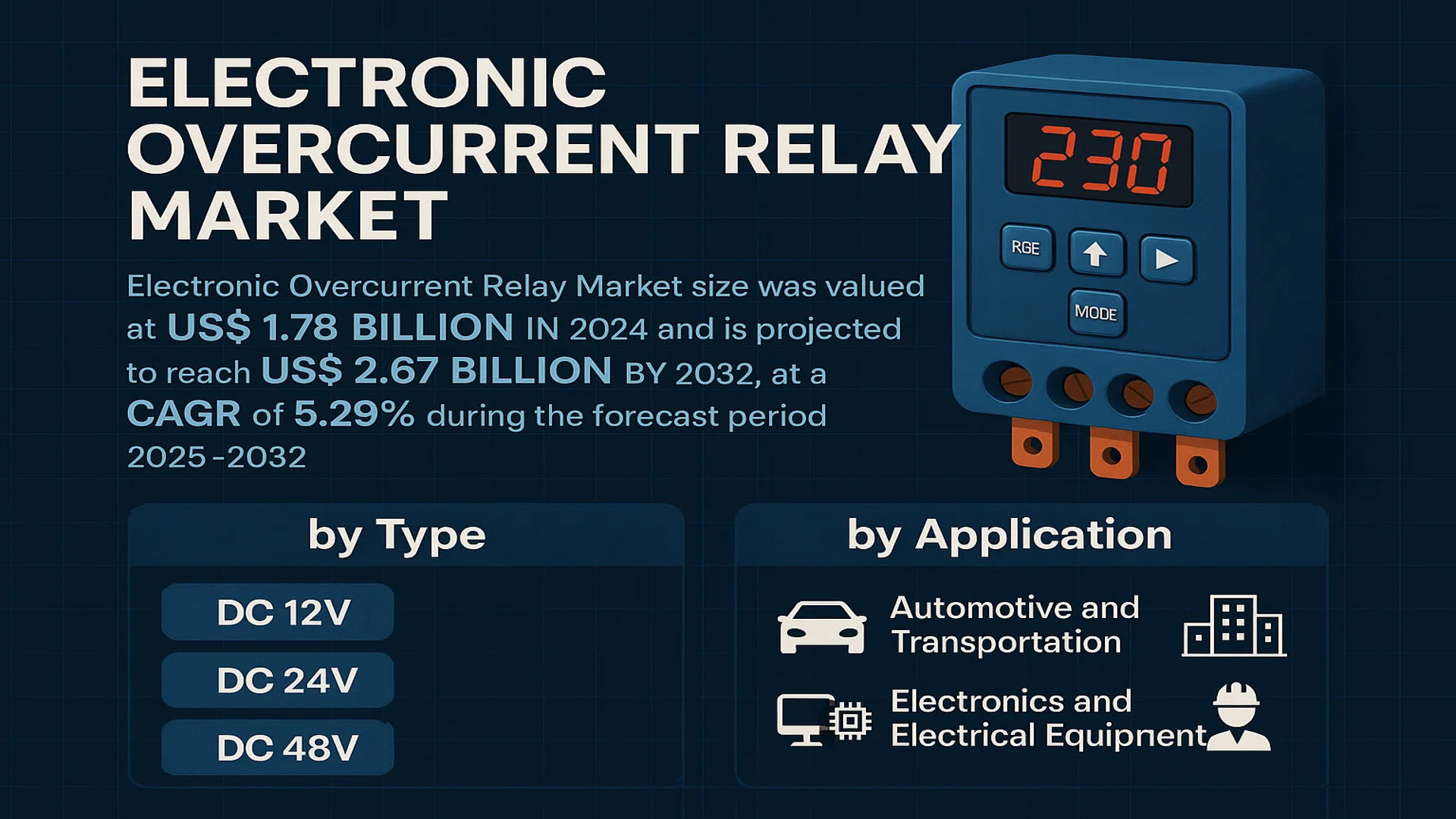
The global Electronic Overcurrent Relay Market size was valued at US$ 1.78 billion in 2024 and is projected to reach US$ 2.67 billion by 2032, at a CAGR of 5.29% during the forecast period 2025–2032. The U.S. market accounted for approximately 28% of global revenue in 2024, while China’s market is expected to grow at a faster CAGR of 7.8% through 2032.
Electronic overcurrent relays are critical protection devices that monitor electrical circuits and disconnect power when current exceeds safe thresholds. These intelligent components safeguard industrial equipment, power distribution systems, and electrical networks from damage caused by short circuits, ground faults, or overload conditions. Modern variants incorporate microprocessor-based technology with advanced features like programmable settings, communication capabilities, and fault recording.
The market growth is driven by increasing electrification across industries, stricter safety regulations, and infrastructure modernization initiatives. The DC 12V segment, particularly important for automotive and renewable energy applications, is projected to reach USD 890 million by 2032. Key players including Siemens AG, ABB, and Schneider Electric SE dominate the competitive landscape, collectively holding over 45% market share. Recent technological advancements focus on IoT integration and predictive maintenance capabilities, with major manufacturers investing heavily in R&D to develop smarter, more efficient relay solutions.
MARKET DYNAMICS
MARKET DRIVERS
Rising Demand for Reliable Power Protection Solutions to Drive Market Expansion
The global electronic overcurrent relay market is experiencing significant growth driven by the increasing need for reliable power protection solutions across industries. Overcurrent relays play a critical role in safeguarding electrical equipment from damage caused by excessive current flow, making them indispensable in modern power systems. The market is projected to grow at a compound annual growth rate of approximately 5-7% over the next decade, fueled by expanding industrial automation and smart grid deployments.
Electrical infrastructure modernization programs worldwide are accelerating adoption, particularly in developing economies where grid reliability remains a challenge. Utilities are prioritizing investments in protective relays to minimize downtime and equipment damage, with transmission and distribution applications accounting for over 40% of market demand. The transition toward renewable energy integration further amplifies this need, as distributed generation systems require advanced protection schemes to maintain grid stability.
Industrial Automation Boom Creating New Growth Avenues
Industry 4.0 initiatives are transforming manufacturing landscapes globally, with smart factories requiring sophisticated protection systems for their automated processes. The manufacturing sector’s overcurrent relay demand is growing at nearly 8% annually, outpacing other segments. These relays ensure uninterrupted operations by preventing catastrophic equipment failures in critical applications such as motor protection and process control systems.
The oil and gas industry represents another high-growth vertical, where hazardous environments demand ruggedized relay solutions. Recent technological advancements have led to the development of intrinsically safe relays capable of operating in explosive atmospheres, opening new market opportunities. Digital relay adoption is particularly strong in this sector due to their diagnostic capabilities and communication features.
MARKET RESTRAINTS
High Installation Costs and Complexity Hinder Market Penetration
While electronic overcurrent relays offer superior performance, their adoption faces challenges from high implementation costs and system complexity. Advanced digital relays typically cost 30-50% more than traditional electromechanical alternatives, posing a significant barrier for budget-constrained utilities and small industrial facilities. The total cost of ownership includes not just the hardware but also specialized installation, configuration, and maintenance expenses.
Integration with legacy systems presents another challenge, particularly in older industrial plants where equipment retrofits require substantial modifications. Many facilities continue to rely on conventional protection schemes due to the perceived risks and costs associated with upgrades. This inertia slows market growth despite the clear technical advantages of modern electronic relays.
Technical Limitations in High-Voltage Applications Constrain Growth
Electronic overcurrent relays face inherent technical constraints in ultra-high voltage applications above 500kV, where electromechanical alternatives still dominate. While digital relays excel in most industrial and commercial applications, their performance in extreme conditions remains an area for improvement. Temperature sensitivity and electromagnetic interference challenges in harsh environments limit their applicability in certain critical infrastructure applications.
Reliability concerns also persist among some conservative industries, where any protection system failure could have catastrophic consequences. This risk aversion leads to extended product qualification periods and cautious adoption cycles, particularly in industries with stringent safety requirements such as nuclear power generation.
MARKET OPPORTUNITIES
Smart Grid Developments Present Significant Growth Potential
The global push toward smart grid modernization represents a substantial opportunity for electronic overcurrent relay manufacturers. Smart grids require intelligent protection systems that can communicate with central control systems and adapt to changing network conditions. Advanced relays with communication capabilities and self-diagnostic features are becoming essential components of utility digital transformation strategies.
Government initiatives worldwide are accelerating smart grid deployments, with over $50 billion in annual global investments driving demand for compatible protection equipment. The ability of modern relays to integrate with SCADA systems and provide real-time data makes them ideal for these applications. Manufacturers developing IoT-enabled relays with predictive maintenance capabilities are well-positioned to capitalize on this growing market segment.
Renewable Energy Integration Creates New Application Areas
The rapid growth of renewable energy generation is creating novel protection challenges that electronic overcurrent relays are uniquely suited to address. Solar farms and wind parks require specialized protection schemes to handle bidirectional power flows and intermittent generation patterns. The renewable sector’s relay demand is growing at double-digit rates as project developers recognize the need for advanced protection solutions.
Microgrid applications present another promising opportunity, particularly in remote locations and military installations. These self-contained power systems require robust protection schemes that can seamlessly transition between grid-connected and islanded modes. Manufacturers developing adaptive relays with flexible protection algorithms stand to gain significant market share in this emerging segment.
MARKET CHALLENGES
Intense Competition from Alternative Technologies Threatens Market Share
The electronic overcurrent relay market faces growing competition from alternative protection technologies, particularly intelligent electronic devices (IEDs) that combine multiple protection functions in single units. These multifunction devices offer space and cost savings that appeal to utilities and industrial users, challenging standalone relay adoption. The IED market has been growing at approximately 9% annually, gradually eroding traditional relay market segments.
Manufacturers must continually innovate to maintain competitiveness, developing relays with enhanced functionality and value-added features. The need to balance advanced capabilities with affordability presents an ongoing challenge in product development strategies. Companies failing to keep pace with technological advancements risk losing market relevance.
Supply Chain Disruptions Impact Manufacturing and Delivery
The electronic components shortage affecting multiple industries has significantly impacted relay manufacturers, with lead times for some critical components extending beyond 12 months. Semiconductor scarcity and logistical challenges have constrained production capacity across the sector, delaying project implementations and increasing costs.
The industry’s heavy reliance on specialized electronic components makes it particularly vulnerable to supply chain disruptions. Manufacturers are responding by diversifying supplier networks and redesigning products to use more readily available components, but these adjustments take time and may impact product performance characteristics. The situation remains a critical challenge for market growth in the short to medium term.
ELECTRONIC OVERCURRENT RELAY MARKET TRENDS
Smart Grid Modernization Driving Market Growth
The global shift toward smart grid technologies is significantly boosting demand for electronic overcurrent relays, which play a critical role in protecting electrical circuits from excessive current flow. As grids become more complex with distributed energy resources like solar and wind, modern protection systems require intelligent relays capable of rapid fault detection and automation. The market is witnessing a compound annual growth rate (CAGR) of over 5.8% as utilities upgrade aging infrastructure. Advanced relays now incorporate microprocessor-based designs with programmable logic, enabling real-time monitoring – a capability absent in traditional electromechanical relays.
Other Trends
Industrial Automation Surge
Manufacturing facilities are increasingly adopting electronic overcurrent relays as part of Industry 4.0 initiatives, where equipment protection is integrated with IoT-enabled predictive maintenance systems. The chemicals and petrochemicals sector alone accounts for nearly 22% of industrial relay applications due to hazardous operating environments requiring failsafe protection. These relays’ ability to log fault events and communicate with SCADA systems makes them indispensable for minimizing downtime in continuous process industries.
Renewable Energy Integration Challenges
The renewable energy sector presents both opportunities and technical challenges for relay manufacturers. While solar and wind farms require specialized protection schemes for bidirectional power flow, voltage fluctuations from intermittent generation demand relays with advanced adaptive protection algorithms. Market data indicates that relays for renewable applications will grow at 7.2% CAGR through 2030, faster than the overall market. Manufacturers are responding with products featuring wider voltage ranges (up to 1500V DC for solar applications) and enhanced cybersecurity features critical for grid-tied systems.
While the automotive industry represents a smaller segment currently, the electrification of vehicles is creating new demand for compact DC overcurrent protection in charging infrastructure. The 48V segment is projected to reach $380 million by 2028 as automakers adopt higher voltage architectures for electric and hybrid vehicles. This niche demonstrates how technological evolution in adjacent industries continues to reshape relay specifications and applications.
COMPETITIVE LANDSCAPE
Key Industry Players
Strategic Investments and Technological Advancements Drive Market Competition
The global Electronic Overcurrent Relay market features a mix of established multinational corporations and specialized manufacturers competing across different voltage ranges and applications. The market remains highly dynamic, with technological innovation and strategic expansions defining the competitive edge. According to recent industry analysis, the top five companies collectively accounted for approximately 35-40% of global revenue share in 2024, reflecting a semi-consolidated landscape.
Siemens AG and ABB dominate the market with their comprehensive product portfolios spanning low-voltage to high-voltage applications. Siemens’ latest digital overcurrent relay solutions, integrated with IoT capabilities, have strengthened its position across industrial energy and infrastructure sectors. Meanwhile, ABB’s focus on grid automation solutions has given it a stronghold in power distribution networks worldwide.
Regional players like Larsen & Toubro (India) and Novatek Electro (Russia) are gaining traction through cost-competitive offerings tailored for developing markets. These companies benefit from local manufacturing advantages and government initiatives supporting electrical infrastructure modernization.
The DC 12V segment, projected to exhibit a CAGR of 6-8% through 2032, has seen particular innovation from Texas Instruments and Eaton Corporation. Their compact relay designs are increasingly adopted in automotive and portable electronics applications.
Strategic moves in 2024 include Schneider Electric’s acquisition of niche relay specialists to enhance its medium-voltage capabilities, while General Electric divested part of its grid solutions division to focus on high-growth segments. Such maneuvers continuously reshape the competitive dynamics.
List of Key Electronic Overcurrent Relay Manufacturers
- Siemens AG (Germany)
- Novatek Electro (Russia)
- General Electric Company (U.S.)
- Schneider Electric SE (France)
- ABB (Switzerland)
- Mechanical Products Company (U.S.)
- Larsen & Toubro (India)
- S&C Electric Company (U.S.)
- Eaton Corporation (U.S.)
- E-T-A Elektrotechnische Apparate GmbH (Germany)
Segment Analysis:
By Type
DC 12V Segment Leads the Market Due to Widespread Adoption in Automotive and Industrial Applications
The market is segmented based on type into:
- DC 12V
- DC 24V
- DC 48V
By Application
Industrial Energy Segment Holds Significant Market Share Due to Critical Power Protection Needs
The market is segmented based on application into:
- Automotive and Transportation
- Electronics and Electrical Equipment
- Building and Construction
- Industrial Energy
- Chemicals and Petrochemicals
By Technology
Digital Overcurrent Relays Gain Traction Due to Enhanced Precision and Connectivity Features
The market is segmented based on technology into:
- Electromechanical Relays
- Digital/Static Relays
- Microprocessor-based Relays
By End User
Utilities Sector Dominates Market Share Driven by Grid Modernization Initiatives
The market is segmented based on end user into:
- Utilities
- Industrial
- Commercial
- Residential
Regional Analysis: Electronic Overcurrent Relay Market
North America
The North American Electronic Overcurrent Relay market is one of the most advanced globally, driven by stringent safety regulations, grid modernization initiatives, and substantial investments in industrial automation. The U.S. dominates this region, accounting for a significant share, while Canada and Mexico exhibit steady growth due to infrastructure upgrades. The region benefits from proactive government policies, such as the Infrastructure Investment and Jobs Act, which allocates substantial funding to upgrade aging electrical grids, creating demand for precision protection devices like overcurrent relays. Manufacturers in this region emphasize smart grid compatibility and IoT integration to enhance efficiency. The presence of key players like General Electric, Eaton Corporation, and Texas Instruments further reinforces technological advancements.
Europe
Europe’s market is shaped by strict regulatory standards, including the EN 60255 and IEC 60255 series, ensuring high safety compliance in electrical protection. The region’s focus on renewable energy integration and decentralized power generation has spurred the need for reliable overcurrent relays that can manage fluctuating loads. Countries like Germany, France, and the U.K. lead in adoption, leveraging industrial automation and smart city projects. Additionally, the European Green Deal’s emphasis on energy efficiency supports market expansion, pushing manufacturers toward eco-efficient designs with lower failure rates. However, intense competition from Asian suppliers presents pricing challenges for domestic players.
Asia-Pacific
Asia-Pacific is the fastest-growing market for Electronic Overcurrent Relays, propelled by rapid industrialization, urbanization, and large-scale infrastructure projects. China remains the largest consumer, driven by its massive power generation projects and manufacturing boom, followed by India and Southeast Asia, where electrification and industrial automation initiatives are accelerating. The DC 12V and 24V segment demand is particularly high in emerging economies due to cost-effectiveness. Despite the dominance of local manufacturers like ABB and Toshiba, price sensitivity and lower adoption of premium products in some markets restrain the full potential. However, increasing awareness of electrical safety norms is gradually shifting preferences toward advanced relays.
South America
South America exhibits moderate growth, largely influenced by Brazil and Argentina, where aging transmission networks require modernization. The market is constrained by economic instability and inconsistent investment cycles, which hinder large-scale deployment of high-end relays. Nonetheless, sectors like mining and oil & gas offer niche opportunities due to their demand for ruggedized protection solutions. Limited regulatory enforcement and reliance on imports restrict domestic production, but government efforts to expand renewable energy capacity could stimulate future demand.
Middle East & Africa
The region shows potential growth with expanding power infrastructure in Gulf Cooperation Council (GCC) countries, particularly in Saudi Arabia and the UAE, driven by smart grid projects and industrial diversification. Africa’s market, though underdeveloped, is gradually improving due to rural electrification initiatives and foreign investments. However, logistical challenges, lack of skilled labor, and political uncertainties curb rapid adoption. The demand for cost-effective DC-based relays is rising, but premium electronic relays remain confined to high-value industrial applications. Long-term growth is anticipated with rising energy needs and infrastructural upgrades.
Report Scope
This market research report provides a comprehensive analysis of the Global and regional Electronic Overcurrent Relay markets, covering the forecast period 2025–2032. It offers detailed insights into market dynamics, technological advancements, competitive landscape, and key trends shaping the industry.
Key focus areas of the report include:
- Market Size & Forecast: Historical data and future projections for revenue, unit shipments, and market value across major regions and segments. The Global Electronic Overcurrent Relay market was valued at US$ 1.78 billion in 2024 and is projected to reach US$ 2.67 billion by 2032.
- Segmentation Analysis: Detailed breakdown by product type (DC 12V, DC 24V, DC 48V), application (Automotive, Industrial Energy, Building & Construction etc.), and end-user industry to identify high-growth segments and investment opportunities.
- Regional Outlook: Insights into market performance across North America (U.S. market estimated at USD million in 2024), Europe, Asia-Pacific (China to reach USD million), Latin America, and the Middle East & Africa.
- Competitive Landscape: Profiles of leading market participants including Siemens AG, ABB, Schneider Electric SE, Eaton Corporation, and General Electric Company, covering their product offerings, market share (global top five players held approximately % share in 2024), and strategic developments.
- Technology Trends & Innovation: Assessment of emerging relay technologies, integration of smart monitoring capabilities, and evolving industry standards for overcurrent protection.
- Market Drivers & Restraints: Evaluation of factors driving market growth including industrial automation trends along with challenges like supply chain constraints and regulatory compliance requirements.
- Stakeholder Analysis: Insights for component manufacturers, system integrators, industrial end-users, and investors regarding market opportunities and strategic positioning.
Primary and secondary research methods are employed, including interviews with industry experts, data from verified sources, and real-time market intelligence to ensure the accuracy and reliability of the insights presented.
FREQUENTLY ASKED QUESTIONS:
What is the current market size of Global Electronic Overcurrent Relay Market?
-> Electronic Overcurrent Relay Market size was valued at US$ 1.78 billion in 2024 and is projected to reach US$ 2.67 billion by 2032, at a CAGR of 5.29% during the forecast period 2025–2032.
Which key companies operate in Global Electronic Overcurrent Relay Market?
-> Key players include Siemens AG, ABB, Schneider Electric SE, Eaton Corporation, General Electric Company, and Toshiba Corporation, among others.
What are the key growth drivers?
-> Key growth drivers include industrial automation trends, renewable energy investments, and modernization of power infrastructure.
Which region dominates the market?
-> Asia-Pacific is the fastest-growing region, while North America remains a technologically advanced market.
What are the emerging trends?
-> Emerging trends include smart relay technologies, IoT integration for predictive maintenance, and development of compact relay solutions.

Get Sample Report PDF for Exclusive Insights
Report Sample Includes
- Table of Contents
- List of Tables & Figures
- Charts, Research Methodology, and more...
 Download Sample Report PDF


