Electrolytic capacitor with 10,000h+ endurance for railway Market Insights
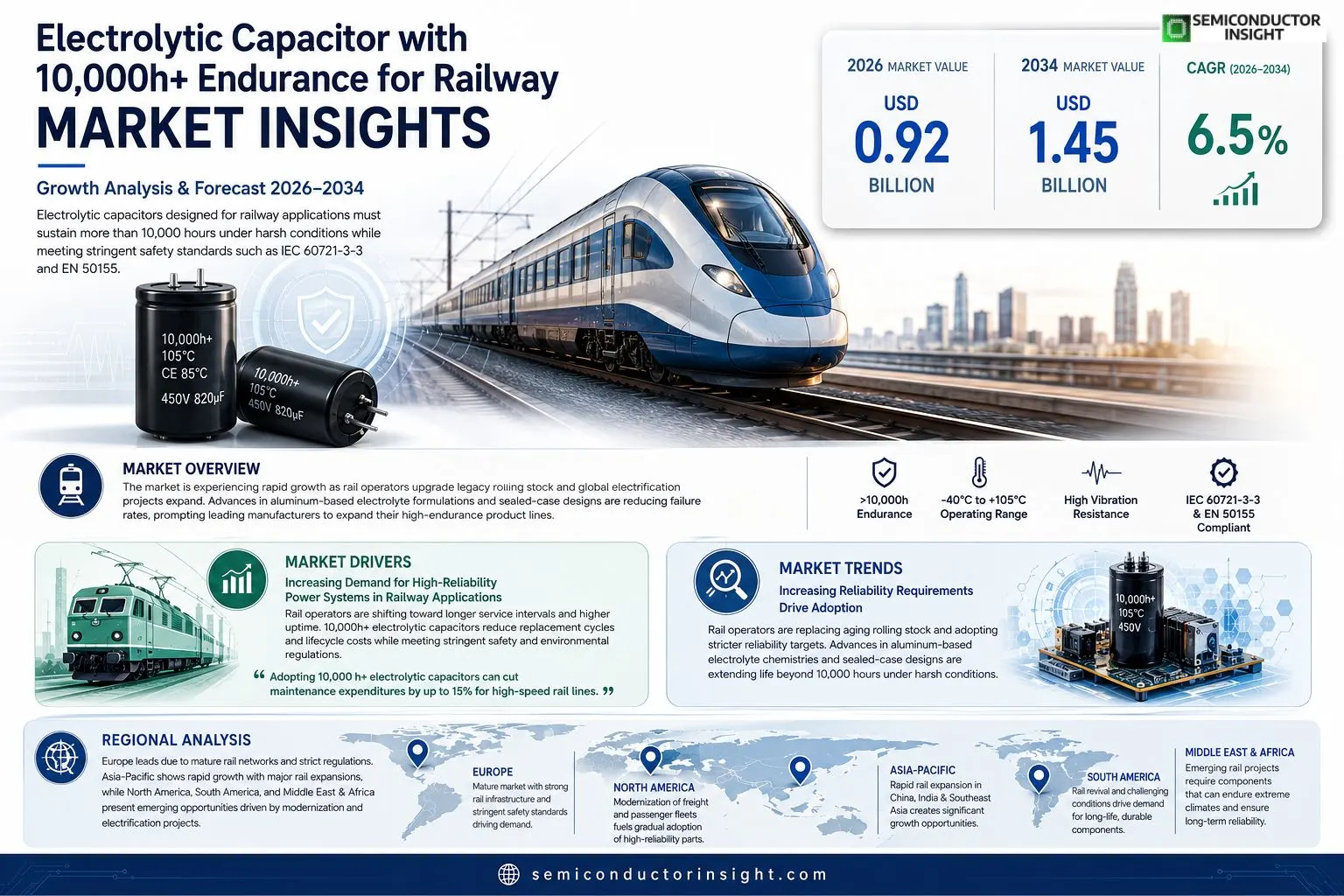
Electrolytic capacitor with 10,000h+ endurance for railway market size was valued at USD 0.85 billion in 2025. The market is projected to grow from USD 0.92 billion in 2026 to USD 1.45 billion by 2034, exhibiting a CAGR of 6.5% during the forecast period.
Electrolytic capacitors designed for railway applications must sustain more than 10,000 hours of operation under harsh temperature cycles, vibration, and electrical stress while meeting stringent safety standards such as IEC 60721‑3‑3 and EN 50155.The market is experiencing rapid growth because rail operators are upgrading legacy rolling stock to meet higher reliability targets and electrification projects are expanding worldwide. Furthermore, advances in aluminum‑based electrolyte formulations and sealed‑case designs are reducing failure rates, prompting manufacturers like Panasonic Corporation, Vishay Intertechnology and KEMET Corporation to expand their high‑endurance product lines.
MARKET DRIVERS
Increasing Demand for High‑Reliability Power Systems in Railway Applications
Electrolytic capacitor with 10,000h+ endurance for railway Market is being propelled by rail operators’ shift toward longer service intervals and higher uptime thresholds. Modern electrified rail networks require capacitors that can sustain continuous operation beyond 10,000 hours, reducing replacement cycles and lowering lifecycle costs.
Stringent Safety and Environmental Regulations
Regulatory frameworks in Europe and Asia mandate components with proven endurance and low failure rates, encouraging manufacturers to adopt high‑endurance Electrolytic capacitors. Compliance with these standards drives investment in capacitors that meet both performance and environmental criteria.
➤ “Adopting 10,000 h+ Electrolytic capacitors can cut maintenance expenditures by up to 15 % for high‑speed rail lines.”
Moreover, the rollout of next‑generation signaling systems (e.g., ETCS Level 2) creates a parallel demand for stable power supplies, further reinforcing market growth for durable Electrolytic capacitor solutions.
MARKET CHALLENGES
High Initial Capital Expenditure
Although long‑life Electrolytic capacitors extend service intervals, their upfront cost is higher than conventional alternatives. Railway operators must balance short‑term budget constraints against long‑term reliability gains, which can delay adoption.
Other Challenges
Supply Chain Complexity
The specialized materials required for high‑endurance Electrolytic capacitors, such as advanced aluminum foils and high‑purity electrolytes, introduce longer lead times and dependence on a limited number of qualified suppliers.
MARKET RESTRAINTS
Limited Proven Track Record in Emerging Rail Networks
Emerging railway projects in developing regions often rely on proven, lower‑cost components with established supply chains, which may restrict the market penetration of premium 10,000 h+ Electrolytic capacitors despite their technical advantages.
MARKET OPPORTUNITIES
Growth of High‑Speed and Urban Rail Corridors
The expansion of high‑speed rail and urban transit systems worldwide offers a substantial opportunity for Electrolytic capacitor with 10,000h+ endurance for railway Market. These projects demand components that can endure intensive duty cycles and harsh operating environments, positioning high‑endurance Electrolytic capacitors as a preferred choice.
Electrolytic capacitor with 10,000h+ endurance for railway Market Trends
Increasing Reliability Requirements Drive Adoption
Rail operators worldwide are intensifying programs to replace aging rolling stock with equipment that can meet stricter reliability targets. In railway signaling and traction systems, the need for uninterrupted operation over long service intervals places a premium on components that can endure more than 10,000 hours under fluctuating temperature, vibration, and electrical stress. This operational pressure has accelerated the uptake of Electrolytic capacitors engineered specifically for railway environments, as manufacturers align product road‑maps with the expectation of higher uptime and lower maintenance cycles.
Other Trends
Regulatory Standards and Compliance
International standards such as IEC 60721‑3‑3 and EN 50155 define the environmental and functional criteria that railway‑grade Electrolytic capacitors must satisfy. Compliance with these benchmarks ensures that devices can withstand the harsh mechanical shocks and temperature excursions typical of rail corridors. Compliance testing has become a decisive factor in supplier selection, prompting vendors to certify their high‑endurance capacitor families against the latest edition of these standards.
Material and Design Innovations
Recent advances in aluminum‑based electrolyte formulations have markedly reduced internal resistance and leakage currents, extending operational life beyond the 10,000‑hour threshold. Sealed‑case designs incorporating moisture‑resistant barriers further mitigate failure modes associated with humidity ingress. Leading manufacturers such as Panasonic Corporation, Vishay Intertechnology, and KEMET Corporation have introduced new product lines that combine these material upgrades with optimized lead configurations, delivering improved thermal stability and vibration tolerance. The convergence of material science and robust mechanical design is lowering field failure rates, thereby reinforcing confidence among rail operators seeking long‑term reliability.
COMPETITIVE LANDSCAPE
Key Industry Players
Electrolytic Capacitors for Railway Applications – 10,000h+ Endurance
Railway‑grade Electrolytic capacitor market is anchored by a few manufacturers that leverage deep R&D resources to satisfy IEC 60721‑3‑3 and EN 50155 tolerances. Panasonic Corporation, Vishay Intertechnology and KEMET Corporation together control a significant share of the $0.85 billion 2025 market, driving the projected growth to $1.45 billion by 2034 with a 6.5 % CAGR. These leaders have expanded sealed‑case aluminum Electrolytic families that guarantee >10,000 hours of operation under extreme temperature cycling, vibration, and electrical stress. Their scale enables rail operators worldwide to retire legacy rolling stock while meeting higher reliability targets, and they benefit from economies of scope across automotive, industrial and consumer sectors.Beyond the three dominant players, a diverse set of niche innovators adds depth to the competitive landscape. Nichicon Corporation, AVX Corporation and Murata Manufacturing specialize in custom electrolyte formulations and compact package geometries that address space‑constrained locomotive equipment. Regional specialists such as Cornell Dubilier, TDK Corporation, Samsung Electro‑Mechanics, Goldeon Tech, Yageo, Taiyo Yuden, Hitachi Chemical and ROHM Semiconductor focus on localized supply chains and certification for specific railway standards, often collaborating with rail OEMs on joint development programs. Their agility in responding to emerging certification updates and electrification projects creates a vibrant ecosystem that sustains long‑term market resilience.
List of Key Electrolytic Capacitor Companies Profiled
- Panasonic Corporation
- Vishay Intertechnology
- KEMET Corporation
- Nichicon Corporation
- AVX Corporation
- Murata Manufacturing
- Cornell Dubilier
- TDK Corporation
- Samsung Electro‑Mechanics
- Goldeon Tech
- Yageo
- Taiyo Yuden
- Hitachi Chemical
- ROHM Semiconductor
Segment Analysis:
| Segment Category | Sub-Segments | Key Insights |
| By Type |
|
Aluminum Electrolytic dominates due to its proven reliability in high‑temperature railway environments, offering robust sealing and superior endurance. – Provides consistent capacitance over extended thermal cycles. – Supports large capacitance values needed for onboard power conditioning. – Benefits from mature manufacturing processes that enhance long‑term availability. |
| By Application |
|
Traction Power Supply is the leading application because it requires sustained energy buffering under repeated acceleration and braking cycles. – High endurance capacitors mitigate voltage sag during regenerative braking. – Sealed designs protect against vibration and moisture within locomotive equipment bays. – Continuous operation aligns with IEC 60721‑3‑3 and EN 50155 safety expectations. |
| By End User |
|
Rail Operators drive demand by mandating durability standards for fleet upgrades. – Prioritize components that minimize unscheduled maintenance windows. – Favor suppliers with proven track records in meeting EN 50155 reliability criteria. – Emphasize long‑life parts to support the extended service life of modern rolling stock. |
| By Voltage Rating |
|
Medium Voltage emerges as the preferred range for on‑board power modules, balancing safety and performance. – Aligns with standard DC bus levels in modern electric locomotives. – Offers sufficient headroom for transient spikes without excessive insulation requirements. – Enables integration with compact power electronics architectures. |
| By Form Factor |
|
Can‑Type Sealed is gaining traction because its hermetic enclosure resists harsh rail environment stresses. – Provides superior protection against moisture ingress and mechanical shock. – Supports higher ripple current capability needed for traction converters. – Facilitates straightforward installation in constrained equipment bays. |
Regional Analysis: Electrolytic capacitor with 10,000h+ endurance for railway Market
Europe
European rail authorities enforce rigorous certification processes for long‑life capacitors, emphasizing thermal stability and vibration resistance. Compliance with EN‑50155 and related standards ensures that manufacturers design parts that meet both durability and safety requirements across diverse climatic zones.
A well‑established supply chain links raw‑material providers, specialized capacitor fabs, and Tier‑1 rail suppliers. Strategic inventory buffers and regional production hubs mitigate disruptions, allowing continuous delivery of high‑quality components to train manufacturers.
Collaborations between capacitor producers and leading train builders such as Alstom and Siemens facilitate joint development programs. These alliances focus on optimizing form factor, capacitance, and ESR to suit next‑generation traction and auxiliary systems.
Research in advanced electrolyte formulations and aluminum foil technologies is delivering improved lifetime performance. Europe’s investment in R&D accelerates the rollout of capacitors that exceed the 10,000‑hour endurance threshold while maintaining compact footprints.
North America
North America’s railway sector, centered in the United States and Canada, is gradually embracing high‑reliability Electrolytic capacitors as freight corridors modernize. Operators seek components that lower downtime and support longer service intervals, aligning with broader asset‑management strategies. While the market remains fragmented, incremental adoption is driven by upgrades to commuter and intercity fleets. Partnerships between capacitor specialists and regional manufacturers focus on meeting AAR standards, ensuring that new designs integrate seamlessly with existing power‑distribution architectures. Environmental initiatives further encourage the shift toward longer‑lasting parts, reducing waste and lifecycle costs.
Asia‑Pacific
The Asia‑Pacific region displays rapid rail expansion, particularly in China, India and Southeast Asia. Emerging high‑speed networks demand dependable power‑conditioning solutions, creating a fertile environment for capacitors with extended endurance. Local manufacturers benefit from cost‑effective production capabilities, yet they must align with international quality benchmarks to secure contracts with multinational rail integrators. Collaborative testing programs are establishing confidence in long‑life Electrolytic technologies, while governmental incentives for rail electrification boost overall market momentum.
South America
South America’s rail revival, led by projects in Brazil, Chile and Argentina, places a premium on reliability due to challenging operating conditions and limited maintenance resources. Operators favor components that can withstand high humidity and temperature fluctuations without sacrificing lifespan. Although the market size is modest, targeted adoption of high‑endurance capacitors supports the longevity of newly built commuter and cargo lines, offering a strategic advantage in regions where spare‑part logistics are complex.
Middle East & Africa
In the Middle East and Africa, railway development is in a nascent yet promising stage, with significant investments in Saudi Arabia, the United Arab Emirates and Kenya. Harsh desert climates and high ambient temperatures necessitate capacitors that can endure extreme thermal cycles while maintaining performance. Stakeholders prioritize suppliers that demonstrate proven endurance beyond 10,000 hours, as this directly translates to reduced maintenance frequency and improved asset reliability across emerging rail corridors.
Report Scope
This market research report provides a comprehensive analysis of the Electrolytic capacitor with 10,000h+ endurance for railway Market , covering the forecast period 2026–2034. It offers detailed insights into market dynamics, technological advancements, competitive landscape, and key trends shaping the industry.
Key focus areas of the report include:
- Market Overview: The report begins with an overview outlining its current market scenario, key growth indicators, and industry transformation drivers. It discusses macroeconomic factors, demand–supply balance, regulatory landscape, and the strategic role of semiconductors in powering advancements across industries such as automotive, telecommunications, consumer electronics, and industrial automation.
- Market Size & Forecast: Historical data and future projections for revenue, unit shipments, and market value across major regions and segments.
- Segmentation Analysis: Detailed breakdown by product type, technology, application, and end-user industry to identify high-growth segments and investment opportunities.
- Regional Insights: Insights into market performance across North America, Europe, Asia-Pacific, Latin America, and the Middle East & Africa, including country-level analysis where relevant.
- Competitive Landscape: Profiles of leading market participants, including their product offerings, R&D focus, manufacturing capacity, pricing strategies, and recent developments such as mergers, acquisitions, and partnerships.
- Technology Trends & Innovation: Assessment of emerging technologies, integration of AI/IoT, semiconductor design trends, fabrication techniques, and evolving industry standards.
- Market Drivers & Restraints: Evaluation of factors driving market growth along with challenges, supply chain constraints, regulatory issues, and market-entry barriers.
- Stakeholder Insights: Insights for component suppliers, OEMs, system integrators, investors, and policymakers regarding the evolving ecosystem and strategic opportunities.
Primary and secondary research methods are employed, including interviews with industry experts, data from verified sources, and real-time market intelligence to ensure the accuracy and reliability of the insights presented.
FREQUENTLY ASKED QUESTIONS:
What is the current market size of Electrolytic capacitor with 10,000h+ endurance for railway Market?
-> Electrolytic capacitor with 10,000h+ endurance for railway Market was valued at USD 0.85 billion in 2025 and is expected to reach USD 1.45 billion by 2034.
Which key companies operate in Electrolytic capacitor with 10,000h+ endurance for railway Market?
-> Key players include Panasonic Corporation, Vishay Intertechnology and KEMET Corporation, among others.
What are the key growth drivers?
-> Key growth drivers include rail operators upgrading legacy rolling stock, worldwide electrification projects, and advances in aluminum‑based electrolyte formulations and sealed‑case designs that reduce failure rates.
Which region dominates the market?
-> The reference does not specify a dominant region.
What are the emerging trends?
-> Emerging trends include improved aluminum‑based electrolyte chemistries, sealed‑case high‑endurance designs, and expanding high‑endurance product lines from major manufacturers.
Get Sample Report PDF for Exclusive Insights
Report Sample Includes
- Table of Contents
- List of Tables & Figures
- Charts, Research Methodology, and more...