
Electrochemical Hydrogen Sulfide Sensor Market Insights
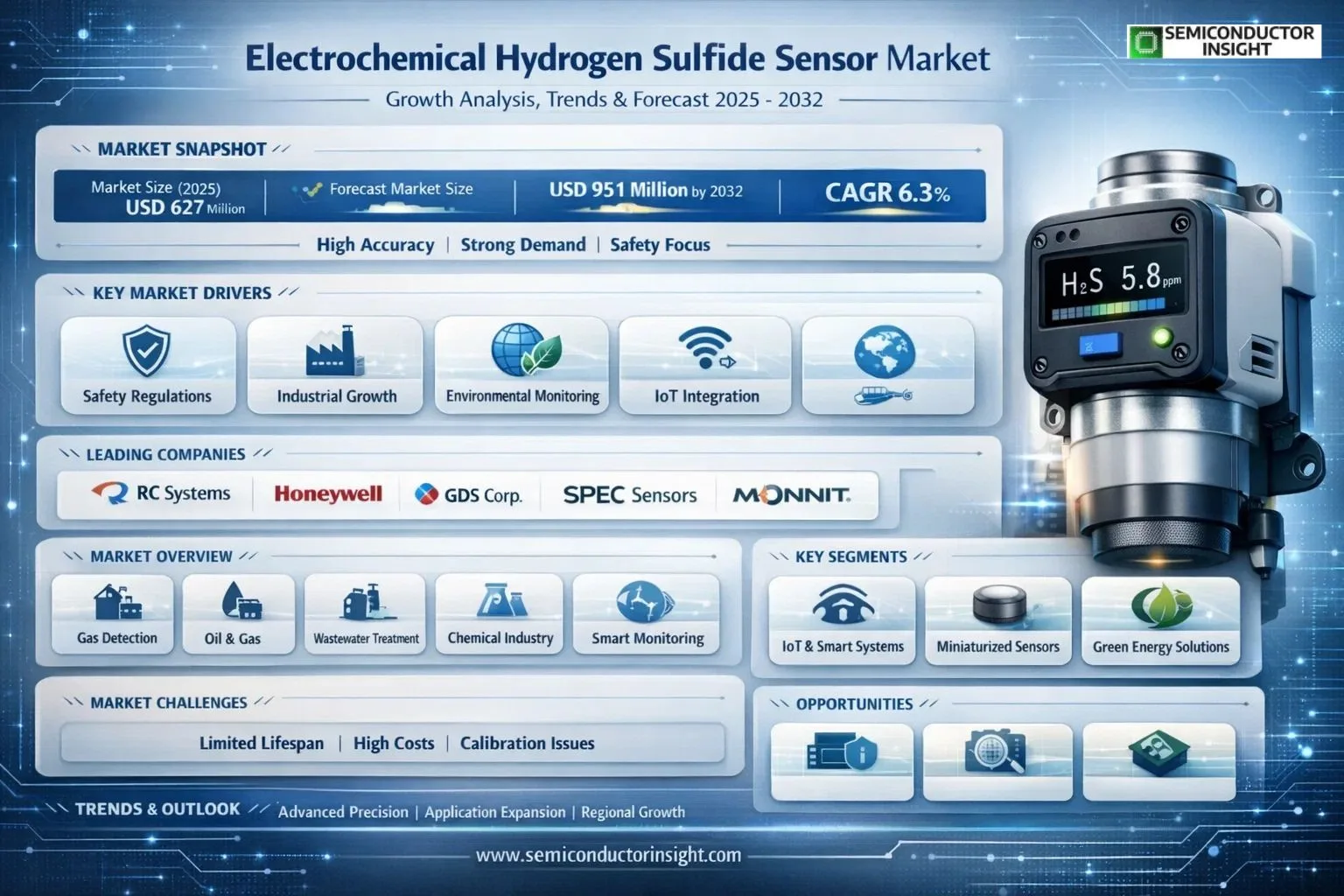
Global Electrochemical Hydrogen Sulfide Sensor market size was valued at USD 627 million in 2025. The market is projected to reach USD 951 million by 2032, exhibiting a CAGR of 6.3% during the forecast period.
Electrochemical hydrogen sulfide sensors are gas detection devices designed for identifying hydrogen sulfide, a highly toxic gas. These sensors operate on electrochemical principles, featuring low power consumption, high precision, high sensitivity, wide linear range, strong anti-interference ability, excellent repeatability, and stability. They find widespread application in the chemical industry, energy sector, environmental protection, and other fields.
The market is experiencing steady growth driven by stringent safety regulations, rising industrial safety concerns, and expanding environmental monitoring needs. Furthermore, advancements in sensor miniaturization and integration with IoT devices are boosting adoption across oil and gas, wastewater treatment, and manufacturing. Key players such as Honeywell, Dräger, Alphasense, RC Systems, and SPEC Sensors dominate with innovative portfolios, focusing on enhanced durability and performance to meet diverse industry demands.
MARKET DRIVERS
Regulatory Compliance and Safety Standards
Electrochemical Hydrogen Sulfide Sensor Market is propelled by stringent global regulations mandating H2S detection in high-risk industries like oil and gas. Agencies such as OSHA and EU ATEX enforce limits below 10 ppm, driving adoption of reliable electrochemical sensors for real-time monitoring. These sensors offer high selectivity and sensitivity, reducing false alarms in hazardous environments.
Expansion in Industrial Sectors
Growth in petrochemical refining and wastewater treatment sectors boosts demand, with the market projected to expand at a 6.2% CAGR through 2028. Electrochemical sensors excel in detecting H2S at ppb levels, supporting safer operations amid rising production volumes. Innovations in portable devices further accelerate market penetration.
➤ Key industries like mining and pulp/paper contribute over 40% of demand, emphasizing the need for durable, low-power sensors.
Urbanization and infrastructure projects in Asia-Pacific amplify the need for fixed and wireless Electrochemical Hydrogen Sulfide Sensor solutions, aligning with broader environmental monitoring trends.
MARKET CHALLENGES
Technical Limitations and Selectivity Issues
Sensitivity to interferents like CO2 and humidity poses challenges in Electrochemical Hydrogen Sulfide Sensor Market, leading to accuracy drifts in humid conditions. Calibration requirements every 6-12 months increase operational complexity for end-users in remote sites.
Other Challenges
High Initial and Maintenance Costs
Premium pricing for advanced electrochemical cells, often exceeding $500 per unit, limits adoption among SMEs. Recurring electrode replacements every 2-3 years add to lifecycle expenses.Supply chain disruptions for rare electrolytes further strain manufacturers, impacting scalability amid fluctuating raw material costs.
MARKET RESTRAINTS
Limited Sensor Lifespan and Durability
Electrochemical Hydrogen Sulfide Sensor Market faces restraints from finite electrode lifespans, typically 24-36 months in aggressive environments, necessitating frequent replacements. This elevates total ownership costs compared to optical alternatives.Extreme temperature fluctuations beyond -40°C to 50°C degrade performance, restricting use in arctic oil fields or tropical refineries. Competition from infrared sensors, which offer longer lifespans, caps market share at around 35% globally.Regulatory hurdles for new sensor approvals delay product launches, while dependency on platinum-based catalysts exposes the market to price volatility in precious metals.
MARKET OPPORTUNITIES
IoT Integration and Smart Monitoring
Advancements in IoT enable wireless Electrochemical Hydrogen Sulfide Sensor networks, opening avenues in predictive maintenance for the market projected to reach $450 million by 2030. Real-time data analytics enhance safety in smart factories.Miniaturization for wearables and drones expands applications in confined space monitoring, with Asia-Pacific growth at 7.5% CAGR driven by biogas sector investments. Hybrid sensor fusions with AI improve interferent rejection.Sustainability initiatives favor low-power electrochemical designs, supporting green hydrogen projects and urban air quality networks globally.
Global Electrochemical Hydrogen Sulfide Sensor Market Trends
Advancements in Sensor Precision and Sensitivity
Electrochemical Hydrogen Sulfide Sensor Market continues to evolve with significant improvements in sensor precision and sensitivity, driven by electrochemical principles that ensure low power consumption, wide linear range, and excellent repeatability. These attributes make the sensors indispensable for detecting hydrogen sulfide gas in hazardous environments. High sensitivity and strong anti-interference capabilities are positioning them as preferred choices in industries requiring reliable gas detection. As regulatory standards for workplace safety and emissions tighten globally, the adoption of these advanced sensors is accelerating, particularly in applications demanding quick response times and long-term stability. Manufacturers are focusing on enhancing resolution levels, such as 0.1ppm and finer variants like 0.05ppm, to meet the needs of precise monitoring scenarios.
Other Trends
Expansion Across Key Applications
Within Electrochemical Hydrogen Sulfide Sensor Market, there is robust growth in diverse applications, including the chemical industry, energy sector, and environmental protection. In the chemical industry, sensors are critical for process safety and leak detection amid complex reactions. The energy sector, encompassing oil, gas, and power generation, relies on them for personnel protection and equipment integrity in H2S-prone operations. Environmental protection efforts are boosting demand, as these sensors support air quality monitoring and compliance with emission controls in industrial zones. Other emerging uses, such as wastewater treatment, further diversify the market landscape.
Competitive Landscape and Regional Dynamics
Competition in Electrochemical Hydrogen Sulfide Sensor Market is intensifying among leading players like RC Systems, Honeywell, GDS Corp, SPEC Sensors, Alphasense, Dräger, and Figaro, who collectively dominate revenue shares through innovation and global distribution networks. Recent developments include product enhancements and strategic partnerships to address market challenges like price fluctuations and supply chain issues. Regionally, North America benefits from established infrastructure and stringent safety regulations, while Asia, particularly China, drives volume growth due to rapid industrialization. Europe emphasizes environmental applications, with key countries like Germany and the UK advancing integration into smart monitoring systems. This geographic diversification underscores the market’s resilience and potential for sustained expansion amid evolving industrial demands.
COMPETITIVE LANDSCAPE
Key Industry Players
Top Manufacturers Dominating Electrochemical Hydrogen Sulfide Sensor Market
Electrochemical Hydrogen Sulfide Sensor Market exhibits a moderately concentrated structure, with a handful of global leaders driving innovation and market share. Key frontrunners include Honeywell, Dräger, and Alphasense, renowned for their advanced electrochemical sensing technologies offering high sensitivity, low power consumption, and robust anti-interference capabilities. These companies collectively hold a substantial portion of the global revenue, with the top five players accounting for a significant percentage in 2025 as the market transitions from a valuation of US$627 million to a projected US$951 million by 2032 at a 6.3% CAGR. Honeywell’s integrated safety solutions and Dräger’s portable detection systems dominate industrial applications in chemical and energy sectors, setting benchmarks for precision and reliability in H2S monitoring.
Beyond the market leaders, a diverse array of niche and regional players contribute to segmentation and innovation, particularly in high-resolution variants like 0.1ppm and 0.05ppm sensors. Companies such as SPEC Sensors, Figaro, and GDS Corp excel in compact, IoT-enabled devices for environmental protection, while Asian firms like Zhengzhou Winsen Electronics Technology and Henan Fosen Electronics Technology are gaining traction with cost-effective solutions tailored for emerging markets in China and Southeast Asia. Additional significant contributors include Monnit for wireless monitoring, Unisense for specialized fermentation applications, and SGX Sensortech for miniature sensors, fostering competition that enhances product repeatability, stability, and application versatility across global regions including North America, Europe, and Asia-Pacific.
List of Key Electrochemical Hydrogen Sulfide Sensor Companies Profiled
- RC Systems
- Honeywell
- GDS Corp
- SPEC Sensors
- Monnit
- Alphasense
- Dräger
- Figaro
- Unisense
- AMT GmbH
- SGX Sensortech
- DD-Scientific
- Nemoto & Co., Ltd
- Zhengzhou Winsen Electronics Technology
- Henan Fosen Electronics Technology
- Guangzhou Luftmy Intelligent Technology
- Sangbay
Segment Analysis:
| Segment Category | Sub-Segments | Key Insights |
| By Type |
|
Resolution 0.1ppm offers a balanced sensitivity suitable for versatile industrial applications.
|
| By Application |
|
Chemical Industry leads due to prevalent use in handling sulfur compounds and hazardous processes.
|
| By End User |
|
Oil & Gas dominates with critical needs for sour gas detection across operations.
|
| By Portability |
|
Fixed/Stationary Sensors prevail for continuous area surveillance.
|
| By Connectivity |
|
Digital Output sensors are favored for modern infrastructure compatibility.
|
Regional Analysis: Electrochemical Hydrogen Sulfide Sensor Market
Asia-Pacific
Explosive growth in oil refineries and petrochemical facilities fuels the Asia-Pacific Electrochemical Hydrogen Sulfide Sensor Market. Heavy investments in upstream exploration heighten the need for dependable sensors to mitigate toxic gas risks, ensuring operational continuity.
Stringent safety standards across the region mandate electrochemical hydrogen sulfide sensors in high-risk industries. Enhanced environmental policies in key nations push industries toward proactive monitoring, solidifying market penetration.
Local manufacturers innovate compact, low-power sensors tailored for diverse applications, from mining to utilities. Integration with IoT platforms elevates the Asia-Pacific Electrochemical Hydrogen Sulfide Sensor Market’s efficiency.
Proximity to semiconductor production supports advanced sensor fabrication, streamlining distribution. Collaborative ecosystems between producers and end-users optimize the Asia-Pacific Electrochemical Hydrogen Sulfide Sensor Market responsiveness.
North America
North America’s Electrochemical Hydrogen Sulfide Sensor Market thrives on technological leadership and mature industrial bases. Shale gas booms and extensive pipeline networks necessitate sophisticated detection systems for safety compliance. Innovation hubs develop next-generation sensors with extended lifespan and wireless capabilities, catering to oilfield services and refining sectors. Regulatory frameworks emphasize emission controls, spurring adoption in environmental monitoring. Wastewater facilities increasingly deploy these sensors for precise gas management, while mining operations leverage them for hazard mitigation. Strong R&D investments foster market resilience against volatile energy prices.
Europe
Europe’s Electrochemical Hydrogen Sulfide Sensor Market emphasizes sustainability and precision engineering. Strict EU directives on workplace safety and air quality drive deployment in chemical plants and biogas facilities. Advanced manufacturing integrates sensors into smart factory systems, enhancing process efficiency. Offshore wind and natural gas infrastructure heighten demand for corrosion-resistant models. Collaborative research initiatives across nations accelerate product enhancements, focusing on selectivity and response times. Environmental remediation projects further embed these sensors in urban utilities.
South America
South America’s Electrochemical Hydrogen Sulfide Sensor Market gains traction amid resource extraction surges. Brazil and Venezuela’s oil sectors prioritize sensors for sour gas handling in refineries. Mining expansions in the Andes demand rugged devices for underground safety. Emerging wastewater infrastructure adopts electrochemical solutions for compliance. Regional partnerships with global suppliers aid technology transfer, bolstering local capabilities. Infrastructure investments signal steady market evolution.
Middle East & Africa
The Middle East & Africa Electrochemical Hydrogen Sulfide Sensor Market centers on vast hydrocarbon reserves. Gulf nations’ mega-refineries require high-performance sensors for H2S-rich environments. Africa’s growing energy projects integrate detection for operational integrity. Harsh climates spur development of durable, heat-resistant models. Safety regulations in upstream operations promote widespread use, while desalination plants employ them for process protection. Strategic alliances enhance market accessibility.
Report Scope
This market research report provides a comprehensive analysis of Electrochemical Hydrogen Sulfide Sensor Market, covering the forecast period 2025–2032. It offers detailed insights into market dynamics, technological advancements, competitive landscape, and key trends shaping the industry.
Key focus areas of the report include:
- Market Overview: The report begins with an overview outlining its current market scenario, key growth indicators, and industry transformation drivers. It discusses macroeconomic factors, demand–supply balance, regulatory landscape, and the strategic role of electrochemical hydrogen sulfide sensors in powering advancements across industries such as chemical, energy, environmental protection, and others.
- Market Size & Forecast: Historical data and future projections for revenue, unit shipments, and market value across major regions and segments.
- Segmentation Analysis: Detailed breakdown by product type, technology, application, and end-user industry to identify high-growth segments and investment opportunities.
- Regional Insights: Insights into market performance across North America, Europe, Asia-Pacific, Latin America, and the Middle East & Africa, including country-level analysis where relevant.
- Competitive Landscape: Profiles of leading market participants, including their product offerings, R&D focus, manufacturing capacity, pricing strategies, and recent developments such as mergers, acquisitions, and partnerships.
- Technology Trends & Innovation: Assessment of emerging technologies, integration of AI/IoT, semiconductor design trends, fabrication techniques, and evolving industry standards.
- Market Drivers & Restraints: Evaluation of factors driving market growth along with challenges, supply chain constraints, regulatory issues, and market-entry barriers.
- Stakeholder Insights: Insights for component suppliers, OEMs, system integrators, investors, and policymakers regarding the evolving ecosystem and strategic opportunities.
Primary and secondary research methods are employed, including interviews with industry experts, data from verified sources, and real-time market intelligence to ensure the accuracy and reliability of the insights presented.
FREQUENTLY ASKED QUESTIONS:
What is the current market size of Electrochemical Hydrogen Sulfide Sensor Market?
-> Electrochemical Hydrogen Sulfide Sensor Market was valued at USD 627 million in 2025 and is expected to reach USD 951 million by 2032, at a CAGR of 6.3% during the forecast period.
Which key companies operate in Electrochemical Hydrogen Sulfide Sensor Market?
-> Key players include RC Systems, Honeywell, GDS Corp, SPEC Sensors, Monnit, Alphasense, Dräger, Figaro, Unisense, AMT GmbH, among others.
What are the key growth drivers?
-> Key growth drivers include demand in chemical industry, energy sector, and environmental protection, stringent safety regulations, and advancements in sensor precision and sensitivity.
Which region dominates the market?
-> Asia is the fastest-growing region, while North America remains a dominant market.
What are the emerging trends?
-> Emerging trends include higher resolution sensors (e.g., 0.05ppm), improved anti-interference capabilities, and integration for real-time monitoring in industrial applications.

Get Sample Report PDF for Exclusive Insights
Report Sample Includes
- Table of Contents
- List of Tables & Figures
- Charts, Research Methodology, and more...


