Electric Focus Lens Market Insights
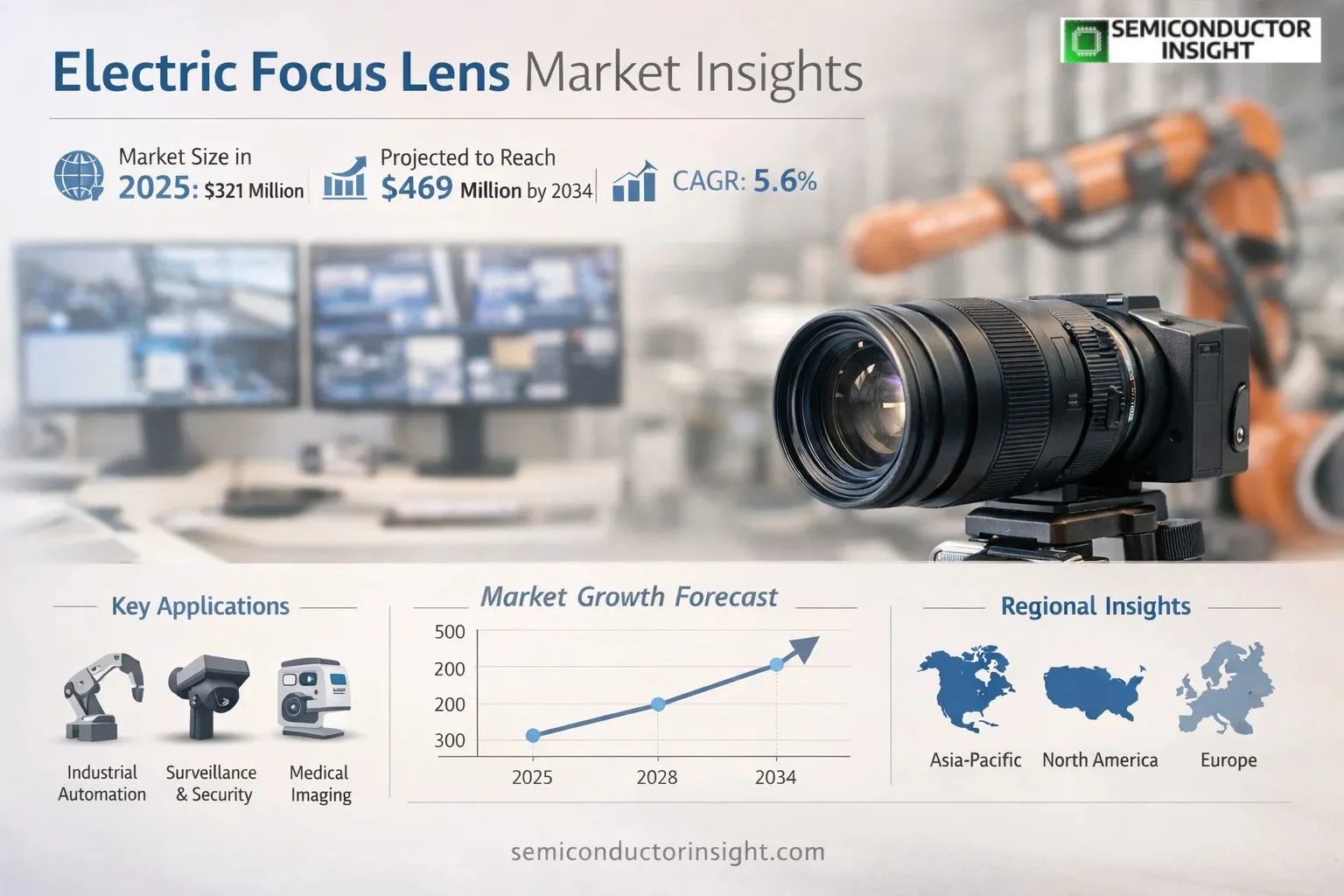
Global Electric Focus Lens Market size was valued at USD 321 million in 2025. The market is projected to grow from USD 338 million in 2026 to USD 469 million by 2034, exhibiting a CAGR of 5.6% during the forecast period.
An electric focus lens is an optical component that adjusts focal length via motorized mechanisms, enabling precise and rapid focusing. These lenses are widely utilized in photography, surveillance systems, industrial automation, and military applications due to their ability to enhance operational efficiency and imaging stability. The integration of high-precision optics with automated control systems makes them indispensable in modern imaging solutions.
The market growth is driven by increasing demand for automation across industries, advancements in optical technologies, and rising adoption of surveillance systems. Key players such as Optotune, TAMRON, and Edmund Optics are expanding their product portfolios through innovation and strategic collaborations. For instance, recent developments include compact designs with improved response times for industrial machine vision applications.
MARKET DRIVERS
Increasing Demand for Precision Imaging
Electric Focus Lens Market is experiencing growth due to rising demand for high-precision imaging solutions in industries like surveillance, medical imaging, and industrial automation. These lenses provide superior focus control compared to traditional manual lenses, enabling more accurate image capture in critical applications.
Advancements in IoT and Smart Camera Systems
Integration of electric focus lenses with IoT-enabled cameras has expanded their applications in smart city projects and industrial IoT. The market is projected to grow at 7.2% CAGR through 2028 as these technologies become more prevalent. Automated focus adjustment is particularly valuable in remote monitoring applications.
➤ Major camera manufacturers are shifting 68% of their production to electric focus lens systems by 2026 to meet evolving market demands
The miniaturization of components has enabled electric focus lenses to be incorporated into compact devices without compromising performance, opening new market segments.
MARKET CHALLENGES
High Production Costs and Technical Complexities
Electric Focus Lens Market faces challenges from the sophisticated engineering required for precision focusing mechanisms. Manufacturing these components demands specialized equipment and skilled labor, which can increase production costs by 30-45% compared to conventional lenses.
Other Challenges
Power Consumption Concerns
Electric focus lenses require continuous power for operation, which can be a limitation in battery-powered devices. Manufacturers are addressing this through energy-efficient designs, but it remains a key challenge in certain applications.
MARKET RESTRAINTS
Adoption Barriers in Price-Sensitive Markets
While Electric Focus Lens Market is growing in industrial and professional segments, price sensitivity in consumer markets has slowed adoption. The premium cost of electric focus systems (typically 40-60% higher than manual alternatives) creates a significant adoption barrier in price-conscious segments.
MARKET OPPORTUNITIES
Emerging Applications in Medical Robotics
Electric Focus Lens Market is poised for expansion in surgical robotics and medical imaging systems, where precise focus control is critical. Industry analysts project a $850 million opportunity in medical applications by 2027 as robotic-assisted surgeries become more common.
Automotive vision systems represent another significant growth avenue, with electric focus lenses enabling adaptive focus for advanced driver-assistance systems (ADAS) in next-generation vehicles.
Key Electric Focus Lens Market Trends
Industrial Automation Driving Adoption of Electric Focus Lenses
Electric Focus Lens Market is experiencing significant growth due to increasing demand in industrial automation applications. These motorized lenses provide precise focus control for machine vision systems used in quality inspection, robotics, and manufacturing processes. Their ability to maintain consistent focus during high-speed operations gives them an edge over manual alternatives in production environments.
Other Trends
Surveillance Sector Expansion
Security monitoring applications account for nearly 28% of Electric Focus Lens deployments, with growing adoption in smart city projects and commercial security systems. The lenses’ remote focus adjustment capabilities make them ideal for PTZ cameras and automated surveillance networks requiring continuous monitoring across varying distances.
Technological Advancements in Optical Components
Leading manufacturers like Optotune and Edmund Optics are developing electric focus lenses with improved response times and durability. Recent innovations include quieter motor mechanisms, reduced power consumption designs, and enhanced dust/water resistance – features particularly valued in outdoor and industrial environments.
Regional Market Developments
Asia-Pacific represents the fastest-growing region for Electric Focus Lens adoption, driven by expanding manufacturing sectors in China and increasing security infrastructure investments. North America maintains strong demand from military and industrial applications, while European markets show steady growth in automation-focused implementations.
Integration with Smart Imaging Systems
Electric Focus Lens Market is benefiting from integration with AI-powered imaging systems. Automated focus tracking algorithms combined with electric lens capabilities enable sophisticated applications in autonomous vehicles, medical imaging, and precision agriculture. This trend is expected to create new growth avenues for market players in coming years.
COMPETITIVE LANDSCAPE
Key Industry Players
Oligopolistic Market Dominated by Optical Technology Specialists
Optotune leads Electric Focus Lens Market with its innovative tunable lens technology, accounting for a significant revenue share among the top five global players. The market features both specialized optical component manufacturers and diversified imaging solution providers, with TAMRON emerging as a key player leveraging its legacy in camera lens technology. Sintec Optronics and Votinfrared have gained substantial footholds in the Asian market through precision engineering and cost-effective solutions.
Niche segments show strong participation from industrial optics specialists like Edmund Optics and Wavelength OE, particularly in scientific and military applications. Japanese manufacturers maintain technological leadership in high-precision focus mechanisms, while Chinese firms are rapidly expanding production capacity. The competitive landscape is characterized by strategic partnerships between lens developers and automation equipment manufacturers to create integrated vision systems.
List of Key Electric Focus Lens Companies Profiled
- Optotune
- TAMRON
- Sintec Optronics
- Votinfrared
- Yamakocn
- Edmund Optics
- Wavelength OE
- Canon
- Sony
- Fujifilm
- Navitar
- Thorlabs
- Schneider Kreuznach
- Kowa Optimed
- Lensation
Segment Analysis:
| Segment Category | Sub-Segments | Key Insights |
| By Type |
|
Standard Zoom Lens maintains a dominant position due to its versatility and widespread adoption across multiple applications.
|
| By Application |
|
Industrial Detection and Automation is the leading application segment, driven by the critical need for precision and reliability in automated systems.
|
| By End User |
|
Original Equipment Manufacturers (OEMs) represent the most influential end-user segment due to their role in designing and producing final integrated systems.
|
| By Technology Integration |
|
Lenses with Integrated Controllers & Sensors are emerging as a key growth area, enhancing functionality and ease of use.
|
| By Operational Environment |
|
Harsh Industrial Environments constitute a critical and demanding segment that dictates specific product design and material choices.
|
Regional Analysis: Asia-Pacific Electric Focus Lens Market
Asia-Pacific
Japan and South Korea are pioneering the integration of Electric Focus Lens modules in automotive LiDAR and advanced camera systems for autonomous driving. This focus on premium, high-reliability applications drives technological refinement in the regional Electric Focus Lens Market, pushing for improved durability and performance in harsh conditions.
National policies in China, India, and other Southeast Asian countries actively promote smart factories and automation. These initiatives create a direct and sustained demand for industrial machine vision systems, a major application segment that relies heavily on precise Electric Focus Lens for quality inspection and robotic guidance.
The region invests heavily in R&D for optical technologies. Leading companies are focused on further miniaturizing the Electric Focus Lens, enhancing power efficiency, and developing faster autofocus algorithms to maintain a technological edge, especially for next-generation mobile devices and wearable tech.
North America
North America presents a highly advanced and innovation-driven market for the Electric Focus Lens. Demand is primarily fueled by the robust defense and aerospace sectors, which require extremely reliable and precise focusing mechanisms for surveillance and targeting systems. The region exhibits strong demand for high-end applications in professional cinematography, medical imaging devices, and specialized industrial automation. Market dynamics here are characterized by a focus on high-value, low-volume, and highly customizable Electric Focus Lens solutions, with significant R&D investments aimed at enhancing speed, accuracy, and integration with sophisticated software control systems.
Europe
Europe maintains a strong position Electric Focus Lens Market, driven by its premium automotive manufacturing and industrial automation sectors. German and French automakers are key adopters, incorporating these lenses into sophisticated ADAS and in-cabin monitoring systems. The region also has a significant presence in high-precision manufacturing equipment, where machine vision systems with Electric Focus Lens are critical. European market dynamics emphasize stringent quality standards, regulatory compliance, and a strong focus on developing energy-efficient and durable optical components for use in demanding environments.
South America
Electric Focus Lens Market in South America is in a developing phase, with growth primarily linked to specific industrial modernization efforts. Brazil and Argentina show increasing adoption in manufacturing sectors like automotive assembly and food processing for quality control applications. The market dynamics are influenced by regional economic conditions, with demand growing gradually as industries invest in automation to improve productivity. Import of technology from Asia and North America is common, with local assembly and servicing forming an emerging segment of the market.
Middle East & Africa
This region shows nascent but promising growth for Electric Focus Lens Market, driven by infrastructure development and security investments. In the Middle East, demand stems from large-scale security and surveillance projects in smart cities, as well as applications in the oil & gas industry for pipeline inspection. In parts of Africa, the growth is linked to telecommunications infrastructure and modest growth in consumer electronics. The market dynamics are characterized by project-based demand and a reliance on international suppliers, with potential for growth as industrial diversification continues.
Report Scope
This market research report provides a comprehensive analysis of the Electric Focus Lens Market , covering the forecast period 2025–2034. It offers detailed insights into market dynamics, technological advancements, competitive landscape, and key trends shaping the industry.
Key focus areas of the report include:
- Market Overview: The report begins with an overview outlining the current market scenario, key growth indicators, and industry transformation drivers. It discusses macroeconomic factors, demand–supply balance, regulatory landscape, and the strategic role of high-precision automation in powering advancements across industries such as photography, security monitoring, industrial automation, and military applications.
- Market Size & Forecast: Historical data and future projections for revenue, unit shipments, and market value across major regions and segments, including a detailed CAGR analysis.
- Segmentation Analysis: Detailed breakdown by product type (e.g., Standard Zoom Lens, Telephoto Zoom Lens) and application (e.g., Photography, Security Monitoring, Industrial Detection and Automation) to identify high-growth segments and investment opportunities.
- Regional Insights: Insights into market performance across North America, Europe, Asia-Pacific, South America, and the Middle East & Africa, including country-level analysis for key markets like the U.S., China, Japan, and Germany.
- Competitive Landscape: Profiles of leading market participants, including their product offerings, market share, R&D focus, manufacturing capacity, and recent developments such as mergers, acquisitions, and partnerships.
- Technology Trends & Innovation: Assessment of emerging technologies in optical design and motorized focus control, integration trends, and evolving industry standards for imaging stability and operational convenience.
- Market Drivers & Restraints: Evaluation of factors driving market growth along with challenges, supply chain constraints, pricing trends, and market-entry barriers.
- Stakeholder Insights: Insights for lens manufacturers, component suppliers, system integrators, distributors, investors, and policymakers regarding the evolving ecosystem and strategic opportunities.
Primary and secondary research methods are employed, including interviews with industry experts, manufacturers, and suppliers, alongside data from verified sources and in-depth surveys to ensure the accuracy and reliability of the insights presented.
FREQUENTLY ASKED QUESTIONS:
What is the current market size of Electric Focus Lens Market?
-> Global Electric Focus Lens Market was valued at USD 321 million in 2025 and is projected to reach USD 469 million by 2034, growing at a CAGR of 5.6% during the forecast period.
Which key companies operate Electric Focus Lens Market?
-> Key players include Optotune, Sintec Optronics, Votinfrared, TAMRON, Yamakocn, Wavelength OE, and Edmund Optics, among others. Global top five players held a significant revenue share in 2025.
What are the key growth drivers?
-> Key growth drivers include increasing demand from photography and security monitoring, adoption in industrial automation and inspection for fast and accurate focus switching, and the need for long-distance and frequent focus adjustment operations.
Which region dominates the market?
-> The markets in North America (U.S.) and Asia (China) are significant, with China expected to reach a substantial market size. Detailed regional analysis covers North America, Europe, Asia, South America, and Middle East & Africa.
What are the emerging trends?
-> Emerging trends include advancements in high-precision optical design integrated with automation technology, growing application in military and industrial detection, and the development of more compact and efficient motor-driven lens systems.

Get Sample Report PDF for Exclusive Insights
Report Sample Includes
- Table of Contents
- List of Tables & Figures
- Charts, Research Methodology, and more...
 Download Sample Report PDF