EEG Hardware Market Insights
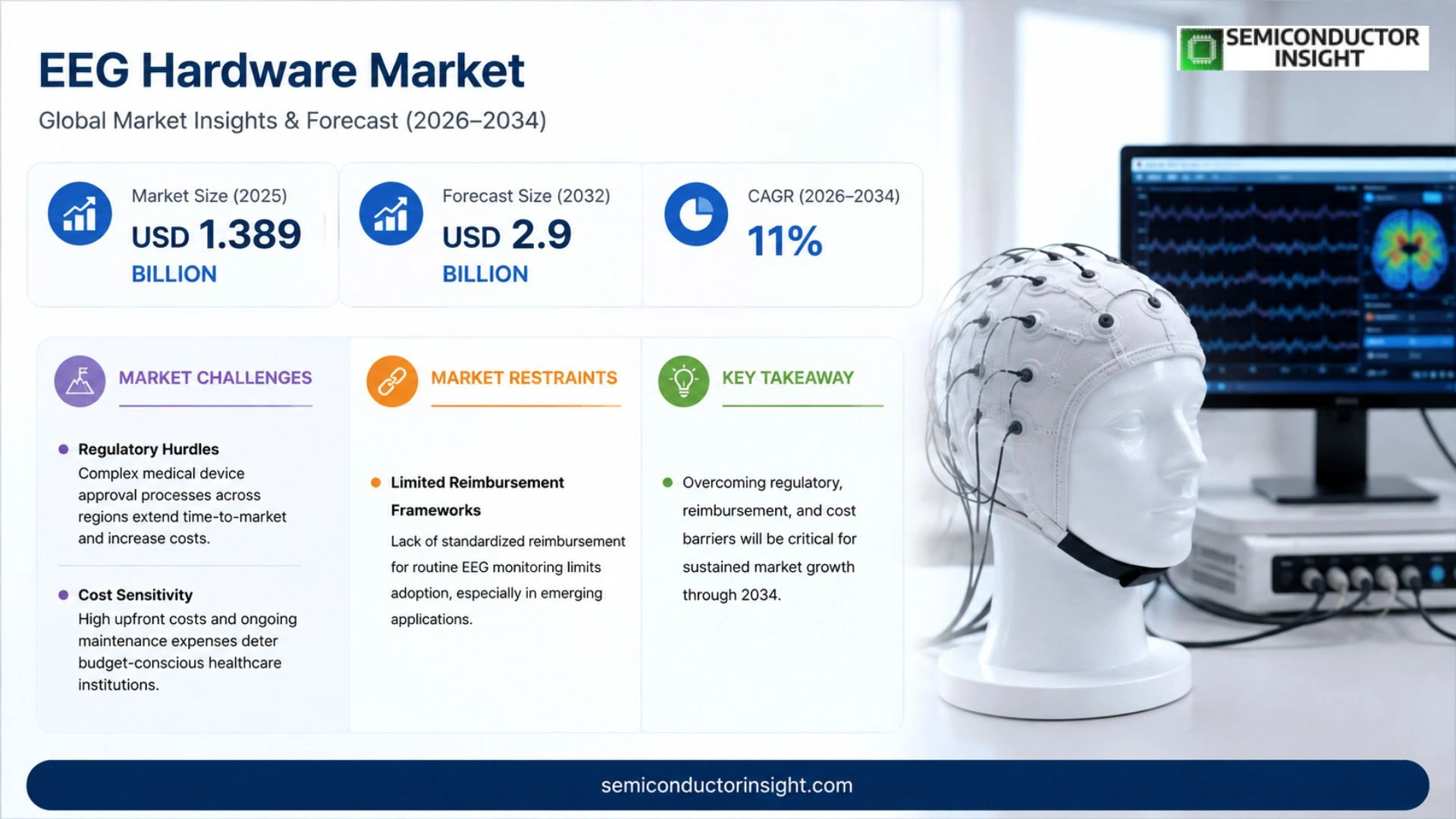
EEG Hardware market size was valued at USD 1.389 billion in 2025 and is forecasted at USD 2.9 billion by 2032, reflecting an annual growth rate of roughly 11 % over the period.
EEG Hardware comprises electroencephalography acquisition equipment used to record brain electrical activity. Typical components include amplifiers or headboxes, electrode caps or sensor nets, individual electrodes and leads, patient‑interface modules, optional wireless transmitters and related accessories for routine clinical EEG, intensive‑care continuous EEG, ambulatory monitoring and research‑grade recordings.
The expansion of the sector stems from several dynamics. Growing demand for portable and wireless EEG solutions enables clinicians and researchers to capture data outside traditional laboratory settings, while integration of machine‑learning algorithms and cloud‑based analytics improves signal interpretation speed and accuracy. Supply‑chain advances,such as low‑noise analog front‑end chips, high‑density connector systems and modular cap designs,have lowered entry barriers for new entrants. Companies such as NeuroScan, Brain Products, BioSemi and Emotiv have recently announced firmware upgrades that support real‑time artifact rejection and remote data streaming, illustrating how product innovation fuels adoption across hospitals, sleep labs and neuroscience institutes.
MARKET DRIVERS
Growing Clinical Adoption
Hospitals and outpatient clinics are expanding the use of electroencephalography for both diagnostic and therapeutic monitoring. The shift toward objective neuro‑physiological metrics is prompting procurement teams to replace legacy systems with newer, high‑resolution devices. As a result, EEG Hardware Market is seeing a steady uptick in order volumes, especially in neurology units that demand real‑time brain‑wave analytics.
Advances in Sensor Technology
Miniaturized dry‑electrode arrays and wireless transmission modules are reducing setup time and patient discomfort. Manufacturers that integrate AI‑assisted artifact reduction are gaining traction with researchers who need cleaner datasets for cognitive studies. These technology strides are translating into higher price points justified by tangible workflow efficiencies.
➤ “Device ergonomics and data fidelity together are reshaping purchasing decisions across academic and private centers.”
Consequently, vendors are allocating capital toward R&D pipelines that prioritize modular designs, a move that sustains momentum across EEG Hardware Market while opening cross‑selling avenues for complementary software suites.
MARKET CHALLENGES
Regulatory Hurdles
Medical device clearance processes differ markedly across regions, creating a fragmented launch timeline. In jurisdictions where classification thresholds are stringent, companies must invest in extensive clinical trials, inflating time‑to‑market and squeezing margins. This environment forces smaller players to either partner with larger incumbents or focus on niche applications.
Other Challenges
Cost Sensitivity
Purchasing committees remain cautious about allocating capital to equipment that requires ongoing maintenance contracts. Even though newer systems lower per‑study costs, upfront expenditures can deter budget‑constrained institutions, slowing overall market penetration.
MARKET RESTRAINTS
Limited Reimbursement Frameworks
Healthcare payers have yet to establish uniform reimbursement codes for routine EEG monitoring, especially in emerging therapeutic areas such as neurofeedback and sleep disorder management. Without clear coverage policies, providers hesitate to adopt premium hardware, capping the growth ceiling of EEG Hardware Market in several key regions.
MARKET OPPORTUNITIES
Home‑Based Monitoring Solutions
The convergence of portable EEG units with cloud‑based analytics platforms creates a viable path for remote patient monitoring. Tele‑neuro services are expanding, and clinicians are increasingly comfortable interpreting high‑quality data gathered outside traditional settings. Companies that can certify reliable at‑home devices while offering secure data pipelines stand to capture a sizable share of the evolving EEG Hardware Market.
EEG Hardware Market Trends
Shift Toward Portable and Wireless Systems
The market is witnessing a measurable migration from bulkier, stationary acquisition rigs to compact, battery‑operated EEG units. In 2025 the average selling price of a full‑featured system hovered around US$18,000, yet sales volume of portable configurations accounted for roughly 38 % of the 84,500 units shipped globally. This mix reflects clinicians’ desire for bedside monitoring that does not impede patient mobility, as well as researchers’ need for field‑compatible data capture. Manufacturers that have accelerated the integration of low‑noise analog front‑ends with wireless transmitters are capturing a larger share of hospital ICU and sleep‑lab contracts, while also opening revenue streams in outpatient neurology clinics.
Other Trends
AI‑Enabled Signal Processing
Artificial‑intelligence algorithms are being embedded directly into acquisition hardware, turning raw voltage traces into artifact‑cleaned, clinically actionable metrics in real time. Vendors that pair proprietary machine‑learning models with their amplifiers report gross margins edging toward the upper bound of the 40‑58 % range, largely because the software layer creates recurring licensing income. The practical outcome is faster diagnostic turnaround for epilepsy monitoring units, which translates into higher bed turnover and incremental cost recovery for hospitals.
Integration of Cloud‑Based Workflow
Cloud connectivity is reshaping the post‑acquisition stage. By routing encrypted EEG streams to centralized servers, institutions can apply continuous quality‑control protocols, share data across research consortia, and tap into remote specialist interpretation without expanding on‑site staffing. The shift reduces the need for on‑premise storage hardware, lowers total cost of ownership, and aligns with the growing preference for subscription‑style service models. As a result, midstream manufacturers that certify their systems for seamless cloud integration are positioning themselves as preferred suppliers for both high‑volume clinical networks and niche academic projects.
COMPETITIVE LANDSCAPE
Key Industry Players
EEG Hardware Competitive Overview – 2025 & Beyond
NeuroScan continues to dominate EEG Hardware arena, leveraging an extensive product suite that spans clinical‑grade amplifiers, modular electrode caps, and integrated software platforms. Its ability to couple low‑noise analog front‑ends with scalable channel architectures has secured a commanding share among hospital networks and large research consortia. The company’s aggressive portfolio refreshes, combined with strategic partnerships for AI‑enabled signal interpretation, reinforce its position as the reference supplier for both ICU continuous EEG and high‑density research systems. Competitive pressure stems from a modest consolidation trend, where mid‑size firms are merging to broaden channel count offerings and to meet rigorous safety‑certification requirements across regions.
In parallel, several niche innovators are reshaping segments of the market. Brain Products and BioSemi specialize in high‑resolution research‑grade hardware, attracting neuroscience labs that prioritize artifact suppression and open‑source data pipelines. Companies such as Emotiv, NeuroSky, and Interaxon focus on portable, wireless solutions that appeal to emerging BCI applications and remote monitoring services. Meanwhile, OpenBCI and Cognionics have cultivated developer communities around modular, dry‑electrode technologies, driving adoption in educational and start‑up environments. Advanced Brain Monitoring, ANT Neuro, and Neuroelectrics differentiate themselves through integrated cloud‑based analytics, targeting clinics that seek turnkey diagnostic workflows. Traditional medical equipment manufacturers,Nihon Kohden, Cadwell, Natus, and EGI,remain strong in regulated markets, capitalising on established service networks and regulatory expertise.
List of Key EEG Hardware Companies Profiled
- NeuroScan
- Brain Products
- BioSemi
- Emotiv
- NeuroSky
- Advanced Brain Monitoring
- Interaxon
- ANT Neuro
- Neuroelectrics
- OpenBCI
- Cognionics
- Natus
- Nihon Kohden
- Cadwell
- EGI
Segment Analysis:
| Segment Category | Sub-Segments | Key Insights |
| By Type |
|
Clinical Diagnostic Grade focuses on reliability, low-noise amplification and compliance with medical safety standards.
|
| By Application |
|
Neurology Clinics drive demand for devices that combine ease of use with high‑fidelity signal capture.
|
| By End User |
|
Hospitals seek comprehensive solutions that align with stringent regulatory requirements and multidisciplinary workflows.
|
| By Integration Level |
|
Integrated Remote/Cloud Workflow is reshaping how data is captured, analyzed and shared.
|
| By Channel Count Tier |
|
64‑128 Channels offers the optimal balance for advanced clinical and research applications.
|
Regional Analysis: EEG Hardware Market
The FDA’s recent class II re‑classification of several wireless EEG platforms reduces time‑to‑market for manufacturers. Clear labeling requirements and a streamlined 510(k) pathway have lowered entry barriers, prompting both established firms and emerging players to file new applications, especially for portable headsets aimed at home monitoring.
Medicare’s expanded coverage for outpatient EEG services, coupled with private payer pilots for tele‑EEG, reduces financial risk for providers. This reimbursement comfort enables hospitals to invest in multi‑channel devices that support both clinical and research workflows, accelerating overall market depth.
Dry‑electrode and Bluetooth‑enabled systems are gaining traction in academic labs because they cut setup time by half. Early adopters cite improved patient throughput and the ability to collect data in naturalistic environments, a shift that reshapes procurement criteria toward flexibility and user experience.
Neurology departments remain primary buyers, yet a noticeable surge in acquisitions by biotech firms seeking biomarker data for drug development is evident. This cross‑sector demand diversifies the customer base and encourages vendors to tailor software bundles for research analytics alongside clinical reporting.
Europe
Europe’s EEG hardware market reflects a fragmented landscape where national health systems dictate procurement cycles. Germany and France lead in hospital‑based deployments, emphasizing integrated platforms that align with electronic health‑record standards. Meanwhile, the United Kingdom’s recent emphasis on digital health has fostered pilot programs for community‑based EEG, prompting manufacturers to adapt modular designs that can be scaled across primary care networks. Regulatory harmonization under the Medical Device Regulation (MDR) creates a unified pathway, yet localized reimbursement policies still cause variance in adoption speed across member states. The overall dynamic yields a steady, region‑wide diffusion of advanced EEG solutions, anchored by strong academic collaborations.
Asia‑Pacific
The Asia‑Pacific region is characterized by rapid urbanization and increasing investment in neuro‑diagnostic capacity. China’s expansive public‑hospital reforms and Japan’s aging population drive demand for high‑throughput EEG systems capable of handling large patient volumes. Emerging economies such as India and South Korea are witnessing a rise in private clinics that favor cost‑effective, portable EEG units for outpatient services. Although regulatory frameworks differ widely, cross‑border partnerships are emerging, with multinational vendors establishing joint ventures to navigate local approval processes. This diversified demand pattern accelerates product localization and creates opportunities for both premium and budget‑segment hardware.
South America
In South America, Brazil and Argentina dominate market activity, primarily through government‑sponsored neurology programs aimed at early detection of epilepsy. Limited reimbursement structures push hospitals toward lower‑cost, reusable electrode kits, yet there is a growing niche for wireless solutions that support remote monitoring in rural areas. International manufacturers often enter through distributorship agreements, adapting to local pricing sensitivities while offering service contracts that address maintenance challenges. The region’s trajectory is shaped by a balance between affordability constraints and a clear need for scalable EEG capabilities across varied health‑care settings.
Middle East & Africa
The Middle East & Africa segment shows a dichotomy between well‑funded Gulf Cooperation Council (GCC) health systems and resource‑constrained markets in sub‑Saharan Africa. GCC countries invest heavily in tertiary care centers that procure state‑of‑the‑art EEG suites, leveraging them as regional referral hubs. Conversely, African nations prioritize basic neuro‑diagnostic tools, often relying on refurbished equipment to expand service coverage. Partnerships with NGOs and public‑private initiatives are instrumental in introducing affordable EEG hardware, while training programs aim to build local expertise. This dual‑track development underscores the importance of flexible product offerings that can serve both high‑end and cost‑sensitive environments within the same broader region.
Report Scope
This market research report provides a comprehensive analysis of the EEG Hardware Market , covering the forecast period 2026–2034. It offers detailed insights into market dynamics, technological advancements, competitive landscape, and key trends shaping the industry.
Key focus areas of the report include:
- Market Overview: The report begins with an overview outlining its current market scenario, key growth indicators, and industry transformation drivers. It discusses macroeconomic factors, demand–supply balance, regulatory landscape, and the strategic role of semiconductors in powering advancements across industries such as automotive, telecommunications, consumer electronics, and industrial automation.
- Market Size & Forecast: Historical data and future projections for revenue, unit shipments, and market value across major regions and segments.
- Segmentation Analysis: Detailed breakdown by product type, technology, application, and end-user industry to identify high-growth segments and investment opportunities.
- Regional Insights: Insights into market performance across North America, Europe, Asia-Pacific, Latin America, and the Middle East & Africa, including country-level analysis where relevant.
- Competitive Landscape: Profiles of leading market participants, including their product offerings, R&D focus, manufacturing capacity, pricing strategies, and recent developments such as mergers, acquisitions, and partnerships.
- Technology Trends & Innovation: Assessment of emerging technologies, integration of AI/IoT, semiconductor design trends, fabrication techniques, and evolving industry standards.
- Market Drivers & Restraints: Evaluation of factors driving market growth along with challenges, supply chain constraints, regulatory issues, and market-entry barriers.
- Stakeholder Insights: Insights for component suppliers, OEMs, system integrators, investors, and policymakers regarding the evolving ecosystem and strategic opportunities.
Primary and secondary research methods are employed, including interviews with industry experts, data from verified sources, and real-time market intelligence to ensure the accuracy and reliability of the insights presented.
FREQUENTLY ASKED QUESTIONS:
What is the current market size of EEG Hardware Market?
-> EEG Hardware market is forecasted at USD 2.9 billion by 2032, reflecting an annual growth rate of roughly 11 % over the period.
Which key companies operate in EEG Hardware Market?
-> Key players include NeuroScan, Brain Products, BioSemi, EGI, Emotiv, NeuroSky, Advanced Brain Monitoring, Interaxon, ANT Neuro, Neuroelectrics, OpenBCI, Cognionics, Natus, Nihon Kohden, and Cadwell.
What are the key growth drivers?
-> Key growth drivers include growing adoption of portable and wireless EEG devices, integration of artificial intelligence and cloud computing for advanced data analysis, and increasing demand from clinical diagnostics, intensive care monitoring, ambulatory settings, and neuroscience research.
Which region dominates the market?
-> Regional dominance information is not specified in the provided reference content.
What are the emerging trends?
-> Emerging trends include portable and wireless EEG solutions, AI/ML‑enhanced signal processing, cloud‑based workflow integration, and the development of higher‑channel count systems for both clinical and research applications.
Get Sample Report PDF for Exclusive Insights
Report Sample Includes
- Table of Contents
- List of Tables & Figures
- Charts, Research Methodology, and more...