Edge Intelligence Vision Chips Market, Trends, Business Strategies 2026-2034

Global Edge Intelligence Vision Chips Market was valued at USD 647 million in 2025 and is projected to reach USD 1507 million by 2034, growing at a CAGR of 14.7% during the forecast period.

PDF Icon Download Sample Report PDF
  • Quick Dispatch

    All Orders

  • Secure Payment

    100% Secure Payment

Price range: $1,500.00 through $4,250.00

Clear

Edge Intelligence Vision Chips Market Insights

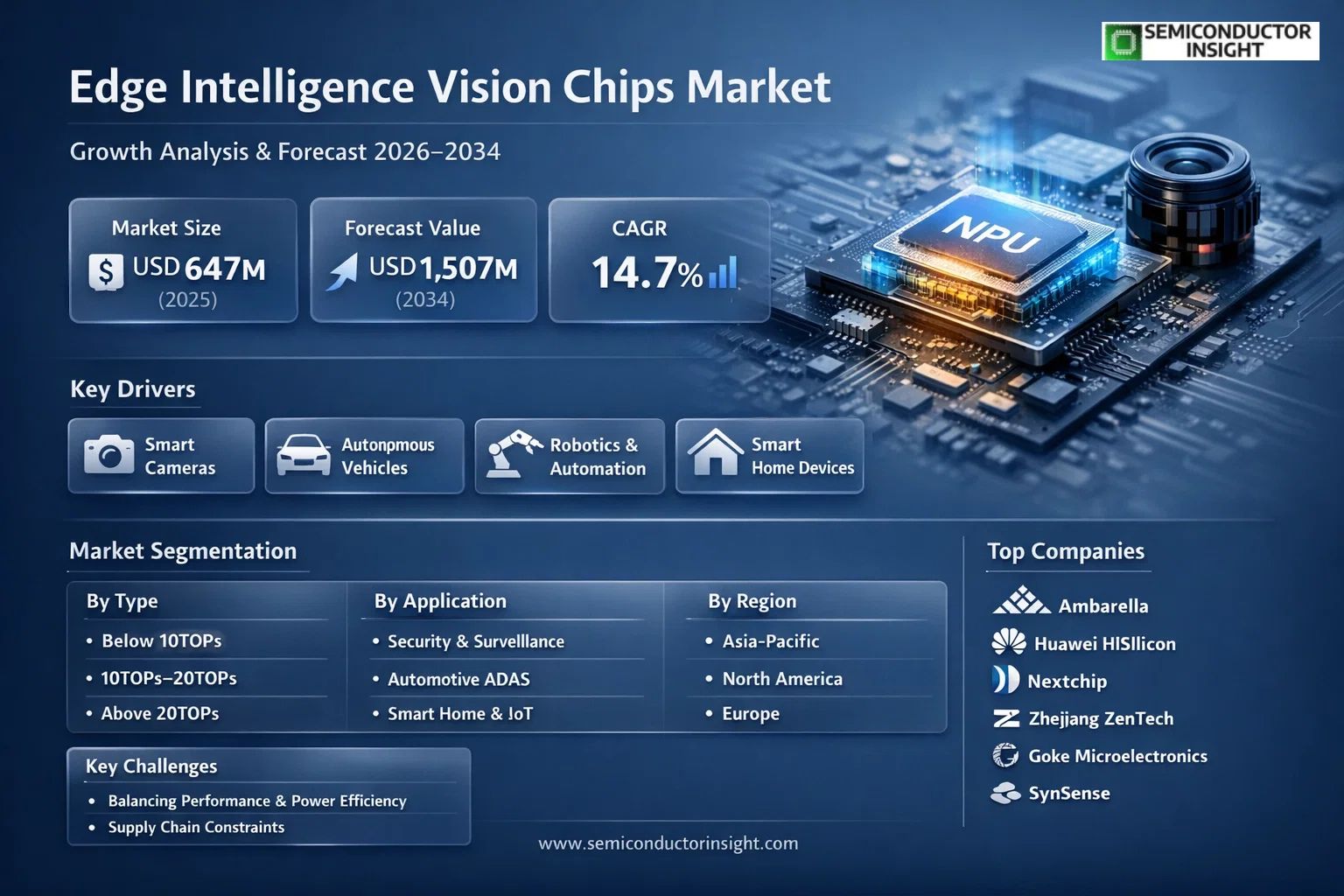
Global Edge Intelligence Vision Chips market size was valued at USD 647 million in 2025. The market is projected to grow from USD 742 million in 2026 to USD 1,507 million by 2034, exhibiting a CAGR of 14.7% during the forecast period.

Edge intelligence vision chips are highly integrated application-specific integrated circuits (ASICs) designed for efficient image and video analysis directly on the device side. These chips integrate functional modules such as image signal processors (ISPs), neural network accelerators (NPUs), and central processing units (CPUs) to process complex visual tasks locally in real-time, thereby reducing latency, bandwidth costs, and dependence on cloud computing. Through their built-in dedicated accelerators, they can execute algorithms like convolutional neural networks (CNNs) to enable critical functions including object detection, facial recognition, and behavioral analysis.

The market is experiencing rapid growth due to several key factors, including the exponential rise in data generated by cameras across industries and the critical need for low-latency processing in applications like autonomous vehicles and industrial automation. Furthermore, advancements in artificial intelligence algorithms and increasing investments in smart city infrastructure are significant contributors to market expansion. Initiatives by key players are also fueling growth; for instance, companies are continuously launching new chips with higher tera-operations per second (TOPS) performance for more complex edge AI workloads. Leading companies such as Ambarella, Huawei HiSilicon, and SynSense operate in this market with diverse portfolios targeting applications from smart security cameras to advanced driver-assistance systems (ADAS).
Edge Intelligence Vision Chips Market Insights

MARKET DRIVERS

Proliferation of Intelligent Edge Devices

The fundamental shift from centralized cloud processing to distributed, low-latency computing at the network edge is a primary catalyst. The widespread deployment of smart security cameras, industrial IoT sensors, autonomous mobile robots, and augmented reality glasses necessitates real-time visual data processing. Edge intelligence vision chips enable these devices to perform complex tasks like object detection and anomaly recognition instantly on-device, eliminating the latency and bandwidth costs associated with sending data to the cloud.

Advancements in Neuromorphic and AI-Specific Architectures

Traditional general-purpose processors are inefficient for continuous vision-based AI workloads. Innovations in chip architecture, such as neuromorphic computing and dedicated neural processing units (NPUs), are driving market growth. These specialized architectures for edge intelligence vision chips offer significantly higher performance per watt, enabling more sophisticated computer vision models to run in power-constrained environments, from battery-powered drones to always-on surveillance systems.

By 2027, over 65% of data generated by enterprise IoT endpoints will be processed at the edge, creating massive demand for specialized vision processors.

Furthermore, increasing regulatory and consumer focus on data privacy is accelerating adoption. Processing sensitive visual data locally on an edge intelligence vision chip ensures that raw footage, such as from a home security camera or a factory floor, never leaves the device, mitigating data breach risks and helping organizations comply with stringent data sovereignty laws.

MARKET CHALLENGES

Balancing Performance, Power, and Cost Constraints

Developing edge intelligence vision chips that deliver high computational throughput for complex neural networks while maintaining ultra-low power consumption and a competitive bill-of-materials is a significant technical hurdle. Achieving this “holy trinity” often requires expensive advanced semiconductor nodes and sophisticated design expertise, creating barriers for new entrants and pressuring margins across the supply chain. Optimizing software toolchains and compilers for these heterogeneous architectures also remains a complex challenge for widespread developer adoption.

Other Challenges

Fragmented Application and Model Requirements

Unlike standardized server-side GPUs, the edge landscape is highly fragmented. Requirements for an automotive vision chip differ vastly from those for a smart retail camera or a medical imaging device. This fragmentation forces semiconductor companies to develop multiple specialized chip variants or highly configurable platforms, complicating design cycles and limiting economies of scale for any single product SKU.

Intense Competitive and Supply Chain Dynamics

The market sees competition from established mobile SoC vendors, traditional FPGA companies, and agile AI chip startups. Concurrently, securing consistent and cost-effective access to advanced semiconductor fabrication capacity remains a persistent challenge, impacting time-to-market and production scalability for edge intelligence vision chip manufacturers.

MARKET RESTRAINTS

High Initial Development and Integration Complexity

The significant non-recurring engineering (NRE) costs associated with designing and fabricating cutting-edge edge intelligence vision chips act as a major restraint. Additionally, for OEMs, integrating a new, specialized vision chip into a product involves substantial software development, system redesign, and validation efforts. This complexity and cost can deter product developers from migrating away from more established, albeit less efficient, general-purpose processors, especially for mid-volume applications.

Rapid Technological Obsolescence

The algorithms and neural network architectures for computer vision are evolving at a breakneck pace. An edge intelligence vision chip optimized for today’s prevailing models (e.g., CNN-based) may become less efficient or even obsolete as new, more effective architectures (e.g., vision transformers) gain dominance. This rapid pace of algorithmic change creates uncertainty for chip developers, who must design for both current and future workloads, potentially restraining investment in highly specialized, inflexible hardware.

MARKET OPPORTUNITIES

Expansion Beyond Traditional Surveillance

While security remains a cornerstone, substantial growth opportunities exist in newer verticals. The integration of edge intelligence vision chips into advanced driver-assistance systems (ADAS) and consumer robotics presents a massive addressable market. Furthermore, smart cities initiatives are deploying intelligent traffic management and public safety solutions, while the industrial sector uses machine vision for predictive maintenance and quality control, all requiring robust, on-device visual processing capabilities.

Rise of Low-Code Platforms and Edge AI Software Ecosystems

The growing availability of low-code development platforms and mature edge AI software stacks lowers the barrier to entry for application developers. This trend allows semiconductor companies to transition from selling just silicon to offering full-stack solutions. By providing optimized software, pre-trained models, and developer tools specifically for their edge intelligence vision chips, vendors can capture greater value, accelerate customer time-to-market, and build stronger, more defensible market positions through ecosystem lock-in.

Convergence with Sensor Fusion and 5G

The future lies in chips that can process multi-modal data streams. Next-generation edge intelligence vision chips that seamlessly integrate processing for radar, LiDAR, and visual data on a single die will be critical for Level 2+ autonomous vehicles and sophisticated robots. Simultaneously, the rollout of 5G networks facilitates hybrid edge-cloud architectures, where the vision chip handles immediate real-time processing, while 5G enables selective, efficient data offloading for more intensive cloud-based model updates and analytics.

Edge Intelligence Vision Chips Market Trends

Specialization in High-Performance Real-Time AI Processing

The Edge Intelligence Vision Chips Market trend analysis shows a decisive shift toward architectural specialization. These chips are moving beyond simple visual capture to directly execute sophisticated machine learning models on-device. By integrating dedicated Neural Processing Units (NPUs) and Image Signal Processors (ISPs) onto a single chip, they enable real-time object detection and behavioral analytics while eliminating cloud transmission latency. This architecture is critical for applications where instantaneous decision-making is non-negotiable, such as in advanced driver-assistance systems and real-time industrial robotics. This core trend validates the market’s move away from general-purpose computing, positioning edge intelligence vision chips as a foundational component for autonomous technology.

Other Trends

Market Diversification Across Compute Tiers

Product segmentation is a prominent trend, with distinct chip categories emerging based on computation power, measured in Trillions of Operations Per Second (TOPs). Low-TOPs chips are optimized for cost-sensitive, high-volume applications like smart home cameras, focusing on power efficiency. Mid-TOPs variants, in the 10-20TOPs range, cater to complex security surveillance systems requiring multi-stream analysis. High-TOPs models, above 20TOPs, are engineered for demanding scenarios such as autonomous vehicles that process data from multiple high-resolution sensors simultaneously. This diversification allows vendors in the Edge Intelligence Vision Chips Market to address a broader spectrum of emerging verticals with tailored solutions.

Supply Chain and Strategic Competition Intensity

A strategic consolidation trend is underway as competition intensifies. Leading semiconductor firms and specialized AI chip manufacturers are investing heavily in proprietary architectures to capture market share. The competitive landscape includes major global players alongside a growing number of specialized regional manufacturers, particularly in Asia. This drives innovation and specialization but also leads to dynamic supply chain strategies as firms seek to secure manufacturing capacity and foundational IP. The evolution within the Edge Intelligence Vision Chips Market is therefore characterized not just by technological advancement but by strategic alignment across Global electronics ecosystem to support mass deployment across key applications.

COMPETITIVE LANDSCAPE

Key Industry Players

A Market Driven by AI Integration and Regional Specialization

The competitive landscape of the Edge Intelligence Vision Chips market is currently characterized by a mix of established semiconductor veterans and aggressive new entrants from Asia, primarily China. Global top five players, led by entities such as Ambarella, held a significant combined revenue share in 2025, underscoring a moderately concentrated market structure. Ambarella (US) leads with its strong legacy in video processing and its strategic pivot towards AI-powered system-on-chips (SoCs) for automotive and security applications. Huawei HiSilicon (China), despite facing global supply chain challenges, remains a formidable player due to its deep vertical integration and significant R&D investment in neural processing units (NPUs) for its ecosystem. The competitive edge is increasingly defined by the chip’s computational power, measured in Tera Operations Per Second (TOPS), and energy efficiency, with products segmented into Below 10TOPs, 10TOPs-20TOPs, and Above 20TOPs categories.

Alongside these leaders, a vibrant tier of specialized and niche companies is driving innovation and market fragmentation. Numerous Chinese firms, such as Shanghai TaskOrientedAI, Zhejiang ZenTech, and Goke Microelectronics, are rapidly capturing market share by offering cost-effective solutions tailored for the massive domestic markets in smart network cameras, security surveillance, and smart city projects. These players often compete in specific performance tiers and applications, such as low-power devices for consumer IoT or dedicated chips for vehicle vision products. Other notable innovators include SynSense, which is pioneering ultra-low-power neuromorphic vision processors. This dynamic competition is fueling rapid technological advancement, pushing the boundaries of on-device inference speeds for tasks like object detection and facial recognition, while simultaneously driving down costs.

List of Key Edge Intelligence Vision Chips Companies Profiled

Segment Analysis:

Segment Category Sub-Segments Key Insights
By Type
  • Below 10TOPs
  • 10TOPs-20TOPs
  • Above 20TOPs
Below 10TOPs chips represent a highly strategic and widely adopted segment, driven by broad applicability and intense market demand. This processing tier is foundational for cost-sensitive, power-efficient applications requiring reliable real-time analysis at the edge.

  • Dominates due to its optimal balance of performance, power consumption, and cost, making it the default choice for mass-market IoT and consumer vision devices.
  • Critical for enabling basic to intermediate computer vision tasks such as object presence detection and facial recognition in smart home security and entry-level industrial sensors.
  • Provides the essential compute foundation for scaling edge intelligence across millions of devices, fostering ecosystem growth and developer accessibility.
By Application
  • Smart Network Camera
  • Security Surveillance
  • Vehicle Vision Products
  • Others
Smart Network Camera is the core application propelling market development, acting as the primary catalyst for innovation and volume deployment in edge vision computing.

  • Represents the most immediate and scalable use case, transforming passive recording devices into proactive, intelligent sensors capable of real-time analytics and alerting.
  • Driven by global trends in smart city infrastructure, retail analytics, and industrial automation, where instant, on-device processing reduces bandwidth costs and enhances privacy.
  • Continuous demand for higher-resolution feeds and more complex behavioral analysis algorithms pushes for iterative improvements in chip efficiency and neural network acceleration.
By End User
  • Commercial & Industrial
  • Consumer Electronics
  • Automotive & Transportation
Commercial & Industrial end users constitute the dominant and most demanding segment, leveraging edge vision intelligence for operational efficiency and safety.

  • This segment’s leadership is anchored in high-value use cases across manufacturing quality control, logistics automation, and enterprise security, where real-time decision-making directly impacts revenue and risk.
  • Demands for reliability, ruggedness, and system integration drive chip development towards higher durability and specialized neural processing capabilities for industrial environments.
  • Acts as a primary testing ground for advanced vision algorithms, with innovations in this segment often filtering down to consumer applications over time.
By Integration Level
  • System-on-Chip (SoC)
  • Standalone Accelerator
  • Full Custom ASIC
System-on-Chip (SoC) integration is the prevailing architectural approach, offering a compelling blend of functionality, design simplicity, and time-to-market advantages.

  • Leading because it consolidates the CPU, ISP, and neural accelerator into a single package, simplifying board design and reducing overall system power and cost for OEMs.
  • Enables faster development cycles for device manufacturers, allowing them to focus on application software rather than complex multi-chip integration and interfacing.
  • The integration trend fosters a vibrant ecosystem of software and development tools specifically optimized for these all-in-one vision platforms.
By Neural Network Support
  • Fixed-Function Accelerators
  • Programmable NPUs
  • Hybrid Architecture
Hybrid Architecture is emerging as the sophisticated and forward-looking segment, combining the strengths of dedicated and programmable compute to address evolving algorithm demands.

  • Gaining prominence as it offers optimal flexibility, allowing for the efficient execution of both well-established convolutional networks and newer, more dynamic vision transformer models.
  • Provides a future-proof pathway for developers, enabling software updates and new feature deployments long after the hardware has been shipped, thus extending product lifecycles.
  • Reflects the market’s maturation, moving beyond single-task optimization towards platforms capable of handling a diverse and growing portfolio of edge AI vision workloads.

Regional Analysis: Edge Intelligence Vision Chips Market

Asia-Pacific

The Asia-Pacific region is the undisputed leader in the Edge Intelligence Vision Chips Market, driven by its role as Global manufacturing hub for consumer electronics, industrial automation, and automotive systems. The intense regional demand for smart manufacturing and industrial IoT solutions necessitates localized, low-latency image processing, a primary driver for chip adoption. China, South Korea, and Japan are at the forefront, with extensive public and private R&D investments in AI hardware, particularly for surveillance, robotics, and mobile devices. A robust semiconductor supply chain, ranging from advanced fabrication facilities to assembly and test operations, provides a critical competitive advantage. Furthermore, supportive government policies promoting smart city infrastructure and industrial digitization across major economies are creating a sustained and fertile environment for the integration of vision chips at the network edge.

Manufacturing & Electronics Hub
The concentration of global electronics manufacturing, especially in China, Taiwan, and South Korea, creates a direct, high-volume demand pipeline for Edge Intelligence Vision Chips used in smartphones, smart home devices, and PCs, accelerating market penetration.
Industrial Automation Focus
Rapid adoption of Industry 4.0 principles and automated quality control systems in manufacturing plants is a key growth driver, requiring the deployment of vision chips for real-time defect detection and robotic guidance on the factory floor.
Government-Led Smart Initiatives
National strategies like China’s “Made in China 2025” and widespread smart city projects across the region mandate advanced surveillance and traffic management systems, directly fueling the Edge Intelligence Vision Chips Market for public infrastructure.
Supply Chain Ecosystem
The region hosts a complete and highly integrated semiconductor supply chain, enabling close collaboration between vision chip designers, foundries, and end-device OEMs, which streamlines development and reduces time-to-market for new products.

North America
North America, led by the United States, is a major innovator and early adopter in the Edge Intelligence Vision Chips Market. The region’s strength lies in its advanced technological ecosystem, with leading chip design firms, AI software developers, and cloud service providers driving innovation. High demand from the automotive sector for advanced driver-assistance systems (ADAS) and autonomous vehicle research, coupled with significant defense and aerospace applications requiring robust edge processing, creates a specialized, high-value market segment. Furthermore, the proliferation of smart retail solutions for inventory management and customer analytics is contributing to regional growth, supported by strong venture capital funding for AI hardware startups.

Europe
Europe demonstrates strong growth in the Edge Intelligence Vision Chips Market, underpinned by stringent industrial standards and a focus on precision engineering. The automotive industry, particularly in Germany, is a primary driver, with a clear roadmap towards autonomous driving necessitating sophisticated, safety-critical vision processing at the edge. Strict data privacy regulations, such as GDPR, are also accelerating the adoption of edge intelligence by encouraging data processing locally rather than in centralized clouds. Additional momentum comes from industrial applications in high-end manufacturing, aerospace, and security systems, where reliability, low power consumption, and real-time analytics are paramount requirements for vision chip solutions.

South America
The Edge Intelligence Vision Chips Market in South America is in a developing phase, with growth primarily concentrated in urban industrial and security applications. Brazil and Argentina are focal points, where investments in modernizing manufacturing facilities and enhancing public security infrastructure are creating initial demand. The adoption is driven by needs in industrial automation for agriculture and mining, as well as for urban surveillance systems in major cities. Market expansion faces challenges related to economic volatility and complex import regulations for high-tech components, but the long-term trend towards digital transformation across key industries presents a steady growth opportunity for edge vision solutions.

Middle East & Africa
The Middle East & Africa region shows promising growth potential for the Edge Intelligence Vision Chips Market, largely fueled by major smart city and infrastructure projects in Gulf Cooperation Council countries like the UAE and Saudi Arabia. Investments in surveillance for public safety, smart traffic management, and automation in the oil & gas sector are key demand drivers. In Africa, select urban centers are beginning to deploy these technologies for security and retail applications. The market’s trajectory is closely tied to large-scale government-led urban development initiatives and the gradual digitalization of key economic sectors, though adoption rates vary significantly across the diverse regional landscape.

Report Scope

This market research report provides a comprehensive analysis of the Edge Intelligence Vision Chips Market , covering the forecast period 2026–2034. It offers detailed insights into market dynamics, technological advancements, competitive landscape, and key trends shaping the industry.

Key focus areas of the report include:

  • Market Overview: The report begins with an overview outlining its current market scenario, key growth indicators, and industry transformation drivers. It discusses macroeconomic factors, demand–supply balance, regulatory landscape, and the strategic role of semiconductors in powering advancements across industries such as automotive, telecommunications, consumer electronics, and industrial automation.
  • Market Size & Forecast: Historical data and future projections for revenue, unit shipments, and market value across major regions and segments.
  • Segmentation Analysis: Detailed breakdown by product type, technology, application, and end-user industry to identify high-growth segments and investment opportunities.
  • Regional Insights: Insights into market performance across North America, Europe, Asia-Pacific, Latin America, and the Middle East & Africa, including country-level analysis where relevant.
  • Competitive Landscape: Profiles of leading market participants, including their product offerings, R&D focus, manufacturing capacity, pricing strategies, and recent developments such as mergers, acquisitions, and partnerships.
  • Technology Trends & Innovation: Assessment of emerging technologies, integration of AI/IoT, semiconductor design trends, fabrication techniques, and evolving industry standards.
  • Market Drivers & Restraints: Evaluation of factors driving market growth along with challenges, supply chain constraints, regulatory issues, and market-entry barriers.
  • Stakeholder Insights: Insights for component suppliers, OEMs, system integrators, investors, and policymakers regarding the evolving ecosystem and strategic opportunities.

Primary and secondary research methods are employed, including interviews with industry experts, data from verified sources, and real-time market intelligence to ensure the accuracy and reliability of the insights presented.

FREQUENTLY ASKED QUESTIONS:

What is the current market size of Edge Intelligence Vision Chips Market?

-> Global Edge Intelligence Vision Chips Market was valued at USD 647 million in 2025 and is projected to reach USD 1507 million by 2034, growing at a CAGR of 14.7% during the forecast period.

Which key companies operate in Edge Intelligence Vision Chips Market?

-> Key players include Ambarella, Nextchip, Huawei HiSilicon, Shanghai TaskOrientedAI, Zhejiang ZenTech, Goke Microelectronics, Zhuhai Eeasy Tech, Zhuhai Allwinner Technology, Shenzhen Intellifusion Technology, SynSense, among others.

What are the key growth drivers?

-> Key growth drivers include growing adoption in smart cameras, autonomous vehicles, robotics, and smart homes, alongside the critical demand for real-time, local visual data processing to reduce cloud dependency and improve system efficiency.

Which region dominates the market?

-> Asia is a significant market, with China playing a major role. The U.S. is also a key market in North America.

What are the emerging trends?

-> Emerging trends include the integration of dedicated neural network accelerators (NPUs) for on-device AI, advanced chip design for higher TOPS (Tera Operations Per Second), and proliferation in applications like security surveillance and vehicle vision products.

Edge Intelligence Vision Chips Market, Trends, Business Strategies 2026-2034

Get Sample Report PDF for Exclusive Insights

Report Sample Includes

  • Table of Contents
  • List of Tables & Figures
  • Charts, Research Methodology, and more...

PDF Icon Download Sample Report PDF
SKU: b69bb9e166da
Category:
License Type

Corporate License, Excel License, PDF and Excel Databook License

Download Sample Report

Table of Content

1 Introduction to Research & Analysis Reports
1.1 Edge Intelligence Vision Chips Market Definition
1.2 Market Segments
1.2.1 Segment by Type
1.2.2 Segment by Application
1.3 Global Edge Intelligence Vision Chips Market Overview
1.4 Features & Benefits of This Report
1.5 Methodology & Sources of Information
1.5.1 Research Methodology
1.5.2 Research Process
1.5.3 Base Year
1.5.4 Report Assumptions & Caveats
2 Global Edge Intelligence Vision Chips Overall Market Size
2.1 Global Edge Intelligence Vision Chips Market Size: 2025 VS 2034
2.2 Global Edge Intelligence Vision Chips Market Size, Prospects & Forecasts: 2020-2034
2.3 Global Edge Intelligence Vision Chips Sales: 2020-2034
3 Company Landscape
3.1 Top Edge Intelligence Vision Chips Players in Global Market
3.2 Top Global Edge Intelligence Vision Chips Companies Ranked by Revenue
3.3 Global Edge Intelligence Vision Chips Revenue by Companies
3.4 Global Edge Intelligence Vision Chips Sales by Companies
3.5 Global Edge Intelligence Vision Chips Price by Manufacturer (2020-2026)
3.6 Top 3 and Top 5 Edge Intelligence Vision Chips Companies in Global Market, by Revenue in 2025
3.7 Global Manufacturers Edge Intelligence Vision Chips Product Type
3.8 Tier 1, Tier 2, and Tier 3 Edge Intelligence Vision Chips Players in Global Market
3.8.1 List of Global Tier 1 Edge Intelligence Vision Chips Companies
3.8.2 List of Global Tier 2 and Tier 3 Edge Intelligence Vision Chips Companies
4 Sights by Product
4.1 Overview
4.1.1 Segment by Type – Global Edge Intelligence Vision Chips Market Size Markets, 2025 & 2034
4.1.2 Below 10TOPs
4.1.3 10TOPs-20TOPs
4.1.4 Above 20TOPs
4.2 Segment by Type – Global Edge Intelligence Vision Chips Revenue & Forecasts
4.2.1 Segment by Type – Global Edge Intelligence Vision Chips Revenue, 2020-2026
4.2.2 Segment by Type – Global Edge Intelligence Vision Chips Revenue, 2026-2034
4.2.3 Segment by Type – Global Edge Intelligence Vision Chips Revenue Market Share, 2020-2034
4.3 Segment by Type – Global Edge Intelligence Vision Chips Sales & Forecasts
4.3.1 Segment by Type – Global Edge Intelligence Vision Chips Sales, 2020-2026
4.3.2 Segment by Type – Global Edge Intelligence Vision Chips Sales, 2026-2034
4.3.3 Segment by Type – Global Edge Intelligence Vision Chips Sales Market Share, 2020-2034
4.4 Segment by Type – Global Edge Intelligence Vision Chips Price (Manufacturers Selling Prices), 2020-2034
5 Sights by Application
5.1 Overview
5.1.1 Segment by Application – Global Edge Intelligence Vision Chips Market Size, 2025 & 2034
5.1.2 Smart Network Camera
5.1.3 Security Surveillance
5.1.4 Vehicle Vision Products
5.1.5 Others
5.2 Segment by Application – Global Edge Intelligence Vision Chips Revenue & Forecasts
5.2.1 Segment by Application – Global Edge Intelligence Vision Chips Revenue, 2020-2026
5.2.2 Segment by Application – Global Edge Intelligence Vision Chips Revenue, 2026-2034
5.2.3 Segment by Application – Global Edge Intelligence Vision Chips Revenue Market Share, 2020-2034
5.3 Segment by Application – Global Edge Intelligence Vision Chips Sales & Forecasts
5.3.1 Segment by Application – Global Edge Intelligence Vision Chips Sales, 2020-2026
5.3.2 Segment by Application – Global Edge Intelligence Vision Chips Sales, 2026-2034
5.3.3 Segment by Application – Global Edge Intelligence Vision Chips Sales Market Share, 2020-2034
5.4 Segment by Application – Global Edge Intelligence Vision Chips Price (Manufacturers Selling Prices), 2020-2034
6 Sights by Region
6.1 By Region – Global Edge Intelligence Vision Chips Market Size, 2025 & 2034
6.2 By Region – Global Edge Intelligence Vision Chips Revenue & Forecasts
6.2.1 By Region – Global Edge Intelligence Vision Chips Revenue, 2020-2026
6.2.2 By Region – Global Edge Intelligence Vision Chips Revenue, 2026-2034
6.2.3 By Region – Global Edge Intelligence Vision Chips Revenue Market Share, 2020-2034
6.3 By Region – Global Edge Intelligence Vision Chips Sales & Forecasts
6.3.1 By Region – Global Edge Intelligence Vision Chips Sales, 2020-2026
6.3.2 By Region – Global Edge Intelligence Vision Chips Sales, 2026-2034
6.3.3 By Region – Global Edge Intelligence Vision Chips Sales Market Share, 2020-2034
6.4 North America
6.4.1 By Country – North America Edge Intelligence Vision Chips Revenue, 2020-2034
6.4.2 By Country – North America Edge Intelligence Vision Chips Sales, 2020-2034
6.4.3 United States Edge Intelligence Vision Chips Market Size, 2020-2034
6.4.4 Canada Edge Intelligence Vision Chips Market Size, 2020-2034
6.4.5 Mexico Edge Intelligence Vision Chips Market Size, 2020-2034
6.5 Europe
6.5.1 By Country – Europe Edge Intelligence Vision Chips Revenue, 2020-2034
6.5.2 By Country – Europe Edge Intelligence Vision Chips Sales, 2020-2034
6.5.3 Germany Edge Intelligence Vision Chips Market Size, 2020-2034
6.5.4 France Edge Intelligence Vision Chips Market Size, 2020-2034
6.5.5 U.K. Edge Intelligence Vision Chips Market Size, 2020-2034
6.5.6 Italy Edge Intelligence Vision Chips Market Size, 2020-2034
6.5.7 Russia Edge Intelligence Vision Chips Market Size, 2020-2034
6.5.8 Nordic Countries Edge Intelligence Vision Chips Market Size, 2020-2034
6.5.9 Benelux Edge Intelligence Vision Chips Market Size, 2020-2034
6.6 Asia
6.6.1 By Region – Asia Edge Intelligence Vision Chips Revenue, 2020-2034
6.6.2 By Region – Asia Edge Intelligence Vision Chips Sales, 2020-2034
6.6.3 China Edge Intelligence Vision Chips Market Size, 2020-2034
6.6.4 Japan Edge Intelligence Vision Chips Market Size, 2020-2034
6.6.5 South Korea Edge Intelligence Vision Chips Market Size, 2020-2034
6.6.6 Southeast Asia Edge Intelligence Vision Chips Market Size, 2020-2034
6.6.7 India Edge Intelligence Vision Chips Market Size, 2020-2034
6.7 South America
6.7.1 By Country – South America Edge Intelligence Vision Chips Revenue, 2020-2034
6.7.2 By Country – South America Edge Intelligence Vision Chips Sales, 2020-2034
6.7.3 Brazil Edge Intelligence Vision Chips Market Size, 2020-2034
6.7.4 Argentina Edge Intelligence Vision Chips Market Size, 2020-2034
6.8 Middle East & Africa
6.8.1 By Country – Middle East & Africa Edge Intelligence Vision Chips Revenue, 2020-2034
6.8.2 By Country – Middle East & Africa Edge Intelligence Vision Chips Sales, 2020-2034
6.8.3 Turkey Edge Intelligence Vision Chips Market Size, 2020-2034
6.8.4 Israel Edge Intelligence Vision Chips Market Size, 2020-2034
6.8.5 Saudi Arabia Edge Intelligence Vision Chips Market Size, 2020-2034
6.8.6 UAE Edge Intelligence Vision Chips Market Size, 2020-2034
7 Manufacturers & Brands Profiles
7.1 Ambarella
7.1.1 Ambarella Company Summary
7.1.2 Ambarella Business Overview
7.1.3 Ambarella Edge Intelligence Vision Chips Major Product Offerings
7.1.4 Ambarella Edge Intelligence Vision Chips Sales and Revenue in Global (2020-2026)
7.1.5 Ambarella Key News & Latest Developments
7.2 Nextchip
7.2.1 Nextchip Company Summary
7.2.2 Nextchip Business Overview
7.2.3 Nextchip Edge Intelligence Vision Chips Major Product Offerings
7.2.4 Nextchip Edge Intelligence Vision Chips Sales and Revenue in Global (2020-2026)
7.2.5 Nextchip Key News & Latest Developments
7.3 Huawei HiSilicon
7.3.1 Huawei HiSilicon Company Summary
7.3.2 Huawei HiSilicon Business Overview
7.3.3 Huawei HiSilicon Edge Intelligence Vision Chips Major Product Offerings
7.3.4 Huawei HiSilicon Edge Intelligence Vision Chips Sales and Revenue in Global (2020-2026)
7.3.5 Huawei HiSilicon Key News & Latest Developments
7.4 Shanghai TaskOrientedAI
7.4.1 Shanghai TaskOrientedAI Company Summary
7.4.2 Shanghai TaskOrientedAI Business Overview
7.4.3 Shanghai TaskOrientedAI Edge Intelligence Vision Chips Major Product Offerings
7.4.4 Shanghai TaskOrientedAI Edge Intelligence Vision Chips Sales and Revenue in Global (2020-2026)
7.4.5 Shanghai TaskOrientedAI Key News & Latest Developments
7.5 Zhejiang ZenTech
7.5.1 Zhejiang ZenTech Company Summary
7.5.2 Zhejiang ZenTech Business Overview
7.5.3 Zhejiang ZenTech Edge Intelligence Vision Chips Major Product Offerings
7.5.4 Zhejiang ZenTech Edge Intelligence Vision Chips Sales and Revenue in Global (2020-2026)
7.5.5 Zhejiang ZenTech Key News & Latest Developments
7.6 Goke Microelectronics
7.6.1 Goke Microelectronics Company Summary
7.6.2 Goke Microelectronics Business Overview
7.6.3 Goke Microelectronics Edge Intelligence Vision Chips Major Product Offerings
7.6.4 Goke Microelectronics Edge Intelligence Vision Chips Sales and Revenue in Global (2020-2026)
7.6.5 Goke Microelectronics Key News & Latest Developments
7.7 Zhuhai Eeasy Tech
7.7.1 Zhuhai Eeasy Tech Company Summary
7.7.2 Zhuhai Eeasy Tech Business Overview
7.7.3 Zhuhai Eeasy Tech Edge Intelligence Vision Chips Major Product Offerings
7.7.4 Zhuhai Eeasy Tech Edge Intelligence Vision Chips Sales and Revenue in Global (2020-2026)
7.7.5 Zhuhai Eeasy Tech Key News & Latest Developments
7.8 Zhuhai Allwinner Technology
7.8.1 Zhuhai Allwinner Technology Company Summary
7.8.2 Zhuhai Allwinner Technology Business Overview
7.8.3 Zhuhai Allwinner Technology Edge Intelligence Vision Chips Major Product Offerings
7.8.4 Zhuhai Allwinner Technology Edge Intelligence Vision Chips Sales and Revenue in Global (2020-2026)
7.8.5 Zhuhai Allwinner Technology Key News & Latest Developments
7.9 Shenzhen Intellifusion Technology
7.9.1 Shenzhen Intellifusion Technology Company Summary
7.9.2 Shenzhen Intellifusion Technology Business Overview
7.9.3 Shenzhen Intellifusion Technology Edge Intelligence Vision Chips Major Product Offerings
7.9.4 Shenzhen Intellifusion Technology Edge Intelligence Vision Chips Sales and Revenue in Global (2020-2026)
7.9.5 Shenzhen Intellifusion Technology Key News & Latest Developments
7.10 SynSense
7.10.1 SynSense Company Summary
7.10.2 SynSense Business Overview
7.10.3 SynSense Edge Intelligence Vision Chips Major Product Offerings
7.10.4 SynSense Edge Intelligence Vision Chips Sales and Revenue in Global (2020-2026)
7.10.5 SynSense Key News & Latest Developments
8 Global Edge Intelligence Vision Chips Production Capacity, Analysis
8.1 Global Edge Intelligence Vision Chips Production Capacity, 2020-2034
8.2 Edge Intelligence Vision Chips Production Capacity of Key Manufacturers in Global Market
8.3 Global Edge Intelligence Vision Chips Production by Region
9 Key Market Trends, Opportunity, Drivers and Restraints
9.1 Market Opportunities & Trends
9.2 Market Drivers
9.3 Market Restraints
10 Edge Intelligence Vision Chips Supply Chain Analysis
10.1 Edge Intelligence Vision Chips Industry Value Chain
10.2 Edge Intelligence Vision Chips Upstream Market
10.3 Edge Intelligence Vision Chips Downstream and Clients
10.4 Marketing Channels Analysis
10.4.1 Marketing Channels
10.4.2 Edge Intelligence Vision Chips Distributors and Sales Agents in Global
11 Conclusion
12 Appendix
12.1 Note
12.2 Examples of Clients
12.3 DisclaimerList of Tables
Table 1. Key Players of Edge Intelligence Vision Chips in Global Market
Table 2. Top Edge Intelligence Vision Chips Players in Global Market, Ranking by Revenue (2025)
Table 3. Global Edge Intelligence Vision Chips Revenue by Companies, (US$, Mn), 2020-2026
Table 4. Global Edge Intelligence Vision Chips Revenue Share by Companies, 2020-2026
Table 5. Global Edge Intelligence Vision Chips Sales by Companies, (K Units), 2020-2026
Table 6. Global Edge Intelligence Vision Chips Sales Share by Companies, 2020-2026
Table 7. Key Manufacturers Edge Intelligence Vision Chips Price (2020-2026) & (US$/Unit)
Table 8. Global Manufacturers Edge Intelligence Vision Chips Product Type
Table 9. List of Global Tier 1 Edge Intelligence Vision Chips Companies, Revenue (US$, Mn) in 2025 and Market Share
Table 10. List of Global Tier 2 and Tier 3 Edge Intelligence Vision Chips Companies, Revenue (US$, Mn) in 2025 and Market Share
Table 11. Segment by Type – Global Edge Intelligence Vision Chips Revenue, (US$, Mn), 2025 & 2034
Table 12. Segment by Type – Global Edge Intelligence Vision Chips Revenue (US$, Mn), 2020-2026
Table 13. Segment by Type – Global Edge Intelligence Vision Chips Revenue (US$, Mn), 2026-2034
Table 14. Segment by Type – Global Edge Intelligence Vision Chips Sales (K Units), 2020-2026
Table 15. Segment by Type – Global Edge Intelligence Vision Chips Sales (K Units), 2026-2034
Table 16. Segment by Application – Global Edge Intelligence Vision Chips Revenue, (US$, Mn), 2025 & 2034
Table 17. Segment by Application – Global Edge Intelligence Vision Chips Revenue, (US$, Mn), 2020-2026
Table 18. Segment by Application – Global Edge Intelligence Vision Chips Revenue, (US$, Mn), 2026-2034
Table 19. Segment by Application – Global Edge Intelligence Vision Chips Sales, (K Units), 2020-2026
Table 20. Segment by Application – Global Edge Intelligence Vision Chips Sales, (K Units), 2026-2034
Table 21. By Region – Global Edge Intelligence Vision Chips Revenue, (US$, Mn), 2026-2034
Table 22. By Region – Global Edge Intelligence Vision Chips Revenue, (US$, Mn), 2020-2026
Table 23. By Region – Global Edge Intelligence Vision Chips Revenue, (US$, Mn), 2026-2034
Table 24. By Region – Global Edge Intelligence Vision Chips Sales, (K Units), 2020-2026
Table 25. By Region – Global Edge Intelligence Vision Chips Sales, (K Units), 2026-2034
Table 26. By Country – North America Edge Intelligence Vision Chips Revenue, (US$, Mn), 2020-2026
Table 27. By Country – North America Edge Intelligence Vision Chips Revenue, (US$, Mn), 2026-2034
Table 28. By Country – North America Edge Intelligence Vision Chips Sales, (K Units), 2020-2026
Table 29. By Country – North America Edge Intelligence Vision Chips Sales, (K Units), 2026-2034
Table 30. By Country – Europe Edge Intelligence Vision Chips Revenue, (US$, Mn), 2020-2026
Table 31. By Country – Europe Edge Intelligence Vision Chips Revenue, (US$, Mn), 2026-2034
Table 32. By Country – Europe Edge Intelligence Vision Chips Sales, (K Units), 2020-2026
Table 33. By Country – Europe Edge Intelligence Vision Chips Sales, (K Units), 2026-2034
Table 34. By Region – Asia Edge Intelligence Vision Chips Revenue, (US$, Mn), 2020-2026
Table 35. By Region – Asia Edge Intelligence Vision Chips Revenue, (US$, Mn), 2026-2034
Table 36. By Region – Asia Edge Intelligence Vision Chips Sales, (K Units), 2020-2026
Table 37. By Region – Asia Edge Intelligence Vision Chips Sales, (K Units), 2026-2034
Table 38. By Country – South America Edge Intelligence Vision Chips Revenue, (US$, Mn), 2020-2026
Table 39. By Country – South America Edge Intelligence Vision Chips Revenue, (US$, Mn), 2026-2034
Table 40. By Country – South America Edge Intelligence Vision Chips Sales, (K Units), 2020-2026
Table 41. By Country – South America Edge Intelligence Vision Chips Sales, (K Units), 2026-2034
Table 42. By Country – Middle East & Africa Edge Intelligence Vision Chips Revenue, (US$, Mn), 2020-2026
Table 43. By Country – Middle East & Africa Edge Intelligence Vision Chips Revenue, (US$, Mn), 2026-2034
Table 44. By Country – Middle East & Africa Edge Intelligence Vision Chips Sales, (K Units), 2020-2026
Table 45. By Country – Middle East & Africa Edge Intelligence Vision Chips Sales, (K Units), 2026-2034
Table 46. Ambarella Company Summary
Table 47. Ambarella Edge Intelligence Vision Chips Product Offerings
Table 48. Ambarella Edge Intelligence Vision Chips Sales (K Units), Revenue (US$, Mn) and Average Price (US$/Unit) & (2020-2026)
Table 49. Ambarella Key News & Latest Developments
Table 50. Nextchip Company Summary
Table 51. Nextchip Edge Intelligence Vision Chips Product Offerings
Table 52. Nextchip Edge Intelligence Vision Chips Sales (K Units), Revenue (US$, Mn) and Average Price (US$/Unit) & (2020-2026)
Table 53. Nextchip Key News & Latest Developments
Table 54. Huawei HiSilicon Company Summary
Table 55. Huawei HiSilicon Edge Intelligence Vision Chips Product Offerings
Table 56. Huawei HiSilicon Edge Intelligence Vision Chips Sales (K Units), Revenue (US$, Mn) and Average Price (US$/Unit) & (2020-2026)
Table 57. Huawei HiSilicon Key News & Latest Developments
Table 58. Shanghai TaskOrientedAI Company Summary
Table 59. Shanghai TaskOrientedAI Edge Intelligence Vision Chips Product Offerings
Table 60. Shanghai TaskOrientedAI Edge Intelligence Vision Chips Sales (K Units), Revenue (US$, Mn) and Average Price (US$/Unit) & (2020-2026)
Table 61. Shanghai TaskOrientedAI Key News & Latest Developments
Table 62. Zhejiang ZenTech Company Summary
Table 63. Zhejiang ZenTech Edge Intelligence Vision Chips Product Offerings
Table 64. Zhejiang ZenTech Edge Intelligence Vision Chips Sales (K Units), Revenue (US$, Mn) and Average Price (US$/Unit) & (2020-2026)
Table 65. Zhejiang ZenTech Key News & Latest Developments
Table 66. Goke Microelectronics Company Summary
Table 67. Goke Microelectronics Edge Intelligence Vision Chips Product Offerings
Table 68. Goke Microelectronics Edge Intelligence Vision Chips Sales (K Units), Revenue (US$, Mn) and Average Price (US$/Unit) & (2020-2026)
Table 69. Goke Microelectronics Key News & Latest Developments
Table 70. Zhuhai Eeasy Tech Company Summary
Table 71. Zhuhai Eeasy Tech Edge Intelligence Vision Chips Product Offerings
Table 72. Zhuhai Eeasy Tech Edge Intelligence Vision Chips Sales (K Units), Revenue (US$, Mn) and Average Price (US$/Unit) & (2020-2026)
Table 73. Zhuhai Eeasy Tech Key News & Latest Developments
Table 74. Zhuhai Allwinner Technology Company Summary
Table 75. Zhuhai Allwinner Technology Edge Intelligence Vision Chips Product Offerings
Table 76. Zhuhai Allwinner Technology Edge Intelligence Vision Chips Sales (K Units), Revenue (US$, Mn) and Average Price (US$/Unit) & (2020-2026)
Table 77. Zhuhai Allwinner Technology Key News & Latest Developments
Table 78. Shenzhen Intellifusion Technology Company Summary
Table 79. Shenzhen Intellifusion Technology Edge Intelligence Vision Chips Product Offerings
Table 80. Shenzhen Intellifusion Technology Edge Intelligence Vision Chips Sales (K Units), Revenue (US$, Mn) and Average Price (US$/Unit) & (2020-2026)
Table 81. Shenzhen Intellifusion Technology Key News & Latest Developments
Table 82. SynSense Company Summary
Table 83. SynSense Edge Intelligence Vision Chips Product Offerings
Table 84. SynSense Edge Intelligence Vision Chips Sales (K Units), Revenue (US$, Mn) and Average Price (US$/Unit) & (2020-2026)
Table 85. SynSense Key News & Latest Developments
Table 86. Edge Intelligence Vision Chips Capacity of Key Manufacturers in Global Market, 2023-2026 (K Units)
Table 87. Global Edge Intelligence Vision Chips Capacity Market Share of Key Manufacturers, 2023-2026
Table 88. Global Edge Intelligence Vision Chips Production by Region, 2020-2026 (K Units)
Table 89. Global Edge Intelligence Vision Chips Production by Region, 2026-2034 (K Units)
Table 90. Edge Intelligence Vision Chips Market Opportunities & Trends in Global Market
Table 91. Edge Intelligence Vision Chips Market Drivers in Global Market
Table 92. Edge Intelligence Vision Chips Market Restraints in Global Market
Table 93. Edge Intelligence Vision Chips Raw Materials
Table 94. Edge Intelligence Vision Chips Raw Materials Suppliers in Global Market
Table 95. Typical Edge Intelligence Vision Chips Downstream
Table 96. Edge Intelligence Vision Chips Downstream Clients in Global Market
Table 97. Edge Intelligence Vision Chips Distributors and Sales Agents in Global Market

List of Figures
Figure 1. Edge Intelligence Vision Chips Product Picture
Figure 2. Edge Intelligence Vision Chips Segment by Type in 2025
Figure 3. Edge Intelligence Vision Chips Segment by Application in 2025
Figure 4. Global Edge Intelligence Vision Chips Market Overview: 2025
Figure 5. Key Caveats
Figure 6. Global Edge Intelligence Vision Chips Market Size: 2025 VS 2034 (US$, Mn)
Figure 7. Global Edge Intelligence Vision Chips Revenue: 2020-2034 (US$, Mn)
Figure 8. Edge Intelligence Vision Chips Sales in Global Market: 2020-2034 (K Units)
Figure 9. The Top 3 and 5 Players Market Share by Edge Intelligence Vision Chips Revenue in 2025
Figure 10. Segment by Type – Global Edge Intelligence Vision Chips Revenue, (US$, Mn), 2025 & 2034
Figure 11. Segment by Type – Global Edge Intelligence Vision Chips Revenue Market Share, 2020-2034
Figure 12. Segment by Type – Global Edge Intelligence Vision Chips Sales Market Share, 2020-2034
Figure 13. Segment by Type – Global Edge Intelligence Vision Chips Price (US$/Unit), 2020-2034
Figure 14. Segment by Application – Global Edge Intelligence Vision Chips Revenue, (US$, Mn), 2025 & 2034
Figure 15. Segment by Application – Global Edge Intelligence Vision Chips Revenue Market Share, 2020-2034
Figure 16. Segment by Application – Global Edge Intelligence Vision Chips Sales Market Share, 2020-2034
Figure 17. Segment by Application -Global Edge Intelligence Vision Chips Price (US$/Unit), 2020-2034
Figure 18. By Region – Global Edge Intelligence Vision Chips Revenue, (US$, Mn), 2026 & 2034
Figure 19. By Region – Global Edge Intelligence Vision Chips Revenue Market Share, 2020 VS 2025 VS 2034
Figure 20. By Region – Global Edge Intelligence Vision Chips Revenue Market Share, 2020-2034
Figure 21. By Region – Global Edge Intelligence Vision Chips Sales Market Share, 2020-2034
Figure 22. By Country – North America Edge Intelligence Vision Chips Revenue Market Share, 2020-2034
Figure 23. By Country – North America Edge Intelligence Vision Chips Sales Market Share, 2020-2034
Figure 24. United States Edge Intelligence Vision Chips Revenue, (US$, Mn), 2020-2034
Figure 25. Canada Edge Intelligence Vision Chips Revenue, (US$, Mn), 2020-2034
Figure 26. Mexico Edge Intelligence Vision Chips Revenue, (US$, Mn), 2020-2034
Figure 27. By Country – Europe Edge Intelligence Vision Chips Revenue Market Share, 2020-2034
Figure 28. By Country – Europe Edge Intelligence Vision Chips Sales Market Share, 2020-2034
Figure 29. Germany Edge Intelligence Vision Chips Revenue, (US$, Mn), 2020-2034
Figure 30. France Edge Intelligence Vision Chips Revenue, (US$, Mn), 2020-2034
Figure 31. U.K. Edge Intelligence Vision Chips Revenue, (US$, Mn), 2020-2034
Figure 32. Italy Edge Intelligence Vision Chips Revenue, (US$, Mn), 2020-2034
Figure 33. Russia Edge Intelligence Vision Chips Revenue, (US$, Mn), 2020-2034
Figure 34. Nordic Countries Edge Intelligence Vision Chips Revenue, (US$, Mn), 2020-2034
Figure 35. Benelux Edge Intelligence Vision Chips Revenue, (US$, Mn), 2020-2034
Figure 36. By Region – Asia Edge Intelligence Vision Chips Revenue Market Share, 2020-2034
Figure 37. By Region – Asia Edge Intelligence Vision Chips Sales Market Share, 2020-2034
Figure 38. China Edge Intelligence Vision Chips Revenue, (US$, Mn), 2020-2034
Figure 39. Japan Edge Intelligence Vision Chips Revenue, (US$, Mn), 2020-2034
Figure 40. South Korea Edge Intelligence Vision Chips Revenue, (US$, Mn), 2020-2034
Figure 41. Southeast Asia Edge Intelligence Vision Chips Revenue, (US$, Mn), 2020-2034
Figure 42. India Edge Intelligence Vision Chips Revenue, (US$, Mn), 2020-2034
Figure 43. By Country – South America Edge Intelligence Vision Chips Revenue Market Share, 2020-2034
Figure 44. By Country – South America Edge Intelligence Vision Chips Sales, Market Share, 2020-2034
Figure 45. Brazil Edge Intelligence Vision Chips Revenue, (US$, Mn), 2020-2034
Figure 46. Argentina Edge Intelligence Vision Chips Revenue, (US$, Mn), 2020-2034
Figure 47. By Country – Middle East & Africa Edge Intelligence Vision Chips Revenue, Market Share, 2020-2034
Figure 48. By Country – Middle East & Africa Edge Intelligence Vision Chips Sales, Market Share, 2020-2034
Figure 49. Turkey Edge Intelligence Vision Chips Revenue, (US$, Mn), 2020-2034
Figure 50. Israel Edge Intelligence Vision Chips Revenue, (US$, Mn), 2020-2034
Figure 51. Saudi Arabia Edge Intelligence Vision Chips Revenue, (US$, Mn), 2020-2034
Figure 52. UAE Edge Intelligence Vision Chips Revenue, (US$, Mn), 2020-2034
Figure 53. Global Edge Intelligence Vision Chips Production Capacity (K Units), 2020-2034
Figure 54. The Percentage of Production Edge Intelligence Vision Chips by Region, 2025 VS 2034
Figure 55. Edge Intelligence Vision Chips Industry Value Chain
Figure 56. Marketing Channels