MARKET INSIGHTS
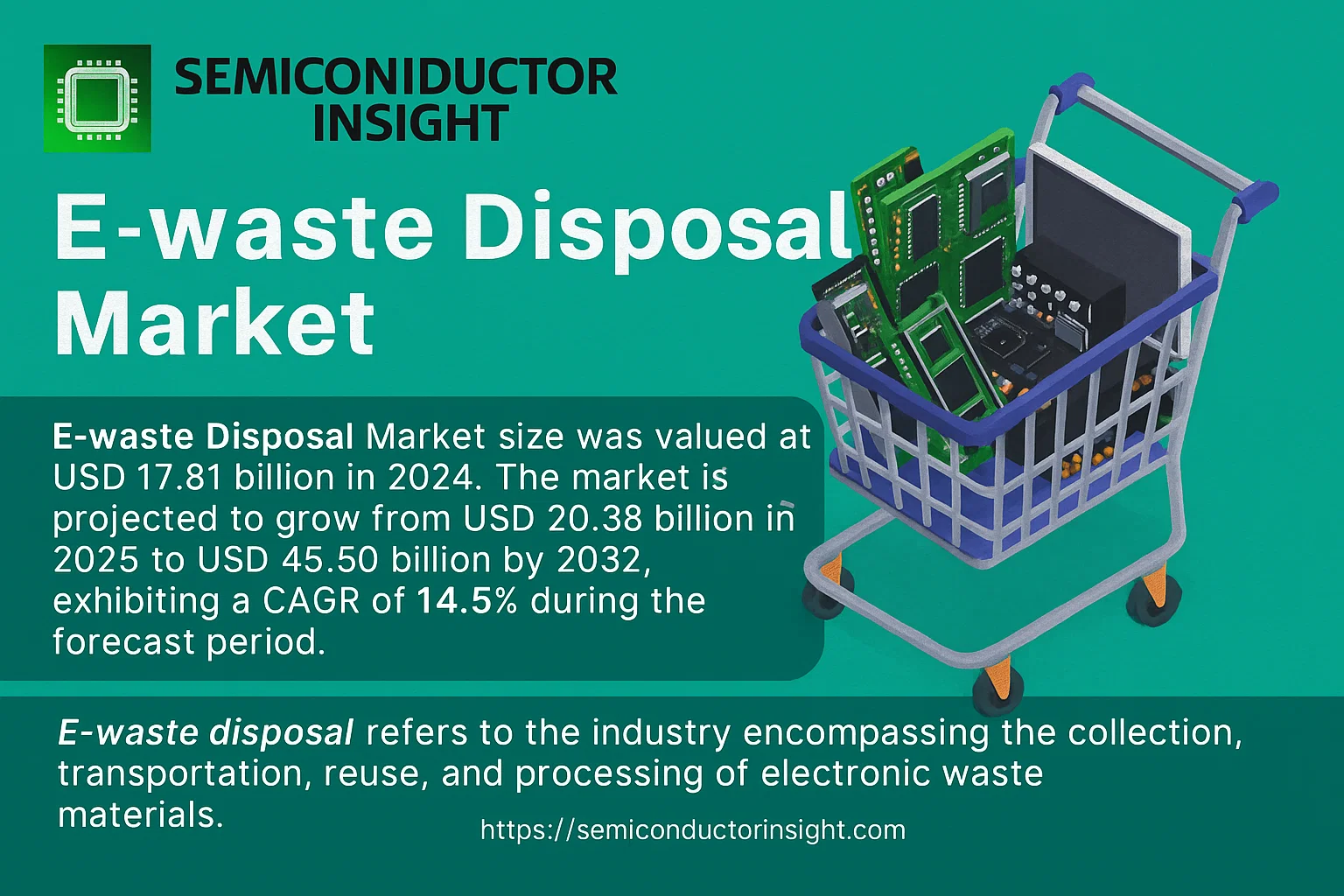
Global E-waste Disposal Market size was valued at USD 17.81 billion in 2024 to USD 45.50 billion by 2032, exhibiting a CAGR of 14.5% during the forecast period.
E-waste disposal refers to the industry encompassing the collection, transportation, reuse, and processing of electronic waste materials. This sector manages discarded electronic devices and components through environmentally responsible methods that include material recovery, component harvesting, and safe disposal of hazardous substances found in electronics.
The market is experiencing substantial growth due to several key factors, including increasing consumer electronics consumption, stringent environmental regulations worldwide, and growing awareness about resource conservation through recycling. Additionally, the rapid technological obsolescence cycle and expanding middle-class populations in developing regions are contributing significantly to market expansion. Initiatives by major industry players are also expected to fuel market growth. For instance, companies like Umicore have developed advanced hydrometallurgical processes for precious metal recovery from circuit boards, while Veolia has implemented large-scale e-waste processing facilities across multiple continents. Sims Lifecycle Services, Electronic Recyclers International, and Aurubis AG are some of the key players that operate in the market with comprehensive service portfolios spanning collection to material recovery.
MARKET DRIVERS
Accelerating Pace of Technological Obsolescence
The rapid lifecycle of electronic devices, particularly smartphones and laptops, is a primary driver for the E-waste Disposal Market. Consumers and businesses upgrade their electronics every 2-3 years on average, creating a continuous and growing stream of discarded equipment. This trend is compounded by the increasing integration of electronics in everyday items, from vehicles to home appliances.
Stringent Regulatory Frameworks and Enforcement
Governments worldwide are implementing and enforcing stricter e-waste management regulations, such as the WEEE Directive in Europe and various state-level laws in the United States. These regulations enforce Extended Producer Responsibility (EPR), placing the onus on manufacturers to finance and manage the collection and recycling of their products, directly fueling demand for compliant disposal services.
Furthermore, corporate sustainability initiatives and Environmental, Social, and Governance (ESG) criteria are compelling businesses to adopt responsible e-waste disposal practices. Public awareness of the environmental and health hazards associated with improper disposal, including soil and water contamination, is also driving consumer demand for certified recycling services.
MARKET CHALLENGES
Informal and Unsafe Recycling Practices
A significant challenge is the prevalence of informal recycling sectors, especially in developing nations, where e-waste is often processed using primitive methods like open-air burning and acid baths to extract valuable metals. These practices pose severe health risks to workers and cause substantial environmental damage, undermining the formal recycling market and creating hazardous waste streams.
Other Challenges
Complexity of Material Recovery
Modern electronics are composed of complex mixtures of precious metals, plastics, and hazardous substances, making efficient and economically viable material separation technologically challenging. This complexity increases processing costs and can reduce the profitability of recycling operations.
Inadequate Collection and Logistics Infrastructure
Establishing efficient collection networks for end-of-life electronics remains a major hurdle. Low consumer participation in take-back programs, coupled with the logistical costs of transporting bulky items from dispersed locations, creates significant operational inefficiencies for recyclers.
MARKET RESTRAINTS
High Costs of Compliant Recycling
The high operational cost associated with environmentally sound recycling is a major market restraint. Proper dismantling, safe handling of hazardous materials, and investment in advanced sorting technologies require significant capital expenditure. These costs can make compliant recycling less attractive compared to cheaper, non-compliant disposal options, particularly in price-sensitive markets.
Data Security Concerns Inhibiting Disposal
Fear of data breaches from improperly sanitized storage devices (hard drives, smartphones) causes many individuals and corporations to hoard old electronics rather than recycle them. This creates a substantial barrier to the collection of e-waste, as ensuring complete and verifiable data destruction adds another layer of cost and complexity to the recycling process.
MARKET OPPORTUNITIES
Urban Mining and Circular Economy
E-waste represents a significant source of valuable materials, including gold, silver, copper, and rare earth elements. The concept of “urban mining” presents a major opportunity to create a circular economy, reducing the need for virgin material extraction. Advanced recycling technologies are improving recovery rates, making this an increasingly profitable and sustainable venture.
Innovation in Recycling Technologies
There is substantial opportunity for growth through technological innovation. Developments in automated sorting, hydrometallurgical processes, and bioleaching offer the potential to increase the efficiency, safety, and economic viability of e-waste recycling. These advancements can unlock higher value from complex waste streams.
Expansion of EPR and Producer-Led Initiatives
Global expansion of Extended Producer Responsibility laws forces manufacturers to be accountable for the entire lifecycle of their products. This creates opportunities for specialized e-waste management companies to partner with producers, offering comprehensive take-back, refurbishment, and recycling services on a large scale.
E-waste Disposal Market Trends
Robust Market Growth and Expansion
Global E-waste Disposal Market is exhibiting vigorous expansion, propelled by increasing electronics consumption and stringent regulatory frameworks. With a 2024 valuation of USD 17,810 million, the market is projected to surge to USD 45,500 million by 2032, achieving a compound annual growth rate (CAGR) of 14.5%. This sustained growth reflects the escalating volume of electronic waste generated worldwide and the corresponding need for specialized disposal and recycling services. The industry, which encompasses the collection, transportation, re-use, and processing of electronic waste, is becoming increasingly critical to sustainable resource management.
Other Trends
Dominance of Europe and the Home Appliances Segment
Europe is the largest market for e-waste disposal, accounting for approximately 58% of Global share, driven by advanced recycling infrastructure and strong environmental legislation. The Asia Pacific and North American markets collectively hold a significant share of about 40%. In terms of product categories, Home Appliances represent the largest segment with a share of about 56%, followed by ICT Equipment. The primary application for processed e-waste is Components Recycling, with Material Recycling also being a major application area.
Industry Consolidation and Competitive Landscape
The market features a competitive landscape with several key global players. The top four manufacturers, including Umicore, Glencore, Mitsubishi Materials Corporation, and DOWA HOLDINGS Co, Ltd, hold a combined market share of approximately 19%. This indicates a moderately fragmented market with opportunities for further consolidation through mergers and acquisitions. Other significant participants include Waste Management, Veolia, and Sims Lifecycle Services, who are expanding their global footprint and technological capabilities to meet the growing demand for efficient and compliant e-waste processing solutions.
COMPETITIVE LANDSCAPE
Key Industry Players
A Market Dominated by Established Global Leaders and Specialized Regional Operators
Global E-waste Disposal Market is characterized by the presence of several large multinational corporations, with the top four manufacturers collectively holding approximately 19% of the market share. Umicore and Glencore are consistently recognized as dominant players, leveraging their extensive global networks and advanced metallurgical expertise for material recovery from complex electronics. This segment of the market focuses heavily on the processing of high-volume e-waste streams to recover precious and base metals, with Europe being the largest market, accounting for about 58% of Global total. The competitive environment is evolving as these leaders increasingly invest in advanced recycling technologies to improve recovery rates and meet stringent environmental regulations.
Beyond the top-tier global corporations, the market includes a diverse range of significant players that operate regionally or specialize in specific service niches. Companies like Sims Lifecycle Services and Electronic Recyclers International are prominent in North America, offering comprehensive IT asset disposition and data destruction services. In Europe, Veolia and Stena Metall Group provide large-scale, integrated waste management solutions. The Asia-Pacific region, which alongside North America holds about 40% of the market, features strong local players such as China Recycling Development and DOWA HOLDINGS Co., Ltd., which are crucial for managing the region’s rapidly growing domestic e-waste volumes. Niche specialists like TES Envirocorp focus on secure, certified recycling for enterprise clients, demonstrating the market’s segmentation by service type and geographic focus.
List of Key E-waste Disposal Companies Profiled
- Umicore
- Glencore
- DOWA HOLDINGS Co., Ltd.
- Mitsubishi Materials Corporation
- Waste Management, Inc.
- TES Envirocorp
- China Recycling Development Co., Ltd.
- Gem Co., Ltd.
- Veolia Environnement S.A.
- Sims Lifecycle Services, Inc.
- Electronic Recyclers International, Inc.
- Electrocycling GmbH
- Stena Metall Group
- Aurubis AG
- Kuusakoski Oy
Segment Analysis:
| Segment Category | Sub-Segments | Key Insights |
| By Type |
|
Home Appliances represents the most dominant product category, driven by the high volume of consumer goods with relatively short lifecycles, such as refrigerators, washing machines, and air conditioners. The sheer scale of production and disposal for these essential household items fuels consistent and substantial e-waste streams. In contrast, the ICT Equipment segment, while also significant, is characterized by rapid technological obsolescence and a push towards miniaturization, which presents unique logistical and material recovery challenges despite its high value potential. |
| By Application |
|
Components Recycling is the leading application, as it focuses on the recovery and potential reuse of functional parts like circuit boards, memory modules, and processors, which offers significant economic value and supports the circular economy by extending the life of valuable components. Material Recycling, which involves processing waste to extract base metals and plastics, is also critically important for raw material security. The market is increasingly recognizing the economic and environmental benefits of a hybrid approach that maximizes both material recovery and component reuse, rather than treating them as mutually exclusive pathways. |
| By End User |
|
Consumer Electronics contributes the largest volume of e-waste, driven by mass consumption, frequent product upgrades, and shorter lifespans of devices like smartphones, laptops, and televisions. The IT & Telecom sector is a major source of high-value e-waste from data centers and network infrastructure, characterized by large, periodic equipment refresh cycles. The Industrial Equipment segment, while generating less frequent waste streams, often involves larger, more complex machinery that requires specialized handling and decommissioning processes, presenting a niche but technically demanding segment of the market. |
| By Service Type |
|
Collection & Transportation is the foundational service segment, representing the critical first link in the e-waste management chain. The efficiency and reach of collection networks, including take-back programs and designated drop-off points, directly influence the volume of material entering the formal recycling stream. Once collected, Sorting & Dismantling is the most labor-intensive phase, requiring skilled manual work to separate hazardous components and segregate materials for efficient downstream processing. The final Recovery & Disposal stage is where advanced technologies are applied to extract maximum value from the waste, with environmental compliance for non-recyclable residues being a key operational focus for stakeholders. |
| By Material Recovered |
|
Metals represent the most economically valuable material stream recovered from e-waste, with a high focus on precious metals like gold, silver, and palladium from PCBs, as well as bulk metals like copper and aluminum. The recovery of these materials is a primary driver for the profitability of the recycling industry. Plastics recovery faces challenges related to the variety of polymer types and the presence of hazardous additives like brominated flame retardants, but advancements in sorting technologies are improving the quality and value of recycled plastics. The recovery of Glass, particularly from CRT monitors which is now a legacy waste stream, and other materials is more niche but remains important for achieving comprehensive waste diversion from landfills. |
Regional Analysis: E-waste Disposal Market
The cornerstone of Europe’s leadership is its stringent WEEE Directive. This policy mandates producer responsibility, ensuring a consistent and high-volume supply of e-waste to recyclers. The legal framework discourages illegal dumping and informal recycling, channeling waste into certified facilities that adhere to strict environmental and data security standards, creating a stable and investable market.
Europe boasts a mature network of high-tech recycling plants capable of complex disassembly and material separation. These facilities employ advanced processes like shredding, sorting, and smelting to maximize the recovery of precious and critical raw materials. This technological sophistication ensures higher recycling efficiency, reduces environmental impact, and adds significant economic value to the recycling chain.
Decades of public information campaigns and convenient collection systems have resulted in strong citizen engagement. Consumers are well-informed about the importance of proper e-waste disposal and have easy access to drop-off points, leading to high collection rates. This active participation is essential for the success of the producer responsibility model.
European policy is increasingly aligned with circular economy principles, prioritizing waste prevention, reuse, and high-quality recycling. This long-term vision encourages eco-design in electronics and supports markets for secondary raw materials. The focus extends beyond mere disposal to creating a sustainable system that minimizes resource extraction and environmental degradation.
North America
The North American E-waste Disposal Market is characterized by a mature but fragmented regulatory landscape, with significant variation between the United States and Canada, and even among individual U.S. states. While lacking a federal mandate equivalent to the WEEE Directive, several states have implemented their own robust e-waste recycling laws, creating regional hubs of advanced management. The market is largely driven by a combination of state-level regulations, corporate sustainability initiatives, and consumer demand for responsible disposal. The presence of large-scale, sophisticated recycling corporations provides advanced processing capabilities, particularly for complex items like CRT monitors and lithium-ion batteries. However, challenges remain, including the export of e-waste to countries with less stringent environmental controls and inconsistent collection rates across different jurisdictions.
Asia-Pacific
The Asia-Pacific region presents a dualistic market for e-waste disposal, being both the largest generator of e-waste and home to significant informal recycling sectors. Rapid technological adoption and manufacturing growth, especially in China and India, drive massive e-waste volumes. While countries like Japan and South Korea have developed advanced formal recycling systems, much of the region relies on informal sectors where hazardous practices pose serious health and environmental risks. Governments are increasingly enacting regulations to formalize the sector, but enforcement remains a challenge. The market potential is enormous, driven by the sheer volume of waste, creating opportunities for investment in formal recycling infrastructure and technology transfer from more advanced markets.
South America
The E-waste Disposal Market in South America is in a developing stage, with growing awareness but still nascent formal infrastructure. Countries like Brazil and Chile are leading efforts to establish regulatory frameworks and extended producer responsibility systems. The market is challenged by a significant informal sector that recovers valuable materials through often unsafe methods. There is a growing recognition of the need for investment in formal collection systems and recycling facilities to capture economic value and mitigate environmental harm. Regional cooperation and technology partnerships are seen as key drivers for market growth, aiming to leapfrog to more sustainable management practices.
Middle East & Africa
The E-waste Disposal Market in the Middle East and Africa is highly varied. Gulf Cooperation Council (GCC) countries, with high per capita generation rates, are beginning to invest in modern recycling facilities as part of broader sustainability agendas. In contrast, many African nations face challenges with limited infrastructure and a reliance on informal recycling, which includes the import of used electronics and e-waste from other regions. There is a critical need for building regulatory capacity and developing locally appropriate, environmentally sound recycling solutions. The market is characterized by significant growth potential but requires substantial investment and international support to develop a sustainable and formal e-waste management sector.
Report Scope
This market research report provides a comprehensive analysis of the E-waste Disposal Market , covering the forecast period 2025–2032. It offers detailed insights into market dynamics, technological advancements, competitive landscape, and key trends shaping the industry.
Key focus areas of the report include:
- Market Overview: The report begins with an overview outlining its current market scenario, key growth indicators, and industry transformation drivers. It discusses macroeconomic factors, demand–supply balance, regulatory landscape, and the strategic role of the e-waste disposal industry in managing the collecting, transporting, re-using, or processing of electronic waste.
- Market Size & Forecast: Historical data and future projections for revenue, unit shipments, and market value across major regions and segments.
- Segmentation Analysis: Detailed breakdown by product type, technology, application, and end-user industry to identify high-growth segments and investment opportunities.
- Regional Insights: Insights into market performance across North America, Europe, Asia-Pacific, Latin America, and the Middle East & Africa, including country-level analysis where relevant.
- Competitive Landscape: Profiles of leading market participants, including their product offerings, R&D focus, manufacturing capacity, pricing strategies, and recent developments such as mergers, acquisitions, and partnerships.
- Technology Trends & Innovation: Assessment of emerging technologies, integration of AI/IoT, evolving recycling techniques, and evolving industry standards.
- Market Drivers & Restraints: Evaluation of factors driving market growth along with challenges, supply chain constraints, regulatory issues, and market-entry barriers.
- Stakeholder Insights: Insights for suppliers, recyclers, OEMs, system integrators, investors, and policymakers regarding the evolving ecosystem and strategic opportunities.
Primary and secondary research methods are employed, including interviews with industry experts, data from verified sources, and real-time market intelligence to ensure the accuracy and reliability of the insights presented.
FREQUENTLY ASKED QUESTIONS:
What is the current market size of E-waste Disposal Market?
-> E-waste Disposal Market size was valued at USD 17.81 billion in 2024 to USD 45.50 billion by 2032, exhibiting a CAGR of 14.5% during the forecast period.
Which key companies operate in E-waste Disposal Market?
-> Key players include Umicore, Glencore, Mitsubishi Materials Corporation, DOWA HOLDINGS Co, Ltd, and Waste Management, among others. Global top four manufacturers hold a share of about 19%.
What are the key growth drivers?
-> Key growth drivers include increasing electronic consumption, stringent environmental regulations, and growing awareness about resource recovery from e-waste.
Which region dominates the market?
-> Europe is the largest market, with a share of about 58%, followed by Asia Pacific and North America.
What are the emerging trends?
-> Emerging trends include advanced material recycling technologies, the dominance of the Home Appliances segment (56% share), and the increasing application of Components Recycling.
Get Sample Report PDF for Exclusive Insights
Report Sample Includes
- Table of Contents
- List of Tables & Figures
- Charts, Research Methodology, and more...
 Download Sample Report PDF