MARKET INSIGHTS
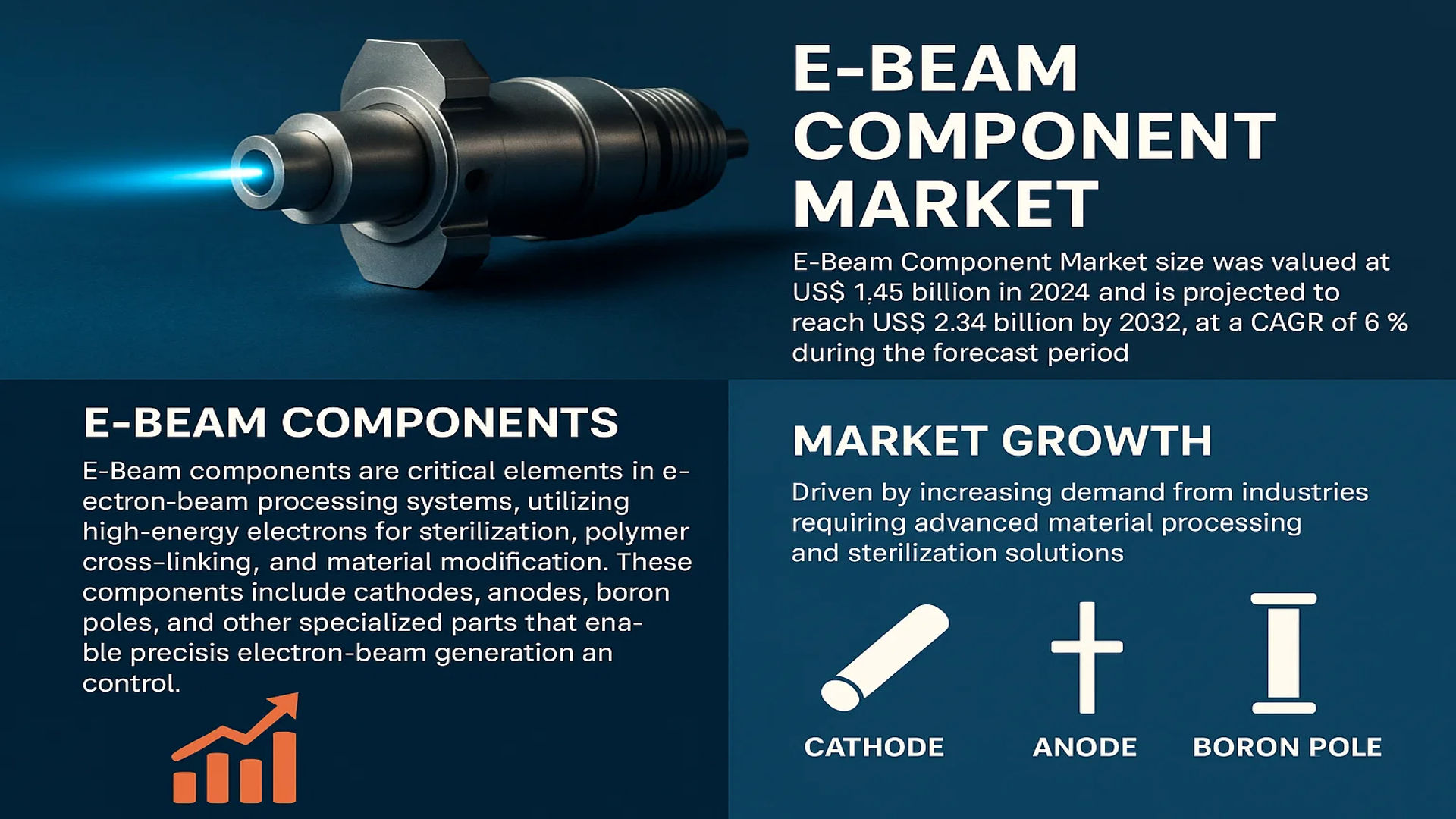
The global E-Beam Component Market size was valued at US$ 1.45 billion in 2024 and is projected to reach US$ 2.34 billion by 2032, at a CAGR of 6.2% during the forecast period 2025-2032.
E-Beam Components are critical elements in electron-beam processing systems, which utilize high-energy electrons for applications such as sterilization, polymer cross-linking, and material modification. These components include cathodes, anodes, boron poles, and other specialized parts that enable precise electron beam generation and control. The technology operates under controlled environments, often at elevated temperatures with nitrogen atmospheres, to ensure optimal performance.
Market growth is driven by increasing demand from industries requiring advanced material processing and sterilization solutions. The pharmaceutical sector’s stringent sterilization requirements and the electronics industry’s need for precision manufacturing are key contributors. While North America currently leads in adoption, Asia-Pacific is experiencing accelerated growth due to expanding manufacturing capabilities. Major players like Mitsubishi Electric, General Electric, and Pro-Beam are investing in R&D to enhance component efficiency and application versatility.
MARKET DYNAMICS
MARKET DRIVERS
Growing Demand for Advanced Sterilization Technologies to Propel Market Growth
The global E-Beam component market is experiencing significant growth driven by increasing demand for advanced sterilization technologies across healthcare, pharmaceuticals, and food processing industries. Electron beam sterilization offers advantages over traditional methods such as gamma irradiation, including faster processing times, lower temperature requirements, and reduced residual radiation. With medical device manufacturers processing over 50% of single-use devices using radiation sterilization, the shift toward e-beam technology is accelerating due to its precision and environmental benefits.
Expansion of Additive Manufacturing to Accelerate E-Beam Adoption
Additive manufacturing (3D printing) applications are creating new opportunities for e-beam component manufacturers. The technology is particularly valuable for high-precision metal part production in aerospace and medical implant sectors, where e-beam melting enables complex geometries with superior material properties. The aerospace industry’s growing adoption of lightweight components manufactured through electron beam additive processes is expected to drive nearly 20% annual growth in this segment through 2032.
Increased Focus on Polymer Modification to Create Market Expansion
E-beam technology is gaining traction in polymer modification applications, particularly for cross-linking cable insulation and improving material properties in automotive components. The ability to enhance polymer durability and thermal resistance without chemical additives aligns with global sustainability initiatives. With the wire and cable industry accounting for approximately 30% of e-beam processing applications, continued infrastructure development in emerging economies presents substantial growth potential.
MARKET RESTRAINTS
High Capital Investment Requirements to Limit Market Penetration
The substantial initial investment required for e-beam systems remains a significant barrier to adoption, with industrial-scale equipment costing several million dollars. This high capital expenditure makes the technology prohibitive for small and medium enterprises, particularly in cost-sensitive markets. The need for specialized shielding and safety measures further increases implementation costs, potentially slowing market growth in price-conscious regions.
Material Limitations and Processing Constraints to Present Challenges
While e-beam technology offers numerous advantages, material compatibility issues restrict its application scope. Certain polymers and sensitive electronic components cannot withstand the high-energy electron bombardment, limiting use in some industries. Additionally, penetration depth constraints mean the technology is often unsuitable for processing thick materials, affecting adoption in sectors requiring deep material modification.
MARKET CHALLENGES
Regulatory Compliance and Safety Concerns to Impact Adoption
Stringent regulatory requirements for radiation-emitting devices present ongoing challenges for market participants. Varying international standards complicate global operations, while workforce safety concerns regarding exposure to high-energy electrons require extensive training programs and protective measures. These factors contribute to longer approval timelines and increased operational costs for end-users.
Competition from Alternative Technologies to Intensify
Emerging sterilization and material processing technologies, including X-ray irradiation and advanced plasma systems, are creating competitive pressures. While e-beam offers distinct advantages in specific applications, continual improvements in alternative methods require ongoing innovation from e-beam component manufacturers to maintain market position.
MARKET OPPORTUNITIES
Expansion in Emerging Markets to Unlock Growth Potential
Developing economies represent significant growth opportunities as healthcare infrastructure expands and manufacturing sectors mature. Government initiatives supporting advanced manufacturing technologies in regions such as Southeast Asia and Eastern Europe are expected to drive demand for e-beam solutions tailored to local market needs.
Technological Advancements in Component Design to Create New Applications
Ongoing innovations in electron gun technology and beam control systems are expanding potential applications. The development of more compact and energy-efficient e-beam components enables deployment in smaller production facilities and opens possibilities for novel applications in semiconductor fabrication and nanotechnology.
Sustainability Initiatives to Drive Adoption Across Industries
The growing emphasis on environmentally friendly manufacturing processes positions e-beam technology favorably. Its ability to replace chemical treatments in textile finishing and reduce energy consumption in material processing aligns with corporate sustainability goals, creating new adoption drivers across multiple industries.
E-BEAM COMPONENT MARKET TRENDS
Industrial Adoption of E-Beam Processing Accelerates Market Expansion
The global e-beam component market is witnessing substantial momentum, driven by the increasing adoption of electron-beam irradiation for sterilization and material modification. The technology’s ability to ensure high-precision processing without thermal distortion is making it indispensable in industries such as healthcare, aerospace, and automotive. By 2024, the global market was valued at $X million, with projections indicating a rise to $Y million by 2032, reflecting a CAGR of Z%. This growth is attributed to surging demand in medical device sterilization, where e-beam processing ensures compliance with stringent safety regulations while significantly reducing cycle times compared to traditional methods.
Other Key Trends
Technological Innovations in E-Beam Component Design
Recent advancements in cathode and anode materials, as well as boron pole optimization, are enhancing the efficiency and longevity of e-beam systems. Manufacturers are investing in R&D to improve beam uniformity and energy distribution, which directly impacts process scalability. For example, enhancements in thermionic cathodes have led to a 20% increase in operational lifespan, reducing downtime in manufacturing facilities. Furthermore, integration with Industry 4.0 technologies, such as real-time monitoring through IoT sensors, is enabling predictive maintenance and operational cost savings.
Regulatory and Environmental Factors Influencing Market Dynamics
Stringent environmental regulations regarding chemical waste disposal are compelling industries to shift toward e-beam sterilization as a greener alternative. Unlike ethylene oxide (EtO) sterilization, e-beam processing generates no residual toxic byproducts, aligning with sustainability goals. North America and Europe currently lead in regulatory-driven adoption, accounting for over 60% of global market revenue in 2024. In parallel, emerging economies in Asia-Pacific are ramping up investments in e-beam infrastructure, particularly for food preservation and pharmaceutical applications, to meet international export standards.
COMPETITIVE LANDSCAPE
Key Industry Players
Technological Innovation and Strategic Investments Drive Market Competitiveness
The global E-Beam Component market exhibits a dynamic competitive environment with prominent players dominating through continuous technological advancements and strategic expansions. The market was valued in the millions in 2024, with projections indicating steady growth toward 2032. This growth is fueled by increasing demand for electron-beam applications in sterilization, polymer cross-linking, and material degradation processes.
Among the key players, WASIK ASSOCIATES, INC and Sciaky lead the market with their proprietary electron-beam technologies, which are widely adopted across industrial and medical sectors. Their dominance is further supported by strong distribution networks and a focus on R&D to enhance component efficiency and durability.
Steigerwald Strahltechnik GmbH and Mitsubishi Electric have secured substantial market shares through partnerships with material science and aerospace industries. These companies are investing heavily in scaling their production capacities to meet the growing demand from emerging markets in Asia-Pacific and North America.
Meanwhile, companies like Pro-Beam and Global Welding Technologies are leveraging strategic collaborations with research institutions to develop next-generation E-beam solutions. Their emphasis on sustainability and energy-efficient applications positions them as strong contenders in an increasingly eco-conscious market.
List of Leading E-Beam Component Manufacturers
- WASIK ASSOCIATES, INC (U.S.)
- Steigerwald Strahltechnik GmbH (Germany)
- Sciaky, Inc. (U.S.)
- CNIM (France)
- Mitsubishi Electric (Japan)
- General Electric (U.S.)
- Pro-Beam (Germany)
- Global Welding Technologies (U.S.)
- Sodick (Japan)
- CAMBRIDGE VACUUM ENGINEERING (U.K.)
Segment Analysis:
By Type
Cathode Segment Leads the Market Due to Its Critical Role in Electron Beam Generation
The E-Beam Component market is segmented based on type into:
- Cathode
- Subtypes: Thermionic, Field-emission, and others
- Boron Pole
- Anode
By Application
Sterilize Segment Dominates Owing to Widespread Use in Medical and Food Safety Applications
The market is segmented based on application into:
- Chemical
- Degradation
- Sterilize
Regional Analysis: E-Beam Component Market
Asia-Pacific
The Asia-Pacific region dominates the E-Beam Component market, driven primarily by rapid industrialization and technological advancements in countries like China, Japan, and South Korea. China, in particular, leads in manufacturing and adoption due to its strong electronics and semiconductor industries, where electron-beam technology is widely used for precision welding, lithography, and sterilization applications. Japan follows closely, leveraging its expertise in high-tech manufacturing, while India is emerging as a key market with increasing investments in healthcare and industrial processing. The region’s focus on automation and efficiency in production processes further accelerates demand for E-Beam components.
North America
North America is a significant player in the E-Beam Component market, largely due to its advanced healthcare sector and robust aerospace and defense industries. The U.S. accounts for the majority of demand, with electron-beam sterilization applications gaining traction in medical device manufacturing, driven by stringent FDA regulations. The presence of leading market players such as General Electric and Sciaky further supports innovation and adoption. Additionally, research institutions and universities contribute to advancements in electron-beam technology, particularly in material science and semiconductor applications.
Europe
Europe holds a strong position in the E-Beam Component market, supported by regulatory frameworks that encourage the adoption of electron-beam technology in industries such as automotive, aerospace, and healthcare. Germany leads the charge due to its engineering prowess, with companies like Steigerwald Strahltechnik GmbH and Pro-Beam driving innovation. The EU’s emphasis on sustainable manufacturing and reducing environmental impact has also spurred the use of electron-beam processing as an eco-friendly alternative to conventional methods. The medical sector, in particular, benefits from sterilization applications, ensuring compliance with strict EU standards.
South America
The E-Beam Component market in South America is still in its nascent stages, with Brazil and Argentina showing moderate growth. Limited industrial infrastructure and economic volatility have hindered widespread adoption, but increasing investments in healthcare and food processing industries present potential opportunities. The sterilization segment is gradually gaining traction as regulatory standards evolve, though cost sensitivity remains a barrier for many end-users in the region.
Middle East & Africa
The market in this region is emerging, with select countries like Saudi Arabia and the UAE investing in modern industrial technologies. Healthcare and oil & gas sectors are primary adopters of electron-beam components, particularly for sterilization and material modification applications. However, the market faces challenges due to limited local manufacturing capabilities and reliance on imports. Long-term growth potential exists as industrialization and infrastructure development projects gain momentum.
Report Scope
This market research report provides a comprehensive analysis of the Global E-Beam Component market, covering the forecast period 2025–2032. It offers detailed insights into market dynamics, technological advancements, competitive landscape, and key trends shaping the industry.
Key focus areas of the report include:
- Market Size & Forecast: Historical data and future projections for revenue, unit shipments, and market value across major regions and segments. The global E-Beam Component market was valued at US$ 1.45 billion in 2024 and is projected to reach US$ 2.34 billion by 2032, with a significant CAGR of 6.2%.
- Segmentation Analysis: Detailed breakdown by product type (Cathode, Boron Pole, Anode), application (Chemical, Degradation, Sterilize), and end-user industry to identify high-growth segments and investment opportunities.
- Regional Outlook: Insights into market performance across North America, Europe, Asia-Pacific, Latin America, and the Middle East & Africa, including country-level analysis. The U.S. market size is estimated at USD million in 2024, while China is projected to reach USD million.
- Competitive Landscape: Profiles of leading market participants, including their product offerings, R&D focus, manufacturing capacity, pricing strategies, and recent developments. Key players include WASIK ASSOCIATES, INC, Steigerwald Strahltechnik GmbH, Sciaky, CNIM, Mitsubishi Electric, and General Electric.
- Technology Trends & Innovation: Assessment of emerging technologies, integration of AI/IoT, and evolving industry standards in electron-beam processing applications.
- Market Drivers & Restraints: Evaluation of factors driving market growth along with challenges, supply chain constraints, regulatory issues, and market-entry barriers.
- Stakeholder Analysis: Insights for component suppliers, OEMs, system integrators, investors, and policymakers regarding the evolving ecosystem and strategic opportunities.
Primary and secondary research methods are employed, including interviews with industry experts, data from verified sources, and real-time market intelligence to ensure the accuracy and reliability of the insights presented.
FREQUENTLY ASKED QUESTIONS:
What is the current market size of Global E-Beam Component Market?
-> E-Beam Component Market size was valued at US$ 1.45 billion in 2024 and is projected to reach US$ 2.34 billion by 2032, at a CAGR of 6.2% during the forecast period 2025-2032.
Which key companies operate in Global E-Beam Component Market?
-> Key players include WASIK ASSOCIATES, INC, Steigerwald Strahltechnik GmbH, Sciaky, CNIM, Mitsubishi Electric, General Electric, Pro-Beam, Global Welding Technologies, Sodick, and CAMBRIDGE VACUUM ENGINEERING, among others.
What are the key growth drivers?
-> Key growth drivers include increasing demand for sterilization applications, advancements in electron-beam technology, and rising adoption in chemical processing industries.
Which region dominates the market?
-> North America currently leads the market, while Asia-Pacific is expected to witness the highest growth rate during the forecast period.
What are the emerging trends?
-> Emerging trends include development of compact e-beam systems, integration with Industry 4.0 technologies, and growing applications in medical device sterilization.

Get Sample Report PDF for Exclusive Insights
Report Sample Includes
- Table of Contents
- List of Tables & Figures
- Charts, Research Methodology, and more...