
Market Insights
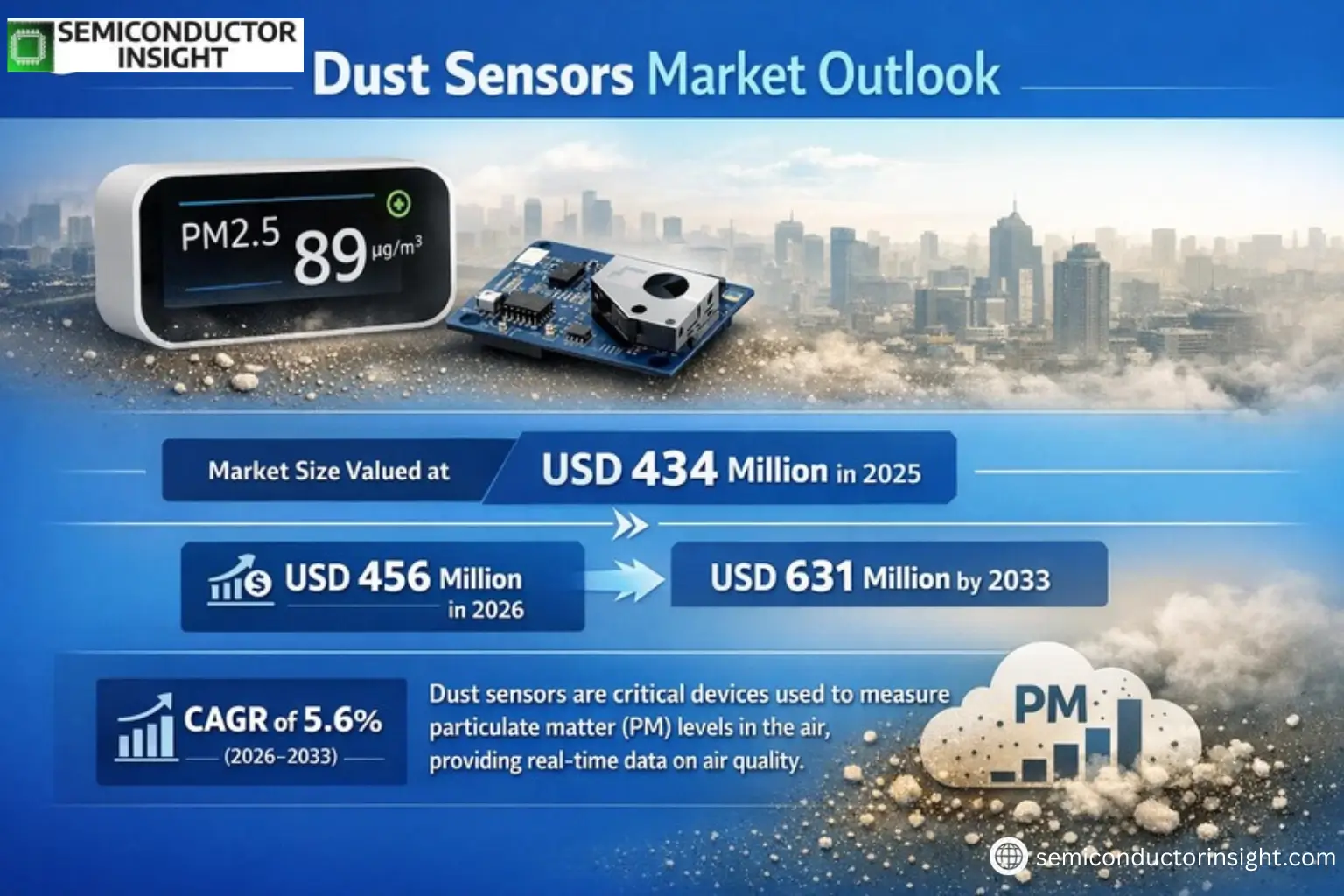
Global Dust Sensors Market size was valued at USD 434 million in 2025. The market is projected to grow from USD 456 million in 2026 to USD 631 million by 2033, exhibiting a CAGR of 5.6% during the forecast period.
Dust sensors are critical devices used to measure particulate matter (PM) levels in the air, providing real-time data on air quality. These sensors operate by detecting Low Pulse Occupancy (LPO) time, which is directly proportional to PM concentration. They are widely utilized across industries such as industrial manufacturing, automotive, healthcare, and environmental monitoring due to increasing regulatory standards and growing awareness of air pollution impacts.
The market growth is driven by rising concerns over air quality degradation, stringent government regulations on emissions, and advancements in sensor technologies. For instance, key players like Sensirion and Panasonic have introduced high-precision laser-based dust sensors for commercial and industrial applications. Europe dominates the market due to strict environmental policies, followed by China and the U.S., where rapid industrialization fuels demand. The commercial segment holds over 60% market share owing to widespread adoption in HVAC systems and smart buildings.
MARKET DRIVERS
Growing Industrial Automation & Smart City Initiatives
The increasing adoption of industrial automation and smart city projects worldwide is driving demand for dust sensors. These sensors play a critical role in monitoring air quality and ensuring compliance with environmental regulations. Global Dust Sensors Market is projected to grow at a CAGR of over 8% as industries prioritize workplace safety and urban air quality management.
Stringent Government Regulations on Air Pollution
Governments worldwide are implementing stricter air quality standards, particularly for PM2.5 and PM10 particulate matter. This regulatory push is accelerating the deployment of dust sensors across manufacturing facilities, construction sites, and urban areas. The European Union’s Ambient Air Quality Directive and similar regulations in Asia-Pacific are creating sustained demand.
Consumer awareness about indoor air quality is also contributing to market growth, with residential applications accounting for nearly 15% of dust sensor demand.
MARKET CHALLENGES
High Development Costs and Technical Limitations
The development of highly accurate dust sensors with low false-positive rates requires significant R&D investment. Many existing sensors struggle with distinguishing between different particulate types, affecting measurement precision in complex environments.
Other Challenges
Calibration and Maintenance Requirements
Dust sensors require regular calibration and maintenance to ensure ongoing accuracy, creating operational challenges for end-users. This is particularly problematic in remote or harsh environments where service access is limited.
MARKET RESTRAINTS
Economic Slowdown Impacting Industrial Investments
Global economic uncertainties are causing delays in capital expenditures across industries that typically deploy dust sensors, including manufacturing and construction. Some regions have seen a 10-15% reduction in new sensor deployments as companies prioritize essential investments.
MARKET OPPORTUNITIES
Integration with IoT and Smart Home Ecosystems
The convergence of dust sensors with IoT platforms presents significant growth potential. Smart home manufacturers are increasingly incorporating particulate monitoring into their systems, with the residential segment expected to grow at 12% annually. Cloud-connected dust sensors that provide real-time air quality analytics are gaining traction.
Dust Sensors Market Trends
Rapid Growth in Commercial Applications
Global Dust Sensors Market is experiencing steady growth, valued at USD 434 million in 2025 and projected to reach USD 631 million by 2033 at a 5.6% CAGR. Commercial applications dominate the Dust Sensors Market, accounting for over 60% of total usage. Major industries driving demand include automotive, healthcare, and aerospace sectors where air quality monitoring is critical.
Other Trends
Technological Advancements in Dust Sensors
Innovations in infrared and laser sensor technologies are enhancing the accuracy of particulate matter (PM) measurements. Manufacturers are focusing on developing sensors with lower power consumption and improved response times. The ability to measure Low Pulse Occupancy (LPO) time has become a standard feature in modern dust detection systems.
Regional Market Dynamics
Europe currently leads the Dust Sensors Market, followed by China and the United States. Emerging economies are showing increased adoption due to stricter environmental regulations and growing industrialization. The Asia-Pacific region is expected to witness the fastest growth during the forecast period, driven by rapid urbanization and air quality concerns.
Key Players Competitive Landscape
The Dust Sensors Market features major players including Sensirion, Panasonic, and Shinyei Group, who collectively hold significant market share. Companies are focusing on strategic partnerships and product innovations to maintain competitive advantage. Recent developments include miniaturized sensors for consumer electronics and IoT-enabled monitoring solutions.
Segment-Specific Growth Patterns
Industrial applications continue to be the largest end-use segment for Dust Sensors, particularly in manufacturing facilities and clean rooms. The environmental monitoring sector is experiencing rapid growth due to increased government initiatives for air pollution control globally.
COMPETITIVE LANDSCAPE
Key Industry Players
Strategic Positioning and Market Concentration in Dust Sensor Technology
Dust Sensors Market is dominated by established players like Sensirion, Paragon, and Panasonic, who collectively hold over 40% of the global market share. Sensirion leads with advanced laser-based particulate matter detection technology, particularly strong in European industrial applications. The market structure shows moderate consolidation, with the top 5 players controlling 55-60% of revenue, while numerous specialized manufacturers compete in niche segments like automotive and healthcare applications.
Emerging players like Plantower Technology and Luftmy Intelligence Technology are gaining traction through innovative IoT-enabled solutions, particularly in Asian markets. Niche specialists such as Cubit Sensor and Instrument focus on high-precision environmental monitoring systems, while Prodrive Technologies serves aerospace applications. The competitive landscape is witnessing increased R&D investments, with 15-20% of industry revenue being reinvested in next-generation sensor development.
List of Key Dust Sensors Companies Profiled
- Sensirion AG
- Paragon Corporation
- Zhengzhou Winsen Electronics Technology
- Panasonic Corporation
- Shinyei Group
- Amphenol Advanced Sensors
- Cubic Sensor and Instrument
- Plantower Technology
- Prodrive Technologies
- Luftmy Intelligence Technology
- Nova Technology Corporation
- Sharp Corporation
- Honeywell International
- Siemens AG
- Omron Corporation
Segment Analysis:
| Segment Category | Sub-Segments | Key Insights |
| By Type |
|
Laser Sensors dominate the market due to:
|
| By Application |
|
Industrial Applications lead due to:
|
| By End User |
|
Manufacturing Sector shows strongest adoption due to:
|
| By Technology |
|
Light Scattering technology is most prevalent because:
|
| By Detection Range |
|
PM2.5 Detection segment leads the market as:
|
Regional Analysis: Global Dust Sensors Market
Manufacturing facilities across Asia-Pacific are integrating dust sensors into ventilation systems and production lines to comply with occupational health standards. The electronics manufacturing sector shows particularly strong adoption rates.
Metropolitan areas are deploying networked dust sensors as part of broader environmental monitoring initiatives. Singapore and Seoul have implemented city-wide particulate monitoring systems using advanced sensor technologies.
Stringent air quality standards in China and India are forcing industries to invest in continuous monitoring solutions. Recent amendments to environmental protection laws have expanded the scope of mandatory dust monitoring.
Local manufacturers are developing low-cost, high-accuracy sensors with IoT capabilities. Partnerships between sensor companies and cloud platforms enable real-time air quality data analysis across the region.
North America
The North American Dust Sensors Market benefits from well-established environmental monitoring infrastructure and advanced manufacturing standards. U.S. regulations like the Clean Air Act mandate particulate monitoring in industrial facilities, driving steady market demand. Canadian mining operations and U.S. construction sites represent significant end-users. The region shows strong adoption of laser-based dust sensors for their precision. Research institutions collaborate with sensor manufacturers to develop next-generation monitoring solutions, particularly for wildfire smoke detection applications.
Europe
European countries maintain rigorous workplace air quality standards, creating consistent demand for dust monitoring equipment. Germany leads in industrial sensor adoption, while Nordic countries focus on environmental monitoring networks. The EU’s ambient air quality directives push municipalities to expand monitoring coverage. Automotive and pharmaceutical manufacturing sectors represent key verticals for high-precision dust sensors. European companies emphasize energy-efficient and sustainable sensor designs with minimal environmental impact.
Middle East & Africa
Gulf countries are investing in dust monitoring infrastructure to address desert environmental challenges. Oil & gas operations and construction projects drive demand for ruggedized sensors capable of harsh environment operation. African markets show gradual growth with mining safety initiatives and urban air quality programs. The region presents opportunities for cost-optimized solutions suitable for developing economies.
South America
Brazil and Chile lead dust sensor adoption in South America, particularly for mining and agricultural applications. Increasing environmental awareness and industrial safety regulations contribute to market expansion. Challenges include price sensitivity and infrastructure limitations in remote areas. Governments are implementing monitoring requirements for cement plants and other particulate-emitting industries.
Report Scope
This market research report provides a comprehensive analysis of the Dust Sensors Market, covering the forecast period 2026–2033. It offers detailed insights into market dynamics, technological advancements, competitive landscape, and key trends shaping the industry.
Key focus areas of the report include:
- Market Overview: The report begins with an overview outlining its current market scenario, key growth indicators, and industry transformation drivers. It discusses macroeconomic factors, demand–supply balance, regulatory landscape, and the strategic role of dust sensors in air quality monitoring across industries such as industrial, automotive, healthcare, and environmental monitoring.
- Market Size & Forecast: Historical data and future projections for revenue, unit shipments, and market value across major regions and segments.
- Segmentation Analysis: Detailed breakdown by product type, technology, application, and end-user industry to identify high-growth segments and investment opportunities.
- Regional Insights: Insights into market performance across North America, Europe, Asia, South America, and the Middle East & Africa, including country-level analysis where relevant.
- Competitive Landscape: Profiles of leading market participants, including their product offerings, R&D focus, manufacturing capacity, pricing strategies, and recent developments such as mergers, acquisitions, and partnerships.
- Technology Trends & Innovation: Assessment of emerging technologies, integration of AI/IoT, sensor design trends, and evolving industry standards.
- Market Drivers & Restraints: Evaluation of factors driving market growth along with challenges, supply chain constraints, regulatory issues, and market-entry barriers.
- Stakeholder Insights: Insights for component suppliers, OEMs, system integrators, investors, and policymakers regarding the evolving ecosystem and strategic opportunities.
Primary and secondary research methods are employed, including interviews with industry experts, data from verified sources, and real-time market intelligence to ensure the accuracy and reliability of the insights presented.
FREQUENTLY ASKED QUESTIONS:
What is the current market size of Dust Sensors Market?
-> Dust Sensors Market size was valued at USD 434 million in 2025. The market is projected to grow from USD 456 million in 2026 to USD 631 million by 2033, exhibiting a CAGR of 5.6% during the forecast period.
What is the growth rate (CAGR) of Dust Sensors Market?
-> The market is expected to grow at a CAGR of 5.6% during 2025-2033.
Which key companies operate in Dust Sensors Market?
-> Key players include Sensirion, Paragon, Winsen, Panasonic, Shinyei Group, Amphenol Advanced Sensors, Cubic Sensor and Instrument, and Plantower Technology, among others.
Which region dominates the Dust Sensors Market?
-> Europe is the largest market, followed by China and the USA.
What are the major applications of Dust Sensors?
-> Major applications include Industrial, Automotive, Healthcare, Aerospace, and Environmental Monitoring.

Get Sample Report PDF for Exclusive Insights
Report Sample Includes
- Table of Contents
- List of Tables & Figures
- Charts, Research Methodology, and more...
 Download Sample Report PDF





