MARKET INSIGHTS
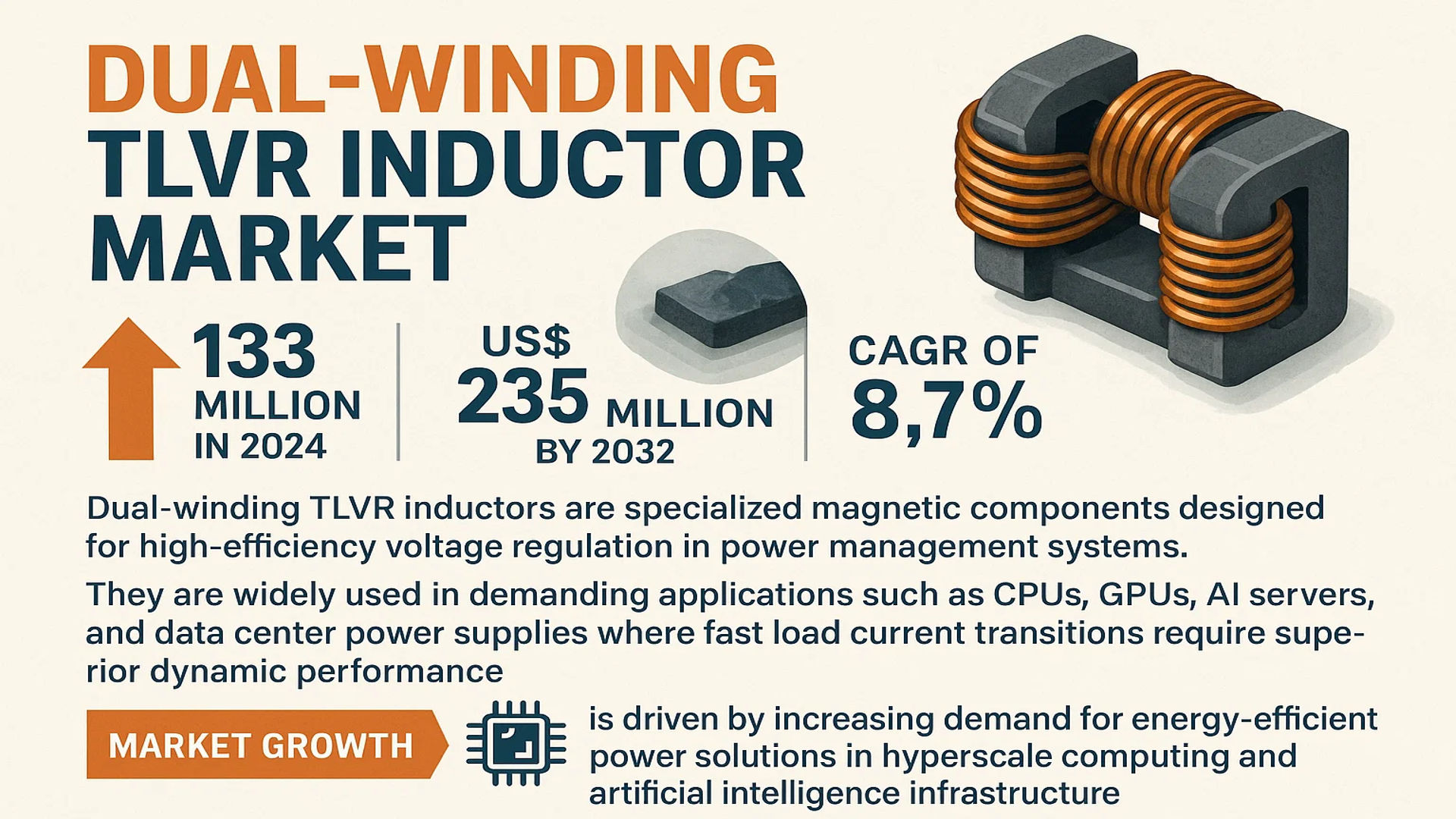
The global Dual-Winding TLVR Inductor Market was valued at 133 million in 2024 and is projected to reach US$ 235 million by 2032, at a CAGR of 8.7% during the forecast period.
Dual-winding TLVR inductors are specialized magnetic components designed for high-efficiency voltage regulation in power management systems. These inductors utilize two interconnected windings to improve transient response, minimize power losses, and enhance current-sharing capabilities in multi-phase voltage regulator modules (VRMs). They are widely used in demanding applications such as CPUs, GPUs, AI servers, and data center power supplies where fast load current transitions require superior dynamic performance.
Market growth is driven by increasing demand for energy-efficient power solutions in hyperscale computing and artificial intelligence infrastructure. The 70-100nH inductance range segment currently dominates the market due to its widespread adoption in server power delivery networks. Key players like TDK, Eaton, and Infineon are expanding their product portfolios to meet the growing requirements of next-generation computing platforms, while emerging applications in 5G infrastructure and electric vehicles present new growth opportunities.
MARKET DYNAMICS
MARKET DRIVERS
Rising Demand for High-Performance Computing to Accelerate Market Growth
The exponential growth in artificial intelligence, cloud computing, and data center applications is driving significant demand for dual-winding TLVR inductors. These components play a critical role in voltage regulation modules (VRMs) that power modern CPUs and GPUs, where precise power delivery with minimal losses is essential. The global data center market is projected to exceed $350 billion by 2026, creating a substantial demand for efficient power management solutions. With AI server shipments expected to grow at a compound annual growth rate (CAGR) of over 20%, the need for high-efficiency inductors capable of handling dynamic load conditions is increasing substantially.
Advancements in Power Delivery Systems to Fuel Adoption
Recent breakthroughs in multi-phase power converter designs have significantly improved the performance parameters of voltage regulators, creating new opportunities for dual-winding TLVR inductors. Modern processors now require power delivery systems capable of handling transient current spikes exceeding 500A/µs while maintaining tight voltage regulation. The dual-winding configuration reduces current ripple and improves transient response by up to 40% compared to conventional inductors, making them ideal for next-generation computing applications. Major chip manufacturers have begun specifying these components in their reference designs, accelerating their adoption across the industry.
Additionally, the transition to higher switching frequencies (up to 2MHz) in power delivery networks is creating new design challenges that dual-winding TLVR inductors are uniquely positioned to address. This technology shift enables smaller form factors while maintaining efficiency, driving adoption in space-constrained applications.
MARKET RESTRAINTS
Complex Manufacturing Processes and Yield Challenges to Limit Expansion
The intricate design and manufacturing requirements of dual-winding TLVR inductors present significant barriers to market expansion. Precise winding alignment, core material selection, and thermal management considerations make production more complex than conventional inductors. Industry data suggests manufacturing yields for high-performance TLVR inductors currently average 70-80%, compared to 90-95% for standard power inductors. This yield differential increases production costs by approximately 15-20%, making price-sensitive applications reluctant to adopt the technology.
Furthermore, the specialized magnetic materials required for optimal performance face supply constraints, with lead times extending beyond 20 weeks for certain high-permeability alloys. These manufacturing challenges are particularly problematic for mid-sized power electronics companies that lack the procurement scale of larger competitors.
MARKET CHALLENGES
Thermal Management Issues in High-Density Applications to Pose Technical Hurdles
As power densities continue increasing in modern electronics, thermal management has emerged as a critical challenge for dual-winding TLVR inductor implementation. The compact designs required for space-constrained applications often lead to concentrated heat generation, with operating temperatures frequently exceeding 125°C in high-current scenarios. This thermal stress can degrade magnetic material properties over time, leading to premature component failure. Recent industry testing indicates that every 10°C increase above rated temperature reduces inductor lifespan by approximately 50%, creating reliability concerns for mission-critical applications.
Moreover, the interaction between high-frequency switching noise and thermal performance creates complex design trade-offs. Engineers must balance core material selection, winding geometry, and cooling solutions to meet both electrical and thermal specifications, often requiring multiple design iterations that delay time-to-market.
MARKET OPPORTUNITIES
Emerging AI Infrastructure Projects to Create New Growth Avenues
The rapid expansion of artificial intelligence infrastructure represents a significant opportunity for dual-winding TLVR inductor suppliers. AI accelerator chips are pushing power requirements beyond 1000W per device, creating unprecedented demands on power delivery networks. Major cloud service providers have announced plans to invest over $200 billion in AI-optimized data centers by 2027, with power efficiency being a key selection criterion for components. The superior transient response and reduced losses of dual-winding TLVR inductors make them particularly suited for these applications.
Additionally, the growing adoption of advanced packaging technologies like chiplet architectures creates new integration opportunities. These designs require distributed power delivery with multiple voltage domains, increasing the total inductor count per system. Industry projections suggest the market for power components in advanced packaging could grow at a CAGR exceeding 25% through 2030, providing substantial growth potential for innovative inductor solutions.
DUAL-WINDING TLVR INDUCTOR MARKET TRENDS
Increasing Demand for High-Efficiency Power Solutions Driving Market Growth
The global dual-winding TLVR (Trans-inductor Voltage Regulator) inductor market is witnessing significant growth due to rising demand for efficient power management solutions in data centers, AI servers, and high-performance computing applications. These specialized inductors are designed to improve transient response and minimize power losses, making them critical for modern voltage regulation systems. As industries prioritize energy efficiency, the market is projected to grow at a CAGR of 8.7%, reaching $235 million by 2032 from $133 million in 2024. The U.S. and China dominate regional demand, with China approaching sales parity as its semiconductor industry expands.
Other Trends
AI & Data Center Expansion
The rapid growth of AI infrastructure is accelerating adoption of dual-winding TLVR inductors. Unlike conventional inductors, they provide superior current sharing and reduced ripple in multi-phase voltage regulators – essential for GPU clusters and AI training servers drawing over 700W per unit. Major cloud providers are upgrading data centers with these components to handle dynamic workloads while maintaining >95% power efficiency. The 70-100nH segment is seeing particularly strong demand as it matches the switching frequency requirements of next-gen processors.
Material Science Advancements Enhancing Performance
Innovations in magnetic core materials like nanocrystalline alloys and advanced ferrites are pushing the boundaries of dual-winding TLVR inductor capabilities. Manufacturers are achieving 30-40% lower core losses compared to traditional designs through optimized winding techniques and distributed gap structures. This allows operation at higher frequencies (up to 2MHz) while maintaining thermal stability – a critical factor for space-constrained server applications. Leading suppliers are now integrating these inductors with digital controllers to create complete smart power stage solutions.
Supply Chain Diversification Strategies
The market is seeing geographic shifts in production as companies mitigate risks from trade tensions. While major players like TDK and Infineon maintain manufacturing hubs in Japan/Germany, over 35% of new capacity expansions are targeting Southeast Asia. Chinese manufacturers including Guanqun Technology and Lianzhen Electronics are gaining share through aggressive pricing while improving technical capabilities. This competitive landscape is driving R&D investments toward application-specific designs for emerging sectors like autonomous vehicles and 5G infrastructure.
COMPETITIVE LANDSCAPE
Key Industry Players
Innovation and Strategic Investments Drive Competition in Dual-Winding TLVR Inductor Market
The global dual-winding TLVR (Transistor-Linear Voltage Regulator) inductor market features a dynamic competitive landscape where both established multinational corporations and emerging regional players are vying for market share. TDK Corporation currently leads the market with approximately 18% revenue share, leveraging its strong technological expertise in passive components and global distribution network spanning North America, Europe, and Asia-Pacific.
Close competitors Infineon Technologies and Eaton Corporation hold significant positions in the market due to their vertically integrated manufacturing capabilities and strong relationships with data center equipment manufacturers. These companies have been particularly successful in the 70-100nH inductance range, which accounts for 42% of total market applications in server voltage regulation systems.
The competitive intensity is increasing as mid-sized players like Abracon and Pulse Electronics (YAGEO) expand their product portfolios through both organic R&D and strategic acquisitions. Meanwhile, Asian manufacturers such as Sunlord Electronics and Tai-Tech Advanced Electronics are gaining traction by offering cost-competitive solutions, particularly in the China market which is projected to grow at 11.2% CAGR through 2032.
Product differentiation has become crucial as companies develop specialized inductors for next-generation applications including AI servers and high-performance computing. Recent developments include TDK’s launch of its CLF6045 series optimized for 48V power delivery systems and Infineon’s introduction of radiation-hardened versions for aerospace applications.
List of Key Dual-Winding TLVR Inductor Manufacturers Profiled
- TDK Corporation (Japan)
- Eaton Corporation (Ireland)
- Abracon, LLC (U.S.)
- Infineon Technologies (Germany)
- Pulse Electronics (YAGEO Group) (U.S.)
- Bourns, Inc. (U.S.)
- ITG Electronics (Taiwan)
- Superworld Electronics (China)
- Sunlord Electronics (China)
- Microgate Technology (Taiwan)
- Tai-Tech Advanced Electronics (Taiwan)
- POCO Holdings (China)
Segment Analysis:
By Inductance Range
70-100 nH Segment Dominates Market Demand Due to High Utilization in AI Servers
The market is segmented based on inductance range into:
- 70-100 nH
- 100-170 nH
- 170-220 nH
- Others
By Application
Data Center Segment Holds Major Share Owing to High-Power Management Needs
The market is segmented based on application into:
- AI Server
- Data Center
- Storage System
- Others
By Core Material
Ferrite Core Segment Leads Market Due to Superior High-Frequency Performance
The market is segmented based on core material into:
- Ferrite Core
- Metal Alloy Core
- Powdered Iron Core
- Others
By End-User Industry
Computing & IT Segment Dominates with Growing Demand for High-Efficiency Power Solutions
The market is segmented based on end-user industry into:
- Computing & IT
- Telecommunications
- Automotive
- Consumer Electronics
- Industrial
Regional Analysis: Dual-Winding TLVR Inductor Market
Asia-Pacific
The Asia-Pacific region dominates the Dual-Winding TLVR Inductor market, primarily driven by the rapid expansion of data centers, AI infrastructure, and high-performance computing in China, Japan, and South Korea. China alone accounts for approximately 40% of the regional demand due to heavy investments in semiconductor manufacturing and 5G infrastructure. Companies like TDK, Sunlord, and Microgate Technology have established strong production bases here to cater to both domestic and export markets. The 70-100 nH inductance range segment is witnessing the fastest growth, as it is widely used in GPU and CPU voltage regulation modules. However, supply chain complexities and geopolitical trade tensions present challenges for manufacturers operating in this region.
North America
North America represents the technological frontier for Dual-Winding TLVR Inductor applications, with the U.S. leading in AI server deployment and hyperscale data center construction. Major cloud service providers like AWS and Microsoft Azure are driving demand for high-efficiency power management solutions. The presence of key players such as Eaton and Abracon facilitates technological innovation, particularly in the 100-170 nH range suited for next-generation processors. Strict energy efficiency regulations and the need for thermal management in compact server architectures are pushing manufacturers to develop advanced inductor designs with lower core losses.
Europe
Europe’s market is characterized by stringent energy efficiency standards and a strong focus on sustainable electronics manufacturing. Germany leads in industrial applications of Dual-Winding TLVR Inductors, particularly for automation equipment and renewable energy systems. Infineon and other European manufacturers emphasize R&D in materials science to improve inductor performance while reducing rare earth material usage. The storage system segment shows promising growth as data localization laws drive investments in regional data centers. However, higher production costs compared to Asian manufacturers create pricing pressures in this market.
South America
The South American market for Dual-Winding TLVR Inductors remains nascent but shows gradual growth potential, particularly in Brazil’s emerging data center industry. Economic volatility and reliance on imports constrain market expansion, though local assembly initiatives by global manufacturers are beginning to take shape. Most demand currently stems from telecommunications infrastructure upgrades rather than high-performance computing applications. The lack of domestic component manufacturing capability results in longer lead times and higher costs compared to other regions.
Middle East & Africa
This region presents a developing market opportunity focused primarily on telecommunications infrastructure and oil/gas industry applications. While AI server and data center adoption lags behind other regions, countries like Saudi Arabia and UAE are making strategic investments in digital infrastructure that may drive future demand for Dual-Winding TLVR Inductors. The market currently relies heavily on imports from Asia and Europe, with limited local technical expertise for advanced power management solutions. Projected growth in smart city initiatives could accelerate market development over the next decade.
Report Scope
This market research report provides a comprehensive analysis of the Global Dual-Winding TLVR Inductor market, covering the forecast period 2024–2032. It offers detailed insights into market dynamics, technological advancements, competitive landscape, and key trends shaping the industry.
Key focus areas of the report include:
- Market Size & Forecast: Historical data and future projections for revenue, unit shipments, and market value across major regions and segments. The global market was valued at USD 133 million in 2024 and is projected to reach USD 235 million by 2032, growing at a CAGR of 8.7%.
- Segmentation Analysis: Detailed breakdown by inductance range (70-100nH, 100-170nH, 170-220nH, Others) and application (AI Server, Data Center, Storage System, Others) to identify high-growth segments and investment opportunities.
- Regional Outlook: Insights into market performance across North America, Europe, Asia-Pacific, Latin America, and the Middle East & Africa. The U.S. and China are key markets driving growth.
- Competitive Landscape: Profiles of leading market participants including TDK, Eaton, Infineon, Bourns, and Pulse Electronics (YAGEO), covering their product offerings, R&D focus, manufacturing capacity, and recent developments.
- Technology Trends & Innovation: Assessment of emerging technologies in power management solutions, semiconductor design trends, and evolving industry standards for high-efficiency voltage regulation.
- Market Drivers & Restraints: Evaluation of factors driving market growth such as increasing demand for efficient power solutions in data centers and AI servers, along with challenges like supply chain constraints and material costs.
- Stakeholder Analysis: Insights for component suppliers, OEMs, system integrators, and investors regarding the evolving ecosystem and strategic opportunities in power management solutions.
Primary and secondary research methods are employed, including interviews with industry experts and data from verified sources, to ensure the accuracy and reliability of the insights presented.
FREQUENTLY ASKED QUESTIONS:
What is the current market size of Global Dual-Winding TLVR Inductor Market?
-> Dual-Winding TLVR Inductor Market was valued at 133 million in 2024 and is projected to reach US$ 235 million by 2032, at a CAGR of 8.7% during the forecast period.
Which key companies operate in Global Dual-Winding TLVR Inductor Market?
-> Key players include TDK, Eaton, Abracon, Infineon, Pulse Electronics (YAGEO), Bourns, ITG Electronics, and Superworld Electronics, among others.
What are the key growth drivers?
-> Key growth drivers include increasing demand for efficient power solutions in data centers, AI server expansion, and the need for advanced voltage regulation in high-performance computing.
Which region dominates the market?
-> Asia-Pacific is the fastest-growing region, while North America remains a dominant market due to advanced technology adoption.
What are the emerging trends?
-> Emerging trends include miniaturization of components, higher efficiency designs, and integration with advanced power management ICs.

Get Sample Report PDF for Exclusive Insights
Report Sample Includes
- Table of Contents
- List of Tables & Figures
- Charts, Research Methodology, and more...