Dual Supply Bus Transceiver Market Insights
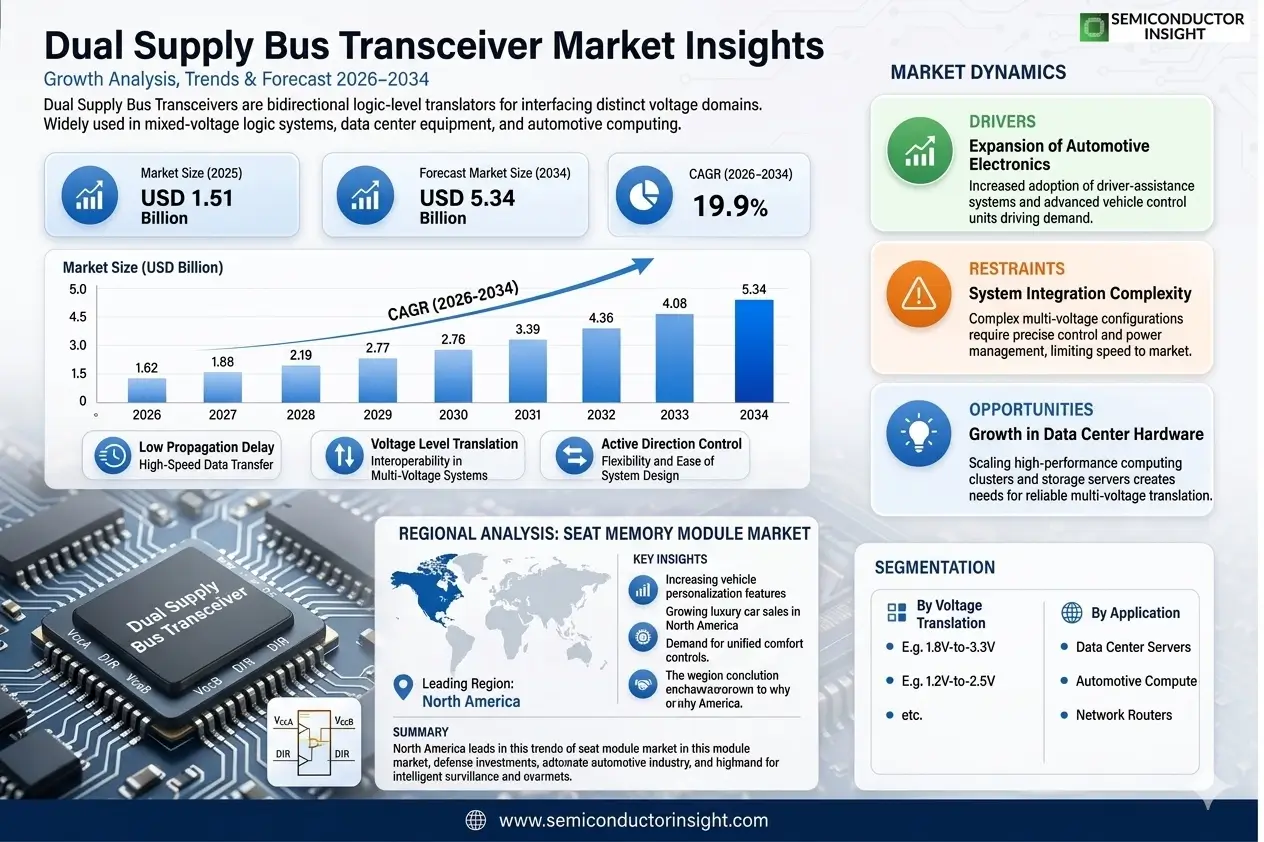
Global Dual Supply Bus Transceiver Market size was valued at USD 1.51 billion in 2025. The market is projected to grow from USD 1.62 billion in 2026 to USD 5.34 billion by 2034, exhibiting a CAGR of 19.9% during the forecast period.
Dual supply bus transceivers are communication interface devices widely used in industrial automation control systems, automotive electronics, and telecommunications equipment. These components feature two independent power inputs to enhance system redundancy and reliability, ensuring uninterrupted operation during power failures by seamlessly switching to backup power sources.
The market growth is driven by increasing industrial automation adoption, rising demand for reliable communication infrastructure in smart factories, and expanding automotive electronics applications. Key players like Texas Instruments, STMicroelectronics, and NXP Semiconductors are developing advanced solutions with improved noise immunity and lower power consumption to meet evolving industry requirements across multiple sectors.
MARKET DRIVERS
Increasing Demand for Energy-Efficient Solutions
Dual Supply Bus Transceiver Market is witnessing growth due to rising demand for energy-efficient electronic components. These devices enable voltage level translation between different logic levels while minimizing power consumption. With Global push toward sustainable electronics, manufacturers are adopting dual supply transceivers in applications such as IoT devices and automotive systems.
IoT and Smart Device Proliferation
The expansion of IoT networks requires reliable communication between devices operating at different voltage levels. Dual supply bus transceivers facilitate seamless data transfer in smart home automation, industrial IoT, and connected vehicle ecosystems. Market research indicates a 12% annual growth in IoT applications utilizing these components.
➤ Advanced Driver Assistance Systems (ADAS) are creating significant demand for robust bus communication solutions in automotive applications
The automotive sector contributes nearly 28% of total dual supply bus transceiver demand, with increasing adoption in infotainment systems and vehicle bus networks.
MARKET CHALLENGES
Design Complexity in Mixed-Voltage Systems
Implementing dual supply bus transceivers requires careful consideration of signal integrity and power sequencing in mixed-voltage environments. Engineers face challenges maintaining signal quality while managing multiple power domains, particularly in high-speed communication systems above 100MHz.
Other Challenges
Thermal Management Constraints
Higher power dissipation in bidirectional voltage translation creates thermal challenges for compact device packaging, requiring advanced heat dissipation solutions in space-constrained applications.
MARKET RESTRAINTS
High Development Costs
The R&D investment required for advanced dual supply bus transceivers with features like auto-direction sensing and low-latency operation limits market entry for smaller semiconductor manufacturers. Component costs remain 15-20% higher than conventional unidirectional level shifters.
MARKET OPPORTUNITIES
5G Infrastructure Development
Deployment of 5G networks presents substantial opportunities for dual supply bus transceiver manufacturers. These components are critical for base station equipment requiring voltage translation between high-speed processors and RF modules. Industry forecasts predict 30% growth in telecom applications through 2026.
Dual Supply Bus Transceiver Market Trends
Increasing Demand in Industrial Automation Driving Market Growth
Dual Supply Bus Transceiver Market is experiencing significant growth due to rising adoption in industrial automation systems. These components provide critical redundancy with dual power inputs, ensuring uninterrupted communication between controllers and actuators. Major industries increasingly prioritize system reliability, creating sustained demand for high-performance transceiver solutions.
Other Trends
Technological Advancements in Automotive Electronics
Automotive manufacturers are integrating advanced Dual Supply Bus Transceiver units to support complex vehicle communication networks. The shift toward electric vehicles and autonomous driving systems requires robust data transmission with fail-safe power redundancy, further accelerating market adoption.
Regional Market Expansion in Asia-Pacific
The Asia-Pacific region leads in Dual Supply Bus Transceiver adoption, particularly in China’s growing industrial and electronics manufacturing sectors. Increasing investments in smart factory infrastructure and 5G communication networks continue to drive regional market expansion, with several global manufacturers establishing local production facilities.
Growing Preference for Higher Bit-Capacity Solutions
Market analysis indicates shifting preferences toward 8-bit and 16-bit Dual Supply Bus Transceiver configurations, particularly for applications requiring higher data throughput. This trend reflects the industry’s move toward more sophisticated control systems with greater data processing requirements.
Supply Chain Optimization Among Key Manufacturers
Leading semiconductor companies are vertically integrating their Dual Supply Bus Transceiver production processes to ensure component availability. Many manufacturers are developing application-specific variants to serve distinct industry needs while maintaining supply chain resilience against global semiconductor shortages.
COMPETITIVE LANDSCAPE
Key Industry Players
Global Leaders Driving Innovation in Dual Supply Bus Transceiver Technology
Global Dual Supply Bus Transceiver Market is dominated by semiconductor giants like Texas Instruments and STMicroelectronics, which collectively hold over 35% market share. These industry leaders have robust R&D capabilities and extensive product portfolios catering to industrial automation, automotive electronics, and communication applications. NXP Semiconductors follows closely with significant advancements in power-efficient solutions, particularly for automotive applications where redundant power systems are critical.
Several Asian manufacturers like SG Micro and Renesas are gaining traction through cost-effective solutions for industrial IoT applications. Niche players like Union Semiconductor and Runic Technology specialize in customized transceiver solutions for specific industry verticals, particularly in the Chinese market where rapid industrialization is fueling demand. The competitive landscape remains dynamic with ongoing technological innovations in power management and signal integrity.
List of Key Dual Supply Bus Transceiver Companies Profiled
- STMicroelectronics
- Texas Instruments
- SG Micro
- Renesas Electronics
- Onsemi
- NXP Semiconductors
- Union Semiconductor
- Runic Technology
- Toshiba
- Microchip Technology
- Analog Devices
- Infineon Technologies
- Fairchild Semiconductor
- Maxim Integrated
- ROHM Semiconductor
Segment Analysis:
| Segment Category | Sub-Segments | Key Insights |
| By Type |
|
8-bit Transceivers are emerging as the preferred choice for most industrial applications.
|
| By Application |
|
Industrial Applications dominate adoption due to critical reliability requirements.
|
| By End User |
|
Industrial OEMs represent the most demanding segment with specific requirements.
|
| By Power Configuration |
|
Mixed Voltage configurations are seeing rising adoption in modern applications.
|
| By Integration Level |
|
Integrated Solutions are gaining traction for space-constrained applications.
|
Regional Analysis: Global Dual Supply Bus Transceiver Market
Asia-Pacific
Asia-Pacific’s growing electric vehicle production is driving demand for high-performance dual supply bus transceivers in vehicle communication networks. The region’s automakers are implementing more sophisticated electronic control units requiring robust signal transmission.
Factory automation initiatives across Asian manufacturing powerhouses create substantial demand for reliable bus transceivers. The components are critical for industrial communication networks connecting sensors, controllers and monitoring systems.
Asia’s position as Global consumer electronics manufacturing center ensures steady adoption of dual supply bus transceivers. Component miniaturization trends and power efficiency requirements favor dual supply solutions.
Substantial regional investments in 5G networks, data centers and smart city projects provide growth opportunities for bus transceiver applications in digital infrastructure equipment.
North America
North America maintains strong demand for high-end dual supply bus transceivers, particularly in aerospace, defense, and telecommunications applications. The region’s semiconductor companies continue to innovate in power-efficient designs for next-generation computing systems. Silicon Valley remains a center for bus transceiver R&D, with emphasis on meeting stringent industrial and automotive grade requirements. The mature automotive sector is transitioning to more sophisticated in-vehicle networking architectures.
Europe
European markets show steady adoption of dual supply bus transceivers in automotive and industrial applications. German automotive OEMs are implementing these components in next-generation vehicle architectures. The region’s focus on industrial IoT and smart manufacturing drives demand for reliable communication components. Strict energy efficiency regulations encourage adoption of power-optimized bus transceiver solutions across multiple sectors.
South America
South America presents emerging opportunities Dual Supply Bus Transceiver Market, primarily driven by industrial automation initiatives in Brazil and Argentina. Automotive production expansion in the region contributes to growing component demand. Infrastructure modernization programs are creating new applications for industrial communication components in utilities and transportation systems.
Middle East & Africa
The MEA region shows potential for bus transceiver adoption in infrastructure and oil/gas applications. Smart city projects in Gulf countries are driving early-stage demand. The region’s industrial sector shows increasing interest in modern communication components, though adoption remains at earlier stages compared to other global markets.
Report Scope
This market research report provides a comprehensive analysis of the Dual Supply Bus Transceiver Market , covering the forecast period 2026–2034. It offers detailed insights into market dynamics, technological advancements, competitive landscape, and key trends shaping the industry.
Key focus areas of the report include:
- Market Overview: The report begins with an overview outlining its current market scenario, key growth indicators, and industry transformation drivers. It discusses macroeconomic factors, demand–supply balance, regulatory landscape, and the strategic role of semiconductors in powering advancements across industries such as automotive, telecommunications, consumer electronics, and industrial automation.
- Market Size & Forecast: Historical data and future projections for revenue, unit shipments, and market value across major regions and segments.
- Segmentation Analysis: Detailed breakdown by product type, technology, application, and end-user industry to identify high-growth segments and investment opportunities.
- Regional Insights: Insights into market performance across North America, Europe, Asia-Pacific, Latin America, and the Middle East & Africa, including country-level analysis where relevant.
- Competitive Landscape: Profiles of leading market participants, including their product offerings, R&D focus, manufacturing capacity, pricing strategies, and recent developments such as mergers, acquisitions, and partnerships.
- Technology Trends & Innovation: Assessment of emerging technologies, integration of AI/IoT, semiconductor design trends, fabrication techniques, and evolving industry standards.
- Market Drivers & Restraints: Evaluation of factors driving market growth along with challenges, supply chain constraints, regulatory issues, and market-entry barriers.
- Stakeholder Insights: Insights for component suppliers, OEMs, system integrators, investors, and policymakers regarding the evolving ecosystem and strategic opportunities.
Primary and secondary research methods are employed, including interviews with industry experts, data from verified sources, and real-time market intelligence to ensure the accuracy and reliability of the insights presented.
FREQUENTLY ASKED QUESTIONS:
What is the current market size of Dual Supply Bus Transceiver Market?
-> Global Dual Supply Bus Transceiver Market was valued at USD 1509 million in 2025 and is expected to reach USD 5338 million by 2034.
What is the growth rate of Dual Supply Bus Transceiver Market?
-> The market is projected to grow at a CAGR of 19.9% during the forecast period 2026-2034.
Which key companies operate Dual Supply Bus Transceiver Market?
-> Key players include STMicroelectronics, Texas Instruments, SG Micro, Renesas, Onsemi, NXP Semiconductors, Union Semiconductor, Runic Technology, and Toshiba.
What are the key growth drivers?
-> Key growth drivers include advancements in industrial automation, automotive electronics, communication equipment, rail transportation, and the increasing adoption of intelligent manufacturing solutions.
Which region dominates the market?
-> Asia is the fastest-growing region, led by China, Japan, and South Korea, while North America remains a significant market.

Get Sample Report PDF for Exclusive Insights
Report Sample Includes
- Table of Contents
- List of Tables & Figures
- Charts, Research Methodology, and more...