Dual Interface IC Payment Card Market Insights
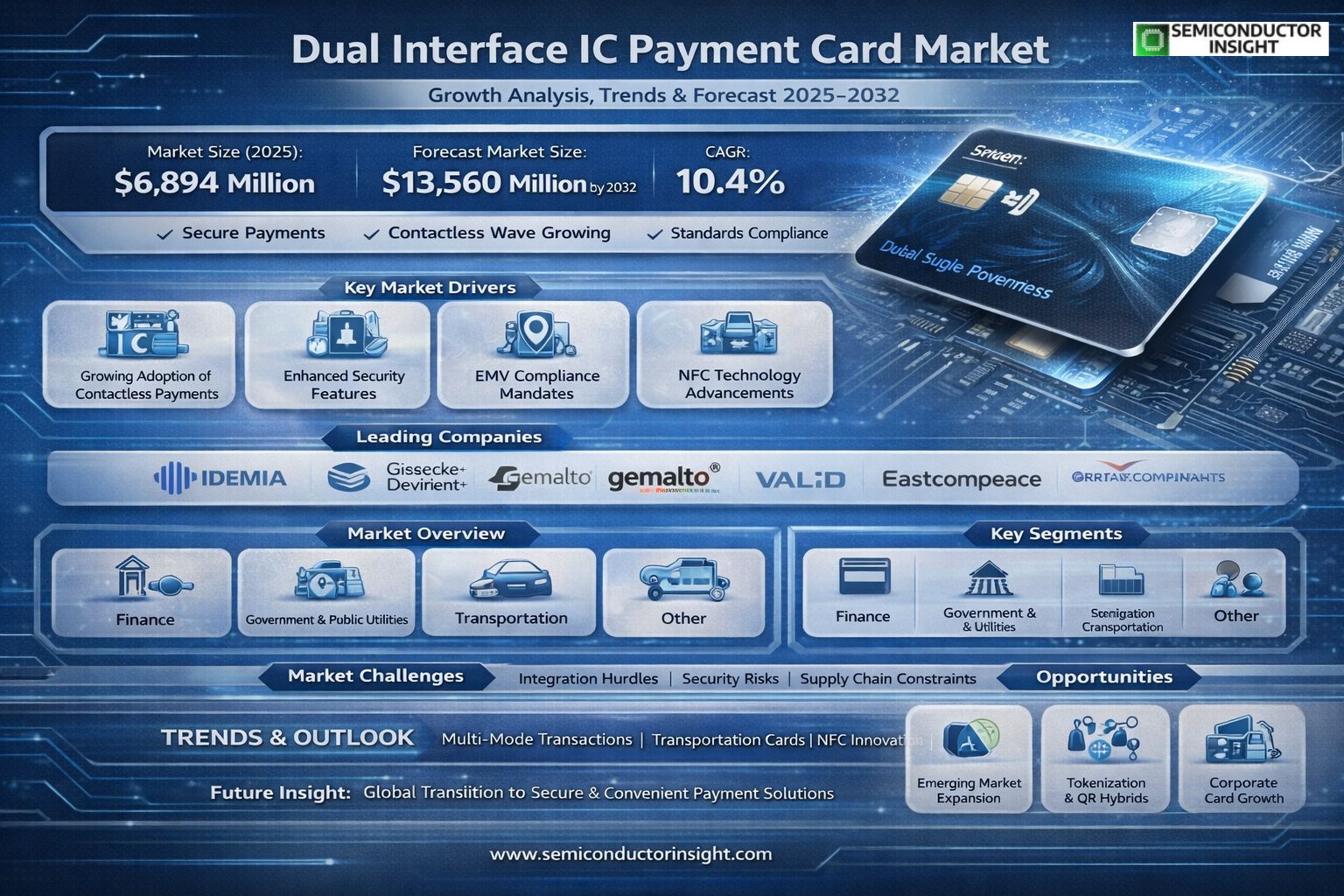
Global Dual Interface IC Payment Card market was valued at USD 6,894 million in 2025 and is projected to reach USD 13,560 million by 2032, exhibiting a CAGR of 10.4% during the forecast period.
A dual interface IC payment card is a type of payment card that incorporates both contactless and contact-based technologies, allowing users to make transactions in multiple ways. The card features an embedded integrated circuit (IC) chip, which stores data and enables secure payments.
The market is experiencing rapid growth due to several factors, including surging demand for convenient and secure payment solutions, widespread adoption of contactless transactions, and regulatory mandates for EMV-compliant cards. Furthermore, advancements in NFC technology and the integration of dual-interface capabilities in finance, transportation, and government sectors are driving expansion. Key players such as IDEMIA, Giesecke & Devrient, Gemalto, VALID, and Eastcompeace operate with diverse portfolios, continuously innovating to meet evolving market needs.
MARKET DRIVERS
Growing Adoption of Contactless Payments
Dual Interface IC Payment Card Market is propelled by the surge in contactless transactions, with global volumes exceeding 15 billion annually as consumers prioritize speed and hygiene. Banks and merchants increasingly issue these cards to support both contact and NFC interfaces, enhancing transaction efficiency in retail and transit.
Enhanced Security Features
Advanced chipsets in dual interface cards incorporate EMV standards and biometric integration, reducing fraud rates by up to 80% compared to magnetic stripe cards. This drives migration from legacy systems, particularly in Europe and Asia-Pacific regions where regulatory mandates accelerate adoption.
➤ Dual interface technology supports seamless interoperability across payment networks, boosting market penetration by 12% year-over-year.
Government initiatives for financial inclusion further fuel demand, as these cards enable secure access to digital banking in underserved areas.
MARKET CHALLENGES
Integration and Compatibility Issues
Deploying Dual Interface IC Payment Card solutions requires upgrading legacy POS terminals, posing hurdles for small merchants with limited budgets. Interoperability across diverse chip vendors remains inconsistent, leading to transaction failures in 5-7% of cases.
Other Challenges
Security Vulnerabilities
Despite robust encryption, risks like relay attacks on NFC interfaces persist, demanding continuous R&D investments estimated at $2 billion globally in 2023.
Supply chain disruptions for semiconductor chips have increased production lead times by 20-30%, straining market scalability amid rising demand.
Competition from mobile wallets challenges physical card issuance, as 40% of users prefer app-based payments for convenience.
MARKET RESTRAINTS
Regulatory Compliance Burdens
Stringent standards from PCI SSC and regional bodies like the European Central Bank impose rigorous testing, delaying Dual Interface IC Payment Card launches by 6-12 months and elevating certification costs by 15%.
High initial investment for issuers, averaging $1.5 per card at scale, restrains adoption in cost-sensitive emerging economies where single-interface alternatives prevail.
Environmental concerns over PVC materials in card production face scrutiny, with EU directives pushing for sustainable alternatives that inflate manufacturing expenses by 10-20%.
MARKET OPPORTUNITIES
Expansion in Emerging Markets
Dual Interface IC Payment Card Market holds potential in Asia-Pacific and Latin America, where cash-to-digital transitions project a 9% CAGR through 2028, driven by urbanization and smartphone proliferation.
Innovations like tokenization and QR-code hybrids on dual interface cards open avenues for loyalty programs, capturing 25% more user engagement in transit and retail sectors.
Partnerships between card manufacturers and fintech firms can accelerate market share, targeting the projected $50 billion opportunity in secure payment ecosystems by 2027.
Growth in corporate card programs for expense management further amplifies demand, with enterprise adoption rising 15% annually.
Dual Interface IC Payment Card Market Trends
Rising Demand for Secure Multi-Mode Payment Solutions
Dual Interface IC Payment Card Market reflects a shift towards versatile payment technologies that combine contact and contactless interfaces in a single embedded chip. This enables secure transactions across diverse scenarios, from traditional chip-and-PIN to NFC-enabled taps, addressing evolving consumer preferences for convenience and speed. Industry surveys indicate strong momentum driven by finance sector needs, where these cards support EMV standards and reduce fraud risks through advanced encryption.
Other Trends
Growth in Transportation and Public Utilities Applications
In Dual Interface IC Payment Card Market, transportation emerges as a key application, facilitating fare payments and access control with seamless contactless features. Government and public utilities segments also expand usage for identity verification and billing, leveraging the cards’ dual functionality to integrate with existing infrastructures. This trend underscores the adaptability of dual interface cards to high-volume, real-time transaction environments.
Dominance of Leading Manufacturers and Segment Differentiation
Dual Interface IC Payment Card Market features prominent players such as Gemalto, Giesecke & Devrient, IDEMIA, and Eastcompeace, who command significant shares through innovation in plastic and metal card variants. Plastic type dual interface IC cards lead due to cost-effectiveness and widespread adoption, while metal types gain traction for premium durability in finance applications. Regional dynamics show robust development in Asia, particularly China, alongside North America and Europe, as manufacturers pursue mergers and product enhancements to meet demand across finance, government, transportation, and other sectors. Challenges like supply chain obstacles are offset by strategic expansions, positioning the market for sustained competitive evolution.
COMPETITIVE LANDSCAPE
Key Industry Players
Dual Interface IC Payment Card Market Leaders and Competitive Dynamics
Dual Interface IC Payment Card Market exhibits an oligopolistic structure dominated by established leaders in smart card manufacturing and secure payment solutions. Key frontrunners include IDEMIA, Giesecke+Devrient (G+D), and Gemalto (now integrated into Thales and IDEMIA ecosystems), which collectively command a significant revenue share, with the global top five players accounting for approximately 40-50% of the market in 2025 based on industry surveys. These companies leverage advanced IC chip integration for both contact and contactless interfaces, driving innovation in EMV-compliant cards used in finance, government, and transportation sectors. Their dominance stems from extensive R&D investments, global supply chains, and partnerships with major payment networks like Visa and Mastercard, enabling them to navigate regulatory standards and high-security demands effectively.
Beyond the top tier, niche and regional players contribute to market diversity, particularly in high-growth areas like Asia-Pacific. Companies such as Eastcompeace, Wuhan Tianyu, DATANG, and HENGBAO have carved out strong positions through cost-competitive production and localization strategies, catering to domestic markets in China while expanding internationally. Others like VALID, CPI Card Group, Paragon Group, Watchdata, and Kona I focus on specialized applications, including metal-type cards and public utilities, fostering innovation in durable, dual-interface designs. This fragmented tail of the market intensifies competition, pushing advancements in biometric integration and sustainability, though smaller firms face challenges from scale economies and raw material volatility.
List of Key Dual Interface IC Payment Card Companies Profiled
- IDEMIA
- Giesecke+Devrient
- Gemalto (Thales Group)
- VALID
- Eastcompeace
- Wuhan Tianyu
- DATANG
- CPI Card Group
- Paragon Group
- Watchdata
- HENGBAO
- Kona I
- NXP Semiconductors
- Infineon Technologies
- MASKTECH
Segment Analysis:
| Segment Category | Sub-Segments | Key Insights |
| By Type |
|
Plastic Type Dual Interface IC Cards
|
| By Application |
|
Finance
|
| By End User |
|
Financial Institutions
|
| By Issuer Type |
|
Commercial Banks
|
| By Personalization Method |
|
Laser Engraving
|
Regional Analysis: Dual Interface IC Payment Card Market
Europe
Europe’s stringent PSD2 regulations mandate strong customer authentication, accelerating Dual Interface IC Payment Card adoption. This framework ensures interoperability across borders, minimizing fraud while supporting innovative authentication methods like tokenization.
High trust in digital payments drives consumer preference for dual interface cards, especially in urban areas. Tap-and-go convenience in daily transactions, from groceries to public transport, has normalized contactless usage across diverse demographics.
Widespread deployment of NFC-compatible POS terminals in retail and hospitality sectors enables frictionless transactions. Transit systems in cities like London exemplify how dual interface cards integrate with mobile wallets for multimodal payments.
Collaborations between fintech startups and traditional banks spur advancements in dual interface chips, incorporating wear-resistant materials and enhanced encryption. This fosters a competitive environment yielding next-generation payment solutions.
North America
North America exhibits steady growth in Dual Interface IC Payment Card Market, transitioning from legacy magnetic stripe systems toward chip-based technologies. The US leads with initiatives promoting contactless payments in high-volume retail environments, supported by major networks like Visa and Mastercard. Canada mirrors this trend, leveraging its advanced banking infrastructure for secure transactions. Consumer demand for faster checkout experiences fuels adoption, particularly in e-commerce-integrated physical stores. However, fragmented regulations across states pose challenges to uniform implementation. Financial institutions invest in education campaigns to build user confidence, emphasizing dual interface versatility for both contact and NFC scenarios. Partnerships with tech giants enhance card personalization, aligning with rising mobile payment synergies. Despite slower pace compared to Europe, North America’s vast market size and innovative spirit promise significant expansion in Dual Interface IC Payment Card utilization.
Asia-Pacific
Asia-Pacific emerges as a dynamic force in Dual Interface IC Payment Card Market, propelled by rapid urbanization and digital transformation. Countries like China, Japan, and India witness surging demand as governments push financial inclusion via subsidized card programs. Dense populations and mobile-first cultures favor contactless features, integrating cards with QR codes and apps for hybrid payments. Local manufacturers scale production to meet volume needs, focusing on cost-effective dual interface solutions. Challenges include varying interoperability standards across nations, yet regional alliances aim to standardize protocols. Retail booms in megacities accelerate POS upgrades, embedding NFC capabilities. Banks target underserved segments with feature-rich cards, blending security and accessibility. This region’s growth trajectory underscores its potential to reshape global Dual Interface IC Payment Card dynamics through scale and innovation.
South America
South America advances in Dual Interface IC Payment Card Market amid economic recovery and anti-cash agendas. Brazil and Mexico pioneer adoption, with central banks mandating chip transitions to curb fraud in informal economies. Urban consumers embrace contactless for convenience in bustling markets and transit hubs. Infrastructure investments upgrade terminals, though rural penetration lags due to connectivity issues. Partnerships between international issuers and local fintechs introduce tailored dual interface products, supporting microtransactions. Regulatory harmonization efforts across Mercosur enhance cross-border usability. Rising middle classes drive premium card uptake, prioritizing security amid cyber threats. South America’s journey reflects resilience, positioning it for accelerated Dual Interface IC Payment Card integration as digital ecosystems mature.
Middle East & Africa
The Middle East & Africa region shows promising developments in Dual Interface IC Payment Card Market, driven by oil-rich economies and inclusion initiatives. UAE and Saudi Arabia lead with luxury card offerings, integrating dual interfaces into smart city frameworks. Africa’s mobile money dominance complements cards, fostering hybrid models in Kenya and Nigeria. Governments incentivize POS modernizations to formalize informal sectors. Challenges like power inconsistencies spur ruggedized card designs. Collaborations with global players introduce Islamic finance-compliant features. Urban youth adopt contactless for lifestyle payments, while remittances boost secure cross-border use. This diverse landscape highlights untapped potential, with strategic investments accelerating Dual Interface IC Payment Card Market penetration.
Report Scope
This market research report provides a comprehensive analysis of Dual Interface IC Payment Card Market, covering the forecast period 2026–2034. It offers detailed insights into market dynamics, technological advancements, competitive landscape, and key trends shaping the industry.
Key focus areas of the report include:
- Market Overview: The report begins with an overview outlining its current market scenario, key growth indicators, and industry transformation drivers. It discusses macroeconomic factors, demand–supply balance, regulatory landscape, and the strategic role of dual interface IC payment cards in powering advancements across industries such as finance, government & public utilities, transportation, and other sectors.
- Market Size & Forecast: Historical data and future projections for revenue, unit shipments, and market value across major regions and segments.
- Segmentation Analysis: Detailed breakdown by product type, technology, application, and end-user industry to identify high-growth segments and investment opportunities.
- Regional Insights: Insights into market performance across North America, Europe, Asia-Pacific, Latin America, and the Middle East & Africa, including country-level analysis where relevant.
- Competitive Landscape: Profiles of leading market participants, including their product offerings, R&D focus, manufacturing capacity, pricing strategies, and recent developments such as mergers, acquisitions, and partnerships.
- Technology Trends & Innovation: Assessment of emerging technologies, integration of AI/IoT, semiconductor design trends, fabrication techniques, and evolving industry standards.
- Market Drivers & Restraints: Evaluation of factors driving market growth along with challenges, supply chain constraints, regulatory issues, and market-entry barriers.
- Stakeholder Insights: Insights for component suppliers, OEMs, system integrators, investors, and policymakers regarding the evolving ecosystem and strategic opportunities.
Primary and secondary research methods are employed, including interviews with industry experts, data from verified sources, and real-time market intelligence to ensure the accuracy and reliability of the insights presented.
FREQUENTLY ASKED QUESTIONS:
What is the current market size of Dual Interface IC Payment Card Market?
-> Dual Interface IC Payment Card Market was valued at USD 6894 million in 2025 and is projected to reach USD 13560 million by 2032, at a CAGR of 10.4% during the forecast period.
Which key companies operate in Dual Interface IC Payment Card Market?
-> Key players include Gemalto, Giesecke & Devrient, IDEMIA, VALID, Eastcompeace, Wuhan Tianyu, DATANG, Paragon Group, CPI Card Group, Watchdata, among others.
What are the key growth drivers?
-> Key growth drivers include rising demand for secure contactless and contact-based payments, expansion of digital finance, and regulatory pushes for advanced payment technologies.
Which region dominates the market?
-> Asia-Pacific is the fastest-growing region, while North America remains a dominant market.
What are the emerging trends?
-> Emerging trends include advancements in dual interface IC chips, growth in plastic and metal type cards, and integration with mobile and NFC technologies.

Get Sample Report PDF for Exclusive Insights
Report Sample Includes
- Table of Contents
- List of Tables & Figures
- Charts, Research Methodology, and more...
 Download Sample Report PDF