Dual Interface Flexible Lead Frame Market, Trends, Business Strategies 2025-2032

Dual Interface Flexible Lead Frame Market was valued at 24.2 million in 2024 and is projected to reach US$ 51.4 million by 2032, at a CAGR of 11.5% during the forecast period

PDF Icon Download Sample Report PDF
  • Quick Dispatch

    All Orders

  • Secure Payment

    100% Secure Payment

Price range: $1,500.00 through $4,250.00

Clear

MARKET INSIGHTS

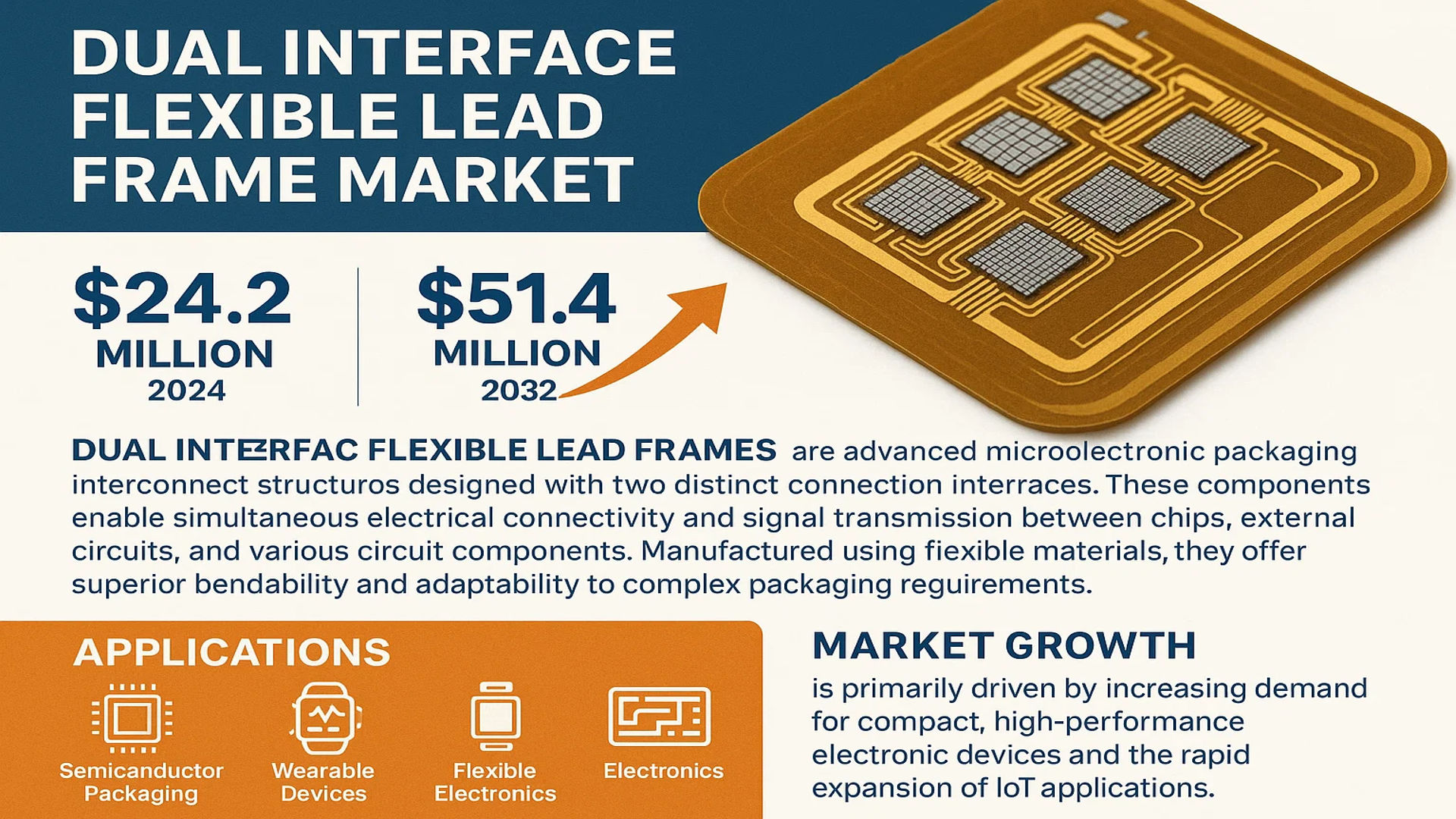
The global Dual Interface Flexible Lead Frame Market was valued at 24.2 million in 2024 and is projected to reach US$ 51.4 million by 2032, at a CAGR of 11.5% during the forecast period.

Dual interface flexible lead frames are advanced microelectronic packaging interconnect structures designed with two distinct connection interfaces. These components enable simultaneous electrical connectivity and signal transmission between chips, external circuits, and various circuit components. Manufactured using flexible materials, they offer superior bendability and adaptability to complex packaging requirements. Their applications span across semiconductor packaging, wearable devices, and flexible electronics, playing a pivotal role in enabling device miniaturization and performance enhancements.

Market growth is primarily driven by increasing demand for compact, high-performance electronic devices and the rapid expansion of IoT applications. The 6PIN segment is expected to witness significant adoption, particularly in financial cards and ETC systems. Key players such as Linxens, LG Innotek, and New Henghui Electronics dominate the competitive landscape, collectively holding a substantial market share. Technological advancements in semiconductor packaging and rising investments in flexible electronics further contribute to market expansion.
Dual Interface Flexible Lead Frame Market

MARKET DYNAMICS

MARKET DRIVERS

Growing Demand for Miniaturized Electronics to Propel Dual Interface Flexible Lead Frame Adoption

The relentless trend toward electronic miniaturization across industries is accelerating demand for dual interface flexible lead frames. With smartphones, wearables, and IoT devices requiring increasingly compact yet high-performance components, flexible lead frames provide the ideal interconnect solution. Studies indicate that the semiconductor packaging market, where these components play a critical role, continues expanding at nearly 9% annually. Dual interface configurations are particularly valuable in space-constrained applications because they can simultaneously handle multiple connection types while maintaining flexibility for complex form factors. As consumer electronics shrink in size but grow in functionality, manufacturers are adopting these advanced packaging solutions at unprecedented rates.

Rise of Contactless Payment Systems Driving Financial Card Applications

The global shift toward contactless financial transactions represents a major growth driver for dual interface flexible lead frames. These components form the backbone of modern smart cards that combine both contact and contactless functionality. With contactless payment transactions projected to exceed $10 trillion annually in coming years, card manufacturers are rapidly upgrading production capabilities. Financial institutions worldwide continue replacing traditional magnetic stripe cards with dual-interface chip cards that offer enhanced security and convenience. This transition creates sustained demand for the specialized lead frames that enable these hybrid payment solutions while meeting stringent banking industry durability requirements.

Furthermore, government initiatives promoting cashless economies across emerging markets are compounding this effect, with several Asian and European nations mandating dual-interface payment cards as the new standard for financial transactions.

MARKET RESTRAINTS

High Production Costs Limit Widespread Market Adoption

While dual interface flexible lead frames offer significant technical advantages, their manufacturing complexity creates substantial cost barriers. The specialized materials and precision fabrication processes required can increase production expenses by 30-40% compared to conventional lead frames. Many small and medium electronics manufacturers find these costs prohibitive, particularly in price-sensitive consumer markets. The sophisticated electroplating and micro-machining techniques demand both expensive equipment and highly trained operators, further elevating overhead expenses. Until economies of scale and manufacturing innovations can reduce these cost premiums, widespread adoption across all market segments remains constrained.

Other Restraints

Material Compatibility Challenges
Finding substrate materials that maintain flexibility while withstanding repeated stress cycles presents ongoing technical challenges. The thermal expansion properties must precisely match semiconductor components to prevent reliability issues, requiring extensive materials research and testing.

Supply Chain Complexities
The specialized nature of raw materials creates vulnerability to supply disruptions. Recent semiconductor industry shortages have highlighted how single-supplier dependencies for key materials can jeopardize production schedules across entire electronics value chains.

MARKET OPPORTUNITIES

Automotive Electronics Revolution Offers Significant Growth Potential

The automotive industry’s electrification and digital transformation represents a major opportunity for dual interface flexible lead frame manufacturers. Modern vehicles incorporate hundreds of electronic control units requiring robust yet compact interconnects able to withstand harsh operating environments. The increasing adoption of advanced driver assistance systems (ADAS) and in-vehicle networking solutions creates strong demand for specialized packaging technologies. With automotive electronics content per vehicle projected to triple in the next decade, component suppliers are actively developing automotive-grade versions of flexible lead frames that meet rigorous industry reliability standards.

Medical Wearables Expand Application Horizons

The booming medical wearable device sector presents another promising avenue for market expansion. Next-generation health monitors require biocompatible, flexible electronics that can conform to the human body while maintaining signal integrity. Dual interface lead frames enable the hybrid functionality needed in devices that combine biosensing with wireless data transmission. The global medical wearables market continues growing rapidly, with particular strength in continuous glucose monitors, cardiac patches, and neurological sensors – all applications where these advanced interconnects provide distinct advantages over traditional packaging solutions.

MARKET CHALLENGES

Technical Limitations in High-Frequency Applications Pose Development Hurdles

While dual interface flexible lead frames excel in many applications, their performance in high-frequency environments presents ongoing engineering challenges. Signal integrity becomes increasingly difficult to maintain as operating frequencies exceed 5GHz, limiting their use in cutting-edge wireless and RF applications. The flexible substrate materials that provide mechanical advantages can introduce unwanted parasitic effects at higher frequencies. Manufacturers are investing heavily in advanced simulation tools and new material formulations to overcome these limitations, but achieving performance parity with rigid substrates remains technically demanding.

Other Challenges

Standardization Gaps
The rapid evolution of flexible packaging technologies has outpaced industry standardization efforts. Differing specifications across manufacturers create compatibility concerns that slow adoption in conservative industries like aerospace and medical equipment.

Environmental Compliance Concerns
Increasingly stringent regulations regarding hazardous substances in electronics manufacturing require continuous reformulation of materials and processes. The lead frames must comply with multiple regional regulations while maintaining performance characteristics, adding complexity to global supply chains.

DUAL INTERFACE FLEXIBLE LEAD FRAME MARKET TRENDS

Growth in Semiconductor Miniaturization Driving Demand for Flexible Lead Frames

The semiconductor industry’s push toward miniaturization and high-density packaging is fueling the adoption of dual interface flexible lead frames. These components enable thinner, more compact designs while maintaining robust electrical connectivity—a critical requirement for next-generation devices. With the global semiconductor packaging market projected to exceed $60 billion by 2027, demand for advanced interconnect solutions continues to accelerate. Dual interface models effectively address the challenges of signal integrity in space-constrained applications like foldable smartphones and IoT sensors, where traditional rigid lead frames struggle to meet performance requirements.

Other Trends

Expansion in Contactless Payment Infrastructure

The global shift toward cashless transactions is creating substantial opportunities for dual interface flexible lead frames in payment card applications. Financial institutions are increasingly adopting hybrid cards combining both contact and contactless functionalities, with over 3.4 billion dual interface payment cards expected to be in circulation by 2026. This trend is particularly strong in Europe and Asia-Pacific regions where governments are mandating EMV chip card migrations, driving card reissuance cycles that typically incorporate the latest flexible lead frame technologies.

Material Innovation Enhancing Performance Characteristics

Manufacturers are achieving performance breakthroughs through novel material compositions in flexible lead frame production. The integration of high-performance polyimide substrates with advanced copper alloys has yielded products with superior thermal stability (withstanding temperatures up to 400°C) while maintaining flexibility. Such innovations are critical for automotive electronics applications where lead frames must endure engine compartment conditions while enabling complex three-dimensional packaging configurations demanded by ADAS sensor arrays and infotainment systems.

COMPETITIVE LANDSCAPE

Key Industry Players

Technological Innovation and Strategic Expansion Define Market Leadership

The global dual interface flexible lead frame market features a moderately competitive structure with major players dominating revenue shares while regional participants compete through localized solutions. Linxens emerges as a market leader, leveraging its decades-long expertise in microconnectors and secure identity solutions. The company’s stronghold in Europe and Asia, coupled with its continuous R&D investment in flexible electronics, positions it favorably for future growth.

LG Innotek represents another pivotal player, particularly in the Asia-Pacific region, where its vertically integrated semiconductor components business provides cost advantages. The company has recently expanded its portfolio to include advanced lead frame solutions for automotive electronics, capitalizing on the growing demand for connected vehicle technologies.

Mid-sized competitors like New Henghui Electronics are gaining traction through specialized offerings for financial cards and government ID applications. With the 6PIN segment projected for significant growth, companies are actively developing thinner, more durable interfaces that meet emerging industry standards for contactless payment systems.

Market dynamics show increasing collaboration between lead frame manufacturers and semiconductor packaging firms to develop integrated solutions. Several industry leaders have formed strategic alliances with chipset providers to create optimized packages for IoT devices and wearables, creating new revenue streams while improving technical specifications.

List of Key Dual Interface Flexible Lead Frame Companies

  • Linxens (France)
  • LG Innotek (South Korea)
  • New Henghui Electronics (China)
  • Mitsui High-tec (Japan)
  • ASM Pacific Technology (Hong Kong)
  • POSSEHL Electronics (Germany)
  • Signetics (South Korea)
  • Jentech Precision Industrial (Taiwan)
  • WuXi Micro Just-Tech (China)

Segment Analysis:

By Type

6PIN Lead Frames Hold Majority Share Due to Compact Design and High Compatibility

The market is segmented based on type into:

  • 6PIN
  • 8PIN
  • Others

By Application

Financial Cards Emerge as Key Application Segment Owing to Increased Adoption of Contactless Payments

The market is segmented based on application into:

  • Financial Card
  • ETC Card
  • Others

By Material

Copper-based Lead Frames Maintain Dominance Due to Superior Electrical Conductivity

The market is segmented based on material composition into:

  • Copper Alloy
  • Iron-Nickel Alloy
  • Other Metal Alloys

By End-Use Industry

Consumer Electronics Leads Market Demand Fueled by Miniaturization Trends

The market is segmented based on end-use industries into:

  • Consumer Electronics
  • Automotive
  • Healthcare
  • Industrial
  • Others

Regional Analysis: Dual Interface Flexible Lead Frame Market

Asia-Pacific
The Asia-Pacific region dominates the Dual Interface Flexible Lead Frame market, accounting for the largest revenue share due to its thriving semiconductor and electronics manufacturing sector. China leads the regional market, with significant investments in miniaturized and flexible electronics, particularly for applications like financial cards and wearables. The presence of major semiconductor foundries and packaging companies, coupled with cost-effective production capabilities, drives adoption. However, intellectual property concerns and competitive pricing pressures create challenges for premium-grade solutions. Japan and South Korea also contribute substantially, leveraging their advanced semiconductor ecosystems and strong R&D focus on next-generation packaging technologies.

North America
North America represents the second-largest market, characterized by high-value applications in secure financial cards and advanced wearables. The U.S. leads regional demand, supported by stringent security requirements for payment cards and government-issued IDs. Major technology firms are adopting Dual Interface Flexible Lead Frames for compact, high-reliability IoT devices. While the market shows steady growth, it faces constraints from higher production costs and shifting supply chains. Canada’s emerging semiconductor packaging sector presents new opportunities, though adoption remains limited to niche applications.

Europe
Europe maintains a strong position in the Dual Interface Flexible Lead Frame market, particularly for banking and transportation card applications. Germany and France lead regional adoption, with their well-established smart card industries and emphasis on secure transaction technologies. The EU’s focus on digital identity solutions and contactless payments drives demand for advanced lead frame solutions. However, the market faces slower growth compared to Asia, hampered by higher production costs and stringent environmental regulations affecting material choices. The region remains a hub for innovation, with several key players developing next-generation flexible electronics solutions.

Middle East & Africa
The MEA region shows emerging potential for Dual Interface Flexible Lead Frames, particularly in GCC countries adopting advanced financial technologies and national ID programs. While still a developing market, increasing urbanization and digital payment adoption create growth opportunities. The lack of local manufacturing capabilities and reliance on imports currently limit market expansion. South Africa and UAE lead regional adoption, though volumes remain relatively small compared to other regions. Future growth will depend on infrastructure development and regional economic stability.

South America
South America presents limited but growing opportunities for Dual Interface Flexible Lead Frames, primarily in Brazil’s financial sector and Colombia’s transportation card applications. Economic volatility and currency fluctuations continue to challenge consistent market growth. While some local manufacturers have begun adopting these technologies for domestic smart card production, most advanced solutions are imported. The region shows long-term potential as digital payment systems become more widespread, though adoption will likely follow rather than lead global trends.

Report Scope

This market research report provides a comprehensive analysis of the global Dual Interface Flexible Lead Frame market, covering the forecast period 2024–2032. It offers detailed insights into market dynamics, technological advancements, competitive landscape, and key trends shaping the industry.

Key focus areas of the report include:

  • Market Size & Forecast: Historical data and future projections for revenue, unit shipments, and market value across major regions and segments. The global market was valued at USD 24.2 million in 2024 and is projected to reach USD 51.4 million by 2032, growing at a CAGR of 11.5%.
  • Segmentation Analysis: Detailed breakdown by product type (6PIN, 8PIN), application (Financial Card, ETC Card, Others), and end-user industry to identify high-growth segments and investment opportunities.
  • Regional Outlook: Insights into market performance across North America, Europe, Asia-Pacific, Latin America, and the Middle East & Africa, including country-level analysis where relevant. Asia-Pacific dominates the market due to strong semiconductor manufacturing presence.
  • Competitive Landscape: Profiles of leading market participants including Linxens, LGInnotek, and New Henghui Electronics, covering their product offerings, R&D focus, manufacturing capacity, and recent developments.
  • Technology Trends & Innovation: Assessment of emerging technologies in flexible electronics, miniaturization trends, and evolving packaging standards for semiconductor devices.
  • Market Drivers & Restraints: Evaluation of factors driving market growth (demand for flexible electronics, semiconductor industry expansion) along with challenges (material costs, technical complexity).
  • Stakeholder Analysis: Insights for component suppliers, semiconductor manufacturers, investors, and policymakers regarding the evolving ecosystem and strategic opportunities.

Primary and secondary research methods are employed, including interviews with industry experts, data from verified sources, and real-time market intelligence to ensure the accuracy and reliability of the insights presented.

FREQUENTLY ASKED QUESTIONS:

What is the current market size of Global Dual Interface Flexible Lead Frame Market?

-> Dual Interface Flexible Lead Frame Market was valued at 24.2 million in 2024 and is projected to reach US$ 51.4 million by 2032, at a CAGR of 11.5% during the forecast period.

Which key companies operate in Global Dual Interface Flexible Lead Frame Market?

-> Key players include Linxens, LGInnotek, and New Henghui Electronics, among others.

What are the key growth drivers?

-> Key growth drivers include increasing demand for flexible electronics, growth in semiconductor packaging, and miniaturization trends in electronic devices.

Which region dominates the market?

-> Asia-Pacific is the dominant market, driven by strong semiconductor manufacturing presence in countries like China, South Korea, and Japan.

What are the emerging trends?

-> Emerging trends include development of advanced materials for better flexibility, integration with IoT devices, and increasing adoption in wearable technology.

Dual Interface Flexible Lead Frame Market, Trends, Business Strategies 2025-2032

Get Sample Report PDF for Exclusive Insights

Report Sample Includes

  • Table of Contents
  • List of Tables & Figures
  • Charts, Research Methodology, and more...

PDF Icon Download Sample Report PDF

Download Sample Report

Table of Content

1 Introduction to Research & Analysis Reports
1.1 Dual Interface Flexible Lead Frame Market Definition
1.2 Market Segments
1.2.1 Segment by Type
1.2.2 Segment by Application
1.3 Global Dual Interface Flexible Lead Frame Market Overview
1.4 Features & Benefits of This Report
1.5 Methodology & Sources of Information
1.5.1 Research Methodology
1.5.2 Research Process
1.5.3 Base Year
1.5.4 Report Assumptions & Caveats
2 Global Dual Interface Flexible Lead Frame Overall Market Size
2.1 Global Dual Interface Flexible Lead Frame Market Size: 2024 VS 2032
2.2 Global Dual Interface Flexible Lead Frame Market Size, Prospects & Forecasts: 2020-2032
2.3 Global Dual Interface Flexible Lead Frame Sales: 2020-2032
3 Company Landscape
3.1 Top Dual Interface Flexible Lead Frame Players in Global Market
3.2 Top Global Dual Interface Flexible Lead Frame Companies Ranked by Revenue
3.3 Global Dual Interface Flexible Lead Frame Revenue by Companies
3.4 Global Dual Interface Flexible Lead Frame Sales by Companies
3.5 Global Dual Interface Flexible Lead Frame Price by Manufacturer (2020-2025)
3.6 Top 3 and Top 5 Dual Interface Flexible Lead Frame Companies in Global Market, by Revenue in 2024
3.7 Global Manufacturers Dual Interface Flexible Lead Frame Product Type
3.8 Tier 1, Tier 2, and Tier 3 Dual Interface Flexible Lead Frame Players in Global Market
3.8.1 List of Global Tier 1 Dual Interface Flexible Lead Frame Companies
3.8.2 List of Global Tier 2 and Tier 3 Dual Interface Flexible Lead Frame Companies
4 Sights by Product
4.1 Overview
4.1.1 Segment by Type – Global Dual Interface Flexible Lead Frame Market Size Markets, 2024 & 2032
4.1.2 6PIN
4.1.3 8PIN
4.2 Segment by Type – Global Dual Interface Flexible Lead Frame Revenue & Forecasts
4.2.1 Segment by Type – Global Dual Interface Flexible Lead Frame Revenue, 2020-2025
4.2.2 Segment by Type – Global Dual Interface Flexible Lead Frame Revenue, 2026-2032
4.2.3 Segment by Type – Global Dual Interface Flexible Lead Frame Revenue Market Share, 2020-2032
4.3 Segment by Type – Global Dual Interface Flexible Lead Frame Sales & Forecasts
4.3.1 Segment by Type – Global Dual Interface Flexible Lead Frame Sales, 2020-2025
4.3.2 Segment by Type – Global Dual Interface Flexible Lead Frame Sales, 2026-2032
4.3.3 Segment by Type – Global Dual Interface Flexible Lead Frame Sales Market Share, 2020-2032
4.4 Segment by Type – Global Dual Interface Flexible Lead Frame Price (Manufacturers Selling Prices), 2020-2032
5 Sights by Application
5.1 Overview
5.1.1 Segment by Application – Global Dual Interface Flexible Lead Frame Market Size, 2024 & 2032
5.1.2 Financial Card
5.1.3 ETC Card
5.1.4 Others
5.2 Segment by Application – Global Dual Interface Flexible Lead Frame Revenue & Forecasts
5.2.1 Segment by Application – Global Dual Interface Flexible Lead Frame Revenue, 2020-2025
5.2.2 Segment by Application – Global Dual Interface Flexible Lead Frame Revenue, 2026-2032
5.2.3 Segment by Application – Global Dual Interface Flexible Lead Frame Revenue Market Share, 2020-2032
5.3 Segment by Application – Global Dual Interface Flexible Lead Frame Sales & Forecasts
5.3.1 Segment by Application – Global Dual Interface Flexible Lead Frame Sales, 2020-2025
5.3.2 Segment by Application – Global Dual Interface Flexible Lead Frame Sales, 2026-2032
5.3.3 Segment by Application – Global Dual Interface Flexible Lead Frame Sales Market Share, 2020-2032
5.4 Segment by Application – Global Dual Interface Flexible Lead Frame Price (Manufacturers Selling Prices), 2020-2032
6 Sights by Region
6.1 By Region – Global Dual Interface Flexible Lead Frame Market Size, 2024 & 2032
6.2 By Region – Global Dual Interface Flexible Lead Frame Revenue & Forecasts
6.2.1 By Region – Global Dual Interface Flexible Lead Frame Revenue, 2020-2025
6.2.2 By Region – Global Dual Interface Flexible Lead Frame Revenue, 2026-2032
6.2.3 By Region – Global Dual Interface Flexible Lead Frame Revenue Market Share, 2020-2032
6.3 By Region – Global Dual Interface Flexible Lead Frame Sales & Forecasts
6.3.1 By Region – Global Dual Interface Flexible Lead Frame Sales, 2020-2025
6.3.2 By Region – Global Dual Interface Flexible Lead Frame Sales, 2026-2032
6.3.3 By Region – Global Dual Interface Flexible Lead Frame Sales Market Share, 2020-2032
6.4 North America
6.4.1 By Country – North America Dual Interface Flexible Lead Frame Revenue, 2020-2032
6.4.2 By Country – North America Dual Interface Flexible Lead Frame Sales, 2020-2032
6.4.3 United States Dual Interface Flexible Lead Frame Market Size, 2020-2032
6.4.4 Canada Dual Interface Flexible Lead Frame Market Size, 2020-2032
6.4.5 Mexico Dual Interface Flexible Lead Frame Market Size, 2020-2032
6.5 Europe
6.5.1 By Country – Europe Dual Interface Flexible Lead Frame Revenue, 2020-2032
6.5.2 By Country – Europe Dual Interface Flexible Lead Frame Sales, 2020-2032
6.5.3 Germany Dual Interface Flexible Lead Frame Market Size, 2020-2032
6.5.4 France Dual Interface Flexible Lead Frame Market Size, 2020-2032
6.5.5 U.K. Dual Interface Flexible Lead Frame Market Size, 2020-2032
6.5.6 Italy Dual Interface Flexible Lead Frame Market Size, 2020-2032
6.5.7 Russia Dual Interface Flexible Lead Frame Market Size, 2020-2032
6.5.8 Nordic Countries Dual Interface Flexible Lead Frame Market Size, 2020-2032
6.5.9 Benelux Dual Interface Flexible Lead Frame Market Size, 2020-2032
6.6 Asia
6.6.1 By Region – Asia Dual Interface Flexible Lead Frame Revenue, 2020-2032
6.6.2 By Region – Asia Dual Interface Flexible Lead Frame Sales, 2020-2032
6.6.3 China Dual Interface Flexible Lead Frame Market Size, 2020-2032
6.6.4 Japan Dual Interface Flexible Lead Frame Market Size, 2020-2032
6.6.5 South Korea Dual Interface Flexible Lead Frame Market Size, 2020-2032
6.6.6 Southeast Asia Dual Interface Flexible Lead Frame Market Size, 2020-2032
6.6.7 India Dual Interface Flexible Lead Frame Market Size, 2020-2032
6.7 South America
6.7.1 By Country – South America Dual Interface Flexible Lead Frame Revenue, 2020-2032
6.7.2 By Country – South America Dual Interface Flexible Lead Frame Sales, 2020-2032
6.7.3 Brazil Dual Interface Flexible Lead Frame Market Size, 2020-2032
6.7.4 Argentina Dual Interface Flexible Lead Frame Market Size, 2020-2032
6.8 Middle East & Africa
6.8.1 By Country – Middle East & Africa Dual Interface Flexible Lead Frame Revenue, 2020-2032
6.8.2 By Country – Middle East & Africa Dual Interface Flexible Lead Frame Sales, 2020-2032
6.8.3 Turkey Dual Interface Flexible Lead Frame Market Size, 2020-2032
6.8.4 Israel Dual Interface Flexible Lead Frame Market Size, 2020-2032
6.8.5 Saudi Arabia Dual Interface Flexible Lead Frame Market Size, 2020-2032
6.8.6 UAE Dual Interface Flexible Lead Frame Market Size, 2020-2032
7 Manufacturers & Brands Profiles
7.1 Linxens
7.1.1 Linxens Company Summary
7.1.2 Linxens Business Overview
7.1.3 Linxens Dual Interface Flexible Lead Frame Major Product Offerings
7.1.4 Linxens Dual Interface Flexible Lead Frame Sales and Revenue in Global (2020-2025)
7.1.5 Linxens Key News & Latest Developments
7.2 LGInnotek
7.2.1 LGInnotek Company Summary
7.2.2 LGInnotek Business Overview
7.2.3 LGInnotek Dual Interface Flexible Lead Frame Major Product Offerings
7.2.4 LGInnotek Dual Interface Flexible Lead Frame Sales and Revenue in Global (2020-2025)
7.2.5 LGInnotek Key News & Latest Developments
7.3 New Henghui Electronics
7.3.1 New Henghui Electronics Company Summary
7.3.2 New Henghui Electronics Business Overview
7.3.3 New Henghui Electronics Dual Interface Flexible Lead Frame Major Product Offerings
7.3.4 New Henghui Electronics Dual Interface Flexible Lead Frame Sales and Revenue in Global (2020-2025)
7.3.5 New Henghui Electronics Key News & Latest Developments
8 Global Dual Interface Flexible Lead Frame Production Capacity, Analysis
8.1 Global Dual Interface Flexible Lead Frame Production Capacity, 2020-2032
8.2 Dual Interface Flexible Lead Frame Production Capacity of Key Manufacturers in Global Market
8.3 Global Dual Interface Flexible Lead Frame Production by Region
9 Key Market Trends, Opportunity, Drivers and Restraints
9.1 Market Opportunities & Trends
9.2 Market Drivers
9.3 Market Restraints
10 Dual Interface Flexible Lead Frame Supply Chain Analysis
10.1 Dual Interface Flexible Lead Frame Industry Value Chain
10.2 Dual Interface Flexible Lead Frame Upstream Market
10.3 Dual Interface Flexible Lead Frame Downstream and Clients
10.4 Marketing Channels Analysis
10.4.1 Marketing Channels
10.4.2 Dual Interface Flexible Lead Frame Distributors and Sales Agents in Global
11 Conclusion
12 Appendix
12.1 Note
12.2 Examples of Clients
12.3 DisclaimerList of Tables
Table 1. Key Players of Dual Interface Flexible Lead Frame in Global Market
Table 2. Top Dual Interface Flexible Lead Frame Players in Global Market, Ranking by Revenue (2024)
Table 3. Global Dual Interface Flexible Lead Frame Revenue by Companies, (US$, Mn), 2020-2025
Table 4. Global Dual Interface Flexible Lead Frame Revenue Share by Companies, 2020-2025
Table 5. Global Dual Interface Flexible Lead Frame Sales by Companies, (K Units), 2020-2025
Table 6. Global Dual Interface Flexible Lead Frame Sales Share by Companies, 2020-2025
Table 7. Key Manufacturers Dual Interface Flexible Lead Frame Price (2020-2025) & (US$/Unit)
Table 8. Global Manufacturers Dual Interface Flexible Lead Frame Product Type
Table 9. List of Global Tier 1 Dual Interface Flexible Lead Frame Companies, Revenue (US$, Mn) in 2024 and Market Share
Table 10. List of Global Tier 2 and Tier 3 Dual Interface Flexible Lead Frame Companies, Revenue (US$, Mn) in 2024 and Market Share
Table 11. Segment by Type – Global Dual Interface Flexible Lead Frame Revenue, (US$, Mn), 2024 & 2032
Table 12. Segment by Type – Global Dual Interface Flexible Lead Frame Revenue (US$, Mn), 2020-2025
Table 13. Segment by Type – Global Dual Interface Flexible Lead Frame Revenue (US$, Mn), 2026-2032
Table 14. Segment by Type – Global Dual Interface Flexible Lead Frame Sales (K Units), 2020-2025
Table 15. Segment by Type – Global Dual Interface Flexible Lead Frame Sales (K Units), 2026-2032
Table 16. Segment by Application – Global Dual Interface Flexible Lead Frame Revenue, (US$, Mn), 2024 & 2032
Table 17. Segment by Application – Global Dual Interface Flexible Lead Frame Revenue, (US$, Mn), 2020-2025
Table 18. Segment by Application – Global Dual Interface Flexible Lead Frame Revenue, (US$, Mn), 2026-2032
Table 19. Segment by Application – Global Dual Interface Flexible Lead Frame Sales, (K Units), 2020-2025
Table 20. Segment by Application – Global Dual Interface Flexible Lead Frame Sales, (K Units), 2026-2032
Table 21. By Region – Global Dual Interface Flexible Lead Frame Revenue, (US$, Mn), 2025-2032
Table 22. By Region – Global Dual Interface Flexible Lead Frame Revenue, (US$, Mn), 2020-2025
Table 23. By Region – Global Dual Interface Flexible Lead Frame Revenue, (US$, Mn), 2026-2032
Table 24. By Region – Global Dual Interface Flexible Lead Frame Sales, (K Units), 2020-2025
Table 25. By Region – Global Dual Interface Flexible Lead Frame Sales, (K Units), 2026-2032
Table 26. By Country – North America Dual Interface Flexible Lead Frame Revenue, (US$, Mn), 2020-2025
Table 27. By Country – North America Dual Interface Flexible Lead Frame Revenue, (US$, Mn), 2026-2032
Table 28. By Country – North America Dual Interface Flexible Lead Frame Sales, (K Units), 2020-2025
Table 29. By Country – North America Dual Interface Flexible Lead Frame Sales, (K Units), 2026-2032
Table 30. By Country – Europe Dual Interface Flexible Lead Frame Revenue, (US$, Mn), 2020-2025
Table 31. By Country – Europe Dual Interface Flexible Lead Frame Revenue, (US$, Mn), 2026-2032
Table 32. By Country – Europe Dual Interface Flexible Lead Frame Sales, (K Units), 2020-2025
Table 33. By Country – Europe Dual Interface Flexible Lead Frame Sales, (K Units), 2026-2032
Table 34. By Region – Asia Dual Interface Flexible Lead Frame Revenue, (US$, Mn), 2020-2025
Table 35. By Region – Asia Dual Interface Flexible Lead Frame Revenue, (US$, Mn), 2026-2032
Table 36. By Region – Asia Dual Interface Flexible Lead Frame Sales, (K Units), 2020-2025
Table 37. By Region – Asia Dual Interface Flexible Lead Frame Sales, (K Units), 2026-2032
Table 38. By Country – South America Dual Interface Flexible Lead Frame Revenue, (US$, Mn), 2020-2025
Table 39. By Country – South America Dual Interface Flexible Lead Frame Revenue, (US$, Mn), 2026-2032
Table 40. By Country – South America Dual Interface Flexible Lead Frame Sales, (K Units), 2020-2025
Table 41. By Country – South America Dual Interface Flexible Lead Frame Sales, (K Units), 2026-2032
Table 42. By Country – Middle East & Africa Dual Interface Flexible Lead Frame Revenue, (US$, Mn), 2020-2025
Table 43. By Country – Middle East & Africa Dual Interface Flexible Lead Frame Revenue, (US$, Mn), 2026-2032
Table 44. By Country – Middle East & Africa Dual Interface Flexible Lead Frame Sales, (K Units), 2020-2025
Table 45. By Country – Middle East & Africa Dual Interface Flexible Lead Frame Sales, (K Units), 2026-2032
Table 46. Linxens Company Summary
Table 47. Linxens Dual Interface Flexible Lead Frame Product Offerings
Table 48. Linxens Dual Interface Flexible Lead Frame Sales (K Units), Revenue (US$, Mn) and Average Price (US$/Unit) & (2020-2025)
Table 49. Linxens Key News & Latest Developments
Table 50. LGInnotek Company Summary
Table 51. LGInnotek Dual Interface Flexible Lead Frame Product Offerings
Table 52. LGInnotek Dual Interface Flexible Lead Frame Sales (K Units), Revenue (US$, Mn) and Average Price (US$/Unit) & (2020-2025)
Table 53. LGInnotek Key News & Latest Developments
Table 54. New Henghui Electronics Company Summary
Table 55. New Henghui Electronics Dual Interface Flexible Lead Frame Product Offerings
Table 56. New Henghui Electronics Dual Interface Flexible Lead Frame Sales (K Units), Revenue (US$, Mn) and Average Price (US$/Unit) & (2020-2025)
Table 57. New Henghui Electronics Key News & Latest Developments
Table 58. Dual Interface Flexible Lead Frame Capacity of Key Manufacturers in Global Market, 2023-2025 (K Units)
Table 59. Global Dual Interface Flexible Lead Frame Capacity Market Share of Key Manufacturers, 2023-2025
Table 60. Global Dual Interface Flexible Lead Frame Production by Region, 2020-2025 (K Units)
Table 61. Global Dual Interface Flexible Lead Frame Production by Region, 2026-2032 (K Units)
Table 62. Dual Interface Flexible Lead Frame Market Opportunities & Trends in Global Market
Table 63. Dual Interface Flexible Lead Frame Market Drivers in Global Market
Table 64. Dual Interface Flexible Lead Frame Market Restraints in Global Market
Table 65. Dual Interface Flexible Lead Frame Raw Materials
Table 66. Dual Interface Flexible Lead Frame Raw Materials Suppliers in Global Market
Table 67. Typical Dual Interface Flexible Lead Frame Downstream
Table 68. Dual Interface Flexible Lead Frame Downstream Clients in Global Market
Table 69. Dual Interface Flexible Lead Frame Distributors and Sales Agents in Global Market

List of Figures
Figure 1. Dual Interface Flexible Lead Frame Product Picture
Figure 2. Dual Interface Flexible Lead Frame Segment by Type in 2024
Figure 3. Dual Interface Flexible Lead Frame Segment by Application in 2024
Figure 4. Global Dual Interface Flexible Lead Frame Market Overview: 2024
Figure 5. Key Caveats
Figure 6. Global Dual Interface Flexible Lead Frame Market Size: 2024 VS 2032 (US$, Mn)
Figure 7. Global Dual Interface Flexible Lead Frame Revenue: 2020-2032 (US$, Mn)
Figure 8. Dual Interface Flexible Lead Frame Sales in Global Market: 2020-2032 (K Units)
Figure 9. The Top 3 and 5 Players Market Share by Dual Interface Flexible Lead Frame Revenue in 2024
Figure 10. Segment by Type – Global Dual Interface Flexible Lead Frame Revenue, (US$, Mn), 2024 & 2032
Figure 11. Segment by Type – Global Dual Interface Flexible Lead Frame Revenue Market Share, 2020-2032
Figure 12. Segment by Type – Global Dual Interface Flexible Lead Frame Sales Market Share, 2020-2032
Figure 13. Segment by Type – Global Dual Interface Flexible Lead Frame Price (US$/Unit), 2020-2032
Figure 14. Segment by Application – Global Dual Interface Flexible Lead Frame Revenue, (US$, Mn), 2024 & 2032
Figure 15. Segment by Application – Global Dual Interface Flexible Lead Frame Revenue Market Share, 2020-2032
Figure 16. Segment by Application – Global Dual Interface Flexible Lead Frame Sales Market Share, 2020-2032
Figure 17. Segment by Application -Global Dual Interface Flexible Lead Frame Price (US$/Unit), 2020-2032
Figure 18. By Region – Global Dual Interface Flexible Lead Frame Revenue, (US$, Mn), 2025 & 2032
Figure 19. By Region – Global Dual Interface Flexible Lead Frame Revenue Market Share, 2020 VS 2024 VS 2032
Figure 20. By Region – Global Dual Interface Flexible Lead Frame Revenue Market Share, 2020-2032
Figure 21. By Region – Global Dual Interface Flexible Lead Frame Sales Market Share, 2020-2032
Figure 22. By Country – North America Dual Interface Flexible Lead Frame Revenue Market Share, 2020-2032
Figure 23. By Country – North America Dual Interface Flexible Lead Frame Sales Market Share, 2020-2032
Figure 24. United States Dual Interface Flexible Lead Frame Revenue, (US$, Mn), 2020-2032
Figure 25. Canada Dual Interface Flexible Lead Frame Revenue, (US$, Mn), 2020-2032
Figure 26. Mexico Dual Interface Flexible Lead Frame Revenue, (US$, Mn), 2020-2032
Figure 27. By Country – Europe Dual Interface Flexible Lead Frame Revenue Market Share, 2020-2032
Figure 28. By Country – Europe Dual Interface Flexible Lead Frame Sales Market Share, 2020-2032
Figure 29. Germany Dual Interface Flexible Lead Frame Revenue, (US$, Mn), 2020-2032
Figure 30. France Dual Interface Flexible Lead Frame Revenue, (US$, Mn), 2020-2032
Figure 31. U.K. Dual Interface Flexible Lead Frame Revenue, (US$, Mn), 2020-2032
Figure 32. Italy Dual Interface Flexible Lead Frame Revenue, (US$, Mn), 2020-2032
Figure 33. Russia Dual Interface Flexible Lead Frame Revenue, (US$, Mn), 2020-2032
Figure 34. Nordic Countries Dual Interface Flexible Lead Frame Revenue, (US$, Mn), 2020-2032
Figure 35. Benelux Dual Interface Flexible Lead Frame Revenue, (US$, Mn), 2020-2032
Figure 36. By Region – Asia Dual Interface Flexible Lead Frame Revenue Market Share, 2020-2032
Figure 37. By Region – Asia Dual Interface Flexible Lead Frame Sales Market Share, 2020-2032
Figure 38. China Dual Interface Flexible Lead Frame Revenue, (US$, Mn), 2020-2032
Figure 39. Japan Dual Interface Flexible Lead Frame Revenue, (US$, Mn), 2020-2032
Figure 40. South Korea Dual Interface Flexible Lead Frame Revenue, (US$, Mn), 2020-2032
Figure 41. Southeast Asia Dual Interface Flexible Lead Frame Revenue, (US$, Mn), 2020-2032
Figure 42. India Dual Interface Flexible Lead Frame Revenue, (US$, Mn), 2020-2032
Figure 43. By Country – South America Dual Interface Flexible Lead Frame Revenue Market Share, 2020-2032
Figure 44. By Country – South America Dual Interface Flexible Lead Frame Sales, Market Share, 2020-2032
Figure 45. Brazil Dual Interface Flexible Lead Frame Revenue, (US$, Mn), 2020-2032
Figure 46. Argentina Dual Interface Flexible Lead Frame Revenue, (US$, Mn), 2020-2032
Figure 47. By Country – Middle East & Africa Dual Interface Flexible Lead Frame Revenue, Market Share, 2020-2032
Figure 48. By Country – Middle East & Africa Dual Interface Flexible Lead Frame Sales, Market Share, 2020-2032
Figure 49. Turkey Dual Interface Flexible Lead Frame Revenue, (US$, Mn), 2020-2032
Figure 50. Israel Dual Interface Flexible Lead Frame Revenue, (US$, Mn), 2020-2032
Figure 51. Saudi Arabia Dual Interface Flexible Lead Frame Revenue, (US$, Mn), 2020-2032
Figure 52. UAE Dual Interface Flexible Lead Frame Revenue, (US$, Mn), 2020-2032
Figure 53. Global Dual Interface Flexible Lead Frame Production Capacity (K Units), 2020-2032
Figure 54. The Percentage of Production Dual Interface Flexible Lead Frame by Region, 2024 VS 2032
Figure 55. Dual Interface Flexible Lead Frame Industry Value Chain
Figure 56. Marketing Channels