Dual Field of View Lens Market, Trends, Business Strategies 2026-2034

Global Dual Field of View Lens Market was valued at USD 297 million in 2025 and is projected to reach USD 433 million by 2034, growing at a CAGR of 5.6% during the forecast period.

PDF Icon Download Sample Report PDF
  • Quick Dispatch

    All Orders

  • Secure Payment

    100% Secure Payment

Price range: $1,500.00 through $4,250.00

Clear

Dual Field of View Lens Market Insights

Global Dual Field of View Lens market size was valued at USD 297 million in 2025. The market is projected to grow from USD 313 million in 2026 to USD 433 million by 2034, exhibiting a CAGR of 5.6% during the forecast period.

A Dual Field of View (DFOV) lens is an advanced optical system engineered to provide two distinct viewing angles within a single unit. This technology allows users to seamlessly switch between a wide-angle view for broad situational awareness and a narrow, telephoto view for detailed inspection or identification, making it exceptionally versatile for diverse imaging scenarios. These lenses are integral components in systems requiring both panoramic monitoring and high-resolution zoom without the need to physically change optics.

The market growth is primarily driven by escalating demand across security and surveillance applications, where the need for comprehensive perimeter monitoring coupled with detailed facial or license plate recognition is critical. Furthermore, advancements in industrial automation and machine vision are creating significant opportunities, as DFOV lenses enhance robotic precision and quality control processes. The military and defense sector remains a key adopter, utilizing this technology for reconnaissance and targeting systems. Recent industry developments include FLIR’s continued integration of DFOV optics into its thermal imaging product lines for commercial and government use. Other prominent players like Wavelength Opto-Electronic and Nanjing Cngeir Technology Co., Ltd. are actively expanding their portfolios to cater to the growing needs in automotive safety, drones, and smart city infrastructure.
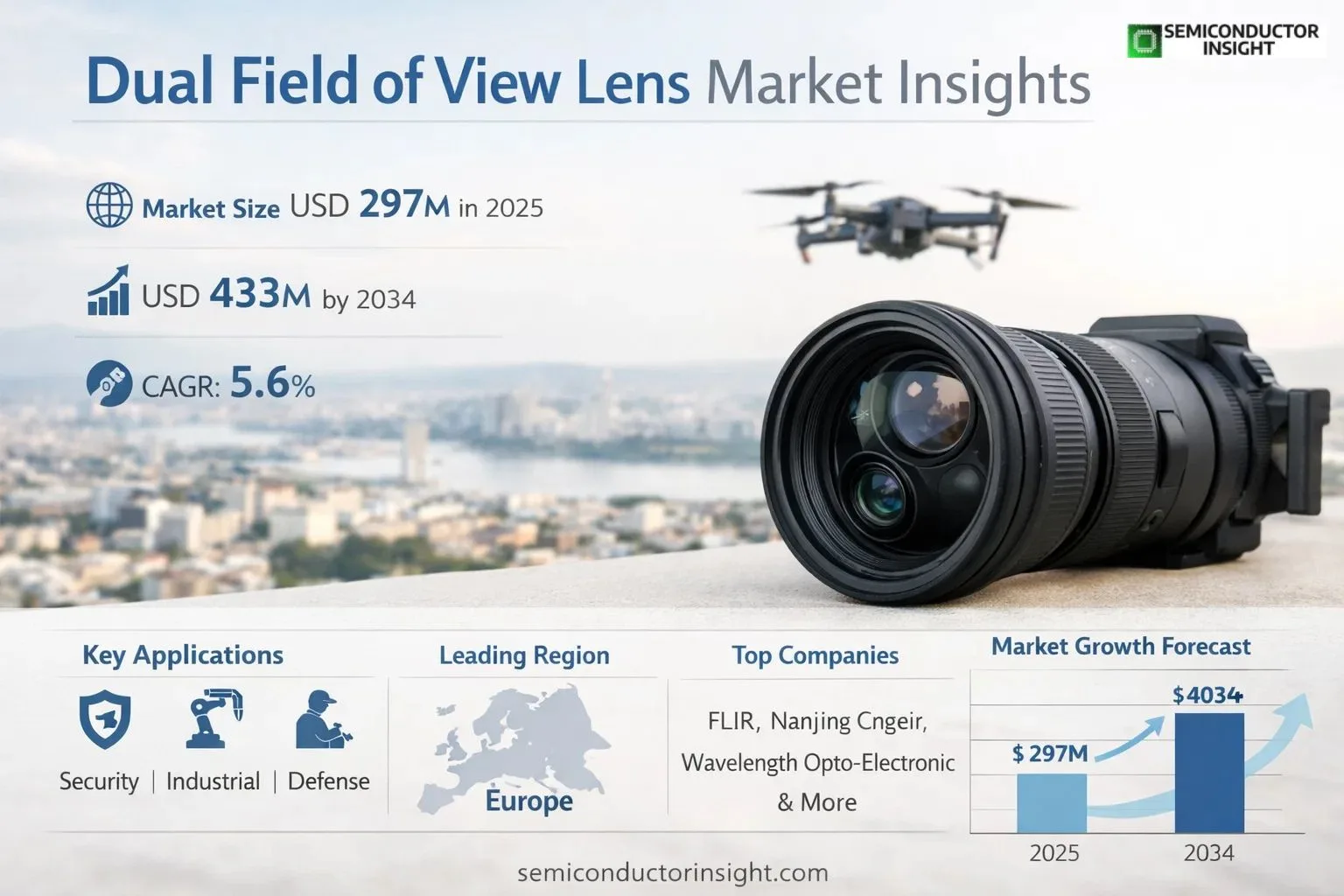
Dual Field of View Lens Market Insights Size & OutLook

MARKET DRIVERS

Rising Demand for Advanced Surveillance and Security Systems

Global push for enhanced security infrastructure is a primary driver for the Dual Field of View Lens Market. These lenses, which seamlessly switch between wide-angle and telephoto perspectives, are critical for applications requiring both situational awareness and detailed identification without physical lens changes. Their adoption is accelerating in smart city projects, critical infrastructure protection, and commercial security, where operational efficiency and comprehensive coverage are paramount. The integration of these lenses with AI-powered video analytics platforms further amplifies their value, enabling automated threat detection across varying focal lengths.

Proliferation of High-Resolution Imaging and Machine Vision

Growth in industrial automation and quality control processes necessitates sophisticated imaging solutions. Dual Field of View (FOV) lenses provide exceptional flexibility for machine vision systems, allowing a single camera to perform multiple inspection tasks—from scanning large product batches to zooming in on minute component details. This capability reduces system cost and complexity, driving adoption in electronics manufacturing, automotive assembly, and pharmaceutical packaging. The trend toward higher-resolution sensors, such as 4K and beyond, complements the advanced optics of these lenses, demanding precision engineering and creating a value-added market segment.

The ability to reduce total system cost by eliminating multiple single-focus cameras is a compelling economic driver for the Dual Field of View Lens Market across industrial and commercial sectors.

Furthermore, advancements in optical design and manufacturing, including the use of aspherical elements and specialized coatings, have improved image quality and reduced optical aberrations in dual FOV systems. This technological maturation is making them a more reliable and mainstream choice, encouraging OEM integration into a wider array of camera products.

MARKET CHALLENGES

Technical Complexities and Higher Production Costs

A significant challenge facing the Dual Field of View Lens Market is the inherent technical complexity of its products. Designing a lens that maintains high image clarity, minimal distortion, and consistent color fidelity across two distinct focal lengths requires sophisticated optical engineering. This results in higher manufacturing costs compared to standard fixed lenses, impacting final system pricing. Calibration and alignment during assembly are also more precise and costly, potentially limiting adoption in extremely price-sensitive market segments.

Other Challenges

Optical Performance Trade-offs

Achieving performance parity with premium single-focus lenses remains difficult. Design compromises can sometimes lead to issues like reduced light transmission at certain zoom positions or slight compromises in edge sharpness, which are critical for high-stakes applications in defense or scientific research.

Integration and Software Dependency

These lenses require seamless integration with camera sensors and robust software for smooth switching and control. A lack of standardized communication protocols between lens and camera manufacturers can create compatibility hurdles, slowing down system development and deployment cycles for integrators.

MARKET RESTRAINTS

High Initial Cost and Budget Constraints in Emerging Markets

The premium cost of dual FOV lens systems acts as a key market restraint, particularly for small and medium-sized enterprises (SMEs) and in developing regions. While the total cost of ownership may be lower than deploying multiple cameras, the higher upfront investment can deter budget-constrained projects. In price-sensitive verticals like entry-level retail security or residential monitoring, consumers often opt for more affordable fixed-lens alternatives, limiting market penetration. Economic volatility and reduced capital expenditure in certain industrial sectors can further delay investment in such advanced optical components.

Competition from Alternative Technologies

The market faces competition from increasingly capable digital solutions. Software-based digital zoom and electronic PTZ (Pan-Tilt-Zoom) functionalities offer a lower-cost alternative for obtaining variable fields of view, albeit often with a loss of image resolution. Additionally, the development of high-resolution, wide-dynamic-range sensors can sometimes reduce the immediate need for optical zoom in some applications, presenting a competitive restraint for the specialized Dual Field of View Lens Market.

MARKET OPPORTUNITIES

Expansion into Autonomous Vehicles and Advanced Driver-Assistance Systems (ADAS)

The evolution of autonomous vehicles presents a substantial growth opportunity. Dual Field of View lenses are ideal for automotive vision systems, providing both a broad context view for navigation and a focused view for object recognition, such as reading road signs or identifying pedestrians. Their integration into ADAS for functions like surround-view monitoring and driver drowsiness detection is a key avenue for market expansion, driven by stringent safety regulations and the rapid advancement of self-driving technology.

Growth in Drone-Based Inspection and Mapping

The commercial drone sector offers high-potential applications for the Dual Field of View Lens Market. For infrastructure inspection, agricultural monitoring, and aerial mapping, drones equipped with these lenses can capture wide-area overviews and then zoom in on specific points of interest—like a crack in a bridge or a diseased crop—in a single flight. This capability enhances operational efficiency and data quality, creating strong demand from service providers in energy, agriculture, and civil engineering, thereby opening a new and dynamic market segment.

Dual Field of View Lens Market Trends

Diversification into New Industrial Applications

The adoption of dual field of view lens technology is accelerating beyond traditional security and military applications. A key trend is the integration of these lenses into industrial automation and detection systems, where they provide both wide-area situational awareness and high-resolution inspection detail in a single unit. This versatility supports quality control on manufacturing lines, automated optical inspection, and machine vision tasks, enhancing operational efficiency and reducing the need for multiple fixed-focus systems.

Other Trends

Evolution of Lens Type Preferences

Market data indicates shifting preferences among specific dual field of view lens configurations. The 20mm/60mm segment, offering a significant switch between a very wide and a medium telephoto view, is witnessing heightened demand for applications requiring broad situational monitoring paired with the ability to zoom in on points of interest without physical lens changes. Meanwhile, 50mm/100mm variants maintain a strong position in professional surveillance and long-range observation roles, catering to applications that prioritize detail over ultrawide coverage.

Regional Manufacturing and Competitive Dynamics

The production landscape for the Dual Field of View Lens market is characterized by a mix of established international players and emerging specialized manufacturers, particularly in Asia. Companies such as FLIR, Wavelength Opto-Electronic, and a growing number of firms in China, including Nanjing Cngeir Technology and Hangzhou Shalom Electro-optics, are driving innovation and competition. This dynamic is leading to advancements in lens coatings, autofocus integration, and ruggedization to meet diverse environmental standards across global markets.

System Integration and Technical Refinement

Future development in the Dual Field of View Lens market is focused on deeper system integration and performance refinement. Trends point toward lenses designed with enhanced compatibility for specific camera sensors, reduced switching latency between fields of view, and improvements in optical clarity across both focal lengths. This technical evolution is crucial for meeting the stringent requirements of advanced photography, automated security systems, and precision industrial detection, ensuring the technology’s value proposition continues to strengthen across its core application segments.

COMPETITIVE LANDSCAPE

Key Industry Players

A rapidly evolving technology segment within advanced optical systems.

Global Dual Field of View Lens market is moderately consolidated with a significant presence of specialized optoelectronic manufacturers. According to recent market data, the top five global players collectively held a notable revenue share in 2025, with FLIR (now part of Teledyne FLIR) recognized as a leading revenue generator. FLIR’s dominance is anchored in its extensive integration of dual-FOV lens technology into high-end thermal imaging systems for defense, industrial, and security applications, leveraging its strong brand and distribution network. The competitive structure is shaped by technological expertise in infrared optics, precision manufacturing, and the ability to serve stringent application requirements in military and industrial detection sectors, where performance and reliability are paramount.

Beyond the top-tier leaders, the landscape features several significant niche and regional players that contribute to market diversity and innovation. Companies like Nanjing Cngeir Technology Co., Ltd. and Wavelength Opto-Electronic have established strong positions, particularly in the Asia-Pacific region, by offering cost-competitive and application-specific solutions. Specialists such as Votinfrared and Hangzhou Shalom Electro-optics Technology Co., Ltd. focus on core optical components, catering to OEM partnerships. Other notable participants, including Kingwin Optics and Leadingoptics, are strengthening their market presence through advancements in lens designs for emerging applications in automation, security monitoring, and photography, creating a dynamic and competitive environment that drives product development and regional market expansion.

List of Key Dual Field of View Lens Companies Profiled

  • FLIR (Teledyne FLIR)
  • Nanjing Cngeir Technology Co., Ltd.
  • Wavelength Opto-Electronic
  • Votinfrared
  • Hangzhou Shalom Electro-optics Technology Co., Ltd.
  • Kingwin Optics
  • Leadingoptics
  • Rwoptics
  • Lead-ir
  • Sunny Optical Technology (Group) Company Limited
  • Lensel Optics Pvt Ltd
  • Thorlabs, Inc.
  • Edmund Optics (now part of MKS Instruments)
  • Navitar, Inc.
  • Optec S.p.A.

Segment Analysis:

Segment Category Sub-Segments Key Insights
By Type
  • 20mm/60mm
  • 50mm/100mm
  • Others
20mm/60mm stands as the leading segment. This specific focal length combination offers a versatile balance, providing users with a notably wide-angle view suited for broad surveillance or general photography and the ability to quickly switch to a moderate telephoto perspective for detailed observation. Its dominance is driven by its suitability for mainstream security and industrial applications where operators need to monitor both expansive areas and specific points of interest without changing equipment. The operational flexibility and cost-effectiveness of this configuration make it a preferred choice for a wide array of system integrators.
By Application
  • Security Monitoring
  • Military
  • Industrial Detection and Automation
  • Photography
  • Others
Security Monitoring is the leading application segment. The core value proposition of dual field of view lenses—switching between situational awareness and target identification—aligns perfectly with the critical needs of modern surveillance systems. This capability enhances threat detection and forensic analysis without blind spots or the need for multiple fixed lenses. Growth is further propelled by increasing investments in smart city infrastructure, critical facility protection, and commercial security, where operators demand greater intelligence and flexibility from their video systems to improve response times and overall security postures.
By End User
  • Commercial & Industrial Enterprises
  • Government & Defense Agencies
  • Professional Consumer/SMEs
Commercial & Industrial Enterprises constitute the leading end-user segment. This broad group includes entities in manufacturing, logistics, energy, and retail that utilize these lenses for security, quality control, and process monitoring. The adoption is driven by the need for operational efficiency and asset protection, where a single lens system reduces hardware complexity and maintenance. The trend towards industrial automation and IoT integration creates a continuous demand for advanced optical components that can provide adaptable vision capabilities for machine vision systems and automated inspection lines in diverse lighting and spatial conditions.
By Technology Integration
  • Standalone Optical Systems
  • Integrated with Thermal Imaging
  • AI-Driven Smart Systems
AI-Driven Smart Systems represent the most dynamic and leading-edge segment. The integration of dual field of view lenses with artificial intelligence and advanced video analytics is transforming their utility from passive observation tools to active diagnostic systems. This synergy allows for real-time object detection, behavior analysis, and predictive maintenance alerts. Market leadership is driven by the escalating demand for autonomous security solutions and intelligent industrial automation, where the lens’s dual perspectives feed rich, contextual visual data to algorithms, significantly enhancing decision-making accuracy and system autonomy across applications.
By Sales Channel
  • Direct Sales (OEM/System Integrators)
  • Distributors & Resellers
  • Online Marketplaces
Direct Sales (OEM/System Integrators) is the dominant channel for market penetration. Given the technical specificity and integration requirements of dual field of view lenses into larger camera systems or platforms, manufacturers primarily engage directly with original equipment manufacturers and specialized system integrators. This channel fosters deep technical collaboration, customization, and ensures the lens meets precise performance specifications for end-use in security, military, and industrial equipment. The complexity of the product and the need for application-specific engineering support solidify this direct relationship as the cornerstone of commercial strategy and market access.

Regional Analysis: Global

Europe

Europe stands as the leading region in the Dual Field of View Lens Market. This leadership is anchored by a highly sophisticated industrial base and the world’s most stringent regulatory frameworks, particularly in automotive safety and advanced security. German engineering in optical systems and French prowess in defense optics are primary catalysts, driving demand for dual-field lenses that enable superior long-range target acquisition and wide-area situational awareness. The region’s emphasis on advanced driver-assistance systems has created a mature yet innovation-hungry market for next-generation automotive vision systems, where these specialized lenses are critical for object detection and classification. Furthermore, Europe dominates in high-performance industrial and scientific imaging applications, supporting research in biotech and photonics in the UK and Scandinavia. Collaborative R&D networks between academic institutions and specialized manufacturers in Central Europe are accelerating the commercialization of advanced, compact designs. This cohesive, high-value industrial approach solidifies Europe’s position as the technology and application leader, with strong export of integrated systems rather than just components.

Automotive & ADAS Hub
Germany’s leadership in automotive manufacturing and its strict Euro NCAP safety protocols make it the central hub for testing and integrating dual-field lenses into advanced driver-assistance systems. This sector prioritizes lenses that function flawlessly in diverse lighting and weather conditions, a core strength of European optical engineering.
Defense & Security Sophistication
Driven by France, the UK, and Italy, Europe demands dual-field optics for advanced military-grade targeting systems, border surveillance, and homeland security. The focus is on rugged, high-resolution optics that provide seamless switching between wide and narrow fields of view in critical defense applications.
Precision Industrial & Scientific Imaging
In industrial centers like Switzerland and Scandinavia, the Dual Field of View Lens Market thrives in complex manufacturing process monitoring and scientific research. These applications require lenses capable of providing both macro-overview and micro-detail for quality control and data collection in cleanroom environments and research labs.
Strong Collaborative R&D Ecosystem
The region benefits from close ties between specialized lens manufacturers in Germany and the Netherlands with major universities and photonics institutes. This environment fosters rapid prototyping of dual-field lens designs optimized for specific, high-value applications rather than mass-market commoditization.

North America
The competitive Dual Field of View Lens Market in North America is propelled by defense modernization programs and a dynamic commercial drone sector. The United States Department of Defense is a primary driver, investing heavily in electro-optical systems for intelligence, surveillance, and reconnaissance missions, which require advanced dual-field optics. This defense demand fuels continuous innovation in miniaturization and thermal imaging integration. Concurrently, commercial and law enforcement applications are expanding, with a focus on dual-field lenses for unmanned aerial vehicles in infrastructure inspection, agriculture, and public safety. Major technology firms and system integrators in the U.S. and Canada are pioneering the use of these lenses in next-generation robotics and autonomous systems, creating a market that values high performance, interoperability, and rapid technical support.

Asia-Pacific
The Asia-Pacific region demonstrates the most aggressive growth within the Dual Field of View Lens Market, characterized by rapid industrialization and massive manufacturing scale. China is the dominant production center for mid-volume optical components, supplying a significant portion of Global supply chain. However, the market dynamics are shifting from pure manufacturing to advanced application. South Korea and Japan are leading innovation in consumer electronics and automotive imaging, pushing for smaller, more power-efficient dual-field lens modules for smartphones and advanced vehicle cameras. Meanwhile, India is emerging as a key demand center for security and surveillance applications, driven by smart city initiatives. Regional competition fosters fast-paced iteration but also emphasizes cost-competitiveness alongside technological capability.

South America
In the South American segment of the Dual Field of View Lens Market, expansion is primarily centered on natural resource management and urban security. Countries such as Brazil and Chile leverage these optical systems for monitoring vast agricultural lands, mining operations, and forested areas, utilizing the dual capability for wide-area reconnaissance and detailed inspection. Urban centers are increasingly adopting advanced surveillance systems to enhance public safety, creating a steady demand. The market is defined by a preference for rugged, reliable systems that can operate in challenging environments with limited infrastructure support. Growth is steady, supported by government initiatives in critical infrastructure protection, though it is tempered by economic volatility and reliance on technology imports.

Middle East & Africa
The Dual Field of View Lens Market in the Middle East & Africa is heavily influenced by defense, oil & gas, and critical infrastructure security. Major Middle Eastern nations invest significantly in sophisticated defense and border surveillance technologies, requiring high-durability dual-field optical systems for harsh desert and maritime environments. The oil and gas sector deploys these lenses for pipeline and facility monitoring across remote areas. In Africa, demand stems from wildlife conservation efforts and mineral resource security, using drones equipped with dual-field capabilities. The market remains niche but high-value, with a strong emphasis on system durability, after-sales service, and the ability to integrate with existing command-and-control platforms.

Report Scope

This market research report provides a comprehensive analysis of the Dual Field of View Lens Market , covering the forecast period 2026–2034. It offers detailed insights into market dynamics, technological advancements, competitive landscape, and key trends shaping the industry.

Key focus areas of the report include:

  • Market Overview: The report begins with an overview outlining its current market scenario, key growth indicators, and industry transformation drivers. It discusses macroeconomic factors, demand–supply balance, regulatory landscape, and the strategic role of semiconductors in powering advancements across industries such as automotive, telecommunications, consumer electronics, and industrial automation.
  • Market Size & Forecast: Historical data and future projections for revenue, unit shipments, and market value across major regions and segments.
  • Segmentation Analysis: Detailed breakdown by product type, technology, application, and end-user industry to identify high-growth segments and investment opportunities.
  • Regional Insights: Insights into market performance across North America, Europe, Asia-Pacific, Latin America, and the Middle East & Africa, including country-level analysis where relevant.
  • Competitive Landscape: Profiles of leading market participants, including their product offerings, R&D focus, manufacturing capacity, pricing strategies, and recent developments such as mergers, acquisitions, and partnerships.
  • Technology Trends & Innovation: Assessment of emerging technologies, integration of AI/IoT, semiconductor design trends, fabrication techniques, and evolving industry standards.
  • Market Drivers & Restraints: Evaluation of factors driving market growth along with challenges, supply chain constraints, regulatory issues, and market-entry barriers.
  • Stakeholder Insights: Insights for component suppliers, OEMs, system integrators, investors, and policymakers regarding the evolving ecosystem and strategic opportunities.

Primary and secondary research methods are employed, including interviews with industry experts, data from verified sources, and real-time market intelligence to ensure the accuracy and reliability of the insights presented.

FREQUENTLY ASKED QUESTIONS:

What is the current market size of Dual Field of View Lens Market?

-> Global Dual Field of View Lens Market was valued at USD 297 million in 2025 and is projected to reach USD 433 million by 2034, growing at a CAGR of 5.6% during the forecast period.

Which key companies operate in Dual Field of View Lens Market?

-> Key players include FLIR, Nanjing Cngeir Technology Co., Ltd., Wavelength Opto-Electronic, Votinfrared, Hangzhou Shalom Electro-optics Technology Co., Ltd., Kingwin Optics, Leadingoptics, Rwoptics, and Lead-ir, among others.

What are the key growth drivers?

-> Key growth drivers include demand from applications in security monitoring, industrial detection, and military sectors, alongside technological advancements in optical systems.

Which region dominates the market?

-> The report provides detailed size estimates for regions including North America (with the U.S. as a key market) and Asia (with China as a significant growing market).

What are the key market segments?

-> The market is segmented by Type (20mm/60mm, 50mm/100mm, Others) and by Application (Photography, Security Monitoring, Industrial Detection and Automation, Military, Others).

Dual Field of View Lens Market, Trends, Business Strategies 2026-2034

Get Sample Report PDF for Exclusive Insights

Report Sample Includes

  • Table of Contents
  • List of Tables & Figures
  • Charts, Research Methodology, and more...

PDF Icon Download Sample Report PDF
SKU: 32f25a8bbbb3
Category:
License Type

Corporate License, Excel License, PDF and Excel Databook License

Download Sample Report

Table of Content

1 Introduction to Research & Analysis Reports
1.1 Dual Field of View Lens Market Definition
1.2 Market Segments
1.2.1 Segment by Type
1.2.2 Segment by Application
1.3 Global Dual Field of View Lens Market Overview
1.4 Features & Benefits of This Report
1.5 Methodology & Sources of Information
1.5.1 Research Methodology
1.5.2 Research Process
1.5.3 Base Year
1.5.4 Report Assumptions & Caveats
2 Global Dual Field of View Lens Overall Market Size
2.1 Global Dual Field of View Lens Market Size: 2025 VS 2034
2.2 Global Dual Field of View Lens Market Size, Prospects & Forecasts: 2020-2034
2.3 Global Dual Field of View Lens Sales: 2020-2034
3 Company Landscape
3.1 Top Dual Field of View Lens Players in Global Market
3.2 Top Global Dual Field of View Lens Companies Ranked by Revenue
3.3 Global Dual Field of View Lens Revenue by Companies
3.4 Global Dual Field of View Lens Sales by Companies
3.5 Global Dual Field of View Lens Price by Manufacturer (2020-2026)
3.6 Top 3 and Top 5 Dual Field of View Lens Companies in Global Market, by Revenue in 2025
3.7 Global Manufacturers Dual Field of View Lens Product Type
3.8 Tier 1, Tier 2, and Tier 3 Dual Field of View Lens Players in Global Market
3.8.1 List of Global Tier 1 Dual Field of View Lens Companies
3.8.2 List of Global Tier 2 and Tier 3 Dual Field of View Lens Companies
4 Sights by Product
4.1 Overview
4.1.1 Segment by Type – Global Dual Field of View Lens Market Size Markets, 2025 & 2034
4.1.2 20mm/60mm
4.1.3 50mm/100mm
4.1.4 Others
4.2 Segment by Type – Global Dual Field of View Lens Revenue & Forecasts
4.2.1 Segment by Type – Global Dual Field of View Lens Revenue, 2020-2026
4.2.2 Segment by Type – Global Dual Field of View Lens Revenue, 2026-2034
4.2.3 Segment by Type – Global Dual Field of View Lens Revenue Market Share, 2020-2034
4.3 Segment by Type – Global Dual Field of View Lens Sales & Forecasts
4.3.1 Segment by Type – Global Dual Field of View Lens Sales, 2020-2026
4.3.2 Segment by Type – Global Dual Field of View Lens Sales, 2026-2034
4.3.3 Segment by Type – Global Dual Field of View Lens Sales Market Share, 2020-2034
4.4 Segment by Type – Global Dual Field of View Lens Price (Manufacturers Selling Prices), 2020-2034
5 Sights by Application
5.1 Overview
5.1.1 Segment by Application – Global Dual Field of View Lens Market Size, 2025 & 2034
5.1.2 Photography
5.1.3 Security Monitoring
5.1.4 Industrial Detection and Automation
5.1.5 Military
5.1.6 Others
5.2 Segment by Application – Global Dual Field of View Lens Revenue & Forecasts
5.2.1 Segment by Application – Global Dual Field of View Lens Revenue, 2020-2026
5.2.2 Segment by Application – Global Dual Field of View Lens Revenue, 2026-2034
5.2.3 Segment by Application – Global Dual Field of View Lens Revenue Market Share, 2020-2034
5.3 Segment by Application – Global Dual Field of View Lens Sales & Forecasts
5.3.1 Segment by Application – Global Dual Field of View Lens Sales, 2020-2026
5.3.2 Segment by Application – Global Dual Field of View Lens Sales, 2026-2034
5.3.3 Segment by Application – Global Dual Field of View Lens Sales Market Share, 2020-2034
5.4 Segment by Application – Global Dual Field of View Lens Price (Manufacturers Selling Prices), 2020-2034
6 Sights by Region
6.1 By Region – Global Dual Field of View Lens Market Size, 2025 & 2034
6.2 By Region – Global Dual Field of View Lens Revenue & Forecasts
6.2.1 By Region – Global Dual Field of View Lens Revenue, 2020-2026
6.2.2 By Region – Global Dual Field of View Lens Revenue, 2026-2034
6.2.3 By Region – Global Dual Field of View Lens Revenue Market Share, 2020-2034
6.3 By Region – Global Dual Field of View Lens Sales & Forecasts
6.3.1 By Region – Global Dual Field of View Lens Sales, 2020-2026
6.3.2 By Region – Global Dual Field of View Lens Sales, 2026-2034
6.3.3 By Region – Global Dual Field of View Lens Sales Market Share, 2020-2034
6.4 North America
6.4.1 By Country – North America Dual Field of View Lens Revenue, 2020-2034
6.4.2 By Country – North America Dual Field of View Lens Sales, 2020-2034
6.4.3 United States Dual Field of View Lens Market Size, 2020-2034
6.4.4 Canada Dual Field of View Lens Market Size, 2020-2034
6.4.5 Mexico Dual Field of View Lens Market Size, 2020-2034
6.5 Europe
6.5.1 By Country – Europe Dual Field of View Lens Revenue, 2020-2034
6.5.2 By Country – Europe Dual Field of View Lens Sales, 2020-2034
6.5.3 Germany Dual Field of View Lens Market Size, 2020-2034
6.5.4 France Dual Field of View Lens Market Size, 2020-2034
6.5.5 U.K. Dual Field of View Lens Market Size, 2020-2034
6.5.6 Italy Dual Field of View Lens Market Size, 2020-2034
6.5.7 Russia Dual Field of View Lens Market Size, 2020-2034
6.5.8 Nordic Countries Dual Field of View Lens Market Size, 2020-2034
6.5.9 Benelux Dual Field of View Lens Market Size, 2020-2034
6.6 Asia
6.6.1 By Region – Asia Dual Field of View Lens Revenue, 2020-2034
6.6.2 By Region – Asia Dual Field of View Lens Sales, 2020-2034
6.6.3 China Dual Field of View Lens Market Size, 2020-2034
6.6.4 Japan Dual Field of View Lens Market Size, 2020-2034
6.6.5 South Korea Dual Field of View Lens Market Size, 2020-2034
6.6.6 Southeast Asia Dual Field of View Lens Market Size, 2020-2034
6.6.7 India Dual Field of View Lens Market Size, 2020-2034
6.7 South America
6.7.1 By Country – South America Dual Field of View Lens Revenue, 2020-2034
6.7.2 By Country – South America Dual Field of View Lens Sales, 2020-2034
6.7.3 Brazil Dual Field of View Lens Market Size, 2020-2034
6.7.4 Argentina Dual Field of View Lens Market Size, 2020-2034
6.8 Middle East & Africa
6.8.1 By Country – Middle East & Africa Dual Field of View Lens Revenue, 2020-2034
6.8.2 By Country – Middle East & Africa Dual Field of View Lens Sales, 2020-2034
6.8.3 Turkey Dual Field of View Lens Market Size, 2020-2034
6.8.4 Israel Dual Field of View Lens Market Size, 2020-2034
6.8.5 Saudi Arabia Dual Field of View Lens Market Size, 2020-2034
6.8.6 UAE Dual Field of View Lens Market Size, 2020-2034
7 Manufacturers & Brands Profiles
7.1 FLIR
7.1.1 FLIR Company Summary
7.1.2 FLIR Business Overview
7.1.3 FLIR Dual Field of View Lens Major Product Offerings
7.1.4 FLIR Dual Field of View Lens Sales and Revenue in Global (2020-2026)
7.1.5 FLIR Key News & Latest Developments
7.2 Nanjing Cngeir Technology Co., Ltd.
7.2.1 Nanjing Cngeir Technology Co., Ltd. Company Summary
7.2.2 Nanjing Cngeir Technology Co., Ltd. Business Overview
7.2.3 Nanjing Cngeir Technology Co., Ltd. Dual Field of View Lens Major Product Offerings
7.2.4 Nanjing Cngeir Technology Co., Ltd. Dual Field of View Lens Sales and Revenue in Global (2020-2026)
7.2.5 Nanjing Cngeir Technology Co., Ltd. Key News & Latest Developments
7.3 Wavelength Opto-Electronic
7.3.1 Wavelength Opto-Electronic Company Summary
7.3.2 Wavelength Opto-Electronic Business Overview
7.3.3 Wavelength Opto-Electronic Dual Field of View Lens Major Product Offerings
7.3.4 Wavelength Opto-Electronic Dual Field of View Lens Sales and Revenue in Global (2020-2026)
7.3.5 Wavelength Opto-Electronic Key News & Latest Developments
7.4 Votinfrared
7.4.1 Votinfrared Company Summary
7.4.2 Votinfrared Business Overview
7.4.3 Votinfrared Dual Field of View Lens Major Product Offerings
7.4.4 Votinfrared Dual Field of View Lens Sales and Revenue in Global (2020-2026)
7.4.5 Votinfrared Key News & Latest Developments
7.5 Hangzhou Shalom Electro-optics Technology Co., Ltd.
7.5.1 Hangzhou Shalom Electro-optics Technology Co., Ltd. Company Summary
7.5.2 Hangzhou Shalom Electro-optics Technology Co., Ltd. Business Overview
7.5.3 Hangzhou Shalom Electro-optics Technology Co., Ltd. Dual Field of View Lens Major Product Offerings
7.5.4 Hangzhou Shalom Electro-optics Technology Co., Ltd. Dual Field of View Lens Sales and Revenue in Global (2020-2026)
7.5.5 Hangzhou Shalom Electro-optics Technology Co., Ltd. Key News & Latest Developments
7.6 Kingwin Optics
7.6.1 Kingwin Optics Company Summary
7.6.2 Kingwin Optics Business Overview
7.6.3 Kingwin Optics Dual Field of View Lens Major Product Offerings
7.6.4 Kingwin Optics Dual Field of View Lens Sales and Revenue in Global (2020-2026)
7.6.5 Kingwin Optics Key News & Latest Developments
7.7 Leadingoptics
7.7.1 Leadingoptics Company Summary
7.7.2 Leadingoptics Business Overview
7.7.3 Leadingoptics Dual Field of View Lens Major Product Offerings
7.7.4 Leadingoptics Dual Field of View Lens Sales and Revenue in Global (2020-2026)
7.7.5 Leadingoptics Key News & Latest Developments
7.8 Rwoptics
7.8.1 Rwoptics Company Summary
7.8.2 Rwoptics Business Overview
7.8.3 Rwoptics Dual Field of View Lens Major Product Offerings
7.8.4 Rwoptics Dual Field of View Lens Sales and Revenue in Global (2020-2026)
7.8.5 Rwoptics Key News & Latest Developments
7.9 Lead-ir
7.9.1 Lead-ir Company Summary
7.9.2 Lead-ir Business Overview
7.9.3 Lead-ir Dual Field of View Lens Major Product Offerings
7.9.4 Lead-ir Dual Field of View Lens Sales and Revenue in Global (2020-2026)
7.9.5 Lead-ir Key News & Latest Developments
8 Global Dual Field of View Lens Production Capacity, Analysis
8.1 Global Dual Field of View Lens Production Capacity, 2020-2034
8.2 Dual Field of View Lens Production Capacity of Key Manufacturers in Global Market
8.3 Global Dual Field of View Lens Production by Region
9 Key Market Trends, Opportunity, Drivers and Restraints
9.1 Market Opportunities & Trends
9.2 Market Drivers
9.3 Market Restraints
10 Dual Field of View Lens Supply Chain Analysis
10.1 Dual Field of View Lens Industry Value Chain
10.2 Dual Field of View Lens Upstream Market
10.3 Dual Field of View Lens Downstream and Clients
10.4 Marketing Channels Analysis
10.4.1 Marketing Channels
10.4.2 Dual Field of View Lens Distributors and Sales Agents in Global
11 Conclusion
12 Appendix
12.1 Note
12.2 Examples of Clients
12.3 DisclaimerList of Tables
Table 1. Key Players of Dual Field of View Lens in Global Market
Table 2. Top Dual Field of View Lens Players in Global Market, Ranking by Revenue (2025)
Table 3. Global Dual Field of View Lens Revenue by Companies, (US$, Mn), 2020-2026
Table 4. Global Dual Field of View Lens Revenue Share by Companies, 2020-2026
Table 5. Global Dual Field of View Lens Sales by Companies, (K Units), 2020-2026
Table 6. Global Dual Field of View Lens Sales Share by Companies, 2020-2026
Table 7. Key Manufacturers Dual Field of View Lens Price (2020-2026) & (US$/Unit)
Table 8. Global Manufacturers Dual Field of View Lens Product Type
Table 9. List of Global Tier 1 Dual Field of View Lens Companies, Revenue (US$, Mn) in 2025 and Market Share
Table 10. List of Global Tier 2 and Tier 3 Dual Field of View Lens Companies, Revenue (US$, Mn) in 2025 and Market Share
Table 11. Segment by Type – Global Dual Field of View Lens Revenue, (US$, Mn), 2025 & 2034
Table 12. Segment by Type – Global Dual Field of View Lens Revenue (US$, Mn), 2020-2026
Table 13. Segment by Type – Global Dual Field of View Lens Revenue (US$, Mn), 2026-2034
Table 14. Segment by Type – Global Dual Field of View Lens Sales (K Units), 2020-2026
Table 15. Segment by Type – Global Dual Field of View Lens Sales (K Units), 2026-2034
Table 16. Segment by Application – Global Dual Field of View Lens Revenue, (US$, Mn), 2025 & 2034
Table 17. Segment by Application – Global Dual Field of View Lens Revenue, (US$, Mn), 2020-2026
Table 18. Segment by Application – Global Dual Field of View Lens Revenue, (US$, Mn), 2026-2034
Table 19. Segment by Application – Global Dual Field of View Lens Sales, (K Units), 2020-2026
Table 20. Segment by Application – Global Dual Field of View Lens Sales, (K Units), 2026-2034
Table 21. By Region – Global Dual Field of View Lens Revenue, (US$, Mn), 2026-2034
Table 22. By Region – Global Dual Field of View Lens Revenue, (US$, Mn), 2020-2026
Table 23. By Region – Global Dual Field of View Lens Revenue, (US$, Mn), 2026-2034
Table 24. By Region – Global Dual Field of View Lens Sales, (K Units), 2020-2026
Table 25. By Region – Global Dual Field of View Lens Sales, (K Units), 2026-2034
Table 26. By Country – North America Dual Field of View Lens Revenue, (US$, Mn), 2020-2026
Table 27. By Country – North America Dual Field of View Lens Revenue, (US$, Mn), 2026-2034
Table 28. By Country – North America Dual Field of View Lens Sales, (K Units), 2020-2026
Table 29. By Country – North America Dual Field of View Lens Sales, (K Units), 2026-2034
Table 30. By Country – Europe Dual Field of View Lens Revenue, (US$, Mn), 2020-2026
Table 31. By Country – Europe Dual Field of View Lens Revenue, (US$, Mn), 2026-2034
Table 32. By Country – Europe Dual Field of View Lens Sales, (K Units), 2020-2026
Table 33. By Country – Europe Dual Field of View Lens Sales, (K Units), 2026-2034
Table 34. By Region – Asia Dual Field of View Lens Revenue, (US$, Mn), 2020-2026
Table 35. By Region – Asia Dual Field of View Lens Revenue, (US$, Mn), 2026-2034
Table 36. By Region – Asia Dual Field of View Lens Sales, (K Units), 2020-2026
Table 37. By Region – Asia Dual Field of View Lens Sales, (K Units), 2026-2034
Table 38. By Country – South America Dual Field of View Lens Revenue, (US$, Mn), 2020-2026
Table 39. By Country – South America Dual Field of View Lens Revenue, (US$, Mn), 2026-2034
Table 40. By Country – South America Dual Field of View Lens Sales, (K Units), 2020-2026
Table 41. By Country – South America Dual Field of View Lens Sales, (K Units), 2026-2034
Table 42. By Country – Middle East & Africa Dual Field of View Lens Revenue, (US$, Mn), 2020-2026
Table 43. By Country – Middle East & Africa Dual Field of View Lens Revenue, (US$, Mn), 2026-2034
Table 44. By Country – Middle East & Africa Dual Field of View Lens Sales, (K Units), 2020-2026
Table 45. By Country – Middle East & Africa Dual Field of View Lens Sales, (K Units), 2026-2034
Table 46. FLIR Company Summary
Table 47. FLIR Dual Field of View Lens Product Offerings
Table 48. FLIR Dual Field of View Lens Sales (K Units), Revenue (US$, Mn) and Average Price (US$/Unit) & (2020-2026)
Table 49. FLIR Key News & Latest Developments
Table 50. Nanjing Cngeir Technology Co., Ltd. Company Summary
Table 51. Nanjing Cngeir Technology Co., Ltd. Dual Field of View Lens Product Offerings
Table 52. Nanjing Cngeir Technology Co., Ltd. Dual Field of View Lens Sales (K Units), Revenue (US$, Mn) and Average Price (US$/Unit) & (2020-2026)
Table 53. Nanjing Cngeir Technology Co., Ltd. Key News & Latest Developments
Table 54. Wavelength Opto-Electronic Company Summary
Table 55. Wavelength Opto-Electronic Dual Field of View Lens Product Offerings
Table 56. Wavelength Opto-Electronic Dual Field of View Lens Sales (K Units), Revenue (US$, Mn) and Average Price (US$/Unit) & (2020-2026)
Table 57. Wavelength Opto-Electronic Key News & Latest Developments
Table 58. Votinfrared Company Summary
Table 59. Votinfrared Dual Field of View Lens Product Offerings
Table 60. Votinfrared Dual Field of View Lens Sales (K Units), Revenue (US$, Mn) and Average Price (US$/Unit) & (2020-2026)
Table 61. Votinfrared Key News & Latest Developments
Table 62. Hangzhou Shalom Electro-optics Technology Co., Ltd. Company Summary
Table 63. Hangzhou Shalom Electro-optics Technology Co., Ltd. Dual Field of View Lens Product Offerings
Table 64. Hangzhou Shalom Electro-optics Technology Co., Ltd. Dual Field of View Lens Sales (K Units), Revenue (US$, Mn) and Average Price (US$/Unit) & (2020-2026)
Table 65. Hangzhou Shalom Electro-optics Technology Co., Ltd. Key News & Latest Developments
Table 66. Kingwin Optics Company Summary
Table 67. Kingwin Optics Dual Field of View Lens Product Offerings
Table 68. Kingwin Optics Dual Field of View Lens Sales (K Units), Revenue (US$, Mn) and Average Price (US$/Unit) & (2020-2026)
Table 69. Kingwin Optics Key News & Latest Developments
Table 70. Leadingoptics Company Summary
Table 71. Leadingoptics Dual Field of View Lens Product Offerings
Table 72. Leadingoptics Dual Field of View Lens Sales (K Units), Revenue (US$, Mn) and Average Price (US$/Unit) & (2020-2026)
Table 73. Leadingoptics Key News & Latest Developments
Table 74. Rwoptics Company Summary
Table 75. Rwoptics Dual Field of View Lens Product Offerings
Table 76. Rwoptics Dual Field of View Lens Sales (K Units), Revenue (US$, Mn) and Average Price (US$/Unit) & (2020-2026)
Table 77. Rwoptics Key News & Latest Developments
Table 78. Lead-ir Company Summary
Table 79. Lead-ir Dual Field of View Lens Product Offerings
Table 80. Lead-ir Dual Field of View Lens Sales (K Units), Revenue (US$, Mn) and Average Price (US$/Unit) & (2020-2026)
Table 81. Lead-ir Key News & Latest Developments
Table 82. Dual Field of View Lens Capacity of Key Manufacturers in Global Market, 2023-2026 (K Units)
Table 83. Global Dual Field of View Lens Capacity Market Share of Key Manufacturers, 2023-2026
Table 84. Global Dual Field of View Lens Production by Region, 2020-2026 (K Units)
Table 85. Global Dual Field of View Lens Production by Region, 2026-2034 (K Units)
Table 86. Dual Field of View Lens Market Opportunities & Trends in Global Market
Table 87. Dual Field of View Lens Market Drivers in Global Market
Table 88. Dual Field of View Lens Market Restraints in Global Market
Table 89. Dual Field of View Lens Raw Materials
Table 90. Dual Field of View Lens Raw Materials Suppliers in Global Market
Table 91. Typical Dual Field of View Lens Downstream
Table 92. Dual Field of View Lens Downstream Clients in Global Market
Table 93. Dual Field of View Lens Distributors and Sales Agents in Global Market

List of Figures
Figure 1. Dual Field of View Lens Product Picture
Figure 2. Dual Field of View Lens Segment by Type in 2025
Figure 3. Dual Field of View Lens Segment by Application in 2025
Figure 4. Global Dual Field of View Lens Market Overview: 2025
Figure 5. Key Caveats
Figure 6. Global Dual Field of View Lens Market Size: 2025 VS 2034 (US$, Mn)
Figure 7. Global Dual Field of View Lens Revenue: 2020-2034 (US$, Mn)
Figure 8. Dual Field of View Lens Sales in Global Market: 2020-2034 (K Units)
Figure 9. The Top 3 and 5 Players Market Share by Dual Field of View Lens Revenue in 2025
Figure 10. Segment by Type – Global Dual Field of View Lens Revenue, (US$, Mn), 2025 & 2034
Figure 11. Segment by Type – Global Dual Field of View Lens Revenue Market Share, 2020-2034
Figure 12. Segment by Type – Global Dual Field of View Lens Sales Market Share, 2020-2034
Figure 13. Segment by Type – Global Dual Field of View Lens Price (US$/Unit), 2020-2034
Figure 14. Segment by Application – Global Dual Field of View Lens Revenue, (US$, Mn), 2025 & 2034
Figure 15. Segment by Application – Global Dual Field of View Lens Revenue Market Share, 2020-2034
Figure 16. Segment by Application – Global Dual Field of View Lens Sales Market Share, 2020-2034
Figure 17. Segment by Application -Global Dual Field of View Lens Price (US$/Unit), 2020-2034
Figure 18. By Region – Global Dual Field of View Lens Revenue, (US$, Mn), 2026 & 2034
Figure 19. By Region – Global Dual Field of View Lens Revenue Market Share, 2020 VS 2025 VS 2034
Figure 20. By Region – Global Dual Field of View Lens Revenue Market Share, 2020-2034
Figure 21. By Region – Global Dual Field of View Lens Sales Market Share, 2020-2034
Figure 22. By Country – North America Dual Field of View Lens Revenue Market Share, 2020-2034
Figure 23. By Country – North America Dual Field of View Lens Sales Market Share, 2020-2034
Figure 24. United States Dual Field of View Lens Revenue, (US$, Mn), 2020-2034
Figure 25. Canada Dual Field of View Lens Revenue, (US$, Mn), 2020-2034
Figure 26. Mexico Dual Field of View Lens Revenue, (US$, Mn), 2020-2034
Figure 27. By Country – Europe Dual Field of View Lens Revenue Market Share, 2020-2034
Figure 28. By Country – Europe Dual Field of View Lens Sales Market Share, 2020-2034
Figure 29. Germany Dual Field of View Lens Revenue, (US$, Mn), 2020-2034
Figure 30. France Dual Field of View Lens Revenue, (US$, Mn), 2020-2034
Figure 31. U.K. Dual Field of View Lens Revenue, (US$, Mn), 2020-2034
Figure 32. Italy Dual Field of View Lens Revenue, (US$, Mn), 2020-2034
Figure 33. Russia Dual Field of View Lens Revenue, (US$, Mn), 2020-2034
Figure 34. Nordic Countries Dual Field of View Lens Revenue, (US$, Mn), 2020-2034
Figure 35. Benelux Dual Field of View Lens Revenue, (US$, Mn), 2020-2034
Figure 36. By Region – Asia Dual Field of View Lens Revenue Market Share, 2020-2034
Figure 37. By Region – Asia Dual Field of View Lens Sales Market Share, 2020-2034
Figure 38. China Dual Field of View Lens Revenue, (US$, Mn), 2020-2034
Figure 39. Japan Dual Field of View Lens Revenue, (US$, Mn), 2020-2034
Figure 40. South Korea Dual Field of View Lens Revenue, (US$, Mn), 2020-2034
Figure 41. Southeast Asia Dual Field of View Lens Revenue, (US$, Mn), 2020-2034
Figure 42. India Dual Field of View Lens Revenue, (US$, Mn), 2020-2034
Figure 43. By Country – South America Dual Field of View Lens Revenue Market Share, 2020-2034
Figure 44. By Country – South America Dual Field of View Lens Sales, Market Share, 2020-2034
Figure 45. Brazil Dual Field of View Lens Revenue, (US$, Mn), 2020-2034
Figure 46. Argentina Dual Field of View Lens Revenue, (US$, Mn), 2020-2034
Figure 47. By Country – Middle East & Africa Dual Field of View Lens Revenue, Market Share, 2020-2034
Figure 48. By Country – Middle East & Africa Dual Field of View Lens Sales, Market Share, 2020-2034
Figure 49. Turkey Dual Field of View Lens Revenue, (US$, Mn), 2020-2034
Figure 50. Israel Dual Field of View Lens Revenue, (US$, Mn), 2020-2034
Figure 51. Saudi Arabia Dual Field of View Lens Revenue, (US$, Mn), 2020-2034
Figure 52. UAE Dual Field of View Lens Revenue, (US$, Mn), 2020-2034
Figure 53. Global Dual Field of View Lens Production Capacity (K Units), 2020-2034
Figure 54. The Percentage of Production Dual Field of View Lens by Region, 2025 VS 2034
Figure 55. Dual Field of View Lens Industry Value Chain
Figure 56. Marketing Channels

