
Dual-channel Speed Sensor Market Insights
Dual-channel Speed Sensor market will grow from USD 285 million in 2026 to USD 557 million by 2034, reflecting a CAGR of 10.2% during the forecast period.
Dual-channel speed sensors are precision devices that deliver two independent speed signals simultaneously. They feature redundancy checking, direction recognition and high reliability, which makes them indispensable for industrial automation, elevators, rail transport, wind power and high‑end equipment manufacturing.
In 2025 worldwide sales reached 8.2 million units at an average selling price of USD 38 per unit; total production capacity was about 9.8 million units with an average utilization of 84 % and a gross margin near 36 %. Demand is reinforced by stricter safety standards, expanding intelligent manufacturing and growing renewable‑energy installations, while future competition will focus on sensing accuracy, environmental robustness and integrated diagnostic functions.
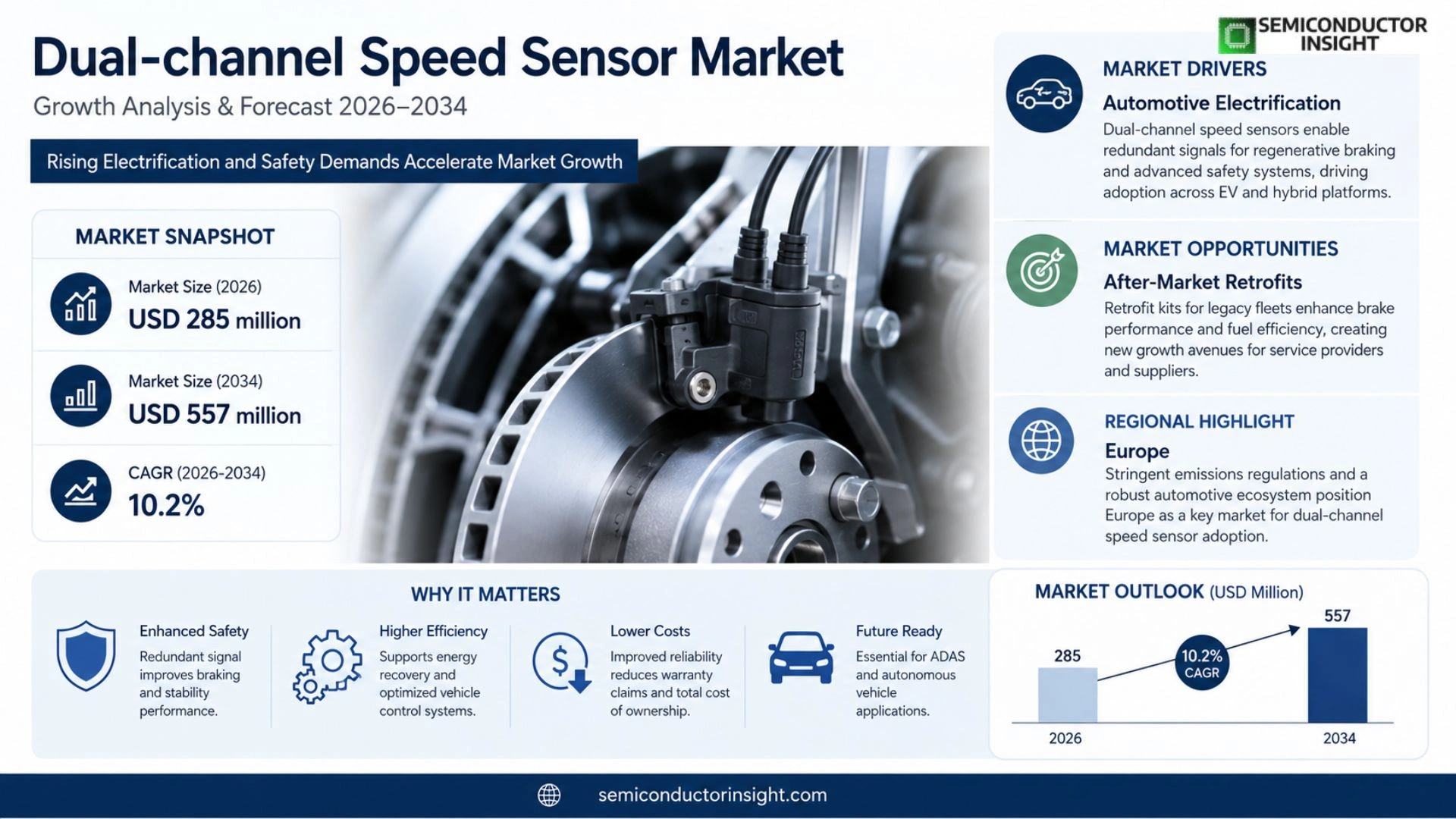
MARKET DRIVERS
Automotive Electrification Accelerates Sensor Integration
The shift toward electric powertrains has altered the architecture of vehicle control systems. Dual-channel speed sensors now provide the redundancy required for regenerative braking algorithms, making them indispensable for manufacturers seeking to meet higher efficiency targets. Enhanced reliability translates directly into lower warranty costs, which has prompted a rapid redesign of chassis modules across midsize and premium segments.
Industrial Automation Demands Higher Precision
In factories where conveyor speed must be monitored at two distinct points, the dual-channel configuration eliminates phase‑offset errors that single‑channel devices cannot correct. This precision is especially valuable in sectors such as semiconductor handling, where a 0.1 % speed deviation can trigger costly production stops. Companies that upgrade to dual‑channel units report a measurable dip in downtime, reinforcing the business case for early adoption.
➤ “Clients that replaced legacy sensors with dual‑channel models observed a 12 % reduction in corrective maintenance within the first year.”
Regulatory bodies in key markets have tightened emission‑control standards, indirectly encouraging manufacturers to adopt sensors that support more exact torque management. The resulting efficiency gains help fleets comply without extensive hardware overhauls, positioning Dual-channel Speed Sensor Market for steady expansion.
MARKET CHALLENGES
Cost Sensitivity in Tier‑2 Suppliers
Smaller component makers often operate on razor‑thin margins, and the premium price of dual‑channel assemblies can strain their procurement budgets. When a single‑channel sensor fulfills basic requirements, the incentive to switch diminishes, especially for OEMs that lack internal expertise to integrate the extra channel.
Other Challenges
Technical Integration Complexity
The requirement for synchronized signal processing introduces additional firmware layers. Firms that lack dedicated engineering resources may encounter longer development cycles, which can deter investment.
MARKET RESTRAINTS
Supply‑Chain Bottlenecks for Specialty Materials
Dual-channel sensors rely on high‑purity magnetic alloys and precision‑etched silicon wafers. Recent disruptions in the rare‑earth market have inflated raw‑material costs, creating a lag between demand spikes and production capacity. Companies that cannot secure stable supplies risk delaying product launches, which in turn tempers overall market momentum.
MARKET OPPORTUNITIES
After‑Market Retrofits for Legacy Fleets
Fleet operators seeking to extend the service life of existing vehicles are exploring retrofit kits that incorporate dual‑channel speed sensors. Such upgrades promise better brake modulation and fuel‑economy gains without the expense of a full vehicle replacement. Service providers that bundle sensor kits with software calibration stand to capture a sizable share of this emerging niche.
Dual-channel Speed Sensor Market Trends
Safety Redundancy as a Growth Engine
The latest revenue figures illustrate a clear shift: the sector moved from a $285 million base in 2025 to an estimated $557 million by 2034, reflecting a double‑digit annual increase. This expansion is anchored in the tightening of safety standards across elevators, rail systems, and wind‑power installations, where a single sensor failure can halt operations and trigger costly downtime. Dual‑channel speed sensors address that risk by delivering two independent signals that continuously cross‑check each other, effectively turning a failure mode into a diagnostic cue. Manufacturers that embed redundancy into their core design are seeing higher order volumes, while OEMs favouring single‑channel solutions are losing market share because they cannot meet the emerging certification thresholds.
Other Trends
Intelligent Manufacturing Integration
Beyond safety, the rise of smart factories is reshaping demand patterns. Production lines now rely on predictive‑maintenance platforms that ingest high‑frequency sensor data to anticipate wear before it manifests. Dual‑channel speed sensors equipped with self‑diagnostic firmware and digital interfaces are becoming preferred assets because they can flag mismatched readings in real time, allowing control systems to schedule interventions without stopping the line. This capability is particularly valuable in high‑vibration environments such as heavy‑duty automation equipment, where conventional sensors suffer premature drift. Companies that combine the classic Hall‑effect core with advanced signal‑processing chips are securing contracts with tier‑one automation integrators, who view the sensor as a gateway to broader condition‑monitoring ecosystems.
Product Evolution Toward Miniaturization and Diagnostics
The next wave of differentiation will hinge on size, immunity, and embedded intelligence. Clients in aerospace and automotive sectors are requesting sensors that occupy less than half the footprint of 2025 models while maintaining the same redundancy level. Simultaneously, exposure to electromagnetic interference in rail corridors forces manufacturers to adopt magnetic‑shielding materials and alloy housings that sustain signal fidelity at temperatures above 120 °C. Vendors that align their R&D roadmaps with these specifications are capitalising on a premium pricing tier, reflected in the current gross margin average of roughly 36 %. As Dual-channel Speed Sensor Market matures, firms possessing both chip‑design expertise and certified production lines are best positioned to lock in long‑term supply contracts, reinforcing the sector’s reputation for high entry barriers and loyal customer bases.
COMPETITIVE LANDSCAPE
Key Industry Players
Dual‑channel Speed Sensor Market – Competitive Overview
TE Connectivity continues to dominate the dual‑channel speed sensor arena, leveraging its extensive portfolio of Hall‑effect and magnetoresistive ASICs. The firm’s ability to integrate sensor chips with robust packaging and to certify its products against IEC 61508 safety standards has entrenched its position among elevator OEMs and rail system integrators. Recent factory upgrades in Southeast Asia have lifted its capacity utilization above 90 %, allowing it to meet the growing demand for redundancy‑critical applications while maintaining a gross margin near the industry average. This scale advantage forces smaller rivals to specialize in niche segments such as wind‑turbine diagnostics or high‑precision laboratory equipment where TE’s mass‑production model is less competitive.
Beyond the market leader, a cluster of technically focused firms competes on differentiation rather than scale. Lenord +Bauer and Infineon exploit deep expertise in magnetic‑field sensing to offer sensors with superior temperature stability, a key requirement for offshore wind farms. Chinese players,Shanghai Yuanben Magnetoelectric Tech., Nanjing KJT Electric, and SHANGHAI ANRUO ELECTRONIC TECHNOLOGY,capitalize on local elevator manufacturers, providing cost‑effective solutions that comply with regional safety directives. European specialists such as RHEINTACHO Messtechnik GmbH and Noris Group GmbH emphasize anti‑interference design for high‑vibration rail environments, while AI‑Tek Instruments and TOPRO target the aerospace sector with miniaturized, diagnostic‑ready modules. The overall competitive picture is one of high entry barriers, where intellectual property around chip design and certification dominates, compelling newcomers to pursue partnership‑driven market entry.
List of Key Dual-channel Speed Sensor Companies Profiled
- TE Connectivity
- Lenord +Bauer
- Infineon Technologies
- Shanghai Yuanben Magnetoelectric Tech., Ltd.
- Nanjing KJT Electric Co., Ltd.
- Motion Sensors, Inc.
- TOPRO
- RHEINTACHO Messtechnik GmbH
- AI‑Tek Instruments
- SHANGHAI ANRUO ELECTRONIC TECHNOLOGY CO., LTD.
- CHENYANG
- Noris Group GmbH
- Motion Sensors Inc.
Segment Analysis:
| Segment Category | Sub-Segments | Key Insights |
| By Type |
|
Magnetoelectric sensors dominate due to their intrinsic reliability and compactness.
|
| By Application |
|
Industrial Automation is the principal driver for sensor adoption.
|
| By End User |
|
Equipment Manufacturers prioritize sensor performance when designing next‑generation machinery.
|
| By Technology |
|
Redundancy‑Enabled Sensors are viewed as the core technology differentiator.
|
| By Value Proposition |
|
Safety‑Critical Applications shape the strategic roadmap for sensor providers.
|
Regional Analysis: Dual-channel Speed Sensor Market
Europe
Tier‑1 and Tier‑2 manufacturers across Germany and the UK are configuring assembly lines to accommodate dual‑channel modules, leveraging existing chassis platforms while adding redundancy for advanced driver‑assistance systems. The shift reflects a strategic move to differentiate premium models through enhanced reliability.
The EU’s latest vehicle safety framework explicitly references redundant sensor architectures, prompting early‑stage compliance planning. Manufacturers that anticipate these requirements gain a certification advantage, shortening time‑to‑market for new platforms.
Proximity between sensor fabricators in the Benelux and automotive plants in Central Europe reduces transportation latency and enables just‑in‑time deliveries. This geographic clustering drives cost efficiencies without sacrificing component quality.
Collaborative research programs funded by the Horizon Europe initiative are experimenting with hybrid‑material sensor housings, aiming to lower weight while preserving the dual‑channel integrity essential for high‑performance vehicles.
North America
The United States and Canada are experiencing a gradual shift toward dual‑channel speed sensing as fleet operators prioritize uptime and safety. While the regulatory environment is less prescriptive than Europe’s, industry groups are lobbying for standards that recognize redundancy as a safety premium. Major semiconductor hubs in the Midwest are beginning to tailor process flows for these sensors, positioning the region to capture a portion of the market that values reliability over pure cost considerations.
Asia-Pacific
In Asia‑Pacific, Japan and South Korea lead the narrative, integrating dual‑channel sensors into next‑generation electric vehicle platforms to meet domestic safety expectations. China’s market, though still dominated by single‑channel solutions, is seeing pilot programs in tier‑one suppliers who recognize the long‑term advantage of redundancy for autonomous driving stacks. The region’s fast‑paced production cycles force suppliers to innovate quickly, fostering a competitive environment for sensor miniaturization.
South America
Brazil’s automotive sector is cautiously adopting dual‑channel technology for high‑end commercial vehicles, motivated by the need to reduce downtime on long haul routes. Local manufacturers are collaborating with European firms to transfer knowledge, creating a nascent ecosystem that blends cost‑effective production with imported engineering expertise. Market momentum is modest but the trajectory points toward incremental growth as logistics operators demand higher reliability.
Middle East & Africa
The Gulf Cooperation Council nations are exploring dual‑channel sensors for luxury vehicle imports, aligning with their high purchasing power and safety-conscious clientele. Meanwhile, South Africa’s automotive clusters are evaluating the technology for off‑road and mining equipment, where sensor failure carries substantial operational risk. The region’s adoption curve remains early, yet strategic partnerships with European OEMs suggest a steady build‑out of capabilities.
Report Scope
This market research report provides a comprehensive analysis of the Dual-channel Speed Sensor Market , covering the forecast period 2026–2034. It offers detailed insights into market dynamics, technological advancements, competitive landscape, and key trends shaping the industry.
Key focus areas of the report include:
- Market Overview: The report begins with an overview outlining its current market scenario, key growth indicators, and industry transformation drivers. It discusses macroeconomic factors, demand–supply balance, regulatory landscape, and the strategic role of semiconductors in powering advancements across industries such as automotive, telecommunications, consumer electronics, and industrial automation.
- Market Size & Forecast: Historical data and future projections for revenue, unit shipments, and market value across major regions and segments.
- Segmentation Analysis: Detailed breakdown by product type, technology, application, and end-user industry to identify high-growth segments and investment opportunities.
- Regional Insights: Insights into market performance across North America, Europe, Asia-Pacific, Latin America, and the Middle East & Africa, including country-level analysis where relevant.
- Competitive Landscape: Profiles of leading market participants, including their product offerings, R&D focus, manufacturing capacity, pricing strategies, and recent developments such as mergers, acquisitions, and partnerships.
- Technology Trends & Innovation: Assessment of emerging technologies, integration of AI/IoT, semiconductor design trends, fabrication techniques, and evolving industry standards.
- Market Drivers & Restraints: Evaluation of factors driving market growth along with challenges, supply chain constraints, regulatory issues, and market-entry barriers.
- Stakeholder Insights: Insights for component suppliers, OEMs, system integrators, investors, and policymakers regarding the evolving ecosystem and strategic opportunities.
Primary and secondary research methods are employed, including interviews with industry experts, data from verified sources, and real-time market intelligence to ensure the accuracy and reliability of the insights presented.
FREQUENTLY ASKED QUESTIONS:
What is the current market size of Dual-channel Speed Sensor Market?
-> Dual-channel Speed Sensor market will grow from USD 285 million in 2026 to USD 557 million by 2034, reflecting a CAGR of 10.2% during the forecast period.
Which key companies operate in Dual-channel Speed Sensor Market?
-> Key players include TE Connectivity, Lenord+Bauer, Shanghai Yuanben Magnetoelectric Tech. Co., Ltd., Rowe Hankins Ltd., Nanjing KJT Electric Co., Motion Sensors, Inc., TOPRO, RHEINTACHO Messtechnik GmbH, AI‑Tek Instruments, SHANGHAI ANRUO ELECTRONIC TECHNOLOGY CO., LTD., CHENYANG, Infineon, Noris Group GmbH, and Motion Sensors Inc..
What are the key growth drivers?
-> Key growth drivers include increasing equipment safety redundancy requirements, rising safety standards in industrial equipment, rapid development of intelligent manufacturing and new‑energy equipment, and demand for high‑precision, anti‑interference and miniaturized sensors.
Which region dominates the market?
-> The reference does not disclose a single dominant region; the market is globally distributed across industrial automation, elevators, rail transportation, wind power and high‑end equipment manufacturing.
What are the emerging trends?
-> Emerging trends include product upgrades toward higher precision, anti‑interference performance, miniaturization, integration of intelligent diagnostic functions, self‑diagnostic capabilities, condition monitoring, and digital communication interfaces driven by smart manufacturing and predictive maintenance concepts.
Get Sample Report PDF for Exclusive Insights
Report Sample Includes
- Table of Contents
- List of Tables & Figures
- Charts, Research Methodology, and more...





