
Drone Control Systems Market Insights
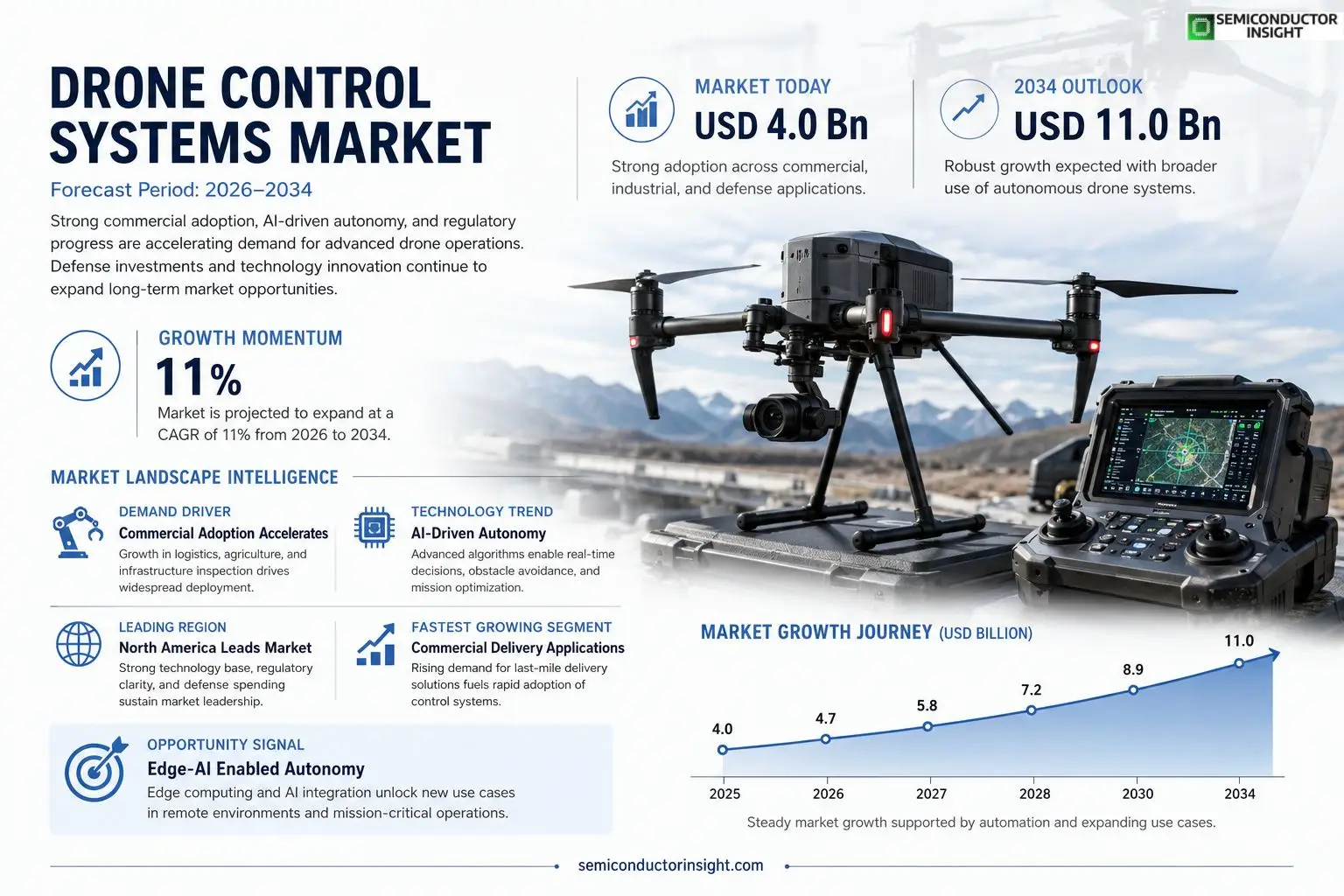
Drone Control Systems market size was valued at USD 4 billion in 2025. The market is projected to grow from USD 4 billion in 2025 to USD 11 billion by 2034, exhibiting a CAGR of 11% during the forecast period.
Drone control systems comprise hardware and software solutions that enable real‑time navigation, flight stabilization, mission planning, and autonomous operation of unmanned aerial vehicles (UAVs). These systems integrate telemetry links, ground control stations, GNSS modules, and advanced algorithms for obstacle avoidance and swarm coordination.The market is experiencing rapid growth because commercial delivery services, precision agriculture, and infrastructure inspection are expanding demand for reliable UAV operations; however, regulatory challenges persist around airspace integration. Furthermore, advancements in AI‑driven flight autonomy and increasing defense budgets are driving investment across both civilian and military segments.
MARKET DRIVERS
Increasing Commercial Adoption
Drone Control Systems Market is being propelled by rapid uptake in sectors such as logistics, infrastructure inspection, and precision agriculture. Companies are investing in autonomous navigation technologies that reduce labor costs and improve operational efficiency.
Regulatory Enablement
Recent regulatory frameworks in North America and Europe provide clearer pathways for beyond‑visual‑line‑of‑sight (BVLOS) operations, encouraging manufacturers to develop advanced control suites that meet safety standards.
➤ “The convergence of AI‑driven flight control and real‑time data links is reshaping how enterprises deploy drone fleets.”
Investment in satellite‑based communication and 5G connectivity further expands the operational envelope of drones, creating a robust foundation for sustained growth in Drone Control Systems Market.
MARKET CHALLENGES
Cybersecurity Threats
As control systems become more interconnected, the risk of unauthorized access and data interception rises. Ensuring end‑to‑end encryption and resilient command‑and‑control protocols is a critical hurdle for vendors.
Other Challenges
Standardization Gaps
The absence of ly harmonized standards for communication protocols and safety certification leads to fragmented market offerings and slows adoption.
MARKET RESTRAINTS
High Development Costs
Designing reliable, low‑latency control architectures demands significant R&D investment, which can deter new entrants and limit price competitiveness.Integration of legacy aircraft with modern control modules often requires extensive retrofitting, adding to overall project expenditures.Supply chain constraints for specialized components such as high‑precision inertial measurement units also restrict rapid scaling.
MARKET OPPORTUNITIES
Edge‑AI Enabled Autonomy
Embedding AI inference at the edge allows drones to make real‑time decisions without reliance on constant uplink, opening new use cases in hostile or remote environments.Developers can capitalize on emerging demand for swarm coordination technologies, where multiple drones operate under a unified control framework to accomplish complex tasks.Growth in public‑sector initiatives, such as disaster response and border surveillance, presents a sizeable addressable market for advanced control solutions.
Drone Control Systems Market Trends
AI‑Driven Autonomy Expands Operational Capabilities
The integration of advanced artificial‑intelligence algorithms into flight control software is redefining the way unmanned aerial vehicles operate across both commercial and defence environments. By embedding deep‑learning‑based obstacle avoidance and dynamic path planning directly into the control stack, operators can now execute complex missions with minimal human intervention. This shift is particularly evident in logistics networks, where autonomous route optimization reduces delivery times and improves fleet utilization. In the agricultural sector, AI‑enhanced precision mapping enables real‑time crop health monitoring, supporting higher yields while lowering input costs. Across these applications, the underlying hardware, such as high‑throughput telemetry modules and robust GNSS receivers, is being engineered for greater reliability, ensuring that Drone Control Systems Market maintains a trajectory of sustained innovation.
Other Trends
Regulatory Landscape and Airspace Integration
Regulatory bodies worldwide are converging on a set of standards that balance safety with operational flexibility. Recent amendments to airspace usage policies now permit beyond‑visual‑line‑of‑sight (BVLOS) flights in designated corridors, provided that operators adhere to stringent data‑link encryption and real‑time tracking requirements. These developments are reducing the uncertainty that previously hindered large‑scale deployment of unmanned platforms. Nevertheless, challenges remain in harmonising cross‑border regulations, especially for multinational delivery services. Industry groups are actively engaging with authorities to establish unified certification pathways, which, if successful, will unlock new market segments for both civilian and military users.
Defense Investment Reinforces Market Momentum
Government defense budgets continue to allocate significant resources toward next‑generation UAV capabilities, emphasizing secure communications, swarm intelligence, and electronic warfare resistance. These investments are prompting rapid advancements in encrypted control links and resilient ground control stations, directly influencing technology road‑maps for commercial suppliers. As a result, dual‑use solutions,those that satisfy both defence specifications and civilian operational needs,are emerging as a key growth vector. The convergence of stringent defence requirements with commercial scalability expectations is fostering a robust ecosystem of component manufacturers, software developers, and system integrators, collectively enhancing the overall health of Drone Control Systems Market.
COMPETITIVE LANDSCAPEKey Industry Players
Competitive Overview of Drone Control Systems Market
Drone Control Systems Market is anchored by a few dominant integrators that combine hardware, software, and telemetry into cohesive ground‑control stations. DJI leads the civilian segment with its highly integrated autonomous flight stack, leveraging a massive ecosystem of third‑party modules. In the defense arena, Lockheed Martin and Boeing command significant share by supplying hardened, mission‑critical control platforms to armed forces worldwide. This concentration creates a tiered structure where large aerospace firms focus on high‑end, secure solutions while numerous specialized vendors occupy niche verticals, fostering both consolidation and collaborative innovation.Beyond the marquee names, several niche innovators shape the competitive landscape. Parrot provides open‑source kits that enable rapid prototyping for agricultural and survey applications. Auterion offers a ROS‑based open ecosystem that accelerates commercial deployment. Altitude Angel supplies air‑traffic‑management integration for urban air mobility. Thales Group delivers encrypted communication suites, while FLIR Systems (now part of Teledyne) couples thermal imaging with control interfaces. Safran, Qualcomm, General Atomics, and Textron’s AAI division contribute advanced avionics, AI‑powered processors, and legacy military control solutions, respectively, enriching the market’s depth and specialization.
List of Key Drone Control Systems Companies Profiled
- DJI
- Lockheed Martin
- Boeing
- Parrot
- Auterion
- Altitude Angel
- Thales Group
- FLIR Systems
- Safran
- Qualcomm
- General Atomics
- Textron AAI
Segment Analysis:
| Segment Category | Sub-Segments | Key Insights |
| By Type |
|
Rotary‑Wing Control Systems
|
| By Application |
|
Commercial Delivery
|
| By End User |
|
Logistics Providers
|
| By Technology |
|
AI‑Driven Autonomy
|
| By Deployment Scenario |
|
Urban Air Mobility
|
Regional Analysis: North America
North America
The commercial sector in North America is a primary driver for drone control systems, with significant adoption in industries like real estate, energy, and logistics. The ability of drone control systems to provide detailed visual data and perform automated tasks is highly valued in these applications.
Drone control systems are increasingly deployed by law enforcement and emergency response teams for surveillance, search and rescue operations, and incident management. The real-time data and aerial perspectives offered by these systems are crucial for enhancing safety and security.
North America has a strong defense sector that heavily utilizes advanced drone control systems for military training, reconnaissance, and border patrol. Continuous innovation in this area is supported by significant government funding.
The need for efficient infrastructure inspection drives the adoption of drone control systems for monitoring bridges, power lines, and pipelines. These systems offer a cost-effective and safer alternative to traditional inspection methods.
Europe
Europe presents a dynamic and evolving market for Drone Control Systems Market. Regulatory frameworks, such as those implemented by the European Union, are shaping the trajectory of drone control systems adoption. The focus on safety and data privacy is paramount in this region, influencing the development and deployment of drone control systems. Key applications include agricultural surveying, environmental monitoring, and urban planning. The integration of drone control systems with existing infrastructure and the development of interoperable solutions are crucial for market growth in Europe.
Asia-Pacific
Asia-Pacific is emerging as a high-growth region for Drone Control Systems Market. Rapid industrialization, coupled with increasing investments in smart city initiatives, is fueling the demand for sophisticated drone control systems. Applications span across logistics, surveillance, and infrastructure development. The region’s focus on technological advancement and cost-effective solutions positions it as a significant player in the drone control systems landscape.
South America
South America is witnessing a rising interest in Drone Control Systems Market, particularly in sectors like agriculture and mining. The ability of drone control systems to enhance productivity and efficiency in these industries is driving adoption. Regulatory landscapes are developing, presenting both opportunities and challenges for Drone Control Systems Market in the region.
Middle East & Africa
Drone Control Systems Market in the Middle East & Africa is characterized by growing investments in infrastructure projects and security applications. The region’s diverse geography and economic activities create unique demands for drone control systems, ranging from oil and gas inspections to border security. The adoption of drone control systems is expected to accelerate with further economic development and technological advancements.
Report Scope
This market research report provides a comprehensive analysis of the Drone Control Systems Market , covering the forecast period 2026–2034. It offers detailed insights into market dynamics, technological advancements, competitive landscape, and key trends shaping the industry.
Key focus areas of the report include:
- ✅ Market Overview: The report begins with an overview outlining its current market scenario, key growth indicators, and industry transformation drivers. It discusses macroeconomic factors, demand–supply balance, regulatory landscape, and the strategic role of semiconductors in powering advancements across industries such as automotive, telecommunications, consumer electronics, and industrial automation.
- ✅ Market Size & Forecast: Historical data and future projections for revenue, unit shipments, and market value across major regions and segments.
- ✅ Segmentation Analysis: Detailed breakdown by product type, technology, application, and end-user industry to identify high-growth segments and investment opportunities.
- ✅ Regional Insights: Insights into market performance across North America, Europe, Asia-Pacific, Latin America, and the Middle East & Africa, including country-level analysis where relevant.
- ✅ Competitive Landscape: Profiles of leading market participants, including their product offerings, R&D focus, manufacturing capacity, pricing strategies, and recent developments such as mergers, acquisitions, and partnerships.
- ✅ Technology Trends & Innovation: Assessment of emerging technologies, integration of AI/IoT, semiconductor design trends, fabrication techniques, and evolving industry standards.
- ✅ Market Drivers & Restraints: Evaluation of factors driving market growth along with challenges, supply chain constraints, regulatory issues, and market-entry barriers.
- ✅ Stakeholder Insights: Insights for component suppliers, OEMs, system integrators, investors, and policymakers regarding the evolving ecosystem and strategic opportunities.
Primary and secondary research methods are employed, including interviews with industry experts, data from verified sources, and real-time market intelligence to ensure the accuracy and reliability of the insights presented.
FREQUENTLY ASKED QUESTIONS:
What is the current market size of Drone Control Systems Market?
-> Drone Control Systems Market was valued at USD 4 billion in 2025 and is expected to reach USD 11 billion by 2034, reflecting a CAGR of 11% over the forecast period.
Which key companies operate in Drone Control Systems Market?
-> Key players include DJI, Parrot, Lockheed Martin, Boeing, Northrop Grumman, and Amazon Robotics, among others.
What are the key growth drivers?
-> Key growth drivers include expanding commercial delivery services, precision agriculture adoption, infrastructure inspection demand, AI‑driven flight autonomy, and increasing defense budgets.
Which region dominates the market?
-> North America holds a leading share due to early technology adoption, while Asia‑Pacific is emerging as the fastest‑growing region.
What are the emerging trends?
-> Emerging trends include advanced AI autonomy, swarm coordination, integration with 5G communications, and edge‑computing capabilities for real‑time data processing.

Get Sample Report PDF for Exclusive Insights
Report Sample Includes
- Table of Contents
- List of Tables & Figures
- Charts, Research Methodology, and more...
 Download Sample Report PDF





