
MARKET INSIGHTS
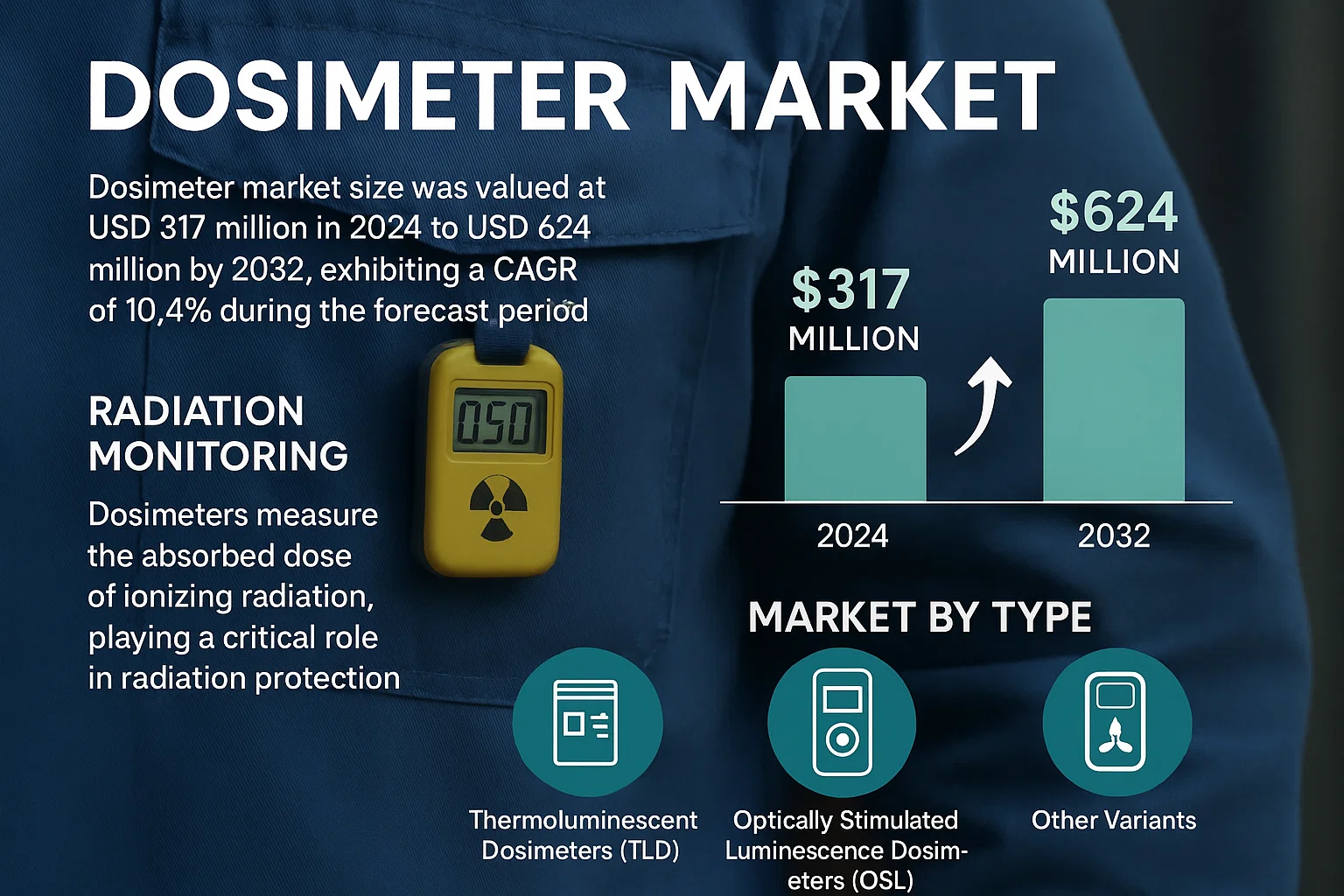
Global Dosimeter Market size was valued at USD 317 million in 2024 to USD 624 million by 2032, exhibiting a CAGR of 10.4% during the forecast period.
Dosimeters are specialized devices designed to measure the absorbed dose of ionizing radiation. These instruments play a critical role in radiation protection by quantifying exposure levels in environments where radioactive materials are handled, such as nuclear power plants, healthcare facilities, and industrial settings. The market primarily includes thermoluminescent dosimeters (TLD), optically stimulated luminescence dosimeters (OSL), and other variants, each offering distinct advantages for radiation monitoring.
Market growth is driven by increasing regulatory requirements for radiation safety, expansion of nuclear medicine, and growing awareness of occupational health hazards. The United States currently leads in market share with 28.98% of global production, followed by Europe. Key players like Landauer, Mirion Technologies, and Thermo Fisher Scientific dominate the competitive landscape, collectively holding 34% of the market value. Recent technological advancements in dosimeter sensitivity and data analysis capabilities are further accelerating adoption across industries.
MARKET DRIVERS
Growing Awareness and Regulatory Compliance
The increasing awareness about the harmful effects of radiation exposure has led to stricter regulations across various industries. Organizations are mandated to monitor radiation exposure for workers, driving the demand for personal dosimeters. This is particularly evident in healthcare, nuclear energy, and industrial sectors where radiation is prevalent.
Expansion in Healthcare and Nuclear Medicine
The growth in nuclear medicine, including PET and CT scans, requires stringent radiation safety measures. This increases the demand for dosimeters in healthcare settings. Additionally, the global push towards nuclear energy as a clean energy source contributes to market growth as nuclear plants require extensive radiation monitoring.
➤ The global push towards nuclear energy as a clean energy source also contributes to market growth, as nuclear plants require extensive radiation monitoring.
Furthermore, the increasing use of radiation in industrial applications such as radiography and material analysis further drives the market. Industries are increasingly adopting radiation sources for various applications, necessitating robust monitoring.
MARKET CHALLENGES
High Cost of Advanced Dosimeters
The development and production of advanced dosimeters with real-time monitoring and connectivity features are expensive. This can be a barrier for small organizations and in developing countries where budgets are limited. The high cost also affects the adoption of dosimeters in sectors where radiation monitoring is not mandatory but recommended.
Other Challenges
Lack of Standardization in Measurement Techniques
Different manufacturers use different technologies and calibration methods, making it difficult to compare readings across devices. This can hinder market growth as users may hesitate to invest in systems that aren’t universally compatible. The lack of standardization also complicates regulatory compliance and international cooperation.
MARKET RESTRAINTS
Economic Constraints and Budgetary Limitations
During economic downturns, companies and governments may cut budgets for safety equipment, including dosimeters. This can temporarily restrain market growth as organizations prioritize essential expenses. Additionally, the high cost of advanced dosimeters can be prohibitive for some markets, especially in developing regions where healthcare and industrial infrastructure is still developing.
MARKET OPPORTUNITIES
Growth in Emerging Economies
Countries like India, China, and Brazil are rapidly expanding their healthcare and nuclear infrastructure. This creates a substantial opportunity for dosimeter manufacturers to expand their presence. The increasing number of nuclear power plants and diagnostic centers in these regions requires robust radiation monitoring, driving market growth.
Technological Innovations in Dosimetry
The development of smart dosimeters with IoT connectivity and real-time data access presents significant opportunities. These devices can integrate with broader safety systems and provide actionable insights, making them attractive for modern industrial and healthcare applications. The integration of AI and machine learning for predictive analysis also offers growth opportunities.
Dosimeter Market Trends
Growing Adoption in Healthcare and Nuclear Sectors
The global dosimeter market is experiencing robust growth, driven by increasing radiation safety regulations across healthcare and nuclear industries. Medical facilities are adopting advanced dosimetry solutions to protect staff during diagnostic and therapeutic procedures, while nuclear power plants continue to invest in radiation monitoring technologies for worker safety. Market analysis indicates North America and Europe currently lead in market share due to stringent regulatory frameworks.
Other Trends
Technological Advancements in Dosimetry
Recent technological innovations are transforming the dosimeter market with the introduction of real-time monitoring solutions and integration with IoT platforms. Manufacturers are developing more compact and user-friendly devices with enhanced accuracy. The emergence of optically stimulated luminescence (OSL) dosimeters is gaining traction over traditional thermoluminescent dosimeters due to their reusability and cost-effectiveness. Market leaders are investing in R&D to incorporate artificial intelligence for dose prediction and alert systems.
Regional Market Expansion
Asia-Pacific is emerging as the fastest-growing market for dosimeters, particularly in countries like China, India, and South Korea. This growth is driven by rapid industrialization, increasing nuclear energy projects, and improving healthcare infrastructure. European and North American manufacturers are establishing partnerships and distribution networks in these emerging markets to capitalize on the growing demand for radiation safety equipment.
Market Consolidation and Partnerships
The dosimeter industry is experiencing consolidation as larger companies acquire specialized manufacturers to expand their product portfolios and geographic reach. Recent partnerships between dosimeter manufacturers and software companies are enabling the development of integrated radiation safety management systems. These collaborations are particularly focused on cloud-based solutions and data analytics platforms that enhance the value proposition of traditional dosimetry services.
COMPETITIVE LANDSCAPE
Key Industry Players
Dosimeter Market Competitive Analysis
The global dosimeters market is highly competitive with key players focusing on technological advancements and expanding their product portfolios to cater to diverse industry needs. Companies like Landauer, Mirion Technologies, and Thermo Fisher Scientific dominate the market, particularly in North America and Europe. These companies offer a wide range of dosimeters including TLD, OSL, and electronic dosimeters, catering to healthcare, nuclear power, and industrial applications.
Asian manufacturers such as Aloka, Fuji Electric, and Panasonic are also significant players, especially in the Asia-Pacific region. These companies are increasingly focusing on developing cost-effective solutions while maintaining high safety standards. The competitive landscape is characterized by strategic partnerships, mergers and acquisitions, and continuous R&D investments to enhance product features and global market presence.
List of Key Dosimeter Manufacturers
- Landauer Inc.
- Mirion Technologies
- ATOMTEX
- Aloka Co. Ltd.
- Fuji Electric Co. Ltd.
- Thermo Fisher Scientific Inc.
- IBA Dosimetry
- Unfors RaySafe
- Panasonic Corporation
- Ludlum Measurements Inc.
- Radiation Detection Company
- Canberra Industries Inc.
- Polimaster
- Arrow-Tech Inc.
Segment Analysis:
| Segment Category | Sub-Segments | Key Insights |
| By Type |
|
Personal Dosimeters lead this segment due to their widespread adoption across industries where individual employee exposure monitoring is mandated by safety regulations, offering continuous monitoring without disrupting workflow. |
| By Application |
|
Healthcare & Medical drives this segment due to increasing use of radiation therapies and diagnostic procedures, requiring strict dosimetry for both patient safety and occupational health of medical staff. |
| By End User |
|
Hospitals & Medical Facilities lead due to stringent radiation safety protocols, regular staff training, and regulatory compliance requirements that demand continuous dosimetry monitoring. |
| By Technology |
|
Active Electronic Dosimeters lead due to real-time monitoring capabilities, immediate readouts, and data integration features that support modern safety management systems and workflow integration. |
| By Service Model |
|
Dosimeter Rental Services lead due to cost-effectiveness for short-term projects, flexibility for contractors, and reduced capital expenditure while maintaining compliance with safety regulations. |
Regional Analysis: Dosimeter Market
North America
The stringent regulatory framework in North America, particularly OSHA’s enforcement of radiation exposure limits, compels industries to adopt advanced dosimetry solutions. Regular monitoring mandates and strict reporting requirements create consistent demand. The region’s mature regulatory ecosystem ensures comprehensive market penetration.
North American healthcare facilities demonstrate high adoption rates of personal dosimeters among radiologists, nuclear medicine staff, and radiation oncology teams. Growing cancer treatment facilities and diagnostic imaging centers drive demand. The region’s advanced healthcare infrastructure supports sophisticated radiation monitoring across medical and dental applications.
Beyond healthcare, North American industries including manufacturing, aerospace, and nuclear energy demonstrate strong adoption of dosimetry solutions. The region’s diverse industrial base creates varied application scenarios, from manufacturing quality control to nuclear plant safety. Strong R&D initiatives continuously improve detection capabilities and data integration.
North American markets show rapid adoption of smart dosimetry solutions with IoT connectivity and real-time monitoring capabilities. The region leads in development of integrated systems combining traditional dosimetry with modern data analytics. Cloud-based monitoring and automated reporting systems find strong adoption in North American markets, supported by advanced technology infrastructure.
Europe
Europe represents the second largest market for dosimeters, characterized by comprehensive radiation protection regulations under Euratom directives. The region demonstrates strong adoption in both industrial and healthcare sectors, with particular strength in Germany, UK, and France where manufacturing sectors implement rigorous worker protection programs. European markets show preference for integrated dosimetry solutions with environmental monitoring capabilities.
Asia-Pacific
The Asia-Pacific region demonstrates the fastest growth rate in dosimeter adoption, driven by rapidly industrializing economies and increasing nuclear energy investments. Countries like China, India, and South Korea are implementing stronger radiation protection regulations. Japan’s advanced technological adoption and Australia’s mining sector contribute to sophisticated market demand. The region shows increasing awareness of occupational safety and gradual implementation of international standards.
Latin America
Latin American markets show steady growth in dosimeter adoption, particularly in Brazil and Mexico where industrial growth drives demand. The region shows increasing regulatory focus on worker protection, though market penetration remains lower than in developed regions. Mining industries and growing healthcare sectors present significant opportunities, though economic fluctuations can impact investment in advanced monitoring technologies.
Middle East & Africa
These regions demonstrate emerging demand for dosimetry solutions, particularly around nuclear energy development and growing industrial sectors. South Africa shows the most developed market with strong mining and healthcare applications. The Middle East shows increasing adoption in oil and gas sector radiation monitoring. Market growth remains closely tied to economic development and infrastructure development across the region.
Report Scope
This report provides a comprehensive analysis of the Global Dosimeter Market, covering the forecast period 2024-2032. It offers detailed insights into market dynamics, technological advancements, competitive landscape, and key trends shaping the industry.
Key focus areas of the report include:
- Market Overview: The report begins with an overview outlining the current market scenario, key growth indicators, and industry transformation drivers. It discusses macroeconomic factors, demand-supply balance, regulatory landscape, and the strategic role of dosimeters in radiation protection across various industries.
- Market Size & Forecast: Historical data and future projections for market value, unit shipments, and revenue across major regions and segments.
- Segmentation Analysis: Detailed breakdown by product type, technology, application, and end-user industry to identify high-growth segments and investment opportunities.
- Regional Insights: Insights into market performance across North America, Europe, Asia-Pacific, Latin America, and Middle East & Africa, including country-level analysis where relevant.
- Competitive Landscape: Profiles of leading market participants, including their product offerings, R&D focus, manufacturing capacity, pricing strategies, and recent developments.
- Technology Trends & Innovation: Assessment of emerging technologies, integration of advanced materials, fabrication techniques, and evolving industry standards.
- Market Drivers & Restraints: Evaluation of factors driving market growth along with challenges, supply chain constraints, regulatory issues, and market-entry barriers.
- Stakeholder Insights: Insights for component suppliers, OEMs, system integrators, investors, and policymakers regarding the evolving ecosystem and strategic opportunities.
Primary and secondary research methods are employed, including interviews with industry experts, data from verified sources, and real-time market intelligence to ensure the accuracy and reliability of the insights presented.
FREQUENTLY ASKED QUESTIONS:
What is the current market size of the Dosimeter Market?
-> Dosimeter market was valued at USD 317 million in 2024 and is projected to reach USD 624 million by 2032.
What is the growth rate of the Dosimeter Market?
-> The market is expected to grow at a CAGR of 10.4% during the forecast period 2024-2032.
Which are the key companies in the Dosimeter Market?
-> Key players include Landauer, Mirion Technologies, ATOMTEX, Aloka, Thermo Fisher Scientific, Fuji Electric, IBA Dosimetry, Unfors RaySafe, Tracerco, Panasonic, and Ludlum Measurements, among others.
What are the major applications of Dosimeters?
-> Major applications include hospitals, nuclear power plants, manufacturing facilities, research institutions, and industrial settings where radiation protection is required.
Which region has the largest market share?
-> The United States currently holds the largest market share, followed by Europe and Asia-Pacific regions.

Get Sample Report PDF for Exclusive Insights
Report Sample Includes
- Table of Contents
- List of Tables & Figures
- Charts, Research Methodology, and more...
 Download Sample Report PDF



