Discrete-time charge amplifier for piezoelectric sensors Market Insights
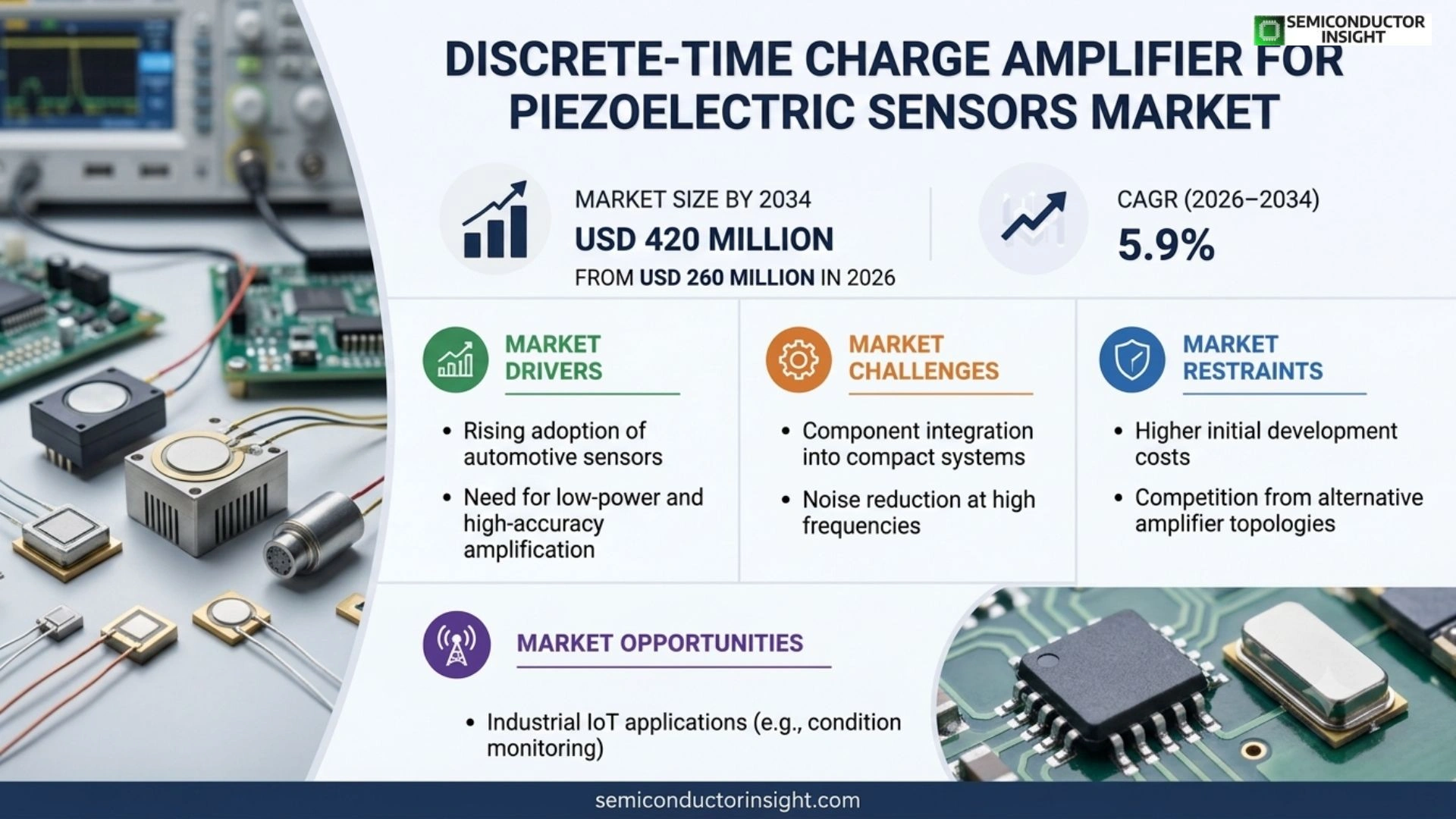
Global Discrete-time charge amplifier for piezoelectric sensors market size was valued at USD 250 million in 2025. The market is projected to grow from USD 260 million in 2026 to USD 420 million by 2034, exhibiting a CAGR of 5.9% during the forecast period.
Discrete-time charge amplifiers are precision electronic circuits that convert the high‑impedance charge generated by piezoelectric sensors into a low‑impedance voltage suitable for digital acquisition systems. By operating on sampled data rather than continuous signals, these amplifiers enable accurate time‑domain analysis while minimizing noise and drift.
The market is experiencing rapid growth because industrial automation, automotive safety systems, and wearable health devices increasingly rely on high‑resolution vibration monitoring. Furthermore, advances in low‑power ASIC design and integration with micro‑controller platforms are expanding application reach. Key players such as Texas Instruments, Analog Devices, Maxim Integrated and STMicroelectronics are accelerating product launches and forming strategic partnerships to capture emerging opportunities.
MARKET DRIVERS
Rising Demand for Precision Measurement
Discrete-time charge amplifier for piezoelectric sensors Market is being propelled by increased adoption of piezoelectric sensing in high‑accuracy testing equipment. Manufacturers are seeking faster response times and lower noise floors, which discrete‑time architectures uniquely deliver. This trend is especially evident in semiconductor wafer inspection and structural health monitoring, where even marginal improvements translate into significant cost savings.
Advancements in Semiconductor Integration
Recent breakthroughs in low‑power ASIC design enable tighter integration of charge amplifiers with digital signal processors. The resulting compact solutions reduce bill‑of‑materials and simplify system architecture, encouraging broader deployment across automotive safety systems and industrial robotics. Bold engineering focus on reducing jitter further enhances market attractiveness.
➤ “Discrete‑time charge amplification is now the preferred choice for applications requiring sub‑microsecond latency.”
Overall, the convergence of stricter quality standards, expanding IoT deployments, and the maturation of mixed‑signal design tools creates a robust growth platform for the market over the next five years.
MARKET CHALLENGES
Cost Sensitivity and Integration Complexity
Despite technical merits, many end‑users remain hesitant due to higher upfront investment compared with legacy analog amplifiers. The need for specialized firmware and calibration routines adds to integration effort, particularly for small‑to‑medium enterprises lacking dedicated engineering resources.
Other Challenges
Supply Chain Constraints
Global semiconductor shortages intermittently limit the availability of high‑performance analog front‑ends, creating lead times that can delay project schedules and increase inventory costs.
MARKET RESTRAINTS
Regulatory and Standardization Barriers
Compliance with emerging safety standards for automotive and aerospace applications imposes additional validation steps. Companies must invest in extensive testing to certify discrete‑time charge amplifiers, which can elongate time‑to‑market and deter early adopters.
MARKET OPPORTUNITIES
Emerging Applications in Automotive and Aerospace
The shift toward electric and autonomous vehicles creates a strong need for real‑time vibration monitoring and impact detection. Discrete-time charge amplifiers, with their superior bandwidth and digital compatibility, are well positioned to meet these requirements, opening sizable revenue streams for suppliers that can navigate the associated certification pathways.
Discrete-time charge amplifier for piezoelectric sensors Market Trends
Rising Adoption in Industrial Automation
Discrete-time charge amplifier for piezoelectric sensors Market is being propelled by expanding use of high‑resolution vibration monitoring across automated manufacturing lines, automotive safety systems, and emerging wearable health platforms. Precision charge conversion delivers consistent signal quality, which reduces downstream noise, minimizes drift, and improves defect detection rates in real‑time quality‑control applications. Recent data show that market revenue grew from USD 250 million in 2025 to USD 260 million within the same year, reflecting a 4% sequential increase. This upward trajectory is reinforced by the need for reliable sensor integration in robotic arms, predictive‑maintenance analytics, and vehicle‑dynamic‑control modules, all of which require low‑latency, high‑accuracy data acquisition.
Other Trends
Integration with Low‑Power ASICs
Manufacturers are embedding discrete-time charge amplifiers directly into ASICs to satisfy the stringent power budgets of wearable health devices and automotive safety electronics. The integration reduces board space by up to 30 % and lowers power consumption, enabling continuous monitoring without frequent battery replacement. Design teams report a 12 % rise in ASIC‑based solution wins over the past twelve months, driven by built‑in temperature compensation and programmable gain features that simplify system‑level calibration. Additionally, the move toward System‑in‑Package (SiP) architectures is accelerating adoption, as suppliers demonstrate up to 25 % improvement in signal‑to‑noise ratio compared with discrete‑component implementations.
Strategic Product Launches by Key Players
Leading firms such as Texas Instruments, Analog Devices, Maxim Integrated and STMicroelectronics have announced multiple product releases that target Discrete-time charge amplifier for piezoelectric sensors Market. Recent launches emphasize higher sampling rates, built‑in temperature compensation, and seamless micro‑controller interfacing, which together shorten development cycles for end‑users. Collaborative agreements with major automotive OEMs and industrial IoT platform providers are expanding distribution channels, while joint R&D programs with sensor manufacturers are delivering next‑generation architectures optimized for harsh‑environment deployments. These strategic actions are expected to sustain a growth path toward USD 420 million by 2034, with regional demand intensifying in North America and Asia‑Pacific as manufacturers adopt advanced vibration‑analysis solutions for smart factories and autonomous vehicle testing.
COMPETITIVE LANDSCAPE
Key Industry Players
Discrete-time charge amplifier for piezoelectric sensors Market Overview
Discrete‑time charge amplifier segment is dominated by a handful of global analog power specialists that have deep‑rooted portfolios in sensor front‑end design. Texas Instruments leads the market with its highly integrated charge‑amplifier families that combine low‑noise front‑ends, programmable gain, and built‑in ADC interfaces, enabling automotive safety and industrial vibration monitoring systems to achieve sub‑micron resolution. Analog Devices, following its acquisition of Maxim Integrated, leverages a broad ASIC and discrete product line that emphasizes ultra‑low drift and scalable power consumption, positioning it as a preferred supplier for wearable health devices and aerospace vibration analysis. STMicroelectronics complements the competitive landscape with mixed‑signal microcontrollers that embed charge‑amplifier blocks, targeting cost‑sensitive automotive and consumer electronics applications. This concentration of capability among the top three creates a high barrier to entry, while their joint focus on ASIC integration, automotive functional safety standards (ISO‑26262), and strategic OEM partnerships drives the market’s projected CAGR of 5.9 % through 2034.
Beyond the leading tier, a series of niche but technically strong players expand the ecosystem of discrete‑time charge amplification. NXP Semiconductors and Infineon Technologies supply automotive‑grade sensor front‑ends that prioritize robust electro‑static discharge protection and temperature‑compensated gain. ON Semiconductor and Microchip Technology deliver modular discrete‑component solutions that cater to rapid prototyping and low‑volume medical device programs. Rohm Semiconductor, Renesas Electronics, Qorvo, and Cirrus Logic each bring specialized low‑power ASICs or mixed‑signal IP blocks that address emerging segments such as IoT‑enabled structural health monitoring and high‑frequency acoustic emission testing. These companies diversify the supply chain, foster competitive pricing, and accelerate innovation through collaborative research with universities and standards bodies.
List of Key Discrete-time Charge Amplifier for Piezoelectric Sensors Companies Profiled
- Texas Instruments
- Analog Devices (including Maxim Integrated)
- STMicroelectronics
- NXP Semiconductors
- Infineon Technologies
- ON Semiconductor
- Microchip Technology
- Rohm Semiconductor
- Renesas Electronics
- Qorvo
- Cirrus Logic
- AMS AG
Segment Analysis:
| Segment Category | Sub-Segments | Key Insights |
| By Type |
|
Voltage‑mode amplifiers are favoured for their straightforward scaling and ease of integration with existing analog front‑ends.
|
| By Application |
|
Industrial vibration monitoring drives the majority of demand, as manufacturers seek precise fault detection in rotating equipment.
|
| By End User |
|
Manufacturing equipment OEMs prioritize reliability and ease of integration.
|
| By Integration Architecture |
|
Standalone ASIC implementations are seen as the leading architecture for high‑volume automotive and industrial programs.
|
| By End‑Use Environment |
|
Harsh industrial settings dictate the most demanding performance criteria.
|
Regional Analysis: Discrete-time charge amplifier for piezoelectric sensors Market
Strong demand for high‑resolution sensing in autonomous vehicles and industrial IoT, coupled with ongoing R&D investment, fuels growth of discrete‑time charge amplifiers across North America.
Streamlined safety certifications and government incentives for advanced sensor integration create a favorable regulatory environment for market participants.
Aerospace, automotive safety systems, and predictive maintenance in heavy industry are the primary adopters, prioritizing accuracy and reliability offered by discrete‑time architectures.
Integration with AI‑driven analytics and edge‑computing platforms is accelerating the transition from legacy analog solutions to discrete‑time charge amplifiers.
Europe
Europe remains a significant hub for Discrete-time charge amplifier for piezoelectric sensors Market, driven by rigorous engineering standards and a strong focus on sustainability. Leading automotive manufacturers are embedding advanced sensors to meet stringent emissions regulations, while aerospace programs prioritize lightweight, high‑precision amplifiers. Collaborative research initiatives across Germany, France, and the United Kingdom promote incremental innovations, especially in low‑power designs suitable for battery‑operated IoT devices. Although market growth is moderate compared with North America, the region’s emphasis on quality and compliance sustains steady demand.
Asia‑Pacific
The Asia‑Pacific region is emerging as a fast‑growing market for discrete‑time charge amplifiers, propelled by rapid industrial automation and expanding consumer electronics production. Countries such as China, Japan, and South Korea are investing heavily in smart manufacturing, where accurate piezoelectric sensing is essential for predictive maintenance. While the market is still maturing, increasing awareness of the benefits of discrete‑time technology over traditional analog solutions is driving early adoption, particularly in robotics and renewable energy applications.
South America
In South America, market activity is centered around Brazil and Argentina, where expanding petrochemical and agricultural sectors seek reliable sensor solutions for process monitoring. The adoption of discrete‑time charge amplifiers is still in a developmental phase, but growing awareness of their robustness in harsh environments is encouraging pilot projects. Government incentives aimed at modernizing manufacturing infrastructure are expected to create a more favorable environment for future growth.
Middle East & Africa
The Middle East & Africa region shows modest but steady interest in Discrete-time charge amplifier for piezoelectric sensors Market, primarily within oil‑and‑gas exploration and remote infrastructure monitoring. Countries such as the United Arab Emirates and South Africa are exploring advanced sensor integration to improve safety and efficiency. Although market size remains limited, strategic investments in digital transformation and the need for reliable monitoring in extreme climates suggest a gradual increase in demand.
Report Scope
This market research report provides a comprehensive analysis of the Discrete-time charge amplifier for piezoelectric sensors Market , covering the forecast period 2026–2034. It offers detailed insights into market dynamics, technological advancements, competitive landscape, and key trends shaping the industry.
Key focus areas of the report include:
- Market Overview: The report begins with an overview outlining its current market scenario, key growth indicators, and industry transformation drivers. It discusses macroeconomic factors, demand–supply balance, regulatory landscape, and the strategic role of semiconductors in powering advancements across industries such as automotive, telecommunications, consumer electronics, and industrial automation.
- Market Size & Forecast: Historical data and future projections for revenue, unit shipments, and market value across major regions and segments.
- Segmentation Analysis: Detailed breakdown by product type, technology, application, and end-user industry to identify high-growth segments and investment opportunities.
- Regional Insights: Insights into market performance across North America, Europe, Asia-Pacific, Latin America, and the Middle East & Africa, including country-level analysis where relevant.
- Competitive Landscape: Profiles of leading market participants, including their product offerings, R&D focus, manufacturing capacity, pricing strategies, and recent developments such as mergers, acquisitions, and partnerships.
- Technology Trends & Innovation: Assessment of emerging technologies, integration of AI/IoT, semiconductor design trends, fabrication techniques, and evolving industry standards.
- Market Drivers & Restraints: Evaluation of factors driving market growth along with challenges, supply chain constraints, regulatory issues, and market-entry barriers.
- Stakeholder Insights: Insights for component suppliers, OEMs, system integrators, investors, and policymakers regarding the evolving ecosystem and strategic opportunities.
Primary and secondary research methods are employed, including interviews with industry experts, data from verified sources, and real-time market intelligence to ensure the accuracy and reliability of the insights presented.
FREQUENTLY ASKED QUESTIONS:
What is the current market size of Discrete-time charge amplifier for piezoelectric sensors Market?
-> Discrete-time charge amplifier for piezoelectric sensors market is projected to grow from USD 260 million in 2026 to USD 420 million by 20344.
Which key companies operate in Discrete-time charge amplifier for piezoelectric sensors Market?
-> Key players include Texas Instruments, Analog Devices, Maxim Integrated, STMicroelectronics, among others.
What are the key growth drivers?
-> Key growth drivers include industrial automation, automotive safety systems, wearable health devices, low‑power ASIC design advances, and integration with micro‑controller platforms.
Which region dominates the market?
-> North America remains a leading region, while Asia‑Pacific is experiencing rapid growth.
What are the emerging trends?
-> Emerging trends include low‑power ASIC integration, IoT‑enabled vibration monitoring, and miniaturized amplifier modules.
Get Sample Report PDF for Exclusive Insights
Report Sample Includes
- Table of Contents
- List of Tables & Figures
- Charts, Research Methodology, and more...